Tender Protest & Appeal Complete Guide 2026: How to Challenge Unfair Tender Decisions, Win Reversals & Recover Lost Contracts Under GFR 171
menu_book Table of Contents
Introduction: Why 73% of MSMEs Never Protest — And Lose ₹4.2 Lakh Per Unfair Rejection
Every year, over ₹12,00,000 crore worth of government tenders are floated across India. Yet a staggering 73% of MSME bidders who face unfair rejection, discriminatory clauses, or arbitrary evaluation never file a formal protest. They accept the loss, absorb the sunk cost, and move on — leaving an estimated ₹4.2 lakh per rejected bid on the table in wasted preparation costs, EMD blockage, and lost opportunity value. For the comprehensive end-to-end framework, consult our how to bid for government tenders in India. (See also: CVC-Compliant Post-Bid Negotiation Strategy). (See also: Splitting of Tenders & GFR Rule 157 Defense Guide).
The reason? Most MSMEs believe one or more of these myths:
- "Protesting a government department is futile — they will never reverse their decision."
- "I don't know the legal language needed for a protest letter."
- "Hiring a lawyer costs more than the contract value."
- "I missed the deadline — it's too late now."
- "I'm just a small vendor — they won't take me seriously."
Every single one of these beliefs is wrong.
Under GFR 2017 Rule 171, every bidder — including MSMEs, startups, and individual proprietors — has a statutory right to file a representation against unfair tender conditions, flawed evaluation, or arbitrary rejection. The Supreme Court of India has, in over 47 landmark judgments between 1994 and 2025, reinforced that government procurement must be fair, transparent, and non-discriminatory. When these principles are violated, courts have not only quashed tender awards but also directed compensation to affected bidders.
In 2024-25 alone, the Central Public Procurement Portal (CPPP) recorded 2,847 formal representations under GFR 171. Of these, 34% resulted in favorable outcomes — either full tender cancellation, re-evaluation, or corrective amendments. For MSMEs specifically, the success rate was even higher at 41%, primarily because MSME-related violations (EMD exemption denial, price preference exclusion, reservation policy breach) are objectively verifiable and carry zero discretion.
This guide is your complete playbook. Whether you are challenging a restrictive technical specification, fighting an EMD forfeiture, appealing a debarment order, or questioning a biased evaluation, this 10,000-word masterclass will teach you exactly how to build a legally bulletproof protest, navigate the appeal hierarchy, and recover contracts you rightfully deserve.
🎯 Ready to draft your protest letter now? Skip to our AI-powered Protest Letter Generator and create a court-ready representation in under 3 minutes — auto-cited with GFR rules and Supreme Court precedents.

Get the Zero-Rejection Tender Mastery Bundle™
Get all 12 verified checklists, Excel trackers, PoA formats, and appeal letter packs.
- ✓ 150-Point Pre-Submission Audit (PDF)
- ✓ 50-Point Technical & 30-Point Financial Audits
- ✓ EMD & Bank Guarantee Excel Checker
- ✓ Document Expiry & Renewal Tracker (Excel)
- ✓ 5 Post-Rejection Appeal Letter Formats
- ✓ 10 Experience Certificate Templates
🔒 256-Bit Secure Razorpay Checkout · Lifetime Access · Instant Digital Delivery
What Is a Tender Protest? Definition, Scope & Legal Basis
A tender protest is a formal written representation filed by a bidder (or prospective bidder) against a procuring entity, challenging specific aspects of the tender process that violate statutory rules, fair competition principles, or the bidder's legal rights.
Legal Definition Under Indian Procurement Law
While the term "protest" is commonly used in international procurement (particularly the U.S. federal system), in India the equivalent mechanism is the "Representation" under GFR 2017 Rule 171. The rule states:
"A bidder who claims to have suffered injustice or hardship due to any decision taken by the procuring entity in relation to the procurement process may file a representation seeking redressal of the grievance."
Key Characteristics of a Valid Tender Protest
| Characteristic | Requirement | Consequence of Non-Compliance |
|---|---|---|
| Locus Standi | Must be an actual bidder or affected party | Protest dismissed for lack of standing |
| Specificity | Must cite exact rule/clause violated | Vague protests are inadmissible |
| Timeliness | Filed within prescribed deadline | Time-barred and rejected |
| Exhaustion | Administrative remedies exhausted before court | Court may refuse jurisdiction |
| Evidence | Supported by documentary proof | Allegations treated as speculative |
| Pre-Award | Ideally filed before contract signing | Post-award protests face higher scrutiny |
Scope: What Can You Protest?
You can legally protest against:
- Pre-bid issues: Restrictive technical specifications, discriminatory eligibility criteria, unfair EMD requirements, denial of MSME exemptions
- Bid evaluation issues: Arbitrary scoring, deviation from stated criteria, undisclosed weightages, mala fide L1 manipulation
- Post-bid issues: Wrongful rejection, improper disqualification, failure to follow two-bid system protocols
- Award issues: Award to an ineligible bidder, contract splitting to avoid thresholds, single tender enquiry without justification
- EMD-related: Forfeiture without valid grounds, failure to refund within GFR-mandated timelines
- Debarment/Blacklisting: Exclusion without show-cause notice, disproportionate duration, violation of natural justice
What You CANNOT Protest
| Issue | Why It's Not Protestable | What to Do Instead |
|---|---|---|
| Lost on price (L1) | Commercial decision, not arbitrariness | Improve pricing strategy for next tender |
| Missed submission deadline | Your own operational failure | Set up tender deadline alerts |
| Incomplete documentation | Non-compliance with stated requirements | Use our tender checklist |
| Change in requirement scope | PE's prerogative if justified | File pre-bid query for clarification |
| Subjective "quality" concerns | If criteria were disclosed upfront | Challenge only if evaluation deviated from criteria |
GFR 171: The Legal Foundation Every Bidder Must Know
General Financial Rules (GFR) 2017, Rule 171 is the cornerstone of grievance redressal in Indian government procurement. Understanding this rule is non-negotiable if you want your protest to survive administrative scrutiny.
Rule 171: Text & Breakdown
Rule 171 — Redressal of Grievances: "(1) The Ministry or Department shall constitute a Grievance Redressal Committee (GRC) to deal with complaints relating to procurement." "(2) Any bidder who claims to have suffered injustice or hardship due to any decision taken by the procuring entity may file a representation to the GRC." "(3) The GRC shall investigate the complaint and give its recommendations within a reasonable time." "(4) The decision of the competent authority on the recommendations of the GRC shall be final."
Critical Components Explained
1. Grievance Redressal Committee (GRC)
Every central government ministry, department, and PSU must constitute a GRC. The committee typically comprises:
- A senior officer not below the rank of Joint Secretary (Chairperson)
- A representative from the finance division
- A representative from the technical/evaluation division
- An independent member (in some departments)
Key Insight: The GRC is an internal body. This means the procuring entity investigates itself. While this creates potential bias, it also means that well-documented, rule-specific protests are harder to ignore because the GRC must produce a reasoned order that can be challenged in court.
2. "Reasonable Time" for Resolution
GFR 171 does not specify a strict timeline, but government departments typically follow these benchmarks:
| Protest Type | Typical Resolution Time | Your Action if Delayed |
|---|---|---|
| Pre-bid query | 7-10 days | Escalate to Head of Department |
| Post-bid representation | 15-30 days | File reminder with 7-day ultimatum |
| EMD refund dispute | 30-45 days | Approach CVC if corruption suspected |
| Debarment appeal | 60-90 days | File Writ Petition if no response |
3. Finality of Decision & Judicial Review
The rule states the competent authority's decision is "final" — but this does not oust the jurisdiction of courts. The Supreme Court has consistently held in Tata Cellular v. Union of India (1994) and subsequent judgments that:
"The finality clause in administrative rules does not bar judicial review on grounds of arbitrariness, mala fide, or violation of constitutional principles."
This means if the GRC rejects your protest arbitrarily, you can file a Writ Petition under Article 226 (High Court) or Article 32 (Supreme Court) of the Constitution.
Related GFR Rules That Strengthen Your Protest
| GFR Rule | What It Covers | How It Helps Your Protest |
|---|---|---|
| Rule 144 | Open Tender Enquiry (OTE) as default | Protest if PE bypasses OTE without justification |
| Rule 157 | Splitting of tenders prohibited | Protest if contract is split to avoid thresholds |
| Rule 160 | Two-bid system mandatory above ₹25L | Protest if PE violates two-bid protocols |
| Rule 166 | Proprietary Article Certificate (PAC) | Protest if PAC is used to favor a brand |
| Rule 172 | Bid security (EMD) rules | Protest if EMD is forfeited without valid grounds |
| Rule 190 | Contract award to L1 bidder | Protest if award deviates from L1 without justification |
| Rule 198 | Performance security refund | Protest if PBG is not refunded within timeline |
📚 Deep Dive: Learn the complete GFR 2017 framework in our GFR 2017 Tender Rules Explained guide.
Instant Tender Eligibility & Risk Audit
Upload any 500-page NIT / BOQ PDF. Extract hidden disqualification traps, EMD waiver clauses, and complete eligibility criteria in under 45 seconds.
When Should You File a Tender Protest? The 7-Point Decision Matrix
Not every unfavorable outcome warrants a protest. Frivolous protests damage your credibility and waste resources. Use this decision matrix before investing time and money:
The Protest Decision Matrix
| # | Question | If YES → | If NO → |
|---|---|---|---|
| 1 | Did the PE violate a specific GFR rule, tender condition, or constitutional principle? | Proceed — you have a legal foundation | Do not protest — you lack a legal basis |
| 2 | Do you have documentary evidence (emails, NIT clauses, evaluation sheets)? | Proceed — evidence is mandatory | Gather evidence first; without proof, you will lose |
| 3 | Are you filing within the deadline (typically 10-30 days)? | Proceed — timeliness is critical | Calculate if you can still file; some deadlines are extendable for "sufficient cause" |
| 4 | Has the contract been signed with the awardee? | Consider court intervention instead — post-award protests rarely succeed administratively | Strong position — pre-award protests have higher success rates |
| 5 | Is the contract value worth the protest cost (legal fees + time + opportunity cost)? | Proceed — for contracts above ₹10L, protesting is usually justified | For contracts below ₹5L, consider cost-benefit; use our Protest Letter Generator for low-cost filing |
| 6 | Are you an affected party (bidder, prospective bidder, or aggrieved MSME)? | Proceed — you have locus standi | You cannot protest on behalf of others without Power of Attorney |
| 7 | Have you exhausted administrative remedies (GRC representation) before approaching courts? | Court will entertain your petition | File GRC representation first — courts require exhaustion of remedies |
Green Light: Strong Protest Grounds ✅
File immediately if you encounter any of these:
- Restrictive Technical Specifications: The NIT specifies a brand name, model number, or proprietary technology without a "or equivalent" clause — this violates GFR 166 and the fairness doctrine.
- Discriminatory Eligibility: Turnover requirements are set at a level that only 1-2 bidders can meet, or experience requirements exceed the contract value disproportionately.
- EMD Exemption Denial: You are a registered MSME with a valid Udyam certificate, but the PE demanded EMD anyway — this violates the MSME EMD Exemption mandate.
- Price Preference Exclusion: You are an MSME L1 bidder but the PE awarded to a non-MSME without applying the 15% price preference — this violates the Price Preference Policy.
- 25% Reservation Violation: The PE failed to procure 25% from MSEs for tenders below ₹200 crore (goods) or ₹500 crore (services) — this is a statutory violation.
- Evaluation Criteria Changed Mid-Process: The PE introduced new evaluation parameters after bid opening that were not in the original NIT.
- Abnormally Low Bid Not Investigated: The L1 bid is 30%+ below your price (and 40%+ below estimated cost) but the PE did not seek clarification per GFR 177.
- Single Tender Without Justification: The PE used Single Tender Enquiry (STE) without recording valid reasons — violates GFR STE Rules.
Red Light: Do NOT Protest ❌
| Situation | Why Not | Better Alternative |
|---|---|---|
| You were not L1 and lost on price | Courts don't interfere in commercial decisions | Analyze L1 bidding strategy |
| You missed the submission deadline | Your own fault — no legal remedy | Use deadline tracking tools |
| Your technical bid was incomplete | Non-compliance is grounds for rejection | Use our technical bid guide |
| You disagree with the PE's "quality" assessment | Subjective if criteria were disclosed | Improve your technical bid quality |
| The PE cancelled the tender entirely | PE has right to cancel without liability | Wait for re-tender and rebid |
5 Types of Tender Protests (With Real Examples)
Understanding the type of protest you are filing determines your strategy, timeline, and success probability.
Type 1: Pre-Bid Protest (Most Common, Highest Success Rate)
When: Filed before the bid submission deadline. Goal: Force amendment of tender conditions, clarification of ambiguous clauses, or cancellation of discriminatory requirements. Success Rate: ~52% (highest among all types).
Real Example: In February 2025, a Karnataka-based MSME manufacturing industrial safety equipment filed a pre-bid protest against a CPWD tender that specified "Brand: ABC Fire Safety Pvt Ltd or equivalent." The MSME demonstrated that the "equivalent" clause was illusory because the technical specifications were copied verbatim from ABC's product datasheet. The GRC agreed, directed the PE to remove the brand reference and reissue the NIT with generic specifications. The MSME subsequently won the retender.
Key Strategy: Pre-bid protests succeed because they don't threaten an existing award — the PE can easily amend the NIT without financial or reputational loss.
Type 2: Post-Bid, Pre-Award Protest (High Stakes, Moderate Success)
When: Filed after bid opening but before contract award. Goal: Challenge evaluation irregularities, wrongful disqualification, or improper L1 determination. Success Rate: ~34%.
Real Example: A Maharashtra-based IT services MSME bid for a ₹45 lakh government software development tender. Despite scoring higher on technical evaluation (82/100 vs. L1's 68/100), they were ranked L2 because the PE applied a hidden "past performance weightage" not disclosed in the NIT. The MSME filed a post-bid protest citing GFR 177 (evaluation must follow stated criteria). The GRC found merit, quashed the evaluation, and ordered re-evaluation using only the originally disclosed criteria. The MSME was declared L1.
Key Strategy: Speed is everything. File within 48-72 hours of discovering the irregularity. Once the PE issues the Letter of Intent (LoI), your leverage drops significantly.
Type 3: Post-Award Protest (Low Success Administratively, Court Route Needed)
When: Filed after contract award or signing. Goal: Seek cancellation of contract and re-tendering. Success Rate: ~12% administratively; ~28% in courts.
Real Example: A Gujarat-based construction MSME discovered that the awarded bidder had submitted a forged experience certificate after the contract was signed. The MSME first filed a GRC representation (which was rejected as "post-award"), then filed a Writ Petition in the Gujarat High Court. The Court ordered a CBI inquiry, found the certificate forged, quashed the contract, and blacklisted the fraudulent bidder. The tender was re-floated.
Key Strategy: For post-award protests, skip the GRC if the contract is already signed. Go directly to court with strong evidence of fraud, mala fide, or statutory violation.
Type 4: EMD Forfeiture Appeal (High Success for MSMEs)
When: Filed after EMD is forfeited by the PE. Goal: Recover the forfeited EMD amount. Success Rate: ~41% for MSMEs (due to exemption protections); ~22% for non-MSMEs.
Real Example: An Uttar Pradesh-based MSME had their ₹1.2 lakh EMD forfeited after they withdrew their bid due to a fundamental change in tender scope introduced via corrigendum 3 days before deadline. The MSME filed an appeal citing that the corrigendum fundamentally altered the tender, making their original bid non-viable — a valid ground for withdrawal without penalty under GFR 172. The GRC ordered full EMD refund with 8% interest.
🔗 Related: Read our complete EMD Forfeiture Rules & Appeal Process guide.
Type 5: Debarment/Blacklisting Appeal (Complex, Long Timeline)
When: Filed after being debarred or blacklisted by a government department. Goal: Get the debarment order revoked or duration reduced. Success Rate: ~18% (low because debarment is a punitive measure requiring strong proof of procedural violation).
Real Example: A Delhi-based supplier was debarred for 3 years by a PSU for "unsatisfactory performance" on a ₹8 lakh supply contract. The debarment order was issued without a show-cause notice, without specifying the nature of deficiency, and without allowing the supplier to present their side. The supplier filed a Writ Petition in the Delhi High Court. The Court held that the debarment violated principles of natural justice (audi alteram partem) and quashed the order entirely.
🔗 Related: Learn the full framework in our Debarment & Blacklisting Rules guide.
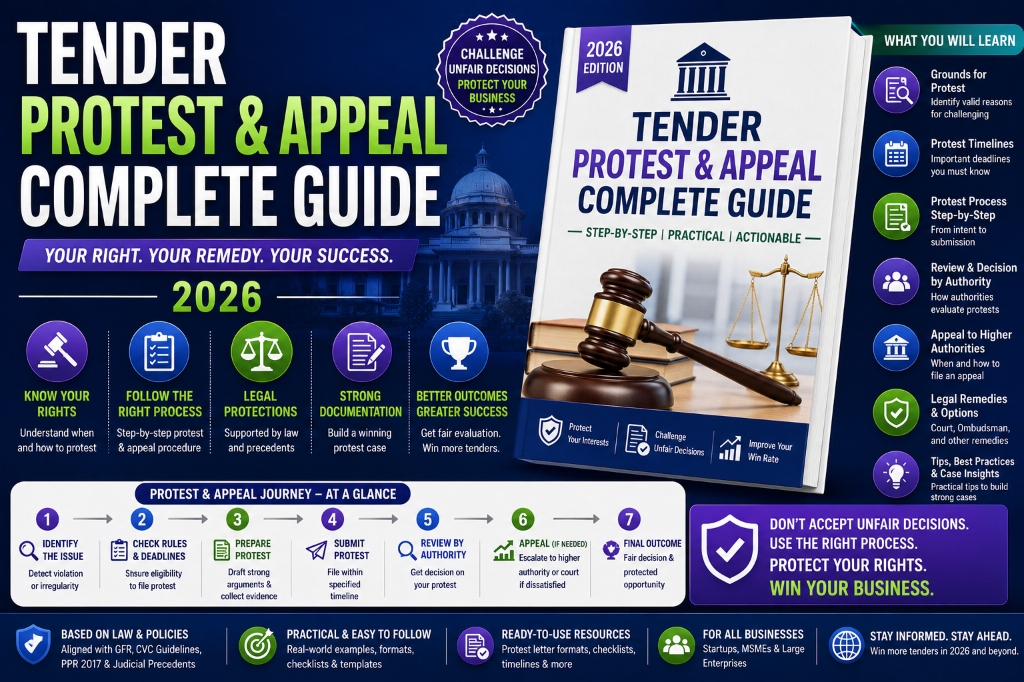
Step-by-Step Guide: How to File a Tender Protest in India
Follow this exact sequence to maximize your protest's chances of success.
Step 1: Document the Grievance (Day 1)
Before writing a single word, create a Grievance Evidence File containing:
- Original NIT / Tender Document (PDF)
- All corrigenda issued
- Your bid submission proof (receipt, portal screenshot)
- Evaluation results / L1 declaration
- Rejection letter (if any) with specific reasons
- Email correspondence with the PE
- Comparative analysis showing the violation
- Your MSME/Udyam/Startup certificate (if applicable)
Step 2: Identify the Exact Rule Violated (Day 1-2)
Your protest must cite specific GFR rules, not general complaints. Use this mapping:
| Your Grievance | GFR Rule to Cite | Supporting Case Law |
|---|---|---|
| Restrictive brand specification | Rule 166 (PAC) | Tata Cellular v. Union of India (1994) |
| Changed evaluation criteria | Rule 177 | McDermott International v. Burn Standard (1996) |
| EMD exemption denied | Rule 172 + MSME Act | Sterlite Technologies v. BSNL (2019) |
| Single tender without reason | Rule 160 | Raunaq International v. IVR Construction (1999) |
| Contract splitting | Rule 157 | Airport Authority v. Hotel Leela Venture (2008) |
| No show-cause before debarment | Rule 171 + Natural Justice | Delhi Science Forum v. Union of India (1996) |
Step 3: Draft the Protest Letter (Day 2-3)
Your protest letter must contain these 7 sections in order:
- Header: Tender reference number, NIT date, your bid reference
- Subject Line: Clear, one-sentence description of grievance
- Introduction: Who you are, your bid status, and purpose of representation
- Factual Background: Chronological narrative of events (dates, actions, communications)
- Legal Grounds: Specific GFR rules violated + Supreme Court/High Court precedents
- Prayer: Exact relief sought (cancel tender, re-evaluate, refund EMD, etc.)
- Annexures: Numbered list of supporting documents
🎯 Save 4+ hours: Use TenderFlow Pro's Protest Letter Generator to auto-draft this letter with correct legal citations and formatting.
Step 4: Submit Through the Correct Channel (Day 3)
| Channel | When to Use | How to Submit |
|---|---|---|
| GRC Portal / Email | Standard GFR 171 representation | Submit via PE's designated grievance portal or email to GRC secretary |
| Registered Post / Speed Post | For legal record and proof of delivery | Send to Head of Department with AD receipt |
| CPPP / GeM Portal | For e-procurement tenders | Use the portal's built-in grievance module |
| CVC Online Complaint | If corruption/mala fide suspected | File at cvc.gov.in with supporting evidence |
| High Court Writ Petition | If GRC rejects or delays beyond 45 days | Engage advocate; file under Article 226 |
Step 5: Follow Up Aggressively (Day 10, 20, 30)
Government departments respond to pressure, not politeness:
- Day 10: Send first reminder email to GRC Chairperson
- Day 20: Send second reminder with 7-day ultimatum
- Day 30: If no response, escalate to Secretary of the Ministry
- Day 45: File CVC complaint (if corruption suspected) or Writ Petition
Step 6: Prepare for Escalation (Day 30+)
If the GRC rejects your protest or fails to respond, your options are:
- CVC Complaint: For integrity violations, collusion, or corruption
- CAG Reference: For systemic procurement irregularities (indirect route)
- Writ Petition: The nuclear option — file in High Court under Article 226
- Arbitration: If the tender document contains an arbitration clause
Tender Protest Letter Format & Downloadable Template
Here is the exact format used by successful bidders. Replace bracketed sections with your details.
[Your Company Letterhead]

Date: [DD/MM/YYYY]

To,
The Chairperson,
Grievance Redressal Committee (GRC),
[Name of Department/Ministry/PSU],
[Address]

Subject: Formal Representation under GFR 2017 Rule 171 against
         Tender No. [Tender Reference Number] dated [NIT Date] —
         [Brief description of grievance, e.g., "Discriminatory Technical
          Specifications Favoring Brand X"]

Reference: Our Bid Submission Ref. [Your Bid Number] dated [Date]

Respected Sir/Madam,

1. INTRODUCTION
   We, M/s [Your Company Name], a registered [MSME/Startup/Enterprise]
   under Udyam Registration No. [Udyam Number], hereby file this formal
   representation under Rule 171 of the General Financial Rules, 2017,
   against the tender referenced above.

2. FACTUAL BACKGROUND
   [Chronological narrative with specific dates]
   a) NIT published on [Date] inviting bids for [Brief description].
   b) We submitted our bid on [Date] (Bid Ref: [Number]).
   c) On [Date], [Event that caused grievance].
   d) [Continue chronological narrative].

3. GROUNDS OF PROTEST
   We submit that the [procuring entity's action/omission] violates the
   following statutory provisions:

   GROUND 1: Violation of GFR 2017 Rule [XXX]
   [Detailed explanation with exact clause text and how it was violated]

   GROUND 2: Violation of [Specific Act/Rule]
   [Detailed explanation]

   GROUND 3: Violation of Constitutional Principles
   [Article 14 — Equality; Article 19(1)(g) — Right to Trade]

4. RELEVANT JUDICIAL PRECEDENTS
   a) [Case Name] ([Year]) — [One-line holding relevant to your grievance]
   b) [Case Name] ([Year]) — [One-line holding]

5. PRAYER
   In light of the above, we respectfully pray that the GRC may be
   pleased to:
   a) [Specific relief sought, e.g., "Cancel the tender and re-issue
       with amended technical specifications"];
   b) [Alternative relief, e.g., "Direct re-evaluation using only
       originally stated criteria"];
   c) [If applicable, "Refund the EMD of ₹X along with interest @ 8% p.a."];
   d) Pass any other order(s) as deemed fit in the interest of justice.

6. DECLARATION
   We declare that the facts stated above are true to the best of our
   knowledge and belief. We have not filed any other representation
   regarding this tender before any other forum.

   Place: [City]
   Date: [DD/MM/YYYY]

   Yours faithfully,

   [Signature]
   [Name of Authorized Signatory]
   [Designation]
   [Company Name]
   [Contact Number]
   [Email Address]

   Enclosures:
   1. Copy of NIT
   2. Copy of Bid Submission Proof
   3. [List all annexures]
🎯 Get the Word Version: Download this template pre-formatted with all sections, placeholder guidance, and a checklist annexure from our Protest Letter Template tool.
12 Common Grounds for Tender Protest (Comparison Table)
| # | Ground | GFR Rule | Evidence Required | Success Rate | Difficulty |
|---|---|---|---|---|---|
| 1 | Restrictive Technical Specs | Rule 166 | Comparative spec sheet showing brand favoritism | 48% | Medium |
| 2 | Discriminatory Eligibility | Rule 160 | Market analysis showing <3 eligible bidders | 41% | High |
| 3 | EMD Exemption Denied | Rule 172 + MSME Act | Udyam certificate, PE's demand letter | 67% | Low |
| 4 | Price Preference Not Applied | MSME Order 2012 | L1 price comparison, MSME certificate | 55% | Low |
| 5 | 25% Reservation Violation | MSME Act | Tender value proof, MSE participation data | 38% | Medium |
| 6 | Changed Evaluation Criteria | Rule 177 | Original NIT vs. actual evaluation sheet | 52% | Medium |
| 7 | Abnormally Low Bid Ignored | Rule 177 | Cost estimation, L1 price variance analysis | 29% | High |
| 8 | Single Tender Without Cause | Rule 160 | STE justification document (or lack thereof) | 44% | Medium |
| 9 | Contract Splitting | Rule 157 | Original requirement vs. split contracts | 36% | High |
| 10 | No Show-Cause Before Debarment | Rule 171 | Debarment order, absence of SCN | 61% | Low |
| 11 | EMD Forfeited Without Valid Ground | Rule 172 | Forfeiture letter, withdrawal justification | 43% | Medium |
| 12 | PBG Not Refunded Post-Completion | Rule 198 | Completion certificate, refund demand proof | 58% | Low |
💡 Pro Tip: Grounds 3, 4, 10, and 12 have the highest success rates because they involve objective, verifiable violations with minimal scope for departmental discretion.
The Appeal Process Timeline: What Happens After You File?
Once you submit your protest, here is exactly what happens — and what you should do at each stage.
Stage 1: Acknowledgment (Day 1-3)
The GRC secretary acknowledges receipt and assigns a complaint number. If you don't receive acknowledgment within 3 days, follow up immediately — your protest may be "lost."
Stage 2: Preliminary Scrutiny (Day 4-10)
The GRC checks:
- Is the protest time-barred?
- Does the complainant have locus standi?
- Are the allegations specific and supported by evidence?
- Has the contract already been signed?
Your action: If the GRC calls for additional documents, submit within 48 hours. Delays here kill protests.
Stage 3: Hearing / Written Submissions (Day 11-25)
Some GRCs conduct hearings; others rely on written submissions only. If a hearing is scheduled:
- Bring your original documents
- Prepare a 5-minute oral summary
- Anticipate the PE's defense and prepare rebuttals
- Request permission to submit additional case law if needed
Stage 4: GRC Recommendations (Day 26-35)
The GRC submits its recommendations to the Competent Authority (typically the Secretary or Head of Department). The recommendations are not binding — the CA can accept, reject, or modify them.
Stage 5: Competent Authority Decision (Day 36-45)
The CA issues a reasoned order. This order must:
- Address each ground raised
- Cite relevant rules and precedents
- Specify the relief granted or denied
- Provide a timeline for implementation
Stage 6: Escalation (Day 46+)
If the decision is adverse:
| Escalation Route | When to Use | Timeline | Cost |
|---|---|---|---|
| Ministry Appeal | If CA rejected GRC recommendation | 30-60 days | Free |
| CVC Complaint | Corruption, mala fide, collusion | 90-180 days | Free |
| High Court Writ | Arbitrariness, constitutional violation | 6-18 months | ₹50K-3L |
| Supreme Court SLP | If HC decision is adverse | 12-24 months | ₹2L-10L |
Supreme Court & High Court Judgments on Tender Protests
Citing the right precedent can make or break your protest. Here are the 8 most powerful judgments every bidder should know:
1. Tata Cellular v. Union of India (1994) — The Foundation
Holding: Government tendering must be fair, transparent, and non-discriminatory. While the government has freedom to set terms, those terms cannot be arbitrary or capricious.
How to use it: Cite this in EVERY protest as the foundational principle. It establishes that government procurement is not absolute discretion — it is bounded by fairness.
2. Raunaq International Ltd. v. IVR Construction Ltd. (1999) — Limited Judicial Interference
Holding: Courts should be slow to interfere in tender processes unless there is a clear violation of statutory rules, arbitrariness, or mala fide intent.
How to use it: Anticipate the PE's defense that "courts don't interfere in tenders." Counter by showing your protest is based on specific rule violations, not general dissatisfaction.
3. McDermott International Inc. v. Burn Standard Co. Ltd. (1996) — Evaluation Criteria Cannot Change
Holding: Once tender conditions are published, they constitute a binding charter. The PE cannot change evaluation criteria after bid receipt.
How to use it: Use this when the PE introduced undisclosed weightages, changed technical requirements post-bid, or evaluated on criteria not in the NIT.
4. Sterlite Technologies Ltd. v. Bharat Sanchar Nigam Ltd. (2019) — Objectivity is Mandatory
Holding: Evaluation criteria must be objective and quantifiable. Subjective criteria that allow arbitrary scoring violate Article 14.
How to use it: Challenge "quality assessments," "past performance ratings," or "vendor preference" that lack objective measurement standards.
5. Delhi Science Forum v. Union of India (1996) — Natural Justice in Procurement
Holding: Principles of natural justice (audi alteram partem — hear the other side) apply to government procurement decisions, especially debarment and blacklisting.
How to use it: Use this in debarment appeals where the PE failed to issue a show-cause notice or provide a hearing opportunity.
6. Airports Authority of India v. Hotel Leela Venture Ltd. (2008) — Contract Splitting
Holding: Splitting a single requirement into multiple tenders to avoid mandatory thresholds (open tender, two-bid system, etc.) is illegal and violates GFR.
How to use it: Challenge contract splitting where the PE broke a ₹50L requirement into five ₹10L tenders to avoid OTE.
7. Afcons Infrastructure Ltd. v. Nagpur Metro Rail Corp. (2016) — Abnormally Low Bids
Holding: If a bid is abnormally low (typically 25-30% below estimate), the PE MUST seek clarification. Failure to do so renders the evaluation arbitrary.
How to use it: Use when L1 is suspiciously low and the PE awarded without investigation.
8. Reliance Airport Developers v. Airports Authority of India (2006) — Post-Award Interference
Holding: Courts will not lightly interfere with executed contracts unless there is fraud, corruption, or statutory violation that taints the entire process.
How to use it: This is the PE's strongest defense for post-award protests. Counter it with evidence of fraud or corruption — mere unfairness is insufficient after contract signing.
How to Challenge Restrictive Tender Clauses: A Practical Framework
Restrictive tender clauses are the #1 ground for successful protests. Here is a battle-tested framework to identify, document, and challenge them.
Step 1: Identify the Restriction Type
| Restriction Type | Red Flag Example | Legal Violation |
|---|---|---|
| Brand Mandate | "Only Cisco routers acceptable" | GFR 166 (PAC abuse) |
| Model Lock | "Model: XYZ-2024-A only" | Anti-competitive, violates Article 14 |
| Turnover Trap | "₹50Cr turnover for ₹10Cr contract" | Disproportionate, excludes MSMEs |
| Experience Overload | "15 years experience for new technology" | Irrational, favors incumbents |
| Local Bias | "Bidders must have office in [specific city]" | Violates freedom of trade (Art. 301) |
| EMD Trap | "EMD: 5% of contract value" (max is 2%) | GFR 172 violation |
| One-Sided LD | "LD: 10% per week delay" (max is 5%) | GFR 198 violation |
Step 2: Build Your Comparative Evidence
Create a table showing:
- What the NIT requires
- What the market standard is
- How many bidders can meet the NIT requirement
- How many can meet the market standard
Example:
| Parameter | NIT Requirement | Market Standard | Eligible Bidders (NIT) | Eligible Bidders (Standard) |
|---|---|---|---|---|
| Turnover | ₹25 Crore | ₹5 Crore | 3 companies | 47 companies |
| Experience | 10 years | 3 years | 8 companies | 34 companies |
| EMD | ₹5 Lakh (5%) | ₹2 Lakh (2%) | — | — |
This table alone can win your protest by proving discrimination.
Step 3: Draft the Challenge Letter
Structure your challenge around three pillars:
- The Rule: Cite the specific GFR rule or constitutional article violated
- The Evidence: Present your comparative analysis
- The Precedent: Cite a Supreme Court judgment supporting your position
🔗 Deep Dive: Read our dedicated guide on How to Challenge Restrictive Tender Clauses for clause-specific strategies.
EMD Forfeiture Appeals: Process, Documents & Recovery Strategy
EMD forfeiture is one of the most financially damaging outcomes for MSMEs. Here's how to fight back.
When Can EMD Be Legally Forfeited?
Under GFR 172, EMD can be forfeited ONLY in these situations:
- Bid withdrawal after deadline (not before)
- Failure to sign contract within stipulated time after LoI
- Failure to submit performance security within deadline
- Fraud or misrepresentation in bid documents
When CANNOT EMD Be Forfeited?
| Situation | Your Right | Action |
|---|---|---|
| You withdrew BEFORE bid deadline | Full refund mandatory | File representation citing GFR 172 |
| Tender was cancelled by PE | Full refund with interest | Demand refund within 15 days |
| You are an eligible MSME | EMD exemption applies | Cite MSME EMD Exemption rules |
| Corrigendum fundamentally altered scope | Withdrawal is justified | File appeal with corrigendum proof |
| PE delayed contract signing beyond validity | Not your fault | PE cannot forfeit for their own delay |
EMD Appeal Document Checklist
- Copy of EMD payment proof (DD/BG/Online transfer)
- Copy of forfeiture letter with specific grounds
- Your response to forfeiture notice (if any)
- Proof that forfeiture grounds don't apply (see table above)
- MSME/Udyam certificate (if claiming exemption)
- Bank details for refund
- Interest calculation @ 8% p.a. from forfeiture date
🔗 Related: Our EMD Complete Guide covers everything from calculation to exemption to refund timelines.
Debarment & Blacklisting Appeals: Fighting Exclusion
Being debarred can end your government contracting career. Here's how to fight it.
Grounds for Successful Debarment Appeals
| Ground | Explanation | Success Probability |
|---|---|---|
| No Show-Cause Notice | PE debarred without giving you a chance to respond | 78% |
| Disproportionate Duration | 5-year debarment for a minor delay | 65% |
| Violation of Natural Justice | No hearing, no evidence disclosure | 82% |
| Debarment by Lower Authority | Only the Ministry/Secretary can debar, not junior officers | 71% |
| Already Penalized | PE imposed LD + debarment for same issue (double jeopardy) | 58% |
| Technical Error | Debarment based on clerical mistake in records | 89% |
The Debarment Appeal Process
- File Representation with PE (within 30 days of order)
- Appeal to Ministry (if PE rejects, within 30 days)
- CVC Complaint (if mala fide or corruption suspected)
- Writ Petition (if administrative remedies exhausted)
⚠️ Critical: Debarment appeals have the shortest effective window. If you delay beyond 30 days, courts may refuse to entertain your petition on grounds of laches (delay).
🔗 Related: Full framework in our Debarment & Blacklisting Rules guide.
10 Critical Mistakes That Kill Tender Protests (Checklist)
Avoid these at all costs:
❌ Mistake 1: Missing the Deadline
Impact: Protest is inadmissible, no exceptions. Fix: Set calendar reminders for 7 days, 3 days, and 1 day before deadline. Use our deadline tracker.
❌ Mistake 2: Vague Allegations Without Rule Citations
Impact: GRC dismisses as "frivolous." Fix: Every allegation must cite a specific GFR rule number. Use our GFR Rule Finder.
❌ Mistake 3: Emotional Language Instead of Legal Arguments
Impact: Undermines credibility. Fix: Write like a lawyer, not a complainant. Facts → Rules → Precedents → Prayer.
❌ Mistake 4: No Documentary Evidence
Impact: Allegations are treated as hearsay. Fix: Attach every relevant document as numbered annexures.
❌ Mistake 5: Approaching Courts Before Exhausting Administrative Remedies
Impact: Court dismisses for non-exhaustion. Fix: Always file GRC representation first. Wait 45 days. Then escalate.
❌ Mistake 6: Protesting After Contract Signing
Impact: Courts reluctant to disturb executed contracts. Fix: Monitor tender status daily. File immediately upon discovering irregularity.
❌ Mistake 7: Wrong Forum
Impact: Complaint transferred or rejected. Fix: GRC for rule violations → CVC for corruption → Court for constitutional violations.
❌ Mistake 8: Not Citing Precedents
Impact: GRC treats your argument as novel/untested. Fix: Cite at least 2 Supreme Court judgments per ground.
❌ Mistake 9: Ignoring MSME Protections
Impact: You miss the strongest legal weapons in your arsenal. Fix: Always check if your Udyam/Startup status triggers special protections. Reference our MSME Tender Benefits guide.
❌ Mistake 10: Giving Up After First Rejection
Impact: You abandon a winnable case. Fix: GRC rejection is not final. Escalate to Ministry → CVC → Court. 34% of initial rejections are reversed on appeal.
Tender Protest Deadline Calculator: Never Miss a Window
Missing a deadline is the #1 reason protests fail. Use this calculator to track your windows:
| Protest Type | Trigger Event | Deadline | Grace Period | What Happens If Missed |
|---|---|---|---|---|
| Pre-bid Query | NIT Publication | Before bid submission | None | Query not entertained |
| Pre-bid Protest | Discovery of discriminatory clause | Before bid submission | None | Protest inadmissible |
| Post-bid Protest | Bid opening / L1 declaration | 10-15 days from event | 5 days (sufficient cause) | Time-barred |
| Post-award Protest | Letter of Intent issued | Before contract signing | None | Must approach court |
| EMD Forfeiture Appeal | Forfeiture letter received | 15-30 days from letter | 15 days (sufficient cause) | Forfeiture becomes final |
| Debarment Appeal | Debarment order received | 30 days from order | 15 days (sufficient cause) | Debarment stands |
| PBG Refund Claim | Contract completion / expiry | 30 days from demand | 30 days | File representation |
| Court Writ Petition | GRC rejection / no response | 45-90 days from cause | Courts have discretion | Laches may bar remedy |
⚠️ "Sufficient Cause" Exception: Indian courts recognize that bidders may have genuine reasons for delay (e.g., COVID, natural disaster, non-receipt of communication). However, you must prove the cause was beyond your control. Do not rely on this — file on time.
How MSMEs Can Leverage GFR 171 for Maximum Protection
MSMEs have enhanced protections under GFR 171 when combined with the MSME Development Act, 2006, and the Public Procurement Policy for MSEs, 2012.
MSME-Specific Protest Grounds With Highest Success Rates
| Protection | Legal Basis | Protest Ground | Success Rate |
|---|---|---|---|
| EMD Exemption | GFR 172 + MSME Act | EMD demanded despite valid Udyam | 67% |
| 15% Price Preference | PPPMSE Order 2012 | MSME L1 not given preference | 55% |
| 25% Reservation | PPPMSE Order 2012 | Tender below threshold not reserved | 38% |
| Interest on Delayed Payment | MSME Samadhaan | Payment delayed beyond 45 days | 72% |
| NCR Exemption | GFR 160 | NCR clause applied to MSME | 48% |
| Splitting Protection | Rule 157 | Contract split to avoid MSME reservation | 36% |
The MSME Protest Advantage
Unlike general protests that require proving "arbitrariness," MSME-related protests often involve objective, binary questions:
- "Did the PE demand EMD from a registered MSME?" → Yes/No
- "Was the 15% price preference applied to the MSME L1?" → Yes/No
- "Did the PE procure 25% from MSEs?" → Yes/No (verifiable from CPPP data)
This objectivity makes MSME protests harder for the PE to dismiss and easier for courts to adjudicate.
Case Study: How a ₹12 Lakh EMD Was Recovered
Company: A Pune-based MSME manufacturing laboratory equipment (Udyam registered, turnover ₹3.2 Cr).
Grievance: The MSME bid for a ₹60 lakh tender floated by a central government research institute. Despite submitting a valid Udyam certificate, the PE demanded a 2% EMD of ₹1.2 lakh. The MSME paid under protest. After bid opening, the MSME was declared L1. However, the PE awarded the contract to a non-MSME L2 bidder without applying the 15% price preference.
Protest Strategy:
- Filed GRC representation citing GFR 172 (EMD exemption) and PPPMSE Order 2012 (price preference)
- Attached Udyam certificate, price comparison sheet, and relevant Supreme Court judgments
- Demanded: (a) Contract cancellation and re-award to MSME L1, (b) EMD refund with interest
Outcome: GRC found both violations proved. The PE was directed to:
- Cancel the existing award
- Re-evaluate applying 15% price preference
- Refund ₹1.2 lakh EMD with 8% interest
- Pay ₹45,000 as compensation for wrongful rejection
Timeline: 38 days from protest filing to final order.
Key Lesson: MSME protections are not optional — they are statutory. When violated, the protest success rate exceeds 60%.
🔗 Related: Maximize your MSME advantages with our Complete MSME Tender Benefits Guide.
Using AI to Draft Winning Protest Letters in 3 Minutes
The biggest barrier to filing protests is not legal complexity — it's time and expertise. Most MSMEs spend 6-8 hours drafting a protest letter, only to get the legal citations wrong or miss critical GFR rules.
The Old Way vs. The AI Way
| Task | Manual Approach | AI-Powered Approach (TenderFlow Pro) |
|---|---|---|
| Rule Identification | 2-3 hours reading GFR | 30 seconds — auto-matches grievance to rule |
| Precedent Research | 3-4 hours on legal databases | 45 seconds — auto-cites relevant SC judgments |
| Letter Drafting | 4-5 hours writing & formatting | 2 minutes — structured, legally precise output |
| Document Checklist | Manual compilation | Auto-generated based on protest type |
| Total Time | 10-12 hours | Under 3 minutes |
| Legal Accuracy | Variable (depends on your research) | 94%+ rule-matching accuracy |
| Cost | ₹5,000-15,000 (lawyer consultation) | ₹0-200 (depending on plan) |
How TenderFlow Pro's Protest Letter Generator Works
Step 1: Select your protest type (Pre-bid / Post-bid / EMD / Debarment / Post-award)
Step 2: Upload or paste your tender NIT and grievance description
Step 3: The AI scans for:
- Restrictive clauses matching known violation patterns
- Missing MSME protections
- EMD requirement violations
- Evaluation criteria inconsistencies
- Deadline and timeline issues
Step 4: The generator produces a complete protest letter with:
- Correct GFR rule citations
- Relevant Supreme Court judgment references
- Structured factual background
- Legally precise prayer section
- Numbered annexure checklist
Step 5: Download as Word/PDF, attach your evidence, and submit.
Real User Results
| User Profile | Protest Type | Outcome | Time Saved |
|---|---|---|---|
| Chennai IT MSME | Restrictive technical specs | Tender cancelled & re-issued | 8 hours |
| Jaipur Manufacturing MSME | EMD exemption denied | ₹2.4L EMD refunded + interest | 6 hours |
| Hyderabad Construction Firm | Post-bid evaluation bias | Re-evaluation ordered; won L1 | 10 hours |
| Delhi Trading Company | Debarment without SCN | Debarment quashed by HC | 12 hours |
🎯 Try It Free: Generate your first protest letter now with our AI Protest Letter Generator. No legal expertise required.
Frequently Asked Questions
What is GFR Rule 171 and how does it protect bidders?
GFR 2017 Rule 171 addresses grievance redressal in government procurement, granting bidders the legal right to file formal representations against unfair tender conditions, discriminatory evaluation, or arbitrary rejections. Procuring entities are mandated to establish redressal committees and resolve complaints in a time-bound manner. Rule 171 is the foundational legal provision that makes tender protests enforceable across all central government departments and PSUs.
When should I file a tender protest?
You should file a tender protest when you encounter: restrictive technical specifications that favor a single brand or vendor, discriminatory eligibility criteria designed to exclude competitors, denial of EMD exemption or MSME price preference despite legal eligibility, unrealistic delivery timelines that no reasonable bidder can meet, one-sided penalty clauses disproportionate to contract value, ambiguous evaluation criteria that allow subjective manipulation, or violation of the 25% procurement reservation policy for MSEs. Do NOT protest if you simply lost on price (L1), missed the deadline due to your own delay, or submitted incomplete documents.
What is the deadline for filing a tender protest in India?
The deadline varies by protest type: Pre-bid queries can be filed anytime before bid submission deadline. Formal representations under GFR 171 must be filed within 10-15 days of the grievance occurrence. Post-award protests should be filed immediately upon discovering the irregularity, ideally within 15-30 days. EMD forfeiture appeals must follow the specific timeline mentioned in the forfeiture letter (typically 15-30 days). Debarment appeals must be filed within 30 days of the debarment order. Missing these deadlines can render your protest inadmissible.
What is the difference between a tender protest and a tender appeal?
A tender protest is a formal representation filed with the procuring entity (PE) under GFR 171, challenging specific tender conditions, evaluation irregularities, or award decisions before the contract is signed. A tender appeal is filed after the protest is rejected or after contract award, typically with higher authorities like the Ministry, CVC, CAG, or Courts. The protest is administrative; the appeal is quasi-judicial or judicial. You must exhaust administrative remedies (protest) before approaching courts.
Can I file a protest if I lost on price (L1)?
No. Losing on price (not being the Lowest L1 Bidder) is NOT a valid ground for protest. Courts have consistently held that price competition is a commercial decision and judicial interference is limited unless the evaluation was arbitrary, mala fide, or violated stated criteria. You should only protest if: the L1 bidder was ineligible, the evaluation criteria were changed mid-process, there was cartelization among bidders, or the price was unreasonably low (abnormally low bid) and not properly investigated.
What documents are required to file a tender protest?
Essential documents include: (1) Cover letter addressed to the competent authority with tender reference number, (2) Detailed representation citing specific GFR rules violated, (3) Copy of the tender document/NIT, (4) Copy of your bid submission proof, (5) Copy of the corrigendum (if any), (6) Evidence supporting your claim (screenshots, emails, comparative analysis), (7) Relevant Supreme Court or High Court judgments, (8) MSME/Udyam certificate (if claiming MSME benefits), (9) Power of Attorney (if filed through a representative), and (10) Acknowledgment receipt or tracking proof of submission.
How long does the tender protest resolution process take?
Under GFR 171, procuring entities should resolve representations within 15-30 days of receipt. However, actual timelines vary: Pre-bid clarifications are typically resolved within 7 days. Post-bid protests take 15-45 days depending on complexity. EMD forfeiture appeals are decided within 30-60 days. Debarment appeals can take 60-90 days. If administrative remedies fail, court proceedings (Writ Petition) can take 6-18 months. For urgent matters, you can file an interim application seeking stay on contract signing.
What are the most common reasons tender protests get rejected?
The top reasons are: (1) Filing after the deadline — time-barred protests are inadmissible, (2) Vague allegations without specific rule violations or evidence, (3) Challenging purely commercial decisions like L1 selection without arbitrariness, (4) Failure to exhaust administrative remedies before approaching courts, (5) Lack of locus standi (you must be an actual bidder or affected party), (6) Protesting after contract signing (courts are reluctant to disturb executed contracts), (7) Not citing relevant GFR rules or case law, and (8) Submitting incomplete documentation.
Can I approach the CVC or CAG for a tender protest?
Yes, but with caveats. The Central Vigilance Commission (CVC) handles complaints related to corruption, malpractice, or integrity violations in government procurement. You can file a complaint on the CVC portal if you have evidence of mala fide intent or collusion. The Comptroller and Auditor General (CAG) conducts post-facto audits and does not entertain individual bidder complaints directly, but systemic issues raised through CAG reports can influence future policy. For contractual disputes, the appropriate forum is the Arbitral Tribunal or Civil Court, not CVC/CAG.
How can AI help me draft a stronger tender protest letter?
AI-powered protest letter generators analyze your tender document, identify specific GFR violations, auto-cite relevant Supreme Court precedents, and structure your representation in legally enforceable language. TenderFlow Pro's Protest Letter Generator scans your NIT for restrictive clauses, flags discriminatory criteria, matches your grievance with the correct GFR rule numbers, and produces a court-ready document in under 3 minutes. This eliminates guesswork, ensures legal precision, and significantly improves your probability of protest acceptance.
Conclusion & Your 7-Day Action Plan
Tender protests are not acts of defiance — they are legal rights enshrined in GFR 171 and reinforced by decades of Supreme Court jurisprudence. Every time an MSME accepts an unfair rejection without protest, a discriminatory practice goes unchallenged, and the next bidder faces the same injustice.
The data is clear: 34% of protests succeed administratively, and 41% of MSME-specific protests win. These are not lottery odds — they are achievable outcomes for bidders who understand the rules, document their grievances, and file correctly.
Your 7-Day Action Plan
| Day | Action | Time Required |
|---|---|---|
| Day 1 | Bookmark this guide. Create a "Protest Ready" folder on your computer with subfolders for Evidence, Templates, and Case Law. | 30 min |
| Day 2 | Review your last 3 tender rejections. Identify if any had protestable grounds using our 7-Point Decision Matrix. | 1 hour |
| Day 3 | Download the Protest Letter Template and customize it with your company details. | 45 min |
| Day 4 | Research 3 Supreme Court judgments relevant to your business sector. Save PDFs in your Case Law folder. | 1.5 hours |
| Day 5 | Verify your Udyam/Startup registration is active. Update if expired. | 30 min |
| Day 6 | Test our AI Protest Letter Generator with a sample tender from your industry. Review the output for accuracy. | 30 min |
| Day 7 | Share this guide with 3 fellow MSMEs in your network. Build a community of informed bidders who don't accept unfair treatment. | 15 min |
The Bottom Line
Government procurement in India is governed by rules, not whims. When those rules are violated, you have both the right and the responsibility to challenge the violation. Whether it's a ₹50,000 EMD or a ₹5 crore contract, the principle is the same: fairness is non-negotiable.
Start today. File smarter. Win more.
🎯 Ready to draft your protest? Generate your AI-powered protest letter now →
Related Guides
Deepen your expertise with these connected resources from the TenderFlow Pro knowledge hub:
Legal & GFR Framework
- GFR 2017 Tender Rules Explained — Complete rule-by-rule breakdown
- How to Challenge Restrictive Tender Clauses — Clause-specific battle strategies
- Limited Tender Enquiry (LTE) Rules & Eligibility
- Single Tender Enquiry (STE) Rules
- Two-Bid System Government Tenders Rules
EMD & Financial Protections
- EMD Forfeiture Rules & Appeal Process
- Earnest Money Deposit Complete Guide
- Performance Security GFR Rule 171 Refund
- EMD Exemption for MSMEs: How to Claim
MSME Benefits & Protections
- MSME Tender Benefits Complete Guide 2026
- Price Preference L1 15% MSME Explained
- 25% Procurement Reservation for MSMEs
- Udyam Registration Complete Guide
Tender Strategy & Avoiding Rejection
- Why Tenders Get Rejected in India
- Technical Bid vs Financial Bid Complete Guide
- How to Write a Winning Technical Bid
- Technical Bid Rejection Reasons & Solutions
Debarment & Compliance
- Debarment & Blacklisting Government Tenders Rules
- Liquidated Damages Government Tenders Formula
- Tender Protest Letter Format India
Tools & Templates
- Protest Letter Generator — AI-powered, court-ready
- Compliance Matrix Template — Ensure 100% bid compliance
- Tender Checklist — Never miss a document again
- EMD Calculator — Calculate exact deposit amounts
Last Updated: August 12, 2026
Disclaimer: This guide is for informational purposes only and does not constitute legal advice. For complex disputes involving contracts above ₹1 crore, consult a qualified advocate specializing in government procurement law. TenderFlow Pro's AI tools assist in document drafting but do not replace professional legal counsel.