Debarment & Blacklisting in Government Tenders: The Complete GFR 2017, GeM Incident Policy & Legal Remedies Guide
Last Updated: July 18, 2026 | Reading Time: 22 minutes | Author: TenderFlow Pro Procurement Intelligence Team For the comprehensive end-to-end framework, consult our step-by-step government tender bidding process.
Quick Answer: Debarment and blacklisting are the most severe administrative penalties in Indian public procurement. Under GFR 2017 Rule 151, a procuring entity may debar a bidder for up to 2 years for breaching the Code of Integrity (Rule 175). GeM's Incident Management Policy (July 2025) classifies deviations into 4 severity levels — Mild (30–45 days), Serious (45–60 days), Severe (60–90 days), and Grave (up to 2 years or permanent debarment). In 2024, Delhi High Court upheld a 2-year debarment of CCS Computers for submitting a forged turnover certificate, ruling that "blacklisting amounts to civil death" but is justified when integrity is breached. For MSMEs, prevention is the only viable strategy — legal remedies are expensive, slow, and uncertain.
menu_book Table of Contents
Facing show-cause notice or debarment threats? Learn how to file a statutory protest to safeguard your eligibility across central and state procurement portals.
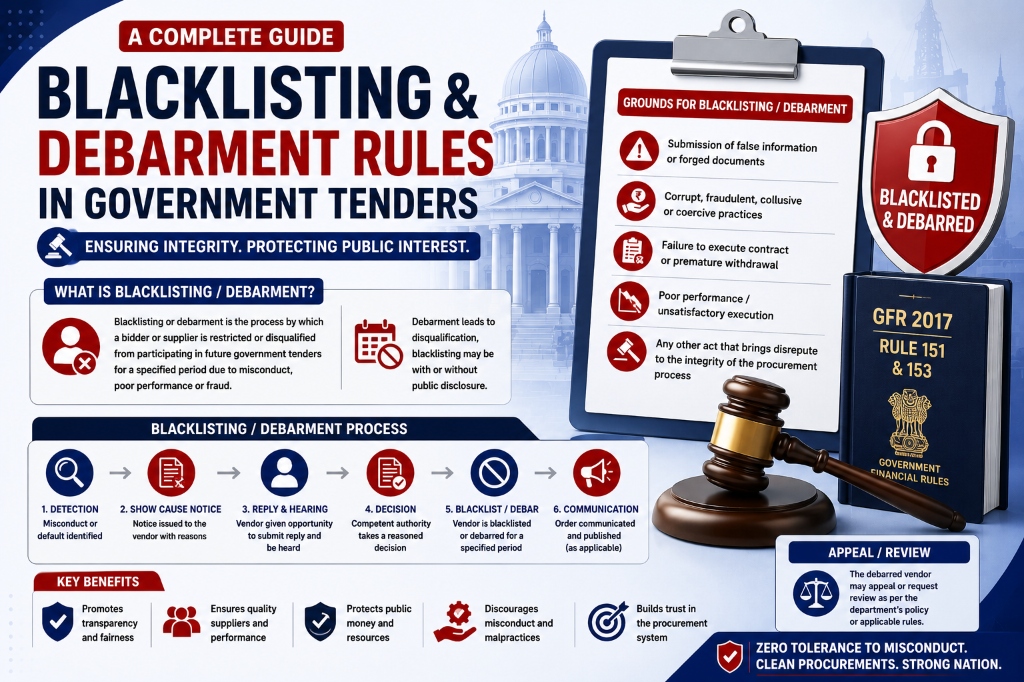
What Is Debarment vs. Blacklisting? The Critical Difference
In Indian public procurement, debarment and blacklisting are often used interchangeably, but they have distinct legal meanings and procedural requirements. Understanding the difference is critical for your defense strategy. To understand foundational rules, refer to our tender rejection complete guide.
Definition Box: Debarment — A formal administrative action under GFR 2017 Rule 151 where a procuring entity disqualifies a bidder from participating in any procurement process for a specified period (not exceeding 2 years) due to breach of the Code of Integrity or other specified grounds. It is governed by statutory rules and requires due process.
Definition Box: Blacklisting — A broader term often used by government departments and PSUs to declare a contractor or supplier as ineligible for future contracts. While not always strictly governed by GFR 151, courts have held that blacklisting must follow principles of natural justice, proportionality, and reasonableness. It is often described as "civil death" for a contractor.
Key Differences
| Parameter | Debarment (GFR 151) | Blacklisting (Departmental) |
|---|---|---|
| Legal Basis | GFR 2017 Rule 151 | Departmental policy / contract terms |
| Maximum Period | 2 years (extendable in some cases) | Varies (1–5 years common) |
| Due Process | Show cause notice + hearing mandatory | Show cause + hearing expected (per courts) |
| Scope | Specific procuring entity or all Central Govt | Specific department / PSU / all government |
| Appeal Route | Administrative + Judicial (Writ) | Judicial (Writ Petition) + Representation |
| GeM Impact | May trigger GeM suspension | May trigger GeM suspension |
| Reversibility | Yes, through appeal/review | Yes, through court intervention |
Critical Insight: While debarment is a statutory remedy with defined procedures, blacklisting is often an administrative action. However, courts have consistently held that both must follow natural justice — notice, opportunity to be heard, and reasoned order. Any action taken without these principles is vulnerable to judicial challenge.

Get the Rejection Recovery Toolkit
Prevent disqualifications with strict audit checklists + lawyer-grade appeal letters.
- ✓ 150-Point Pre-Submission Checklist (PDF)
- ✓ 50-Point Technical Bid Compliance Audit
- ✓ 30-Point Financial Bid Accuracy Verification
- ✓ 5 Post-Rejection Appeal Letter Formats (GFR 171)
🔒 256-Bit Secure Razorpay Checkout · Lifetime Access · Instant Digital Delivery
GFR 2017 Rule 151: Debarment from Bidding
Rule 151 of the General Financial Rules, 2017 is the statutory foundation for debarment in Indian public procurement.
The Rule Text
"A procuring entity may debar a bidder from participating in any procurement process for a period not exceeding two years, if it determines that the bidder has breached the Code of Integrity."
Key Provisions of Rule 151
| Provision | Details |
|---|---|
| Authority | Procuring entity (Ministry, Department, PSU, Autonomous Body) |
| Maximum Period | 2 years from date of order |
| Grounds | Breach of Code of Integrity (Rule 175) |
| Due Process | Reasonable opportunity to represent against debarment (Rule 151(iv)) |
| Record | Must be recorded in writing with reasons |
| Publication | Debarment list published on CPPP / GeM / Department website |
| Effect | Bidder cannot participate in any tender of the debarring entity |
Rule 151(iii) — Additional Grounds
Beyond Code of Integrity breaches, a bidder may be debarred for:
- Consistent failure to execute contracts
- Abandonment of work without reasonable cause
- Subcontracting without approval
- Willful misrepresentation of facts
- Collusion or cartelization
The 2-Year Limit
The statutory maximum is 2 years. However, some departments (like NDMC in the CCS Computers case) have extended this through:
- Pre-integrity pact clauses allowing 5-year debarment
- Contractual terms specifying longer periods
- Separate departmental blacklisting policies
Legal Position: While GFR 151 caps debarment at 2 years, courts have upheld longer blacklisting periods when justified by contract terms and the gravity of misconduct — provided natural justice is followed.
GFR 2017 Rule 175: The Code of Integrity
Rule 175 defines the Code of Integrity — the behavioral standards that, if breached, trigger debarment under Rule 151.
What the Code of Integrity Prohibits
Rule 175(1)(i) prohibits officials and bidders from:
| Prohibition | Description | Common Examples |
|---|---|---|
| (a) | Offering bribes or inducements | Cash, gifts, hospitality to officials |
| (b) | Collusion between bidders | Bid-rigging, price-fixing, market allocation |
| (c) | Conflict of interest | Bidder related to evaluation officer |
| (d) | Obstruction of investigation | Hiding documents, threatening witnesses |
| (e) | Disclosure of confidential information | Leaking bid prices, technical specs |
| (f) | Fraudulent practices | Fake certificates, forged documents |
| (g) | Misrepresentation | False turnover, fake experience certificates |
| (h) | False declaration or information | Forged documents to secure contract |
| (i) | Violation of pre-integrity pact | Breaching anti-corruption commitments |
Rule 175(2) — Action on Breach
"If a procuring entity, after giving a reasonable opportunity of being heard, comes to the conclusion that a bidder has contravened the Code of Integrity, it may take appropriate measures including debarment."
Key Requirements:
- Reasonable opportunity of being heard — personal hearing or written representation.
- Conclusion based on evidence — not suspicion or hearsay.
- Proportionate penalty — debarment must match the gravity of the breach.
Instant Tender Eligibility & Risk Audit
Upload any 500-page NIT / BOQ PDF. Extract hidden disqualification traps, EMD waiver clauses, and complete eligibility criteria in under 45 seconds.
GeM Incident Management Policy 2025: The 4 Deviation Categories
GeM's Incident Management Policy (updated 21 July 2025) is the operational framework for handling seller deviations on the platform. It operates parallel to — and often triggers — GFR 151 debarment.
What Is a "Deviation"?
A deviation is any action that breaks GeM's terms, including:
- Fake listings or counterfeit products
- False documentation
- Delayed or non-delivery
- Quality complaints
- Non-payment to buyers
- Breach of warranty obligations
- GFR Rule 144(xi) non-compliance (land border countries)
The 4 Deviation Severity Levels
| Category | Definition | Typical Suspension | Examples |
|---|---|---|---|
| Mild | Minor procedural errors | 30–45 days | Wrong product category, incomplete documents, minor specification mismatch |
| Serious | Misleading information or performance failures | 45–60 days | Payment delays, poor delivery performance, misleading product descriptions |
| Severe | Fake documents, non-delivery, bid withdrawal | 60–90 days | Counterfeit goods, forged certificates, non-delivery after award, withdrawal after bid acceptance |
| Grave | Repeated or intentional violations | Up to 2 years or permanent debarment | Repeated serious/severe violations, integrity pact breaches, criminal fraud, systematic misrepresentation |
Incident Management Process Flow
Step 1: Incident Raised
- By buyer, GeM admin, system auto-flag, or verifying agency.
- Incident recorded on IM Dashboard with deviation category.
Step 2: Response Period
- Seller has 7 days to respond or fix the issue (for post-contract matters).
- For pre-contract deviations, timeline varies by category.
Step 3: Show Cause Notice (SCN)
- If unresolved, GeM issues SCN.
- Seller must respond within 5 calendar days (10 days in some cases).
- Silence is fatal — no response leads to automatic penalty.
Step 4: Review & Decision
- GeM admin reviews evidence and response.
- Decision: suspension, moratorium, or closure.
Step 5: Action & Appeal
- Penalty imposed.
- Seller has 10 calendar days to file one appeal with new material evidence.
Temporary Moratorium vs. Suspension
| Feature | Temporary Moratorium | Suspension |
|---|---|---|
| Bidding | ❌ Blocked | ❌ Blocked |
| Ongoing Orders | ✅ Can complete | ⚠️ May be restricted |
| Catalogue Updates | ❌ Blocked | ❌ Blocked |
| Visibility | Visible on profile | Visible on profile |
| Duration | Typically shorter | As per severity |
Buyer-Specific vs. Portal-Wide Debarment
GeM distinguishes between:
- Buyer-specific debarment: Only the buyer who raised the incident can block you from their tenders.
- Portal-wide suspension: GeM admin action affecting all buyers.
- Departmental blacklisting: Outside GeM, through the buyer's internal policy.
Important: Departments can raise incidents on sellers for buyer-specific debarment related to bids/contracts placed outside GeM using Seller ID and PAN.
Common Reasons for Debarment & Blacklisting
Based on GFR 175, GeM IM Policy, and court judgments, here are the top reasons contractors get debarred or blacklisted:
1. Submission of Forged Documents
The #1 reason for debarment. Fake turnover certificates, forged experience letters, counterfeit ISO certifications, and manipulated bank statements.
Case: CCS Computers (Delhi HC, 2025) — 2-year debarment for uploading a forged turnover certificate showing ₹128 crore instead of actual ₹28 crore.
2. Non-Delivery or Delayed Delivery
Consistent failure to deliver goods/services within stipulated timelines. Particularly damaging if the delay affects critical government operations.
3. Supply of Inferior/Substandard Goods
Delivering products that don't match technical specifications. Quality complaints from buyers that are substantiated upon inspection.
4. Bid Rigging & Collusion
Forming cartels, price-fixing, or submitting cover bids. GeM actively monitors bidding patterns and refers suspected cartelization to the Competition Commission of India (CCI).
5. Breach of Pre-Integrity Pact
Violating anti-corruption commitments made in the integrity pact. This includes offering bribes, kickbacks, or inducements to government officials.
6. Withdrawal After Bid Acceptance
Withdrawing a bid after being declared L1 or after contract award. This disrupts procurement timelines and may force re-tendering.
7. Abandonment of Contract
Stopping work mid-contract without reasonable cause. This is treated as a severe breach and often triggers both financial penalties and debarment.
8. Non-Payment to Subcontractors (for works contracts)
Failure to pay subcontractors or laborers, especially in construction contracts. This attracts both labor law penalties and procurement debarment.
9. GFR Rule 144(xi) Non-Compliance
Sellers from countries sharing a land border with India (or their Indian affiliates) who fail to register with the Competent Authority.
10. Repeated Mild/Serious Violations
Even minor deviations, if repeated, can escalate to Grave category and trigger long-term debarment.
The Debarment Process: Show Cause to Final Order
Understanding the procedural safeguards is essential for mounting an effective defense.
Stage 1: Detection of Deviation
- Buyer raises complaint on GeM IM Dashboard.
- GeM system auto-flags suspicious activity.
- Internal audit or vigilance department discovers irregularity.
Stage 2: Preliminary Inquiry
- Department conducts preliminary fact-finding.
- May examine documents, interview officials, verify certificates.
- No debarment can happen without a preliminary inquiry.
Stage 3: Show Cause Notice (SCN)
The SCN must contain:
- Specific allegations — not vague generalities.
- Evidence relied upon — documents, witness statements, audit reports.
- Proposed action — debarment period, blacklisting scope.
- Response deadline — typically 10–15 days.
- Hearing opportunity — date, time, and mode (physical/virtual).
Legal Standard: A show cause notice that merely says "you have breached integrity" without specifics is bad in law and can be quashed by courts.
Stage 4: Seller's Response
- Submit written representation addressing each allegation point-by-point.
- Attach documentary evidence.
- Request personal hearing if offered.
- Engage legal counsel for complex cases.
Stage 5: Hearing
- Present oral arguments before the competent authority.
- Cross-examine evidence if permitted.
- Submit additional documents.
- Request mitigation of proposed penalty.
Stage 6: Reasoned Order
The final order must:
- Record the facts found.
- Apply the relevant legal provisions (GFR 151, 175, contract terms).
- State the reasons for the penalty.
- Specify the period of debarment/blacklisting.
- Mention the appeal/review mechanism.
Without a reasoned order, the debarment is arbitrary and liable to be set aside.
Stage 7: Publication
- Debarment list published on CPPP (eprocure.gov.in).
- GeM updates "Suspended/Debarred Sellers" list.
- Department website may publish blacklisted firms.
GeM Debarment vs. Buyer-Specific Debarment vs. Portal-Wide Suspension
Type 1: GeM Portal-Wide Suspension
Authority: GeM SPV (Government e-Marketplace Special Purpose Vehicle). Trigger: Grave deviations, repeated violations, system-flagged fraud. Effect: Cannot bid, accept orders, or update catalogues on ANY GeM tender. Duration: As per IM Policy severity matrix (30 days to 2 years). Appeal: One appeal to GeM Appellate Authority within 10 days.
Type 2: Buyer-Specific Debarment
Authority: Individual buyer (Ministry, Department, PSU). Trigger: Contract breach, quality complaint, delivery failure on that buyer's tender. Effect: Cannot participate in that specific buyer's tenders only. Duration: As per buyer's internal policy (typically 1–3 years). Appeal: Representation to buyer + judicial remedy.
Type 3: Departmental Blacklisting
Authority: Department/PSU under its own policy. Trigger: Serious breach of contract, integrity violation, criminal conviction. Effect: Cannot participate in any tender of that department/PSU. Duration: 1–5 years (varies by policy). Appeal: Writ petition under Article 226.
Type 4: Central Debarment (CPPP/GeM Central List)
Authority: Central Vigilance Commission or nodal ministry. Trigger: Serious fraud, national security concerns, repeated cross-departmental violations. Effect: Cannot participate in Central Government tenders across all departments. Duration: 2+ years. Appeal: Limited — typically judicial only.
Type 5: State Government Blacklisting
Authority: State departments, PSUs, local bodies. Trigger: Similar to Central grounds but under state procurement rules. Effect: State-specific ineligibility. Duration: Varies by state policy.
How to Respond to a Show Cause Notice (SCN)
A Show Cause Notice is not a death sentence — it's an opportunity to defend yourself. How you respond determines whether you walk away unscathed or face years of debarment.
The 10-Point SCN Response Framework
1. Acknowledge Receipt Immediately
- Log into GeM/dashboard and confirm receipt.
- Note the response deadline. Set 3 reminders.
2. Read the SCN Line by Line
- Identify every specific allegation.
- Note the evidence cited against you.
- Identify the proposed penalty.
3. Gather Evidence
- Original documents referenced in the SCN.
- Delivery proofs, inspection reports, communication records.
- Third-party certifications or expert opinions.
- Bank records, GST filings, audit reports.
4. Draft Point-by-Point Rebuttal
RESPONSE TO SHOW CAUSE NOTICE

Ref: SCN No. _______ dated _______

1. ALLEGATION: [Quote exact allegation from SCN]
   RESPONSE: [Your factual rebuttal with evidence]
   DOCUMENTS ATTACHED: [List]

2. ALLEGATION: [Next allegation]
   RESPONSE: [Your rebuttal]
   ...

PRAYER:
- Reject the proposed debarment/blacklisting.
- Close the incident with a warning/caution if any lapse is found.
- Allow continued participation in tenders.

Signature: _____________
Date: _____________
5. Admit & Explain (If Partially at Fault)
- If some allegations are true, admit them.
- Explain mitigating circumstances (e.g., "delay was due to Force Majeure — attached flood notification").
- Show corrective action taken.
6. Challenge Procedural Defects
- Was the SCN issued within time limits?
- Was preliminary inquiry conducted?
- Are the allegations vague or non-specific?
- Is the proposed penalty disproportionate?
7. Highlight Track Record
- Past successful deliveries with the same buyer.
- Years of unblemished service.
- MSME status and employment generated.
- Awards or recognitions received.
8. Request Personal Hearing
- If the SCN offers a hearing, ALWAYS request it.
- Oral advocacy can change outcomes.
- Bring your authorized representative and all original documents.
9. Submit Before Deadline
- Never miss the deadline. Late responses are often rejected outright.
- Keep proof of submission (screenshot, acknowledgement number).
10. Follow Up
- If no response within 30 days, send a polite reminder.
- Escalate to higher authority if the matter is stuck.
Common SCN Response Mistakes
| Mistake | Why It's Fatal | Correct Approach |
|---|---|---|
| Ignoring the SCN | Automatic penalty | Respond within deadline, even if brief |
| Generic denial | "We deny all allegations" without evidence | Point-by-point rebuttal with documents |
| Blaming employees | "Our employee did it without management knowledge" | Accept organizational responsibility + show corrective action |
| Emotional appeal | "We are a small MSME, please be kind" | Facts + law + proportionality argument |
| Missing the hearing | Forfeit your best chance to persuade | Attend personally with prepared notes |
Appeal Process: GeM, Administrative & Judicial Remedies
If debarment or blacklisting is imposed, you have multiple layers of appeal. Use them in sequence.
Level 1: GeM Appeal (For GeM Suspensions)
Who can appeal: Any seller/service provider facing GeM suspension or debarment. Deadline: Within 10 calendar days of the penalty order. Grounds: Only if you have new material evidence not considered earlier. Process:
- Contact GeM helpdesk (gem.gov.in/gemtickets/create).
- Submit appeal with new evidence and appeal fee.
- Appellate Authority reviews and decides. Outcome: Can reduce, enhance, or uphold the penalty. Limitation: Only one appeal per incident is permitted.
Level 2: Representation to Higher Authority
For departmental blacklisting:
- File representation to the Head of Department.
- Copy to the Ministry/PSU's vigilance officer.
- Request review citing procedural defects or disproportionate penalty.
Level 3: CPGRAMS Grievance
Portal: pgportal.gov.in Ministry: Ministry of Commerce and Industry (for GeM matters) Organization: GeM SPV When to use: When GeM helpdesk is unresponsive or the decision appears arbitrary. Advantage: Creates a formal government paper trail. Publicly tracked.
Level 4: RTI Application
To: GeM CPIO (Central Public Information Officer) Ask for:
- Recorded reason for suspension/debarment.
- File notings and internal communications.
- Decision-making authority and process followed. Use: Evidence for further representations or court proceedings.
Level 5: Writ Petition (High Court)
Under: Article 226 of the Constitution. Grounds:
- Violation of natural justice (no notice, no hearing).
- Arbitrary and unreasonable order.
- Disproportionate penalty.
- Violation of GFR 151/175 procedures.
- Mala fide intention. Relief sought:
- Quashing of debarment/blacklisting order.
- Stay on operation of order (interim relief).
- Permission to participate in pending tenders.
- Mandamus to remove name from debarment list.
Critical Timing: File within days or weeks — not months. Delay weakens your case and may lead to dismissal on grounds of laches.
Key Precedents:
- Kulja Industries v. Union of India (SC): Debarment must be proportionate and follow due process.
- Patel Engineering Ltd. v. Union of India: Any authority has the inherent right to blacklist a contractor for fraudulent practices.
- Delhi HC (CCS Computers, 2025): Management cannot escape liability for acts of employees done in the course of duty. Blacklisting is justified for forged documents.
- Calcutta High Court: Blacklisting must follow fair procedure and natural justice.
How to Legally Remove Blacklisting: Writ Petition Strategy
If administrative remedies fail, judicial intervention is your last resort. Here's the strategic framework.
Grounds for Judicial Challenge
| Ground | When It Applies | Success Probability |
|---|---|---|
| No Show Cause Notice | SCN was never issued | High |
| No Hearing | Opportunity to represent denied | High |
| Vague Allegations | SCN/order lacks specifics | Medium-High |
| Disproportionate Penalty | 5-year blacklist for minor delay | Medium |
| Mala Fide | Evidence of bias/ulterior motive | Medium (if provable) |
| Employee vs. Company | Junior employee acted without management knowledge | Low (courts reject this defense) |
| Delay in Filing | Petition filed after 6+ months | Low (laches doctrine) |
Step-by-Step Writ Petition Process
Step 1: Consult a Tender Lawyer (Day 1)
- Engage a lawyer with High Court experience in procurement matters.
- Tender law is specialized — general practice lawyers often miss nuances.
Step 2: Collect Documents (Days 1–3)
- Blacklisting order.
- Show cause notice (if any).
- Your response to SCN.
- Hearing records (if any).
- Contract documents.
- All communication with the department.
- Evidence of your track record and compliance.
Step 3: Draft Writ Petition (Days 3–5)
- Include: Facts, legal violations, relief sought, interim prayer.
- Cite relevant GFR provisions, Supreme Court precedents, and Article 14/226.
Step 4: File in High Court (Day 5–7)
- Jurisdictional High Court (where the blacklisting authority is located).
- Pay court fees and process fees.
- Serve notice on the respondent (department/PSU).
Step 5: Seek Interim Relief (Day 7–10)
- Urgent hearing for stay on blacklisting order.
- Prayer to allow participation in pending tenders.
- If interim stay is granted, you can bid while the case continues.
Step 6: Final Hearing (Months 2–6)
- Both sides present arguments.
- Court examines evidence and legal provisions.
- Judgment: Quash, modify, or uphold the blacklisting.
Realistic Expectations
- Interim stay: Possible within 1–2 weeks if grounds are strong.
- Final judgment: 3–12 months depending on court backlog.
- Success rate: Higher when procedural violations are proven; lower when the offense is substantive (forged documents, bribery).
Case Study: Delhi High Court Upholds 2-Year Debarment of CCS Computers
Case: CCS Computers Private Limited v. New Delhi Municipal Council (NDMC) & Ors. Court: Delhi High Court Date: 8 August 2025 Citation: W.P.(C) 11006/2024
Background
NDMC floated a tender on GeM for procurement of 4,159 pre-loaded electronic tablets. The minimum turnover required was ₹37.43 crore. CCS Computers, an MSME-registered IT services company, was authorized by OEM Datamini Technologies to bid on its behalf.
The Forgery
CCS Computers uploaded a Turnover Certificate dated 24.03.2022 showing a turnover of ₹128,20,10,671 instead of the actual ₹28,20,10,671. The number "1" had been added before the actual figure to meet the eligibility criteria.
A complaint was received. NDMC asked CCS to verify. CCS conducted an "internal inquiry" where two employees allegedly "confessed" to forging the certificate. NDMC then issued a Show Cause Notice and held a personal hearing.
The Debarment Order
On 7 June 2024, NDMC blacklisted CCS Computers and debarred it from participating in any NDMC tender for 2 years.
CCS's Defense
- Employee Act Defense: The forgery was done by junior employees without management knowledge.
- Zero Tolerance Policy: CCS claimed it had a zero-tolerance policy for corruption.
- Impeccable Track Record: Years of service to Indian Navy, Army, DRDO, Ministry of Home Affairs.
- Civil Death Argument: Blacklisting would be "civil death" for the company.
Court's Ruling
The Delhi High Court UPHELD the debarment. Key observations:
"It cannot be accepted or believed that junior executives of the Petitioner would not have pointed out at the very outset that the Turnover Certificate of Respondent No. 2 was not meeting the eligibility condition and/or that at the time of bid submission, numerical '1' was added to the existing figure of turnover, more so, when Petitioner itself claims that it is extremely cautious of its reputation and has a policy of zero tolerance to corruption."
"Assuming that the management has chosen to keep itself aloof from the tendering process as a practise or business decision, it is at its own peril but in so far as NDMC is concerned, the decision is justified as submitting forged bid documents directly impacts the sanctity of tender process and it is against public interest to encourage such practices."
"The in-house inquiry or the criminal action initiated by the Petitioner is well taken, however, this does not render the decision of blacklisting illegal or arbitrary. Submission of admittedly forged documents with a bid is a good enough reason for NDMC to take the action it did in public interest and to maintain sanctity of the tender process."
"Petitioner has been independently debarred by GeM portal vide order dated 02.09.2024 to participate in any tender process for 60 days."
Key Takeaways
- Management is liable for employee acts in the course of duty. The "employee did it" defense does not work.
- Internal inquiry does not immunize you from departmental action. You can investigate internally AND face external penalties.
- "Civil death" argument fails when integrity is breached. Courts prioritize public interest over individual contractor hardship.
- GeM debarment runs parallel to departmental blacklisting. CCS faced BOTH NDMC blacklisting AND GeM 60-day suspension.
- Natural justice was followed = order is valid. Since SCN and hearing were provided, the court found no procedural defect.
Prevention Framework: 15 Rules to Never Get Debarred
The best defense against debarment is never needing a defense. Here's the prevention framework used by India's most compliant government contractors.
Rule 1: Document Verification Protocol
Before uploading ANY document to GeM or a tender portal:
- Verify the document against original records.
- Check dates, amounts, names, and signatures.
- Ensure the document is issued by the claimed authority.
- Scan at 300 DPI minimum for clarity.
- Keep original physical copies for 5 years.
Rule 2: The "Two-Person Rule" for Bid Submission
Never let one employee handle bid submission alone.
- Person 1: Prepares and uploads documents.
- Person 2: Independently verifies every document before final submission.
- Manager: Gives final approval.
Rule 3: OEM Authorization Verification
Before bidding as a reseller:
- Confirm OEM authorization is current and valid.
- Verify authorization covers the specific product and tender.
- Check OEM's GeM panel status.
- Get authorization on OEM letterhead with verifiable signature.
Rule 4: Turnover & Financial Document Audit
- Use only audited financial statements for turnover claims.
- Cross-check CA turnover certificate against GST returns.
- Never round up or "estimate" turnover figures.
- If turnover is close to eligibility threshold, bid on lower-value tenders instead.
Rule 5: Delivery Timeline Realism
- Add 20% buffer to your estimated delivery timeline.
- Factor in monsoon, festivals, and logistics disruptions.
- If force majeure occurs, notify the buyer IMMEDIATELY with evidence.
- Never promise what you cannot deliver.
Rule 6: Quality Control Before Dispatch
- Inspect every batch before dispatch.
- Match dispatched goods against approved technical samples.
- Include test reports and inspection certificates.
- Photograph goods before packaging.
Rule 7: Communication Discipline
- All communication with buyers must be through official channels (GeM portal, official email).
- Never use personal WhatsApp for official negotiations.
- Keep records of every promise, clarification, and commitment.
- Confirm verbal agreements in writing.
Rule 8: Integrity Pact Compliance
- Read the pre-integrity pact before signing.
- Train all bidding team members on anti-corruption rules.
- Report any approach for bribery or collusion to the vigilance officer.
- Maintain a "no gifts" policy for government officials.
Rule 9: Subcontractor Vetting
- Vet every subcontractor for compliance history.
- Ensure subcontractors are not debarred or blacklisted.
- Include subcontractor compliance in your internal audit.
Rule 10: Statutory Compliance Calendar
- GST filing — monthly/quarterly without fail.
- Udyam renewal — before expiry.
- BIS/ISO certifications — track expiry dates.
- PAN, bank details, DSC — update on GeM immediately upon change.
Rule 11: Incident Response Protocol
If a buyer raises ANY complaint:
- Respond within 24 hours.
- Acknowledge the issue and propose corrective action.
- Document every step of resolution.
- Request mutual closure on GeM dashboard once resolved.
Rule 12: Avoid Cartelization Red Flags
- Never discuss pricing with competitors.
- Don't submit bids with identical pricing to other sellers.
- Avoid bidding only on tenders where one competitor always wins.
- If GeM flags suspicious bidding patterns, seek legal advice immediately.
Rule 13: Employee Training & Background Checks
- Train all employees on GFR Code of Integrity.
- Conduct background checks on employees handling sensitive documents.
- Make employees sign compliance declarations.
- Restrict document access to authorized personnel only.
Rule 14: Insurance & Risk Mitigation
- Consider bid bond insurance for high-value tenders.
- Maintain professional indemnity insurance.
- Keep legal counsel on retainer for emergency advice.
Rule 15: Regular Compliance Audit
- Quarterly internal audit of all active tenders and contracts.
- Annual third-party compliance review.
- Mock SCN response drills.
- Update prevention protocols based on new GeM policy changes.
MSME-Specific Protections & Vulnerabilities
Protections
- EMD Exemption: Reduces financial exposure if debarment occurs.
- Price Preference: May survive mild deviations if track record is strong.
- Small Scale = Limited Exposure: Smaller contract values mean lower risk of catastrophic debarment.
- Government Support: MSME Ministry may intervene in arbitrary blacklisting cases.
Vulnerabilities
- Limited Legal Resources: Cannot afford expensive litigation.
- Informal Processes: Often lack documented internal controls.
- Employee Trust: Family-run businesses trust employees implicitly — leading to the CCS Computers scenario.
- Documentation Gaps: May not maintain 5-year records.
- OEM Dependence: Resellers are vulnerable to OEM authorization issues.
MSME-Specific Prevention Checklist
- Register on Udyam and keep certificate current.
- Use GeM's SAHAYAK programme for compliance training.
- Join industry associations for collective vigilance support.
- Use free CPGRAMS and RTI for grievance redressal.
- Maintain a compliance file for every tender — even small ones.
Frequently Asked Questions (FAQ)
Q1. What is the maximum period for debarment under GFR 2017?
A: Rule 151 specifies a maximum debarment period of 2 years from the date of the order. However, departmental blacklisting policies (like pre-integrity pacts) may prescribe longer periods (up to 5 years), which courts have upheld if natural justice is followed.
Q2. Can a debarred company bid through a subsidiary or sister concern?
A: No. GeM and most departments track debarment by PAN number. Any entity with the same PAN or common directors/promoters is likely to be flagged. Attempting to circumvent debarment through a new entity is itself a ground for further debarment and potential criminal prosecution.
Q3. What is the difference between suspension and debarment on GeM?
A: Suspension is a temporary restriction (30 days to 2 years) based on deviation severity. Debarment is a more serious, longer-term ban. Suspension can escalate to debarment for repeated or grave violations. During suspension, you cannot bid or update listings; during debarment, you are effectively excluded from the platform.
Q4. Can I challenge debarment if I was not given a show cause notice?
A: Yes. The absence of a show cause notice is one of the strongest grounds for judicial challenge. Courts have consistently held that natural justice requires notice and hearing before debarment. File a writ petition under Article 226 immediately.
Q5. How long does it take to remove blacklisting through court?
A: Interim relief (stay on blacklisting) can be obtained within 1–3 weeks if the case is urgent and grounds are strong. Final judgment typically takes 3–12 months. However, if the blacklisting is upheld, the court process may have consumed 6–12 months of your debarment period.
Q6. Does debarment affect existing contracts?
A: Generally, no. Debarment applies to future procurement. Existing contracts are typically allowed to continue unless the breach is so severe that termination is justified. However, GeM may restrict your ability to accept new orders or amendments under existing contracts.
Q7. Can an employee's personal act lead to company debarment?
A: Yes. As the Delhi High Court held in the CCS Computers case, the company is liable for acts of employees done in the course of their duty. The "employee did it without management knowledge" defense is generally rejected by courts and departments.
Q8. What happens if a debarred company is the only supplier of a critical item?
A: In rare cases, the competent authority may allow a debarred company to continue supplying critical items on grounds of public interest. However, this requires a specific written approval from the agency head and is heavily scrutinized by auditors.
Q9. Are there any statistics on how many companies are debarred annually?
A: While consolidated national statistics are not published, GeM maintains a public list of "Suspended/TM marked/Buyer Specific Debarred sellers" on its portal. Individual departments (like DVC, JNPA) also publish banned firm lists. The number runs into hundreds annually across all Central and State entities.
Q10. Can I get insurance against debarment risk?
A: Standard business insurance does not cover debarment. However, professional indemnity insurance and directors' & officers' (D&O) liability insurance may cover legal defense costs if debarment arises from alleged professional negligence. Consult an insurance specialist for tailored coverage.
Conclusion & Action Plan
Debarment and blacklisting are the nuclear weapons of Indian public procurement. They don't just cost you one contract — they can destroy your entire government contracting business. The CCS Computers case proves that even an MSME with an "impeccable track record" serving the Navy, Army, and DRDO can be brought to its knees by one forged document.
The courts will protect you only if the department violated procedure. They will NOT protect you from the consequences of your own fraud, negligence, or breach of integrity. The "employee did it" defense is dead. The "we didn't know" defense is dead. The only viable strategy is absolute prevention.
Your 30-Day Debarment Prevention Plan
| Week | Action |
|---|---|
| Week 1 | Audit all documents uploaded in your last 10 bids. Verify authenticity of every certificate, turnover proof, and experience letter. |
| Week 2 | Implement the Two-Person Rule for bid submission. Create a verification checklist. Train your team on GFR Code of Integrity. |
| Week 3 | Review all active OEM authorizations. Verify expiry dates. Contact OEMs for renewals if needed. Update GeM catalogue. |
| Week 4 | Set up a compliance calendar for GST, Udyam, BIS, ISO, and DSC renewals. Set 30-day advance reminders. |
The Long Game
- Month 3: Conduct first internal compliance audit.
- Month 6: Review and refine prevention protocols based on new GeM policy changes.
- Month 12: Achieve zero incidents, zero deviations, zero complaints.
- Month 18: Build a reputation as the most reliable, compliant supplier in your category.
"In government procurement, your reputation is your only insurance. One forged document, one missed delivery, one bribe offer — and that reputation is gone forever. Prevention is not a cost. It is the only investment that guarantees your survival."
Related Articles
- GeM Portal Reverse Auction Strategy: Complete Winning Guide
- Make in India Preference Policy: Complete DPIIT PPP-MII Guide
- Proprietary Article Certificate (PAC): GFR 166 Complete Guide
- Limited Tender Enquiry (LTE): Rules, Eligibility & Supplier Registration
- Corrigendum in Tenders: How to Track Changes & Protect Your Bid
Disclaimer: This article is for informational purposes only and does not constitute legal advice. Debarment and blacklisting cases involve complex legal principles. If you are facing debarment, consult a qualified lawyer with High Court experience in procurement matters immediately. TenderFlow Pro is not a law firm and does not provide legal representation.
© 2026 TenderFlow Pro. All rights reserved.