GeM Portal Reverse Auction Strategy: The Complete Guide to Winning RA Bids in 2026
Last Updated: July 18, 2026 | Reading Time: 20 minutes | Author: TenderFlow Pro Procurement Intelligence Team For the comprehensive end-to-end framework, consult our step-by-step government tender bidding process. (See also: Tender Pricing Strategy to Win L1 Profitably).
Quick Answer: GeM Reverse Auction (RA) is a live, timed price competition where technically qualified sellers bid down from their initial offers until the auction closes. The winner is the lowest responsive bidder (L1). Critical rules most competitors get wrong: (1) Auto-extension is 15 minutes (not 5), triggered by any bid in the final 15 minutes, with unlimited extensions. (2) RA entry uses either "50% of technically qualified sellers" or "H1 elimination" criteria. (3) MSMEs within L1+15% can match L1 and win 25–100% quantity even without being the lowest bidder. With GeM processing ₹5.43 lakh crore in FY 2024–25 and 44.72% of order value flowing to MSEs, mastering RA is non-negotiable for serious government contractors.
menu_book Table of Contents
Evaluating RA margin risks? Run our bid or skip tool before bidding to confirm if reverse auction competition will compress your profits below viability.
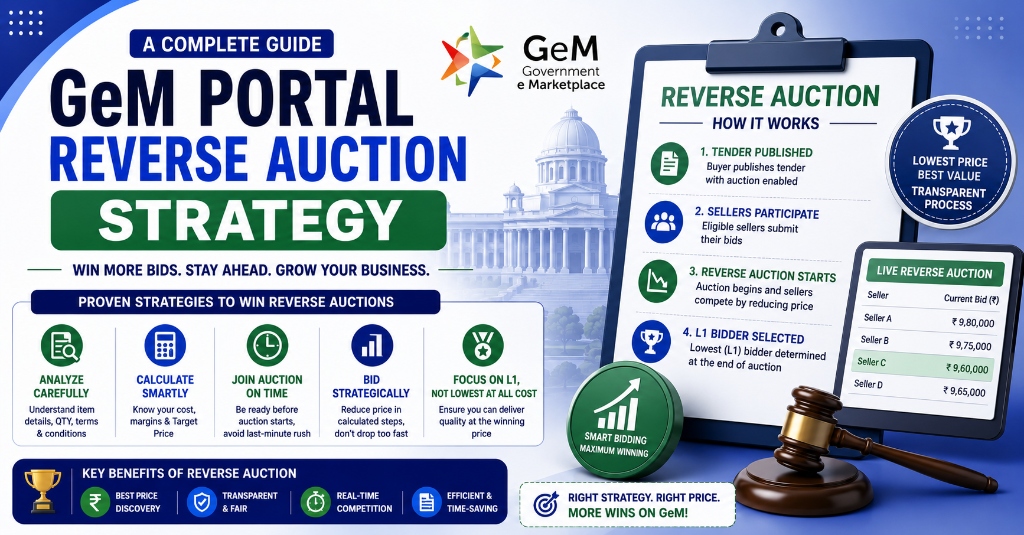
What Is a Reverse Auction on GeM?
A Reverse Auction (RA) on the Government e-Marketplace (GeM) is a real-time, competitive price-reduction mechanism where multiple technically qualified sellers simultaneously lower their bids to win a government contract. Unlike a traditional auction where buyers bid prices up, in a reverse auction, sellers bid prices down. To understand foundational rules, refer to our complete GeM portal guide.
Definition Box: GeM Reverse Auction (RA) — An online procurement process on the Government e-Marketplace where technically qualified sellers compete by submitting progressively lower bids within a defined time window. The auction uses a descending-price model with auto-extension rules, minimum decrement requirements, and rank-based visibility. The lowest compliant bid at auction close is declared L1 and awarded the contract (subject to post-auction verification).
When Is RA Used on GeM?
| Procurement Type | RA Applicability | Typical Value Range |
|---|---|---|
| Product Bids | Mandatory when buyer enables RA | ₹5 lakh+ (buyer discretion) |
| Service Bids | Optional, buyer-dependent | ₹5 lakh+ |
| BOQ Bids | Common for multi-item tenders | ₹10 lakh+ |
| Custom Bids | Frequently used | ₹5 lakh+ |
| Direct Purchase | Never | Up to ₹50,000 |
| L1 Purchase | Never | ₹50,000 – ₹10 lakh |
Key Insight: RA is the default for high-value GeM procurements because it delivers the highest cost savings to government buyers. For sellers, it's the most profitable format — if you know the rules.

Get the GeM Success Toolkit
Register, list, bid, and win on GeM without losing a single rupee in deposits or caution money.
- ✓ 150-Point Pre-Submission Checklist (PDF)
- ✓ EMD & BG Format Verification Guide + Excel Checker
- ✓ GST / PAN / TAN Cross-Verification Guide
- ✓ MSME EMD Exemption Claim Letters (4 Formats)
🔒 256-Bit Secure Razorpay Checkout · Lifetime Access · Instant Digital Delivery
GeM RA Statistics: Why This Format Dominates Government Procurement
Understanding the scale of GeM RA activity is essential for strategic prioritization.
GeM Platform Statistics (FY 2024–25 / As of 2026)
| Metric | Value | Implication for Sellers |
|---|---|---|
| Cumulative GMV | ₹14.77+ lakh crore | Massive market opportunity |
| Last FY Order Value | ₹5,43,041 crore | ₹5.43L Cr flowing through GeM annually |
| Last FY Order Volume | 72,37,489 orders | High transaction frequency |
| Current FY Order Value (ongoing) | ₹3,55,831 crore | Strong momentum continuing |
| MSE Order Value Share | 44.72% | Nearly half of all procurement goes to MSEs |
| Registered Sellers | 22.5+ lakh | High competition but MSME filters help |
| Product Categories | 10,730+ | Diverse opportunity spectrum |
| Service Categories | 350+ | Growing services market |
| Primary Buyers | 1,67,961 | Massive buyer base |
| Secondary Buyers | 2,42,249 | Expanding procurement ecosystem |
Source: GeM Official Statistics Portal (gem.gov.in/statistics), data as of 2025–2026.
Why RA Matters More Than Ever
- State procurement grew 38.3% in FY 2025–26, with Uttar Pradesh, Gujarat, and Maharashtra leading.
- GeM 5.0 introduced AI-driven vendor ranking, making RA outcomes more predictable for prepared sellers.
- The SAHAYAK programme is training thousands of sellers, but only those with systematic RA strategies will win consistently.
- With 89% of global procurement teams projected to adopt generative AI by 2025, GeM's AI-powered compliance checks mean documentation errors are caught instantly — preparation is everything.
How GeM Reverse Auction Works: The Complete Mechanics
Understanding the RA lifecycle is the foundation of winning strategy. Here's the exact process from bid creation to contract award.
Stage 1: Bid Creation by Buyer
- Buyer creates a bid on GeM with product/service specifications, quantity, delivery terms, and eligibility criteria.
- Buyer selects RA as the bidding method (mandatory for bids above certain thresholds, optional below).
- Buyer configures RA parameters:
- RA Entry Criteria: 50% rule OR H1 elimination
- Minimum Decrement: Percentage or absolute value
- RA Duration: Typically 30 minutes to 2 hours
- Auto-Extension: Enabled by default (15-minute rule)
Stage 2: Technical Bid Submission
- Sellers submit technical bids during the bid submission window.
- Technical bids include: compliance documents, certifications, experience certificates, technical brochures.
- Buyer evaluates technical bids and declares technically qualified sellers.
Stage 3: RA Entry Determination
Based on the buyer-selected criteria:
| Criteria | Rule | Example |
|---|---|---|
| 50% Rule | Lowest-priced 50% of technically qualified sellers enter RA | 7 qualified → L1 to L4 enter RA |
| H1 Elimination | Highest bidder (H1) eliminated; rest enter RA | 4 qualified → H1 eliminated; L1-L3 enter RA |
Critical: If only 2 or 3 sellers qualify technically, no elimination applies — all proceed to RA.
Stage 4: RA Invitation & Scheduling
- GeM schedules the RA (must commence at least 24 hours after bid initiation per September 2025 update).
- Shortlisted sellers receive email/SMS/dashboard notifications.
- Sellers receive RA parameters: start time, duration, minimum decrement, starting price (current L1).
Stage 5: Live Reverse Auction
- Sellers log into GeM at scheduled time.
- System displays: current L1 price, your rank (L1/L2/L3), time remaining.
- Sellers submit progressively lower bids.
- Each bid must be lower than current L1 by at least the minimum decrement.
- Auto-extension triggers if bid placed in final 15 minutes.
- Auction closes when time expires with no bids in the final 15-minute window.
Stage 6: Auction Close & L1 Declaration
- Lowest bid at close is declared L1.
- For MSMEs within L1+15% band: Price Match Accept notifications sent.
- Buyer verifies L1 documentation.
- Contract awarded to L1 (or matched MSMEs per quantity split rules).
Instant Tender Eligibility & Risk Audit
Upload any 500-page NIT / BOQ PDF. Extract hidden disqualification traps, EMD waiver clauses, and complete eligibility criteria in under 45 seconds.
RA Entry Criteria: 50% Rule vs. H1 Elimination
Your initial bid price determines whether you even get into the RA. This is where most sellers lose before the auction begins.
Criteria 1: 50% of Technically Qualified Sellers
Rule: Only the lowest-priced 50% (rounded up) of all technically qualified bidders enter the RA.
| Technically Qualified | Enter RA | Eliminated |
|---|---|---|
| 2 | 2 (no elimination) | 0 |
| 3 | 2 (L1, L2) | 1 (H1) |
| 4 | 2 (L1, L2) | 2 (H1, H2) |
| 5 | 3 (L1, L2, L3) | 2 (H1, H2) |
| 6 | 3 (L1, L2, L3) | 3 (H1, H2, H3) |
| 7 | 4 (L1–L4) | 3 (H1–H3) |
| 8 | 4 (L1–L4) | 4 (H1–H4) |
Strategic Implication: Your initial bid must be competitive enough to place you in the bottom 50%. If you quote too high in the technical stage, you're eliminated before RA even begins.
Criteria 2: H1 Elimination
Rule: The highest-quoting technically qualified seller (H1) is eliminated. All remaining sellers enter RA.
| Technically Qualified | Enter RA | Eliminated |
|---|---|---|
| 2 | 2 (no elimination) | 0 |
| 3 | 2 (L1, L2) | 1 (H1) |
| 4 | 3 (L1, L2, L3) | 1 (H1) |
| 5 | 4 (L1–L4) | 1 (H1) |
Strategic Implication: Less aggressive than the 50% rule. You only need to avoid being the single highest bidder.
Minimum Sellers Requirement for H1 Elimination
Per GeM Buyer FAQs:
- Minimum 3 sellers must be technically qualified.
- Minimum 2 OEMs must remain after H1 elimination.
- If fewer than 3 qualify technically → no elimination; all proceed to RA.
MSME Protection in RA Entry
Critical Rule: If the L1 bidder is a non-MSE, MSE sellers are NOT subject to H1 elimination and retain RA access as long as their price falls within the specified band.
This means an MSME can be H1 (highest bidder) and still enter the RA if L1 is a large non-MSME competitor.
The 15-Minute Auto-Extension Rule (Competitors Get This Wrong)
This is the single most misunderstood rule in GeM RA — and getting it wrong costs sellers contracts.
The Correct Rule
"If a Seller participates in the last 15 minutes of RA end time, the system will auto extend RA by 15 minutes. The number of extensions will be Unlimited times." — GeM Buyer FAQs (gem.gov.in/userFaqs)
Key Facts:
- Trigger Window: Final 15 minutes (not 5 minutes).
- Extension Duration: 15 minutes added to the clock.
- Unlimited Extensions: Can happen infinite times until no bid is placed in a 15-minute window.
- Practical Impact: A 30-minute auction can easily extend to 2+ hours if competition is active.
What Competitors Say vs. Reality
| Source | What They Claim | The Truth |
|---|---|---|
| TenderDekho | "Final five minutes… extends by five minutes" | ❌ Wrong. It's 15 minutes. |
| TenderShark | "Bid at last moment… system will automatically extend" | ⚠️ Vague, implies short extension |
| TenderBook | "Final 15 minutes… extends by 15 minutes" | ✅ Correct |
| Tender18 | No specific timing mentioned | ⚠️ Missing critical detail |
Why This Matters: If you plan for a 5-minute extension and the auction runs for 90 minutes, you'll exhaust your mental stamina, miss your floor price discipline, or log out prematurely.
Auto-Extension Strategy
| Auction Phase | Time Remaining | Your Action |
|---|---|---|
| Early Phase | >30 minutes | Test the system with one bid. Confirm your rank. |
| Mid Phase | 15–30 minutes | Monitor competitor activity. Make small decrements if needed. |
| Extension Zone | <15 minutes | Hold your final bid. Do NOT bid early in this zone. |
| Active Extension | 0–15 min into extension | Wait. Let competitors exhaust themselves. |
| Final Push | Last 2 minutes of any extension | Place your floor-price bid if you're not L1. |
Golden Rule: Never place a bid in the first 10 minutes of an auto-extension. Wait until the final 2–3 minutes of each extension cycle. This minimizes counter-bids and preserves your margin.
Floor Price Calculation: The Pre-Auction Foundation
Your floor price is the absolute minimum at which you can execute the contract profitably. Bidding below this is not "aggressive strategy" — it's business suicide.
The Floor Price Formula
FLOOR PRICE =
    Cost of Goods/Services (COGS)
    + Logistics & Delivery Costs
    + Packaging Costs
    + GST (if bid is inclusive)
    + Warranty/AMC Provision
    + GeM Transaction Fee (0.5%–1% depending on category)
    + Payment Delay Provision (2–3% for government delays)
    + Minimum Acceptable Margin (10–15%)
Detailed Floor Price Calculator
Example: Supply of 500 Office Chairs to a Central Ministry
| Cost Component | Calculation | Amount (₹) |
|---|---|---|
| COGS (manufacturing cost per chair × 500) | ₹3,200 × 500 | 16,00,000 |
| Logistics (freight to Delhi + unloading) | 45,000 | |
| Packaging (corrugated boxes + bubble wrap) | ₹150 × 500 | 75,000 |
| GST (18%) | On total value | 3,10,500 |
| Warranty Provision (2-year spare parts) | 2% of COGS | 32,000 |
| GeM Transaction Fee (0.5% on order value) | 10,000 | |
| Payment Delay Provision (30-day delay buffer) | 2% | 40,000 |
| Subtotal (Break-Even) | 20,12,500 | |
| Minimum Margin (12%) | On subtotal | 2,41,500 |
| FLOOR PRICE | ₹22,54,000 | |
| Per Unit Floor Price | ₹22,54,000 ÷ 500 | ₹4,508 |
Your initial bid might be ₹5,200/chair. Your floor is ₹4,508/chair. You have ₹692/chair (15.3%) of bidding room.
Floor Price Template (Copy for Every Bid)
BID ID: _________________
PRODUCT: _________________
QUANTITY: _________________

COST BREAKDOWN:
□ COGS: ₹___________
□ Logistics: ₹___________
□ Packaging: ₹___________
□ GST: ₹___________
□ Warranty/AMC: ₹___________
□ GeM Fee: ₹___________
□ Delay Provision: ₹___________
□ Other: ₹___________

BREAK-EVEN: ₹___________
MINIMUM MARGIN (%): ___%
MINIMUM MARGIN (₹): ₹___________

FLOOR PRICE: ₹___________
PER UNIT FLOOR: ₹___________

INITIAL BID: ₹___________
BIDDING ROOM: ₹___________ (%)

I WILL NOT BID BELOW: ₹___________

Signature: _____________ Date: _____________
Pre-Auction Preparation: The 24-Hour Mandatory Window
Since September 2025, GeM mandates that all reverse auctions must commence at least 24 hours after bid initiation. This creates a mandatory preparation window that separates winners from losers.
The 24-Hour Preparation Checklist
Hour 0–2: Documentation Verification
- All technical documents uploaded and verified.
- Udyam certificate linked to this specific bid.
- OEM authorization current (if applicable).
- GST, PAN, bank details match bid requirements.
- DSC (Digital Signature Certificate) valid and working.
Hour 2–4: Competitor Intelligence
- Check how many sellers have bid so far.
- Review buyer's past purchase history on GeM.
- Analyze past RA outcomes for similar products (if available).
- Identify likely competitors and their pricing patterns.
Hour 4–8: Floor Price Calculation
- Complete detailed cost breakdown (use template above).
- Verify GST applicability (inclusive vs. exclusive).
- Factor in delivery location costs.
- Add contingency for payment delays.
- Set absolute floor price in writing.
Hour 8–12: Strategy Simulation
- Model 3 scenarios: (a) You're L1 entering RA, (b) You're L2, (c) You're L3+.
- Plan decrement sizes for each scenario.
- Identify your "walk-away" trigger (e.g., "If price drops below ₹X, I stop").
- Set calendar reminders for RA start time.
Hour 12–24: Physical & Mental Prep
- Ensure stable internet (primary + backup: mobile hotspot).
- Test GeM login and DSC functionality.
- Clear calendar during RA window + 2 hours buffer.
- Inform team members of RA timing for support.
- Get adequate rest — RA requires sharp mental focus.
Live Auction Strategy: Timing, Decrements & Competitor Psychology
The live auction is where strategy meets execution. Here's how top-performing sellers navigate the pressure.
The Descending Price Model
GeM uses a strict descending price model:
- Every new bid must be lower than current L1.
- Must meet the minimum decrement (percentage or absolute value set by buyer).
- Bids that don't meet the decrement are automatically rejected.
- No bid increases allowed.
Minimum Decrement Examples
| Current L1 | Min Decrement (1%) | Your Next Valid Bid Must Be ≤ |
|---|---|---|
| ₹10,00,000 | ₹10,000 | ₹9,90,000 |
| ₹50,00,000 | ₹50,000 | ₹49,50,000 |
| ₹1,00,00,000 | ₹1,00,000 | ₹99,00,000 |
Strategy: Calculate your decrement steps in advance. Don't waste time calculating during the auction.
Bid Timing Strategy: The Three-Phase Approach
Phase 1: Opening (First 10 Minutes)
Objective: Establish presence, test system, gauge competition.
| Your Position | Action |
|---|---|
| You're L1 entering RA | Place one token bid 1% below your initial. Confirm rank. Then STOP. |
| You're L2/L3 | Place one bid to move up one rank. Assess competitor response speed. |
Don't: Burn your bidding room early. The opening phase is for intelligence, not victory.
Phase 2: Middle (10 Minutes to Final 15 Minutes)
Objective: Maintain competitive position without hitting floor price.
| Scenario | Action |
|---|---|
| No bids for 5+ minutes | L1 may be near floor. Small decrement (0.5%) to test. |
| Rapid bidding every minute | Active price war. Hold back. Let competitors burn margin. |
| You're L1 and being chased | Small decrements (₹1–5 per unit) to maintain position. |
| You're L3+ and far behind | Calculate if reaching L1 is possible above floor. If not, hold for MSME band. |
Phase 3: The Extension Zone (Final 15 Minutes & Beyond)
Objective: Execute your final reserved bid at the optimal moment.
The Golden Sequence:
- Wait. Do NOT bid in the first 12 minutes of the extension zone.
- Monitor. Watch if competitors are actively bidding or holding.
- At 2–3 minutes remaining: If you're not L1 and still above floor, place your final bid.
- If auto-extension triggers: Wait again. Repeat the sequence.
- Final bid placement: Only bid in the last 60–90 seconds of any extension cycle.
Why this works: Bidding early in the extension zone triggers competitor counter-bids. Bidding late gives them no time to respond before the next extension (if any) or close.
Competitor Psychology: Reading the Rank Signal
GeM shows your rank (L1, L2, L3) but NOT the actual rupee amounts of competitors. This limited information is your only live intelligence.
| Signal | What It Means | Your Response |
|---|---|---|
| You're L1, no new bids for 4+ min | Competitors may be at/near floor | Hold. Don't lower unnecessarily. |
| You're L2, L1 hasn't moved for 3 min | L1 is likely holding at floor | One small decrement may take L1. |
| Rapid L1 changes every 30 seconds | Active price war between 2+ bidders | Stay out. Let them exhaust each other. |
| You're L3+, L1 drops by large decrement | Aggressive competitor with deep pockets | Assess if matching is viable. If not, hold for MSME band. |
| Auction extends 3+ times | High competition, no one at floor yet | Pace yourself. This is a marathon, not a sprint. |
The "Odd Number" Tactic
Never bid at round numbers (₹10,00,000; ₹9,50,000). Competitors anchor to round numbers. Instead:
- Bid at ₹9,98,750 instead of ₹10,00,000.
- Bid at ₹4,99,100 instead of ₹5,00,000.
This creates psychological friction — competitors can't easily calculate their next decrement against an odd number under pressure.
MSME Price Band Advantage: Win Without Being L1
This is the most underutilized advantage in GeM RA. Most MSMEs don't even know it exists.
The 15% Price Band Rule
Under the Public Procurement Policy for MSEs (MSME Ministry):
If the L1 bidder is a non-MSE, any MSE seller quoting within L1 + 15% is given the opportunity to match the L1 price and secure at least 25% of the tendered quantity.
How It Works:
- RA concludes. L1 is a non-MSME (e.g., large corporate) at ₹10,00,000.
- You're an MSME who quoted ₹11,20,000 (12% above L1 — within the 15% band).
- GeM sends you a "Price Match Accept" notification.
- If you accept and match ₹10,00,000, you win 25–100% of the order quantity.
- Up to 5 MSMEs within the band can receive split orders.
Price Band Calculation
Maximum MSME Price for Preference = L1 Price × 1.15

Example:
L1 (non-MSME) = ₹10,00,000
MSME Band = ₹10,00,000 to ₹11,50,000

If you quoted ₹11,00,000 → Within band → Eligible for Price Match
If you quoted ₹11,60,000 → Outside band → Not eligible
MSME Protection in H1 Elimination
If the current L1 bidder is a non-MSE, MSME sellers are exempt from H1 elimination regardless of their rank. This means:
- You can be the highest bidder (H1) among all sellers.
- If L1 is a non-MSME, you still enter the RA.
- This protection does NOT apply if L1 is also an MSME.
MSME Checklist for RA
- Udyam Registration active and uploaded to GeM profile.
- MSE category selected at time of bid submission (not just in profile).
- Manufacturer status confirmed (traders excluded from EMD exemption for goods).
- Floor price pre-calculated to decide instantly on Price Match Accept.
- EMD exemption claimed (saves 1–2% of tender value per bid).
- Price Match Accept response plan — know your answer before the notification arrives.
Make in India + MSME: The Dual Advantage in RA
The most powerful position in GeM procurement is being both an MSME and a Class-I Local Supplier under the Make in India policy.
Concurrent Benefits
| Benefit | Make in India (PPP-MII) | MSME Policy | Combined Impact |
|---|---|---|---|
| Price Preference | 20% margin to match L1 | 15% margin to match L1 | Use whichever is larger |
| Quantity Reservation | Up to 50% for Class-I | 25% for MSEs | Potential 50%+ allocation |
| EMD Exemption | Standard rules | Full exemption | Zero blocked capital |
| Turnover Relaxation | As per tender | 50% relaxation | Easier eligibility |
| RA Entry Protection | None specific | H1 elimination exemption if L1 is non-MSE | Guaranteed RA access |
How Dual Status Works in RA
Scenario: A tender for 1,000 laptops worth ₹50 lakh.
| Bidder | Quote | MSME? | Class-I Local? | Outcome |
|---|---|---|---|---|
| M/s. Dell India | ₹48,00,000 | No | No | L1, but non-local — may be excluded if nodal ministry notified |
| M/s. Bharat Laptops (MSE) | ₹52,00,000 | Yes | Yes | Within 20% MII margin → Can match L1 at ₹48L |
| M/s. TechWorld (Large) | ₹49,50,000 | No | Yes | Within 20% margin → Can match L1 |
| M/s. SmallPC (MSE) | ₹53,00,000 | Yes | No | Within 15% MSME band → Can match L1 at ₹48L |
Result: M/s. Bharat Laptops (dual status) has the most flexibility — they can match under either the 20% Make in India margin or the 15% MSME band, whichever is more advantageous.
Post-RA Tactics: Price Match Accept, Negotiation & Documentation
Winning the RA is only half the battle. Post-auction execution determines whether you actually get the contract.
Price Match Accept (For MSMEs)
- Notification arrives within 24–48 hours of RA close.
- You have limited time to accept (typically 24–72 hours).
- Decision matrix:
| Your Floor Price | L1 Price | Decision |
|---|---|---|
| ₹10,00,000 | ₹10,50,000 | ❌ Decline — below floor |
| ₹10,00,000 | ₹10,00,000 | ✅ Accept — at floor, margin is zero but you get the contract |
| ₹10,00,000 | ₹9,80,000 | ⚠️ Accept only if strategic value (relationship, future orders) justifies loss |
- If you accept: GeM generates the purchase order at the matched L1 price.
- If you decline: The offer passes to the next MSME in the band.
Post-RA Documentation
Within 24–48 hours of RA close or Price Match Accept:
- Upload all compliance documents (if not pre-uploaded).
- Confirm delivery timeline acceptance.
- Verify consignee details and delivery address.
- Check for any ATC (Additional Terms & Conditions) amendments.
- Accept the order on GeM dashboard within stipulated time.
Failure to respond in time = automatic cancellation + potential blacklisting.
Post-RA Negotiation (Rare but Possible)
In some cases, buyers may initiate post-RA negotiation if:
- L1 price is significantly below market rate (suspicion of unsustainable bidding).
- Delivery terms need clarification.
- Technical specifications require minor adjustment.
Your position: Be prepared to justify your pricing with cost breakdowns. If you bid at floor price, explain your efficiency, not your desperation.
Common RA Mistakes That Cost Sellers Crores
❌ Mistake 1: No Floor Price Calculated
The Error: Entering the RA without knowing your absolute minimum price.
The Consequence: Winner's Curse — you win the contract but lose money executing it.
The Fix: Use the Floor Price Calculator (provided above). Print it. Tape it to your monitor during the RA.
❌ Mistake 2: Bidding Early in the Extension Zone
The Error: Placing a bid at 14 minutes remaining, triggering a 15-minute extension, then watching competitors undercut you.
The Consequence: You burn margin unnecessarily and extend the auction for everyone.
The Fix: Wait until the final 2–3 minutes of ANY extension cycle before bidding.
❌ Mistake 3: Ignoring the 50% Entry Rule
The Error: Quoting too high in the technical bid, thinking "I'll lower it in RA."
The Consequence: You're eliminated before RA begins. No chance to compete.
The Fix: Your technical bid price must place you in the bottom 50% (or avoid H1).
❌ Mistake 4: Missing Price Match Accept
The Error: Not checking GeM dashboard for 48 hours after RA close.
The Consequence: Price Match Accept notification expires. You lose a contract you could have won.
The Fix: Set a calendar reminder for +24 hours and +48 hours after every RA.
❌ Mistake 5: Underestimating Payment Delays
The Error: Not factoring government payment delays into floor price.
The Consequence: Working capital crunch. You delivered goods but can't pay suppliers.
The Fix: Add 2–3% "payment delay provision" to your floor price calculation.
❌ Mistake 6: Bidding on Too Many Categories
The Error: Spreading thin across 15+ product categories.
The Consequence: Low preparation quality per bid. 34% lower win rate (TenderDekho data).
The Fix: Focus on 3–5 closely related categories. Deep expertise beats broad mediocrity.
❌ Mistake 7: Technical Disqualification
The Error: Focusing entirely on price strategy while neglecting technical compliance.
The Consequence: Disqualified at technical stage — all price preparation wasted.
The Fix: Complete technical compliance matrix before touching price strategy.
Advanced RA Tactics: Proxy Bidding, Decrement Manipulation & Bluffing
Tactic 1: The "Anchor Drop"
How it works: In the opening phase, place a bid significantly lower than your initial technical bid (but still above floor). This sets a low anchor for competitors.
Risk: If competitors match or beat your anchor, you've burned margin early.
Best used when: You have genuine cost advantages competitors can't match.
Tactic 2: The "Ghost Bidder" Bluff
How it works: Place a bid at an odd, aggressive number early. Competitors may assume you have deep cost advantages and stop competing.
Risk: If they call your bluff, you're stuck at a low price.
Best used when: Market intelligence suggests competitors are near their floors.
Tactic 3: The "Wait-and-Pounce"
How it works: Don't bid for the first 20 minutes. Let competitors establish a price range. Then place one well-calculated bid near your floor in the final minutes.
Risk: You might miss the RA entirely if you forget to log in.
Best used when: You have a clear floor price and want to minimize bidding rounds.
Tactic 4: The "Extension Exhaustion"
How it works: If you know a competitor has limited time (e.g., they have another RA scheduled), trigger multiple extensions early to exhaust their attention.
Risk: You exhaust yourself too.
Best used when: You have dedicated team support and the competitor is a one-person operation.
Tactic 5: The "MSME Band Trap"
How it works: As an MSME, deliberately quote at L1 + 14% in the technical bid. Let a non-MSME win L1 in RA. Then accept Price Match Accept at L1 price — which is above your floor.
Result: You win without ever entering the live RA, preserving margin and mental energy.
Case Study: How a Delhi Trader Turned ₹12L Loss Into ₹3.8 Cr Profit
Company: Nav Bharat Office Solutions, Delhi (Udyam-registered MSME) Sector: Office Furniture & Equipment Challenge: Lost ₹12 lakh in FY 2023–24 by winning 3 RA contracts at below-floor prices.
The Problem
Nav Bharat was bidding aggressively on every furniture RA they saw. Their logic: "Win first, figure out margins later." They won 8 RAs but lost money on 3 major ones:
| Contract | Value | Actual Cost | Loss |
|---|---|---|---|
| Ministry of Defence chairs | ₹28 lakh | ₹31 lakh | ₹3 lakh |
| PSU Delhi desks | ₹45 lakh | ₹51 lakh | ₹6 lakh |
| Railway station benches | ₹18 lakh | ₹21 lakh | ₹3 lakh |
| Total Loss | ₹12 lakh |
The Transformation
Month 1: Systematic Floor Pricing
- Created a standardized cost calculator for every product category.
- Added 15% minimum margin + 3% payment delay provision.
- Printed floor price and taped it to the bidding desk.
Month 2: Category Focus
- Dropped from 12 categories to 4: office chairs, desks, filing cabinets, conference tables.
- Deepened supplier relationships for better COGS.
Month 3: RA Intelligence System
- Built a simple tracker: buyer name, past L1 prices, competitor names, RA frequency.
- Identified 6 "sweet spot" buyers who paid fair L1 prices.
Month 4: MSME Band Strategy
- Started quoting at L1 + 12–14% in technical bids for high-competition RAs.
- Let non-MSMEs fight in RA. Accepted Price Match Accept when L1 was acceptable.
The Results (FY 2024–25)
| Metric | Before | After |
|---|---|---|
| RA Contracts Won | 8 | 14 |
| Win Rate | 12% | 31% |
| Average Margin | -5% | 14% |
| Total Revenue | ₹1.2 Cr | ₹3.8 Cr |
| Profit/Loss | ₹12L Loss | ₹53L Profit |
| Bids Placed | 67 | 45 |
Key Lessons
- Floor price discipline is non-negotiable. Every bid below floor is a loan you give to the government — and they never pay it back.
- Category focus beats volume. 45 focused bids won more than 67 scattered bids.
- MSME band is a superpower. 6 of their 14 wins came from Price Match Accept, not live RA.
- Intelligence beats instinct. Knowing a buyer's past L1 range is worth more than gut feeling.
"We went from being the cheapest bidder to being the smartest bidder. The difference is ₹65 lakh in profit." — Mr. Pradeep Kumar, Proprietor, Nav Bharat Office Solutions
GeM RA vs. L1 Bidding vs. BOQ Bidding: Comparison
| Parameter | L1 Bidding | Reverse Auction (RA) | BOQ Bidding |
|---|---|---|---|
| Competition Type | Static — one-time quote | Dynamic — live price war | Static — item-wise quotes |
| Price Visibility | None after submission | Real-time rank (L1/L2/L3) | None after submission |
| Time Pressure | Low — deadline-based | High — live clock | Medium — deadline-based |
| Strategy Complexity | Low | High | Medium |
| Margin Control | Fixed at submission | Adjustable during auction | Fixed at submission |
| MSME Advantage | 15% band post-bid | 15% band + H1 protection | 15% band post-bid |
| Best For | Standard products, low competition | High-value, multi-seller | Multi-item, complex specs |
| Risk Level | Low | High (Winner's Curse) | Medium |
| Skill Required | Basic | Advanced | Intermediate |
| GeM Fee | Standard | Standard | Standard |
Frequently Asked Questions (FAQ)
Q1. What is the minimum number of sellers required for a GeM Reverse Auction?
A: For H1 elimination to apply, a minimum of 3 sellers must be technically qualified, with at least 2 OEMs remaining after elimination. If fewer than 3 qualify, no elimination applies and all proceed to RA.
Q2. How long does a GeM Reverse Auction last?
A: The scheduled duration is typically 30 minutes to 2 hours, but due to the 15-minute auto-extension rule (unlimited extensions), auctions can extend to 3+ hours if competition is active.
Q3. Can I increase my bid during a reverse auction?
A: No. GeM uses a strict descending price model. Once you bid a price, you can only bid lower. You cannot increase your bid or withdraw a bid during the live auction.
Q4. What is the minimum decrement in GeM RA?
A: The minimum decrement is set by the buyer and published in the bid document. Common values range from 0.5% to 2% of the current L1 price. Bids that don't meet the minimum decrement are automatically rejected.
Q5. Can an MSME win without being the lowest bidder in RA?
A: Yes. If the L1 bidder is a non-MSE, MSMEs quoting within L1 + 15% receive a Price Match Accept notification. If they match L1, they win at least 25% of the quantity. Up to 5 MSMEs can receive split orders.
Q6. What happens if I miss the live RA?
A: If you don't log in during the RA window, you cannot participate. Your last technical bid price stands as your final offer. If you were already L1 entering RA, you might still win if no one undercuts you.
Q7. Is proxy bidding allowed in GeM RA?
A: Proxy bidding is not allowed unless specifically enabled by the system for a particular bid. All bids must be placed manually by the seller during the live auction.
Q8. Can a buyer reject the L1 bid after RA?
A: Yes. The buyer can reject the L1 bid if:
- The price is unrealistically low (suspicion of unsustainable bidding).
- The seller fails post-auction documentation verification.
- The seller has a history of non-performance.
- The buyer exercises the right to not accept any offer (rare but possible).
Q9. How do I find the minimum decrement for a specific RA?
A: Log into your GeM seller account, open the relevant bid, and check the "Reverse Auction Parameters" section. The minimum decrement (percentage or absolute value) is published there before the auction begins.
Q10. What should I do if my internet disconnects during RA?
A:
- Don't panic. Your last valid bid remains in the system.
- Reconnect immediately using a backup connection (mobile hotspot).
- Log back into GeM and re-enter the RA.
- Check your current rank and assess if you need to bid again.
- Prevention: Always have a backup internet connection ready before the RA starts.
Conclusion & 14-Day RA Mastery Plan
GeM Reverse Auction is not a lottery — it's a skill-based competition where preparation, discipline, and strategy consistently outperform luck and aggression. The sellers who win are not the ones who bid the lowest; they're the ones who know exactly how low they can go and stop there.
The data is overwhelming: with ₹5.43 lakh crore flowing through GeM and 44.72% of that value going to MSEs, the opportunity is massive. But the Winner's Curse is real — thousands of sellers have won contracts that bankrupted them because they didn't calculate their floor price.
Your competitive advantage is not your price. It's your process.
14-Day RA Mastery Plan
| Day | Action |
|---|---|
| Day 1 | Audit your last 10 bids. Calculate how many were below your actual floor price. |
| Day 2 | Create the Floor Price Calculator template for your top 3 product categories. |
| Day 3 | Review your Udyam registration. Ensure it's active and correctly linked to GeM. |
| Day 4 | Set up TenderFlow Pro alerts for RAs in your focused categories. |
| Day 5 | Study 5 past RAs in your category. Note L1 prices, number of bidders, duration. |
| Day 6 | Practice bidding on a low-value RA (₹5–10 lakh) to test your system and nerves. |
| Day 7 | Analyze your practice RA. What did you do right? What would you change? |
| Day 8 | Build your "RA War Room" — dual internet, printed floor price, water, timer. |
| Day 9 | Identify 3 active RAs worth bidding on. Complete technical compliance for each. |
| Day 10 | Calculate floor prices for all 3. Get a second opinion from your accountant. |
| Day 11 | Submit technical bids. Ensure MSE category is selected. |
| Day 12 | Pre-Auction Prep Day. Review RA parameters. Simulate scenarios. Rest. |
| Day 13 | Execute your first disciplined RA using the Three-Phase strategy. |
| Day 14 | Review results. Document lessons. Refine your process for the next RA. |
Related Articles
- Make in India Preference Policy: Complete DPIIT PPP-MII Guide
- Proprietary Article Certificate (PAC): GFR 166 Complete Guide
- Limited Tender Enquiry (LTE): Rules, Eligibility & Supplier Registration
- Corrigendum in Tenders: How to Track Changes & Protect Your Bid
- GeM Portal Bidding: The Complete MSME Guide 2026
Disclaimer: This article is for informational purposes only. GeM rules and procedures are subject to change. Always verify current guidelines on gem.gov.in before bidding. TenderFlow Pro is not affiliated with the Government e-Marketplace or any government department.
© 2026 TenderFlow Pro. All rights reserved.