Make in India Preference Policy in Government Tenders: The Definitive DPIIT PPP-MII Guide (2024–2026)
Last Updated: July 18, 2026 | Reading Time: 22 minutes | Author: TenderFlow Pro Procurement Intelligence Team For the comprehensive end-to-end framework, consult our how to bid for government tenders in India. (See also: DPIIT Startup Zero-Experience Tender Benefits). (See also: Tender Pricing Strategy to Win L1 Profitably).
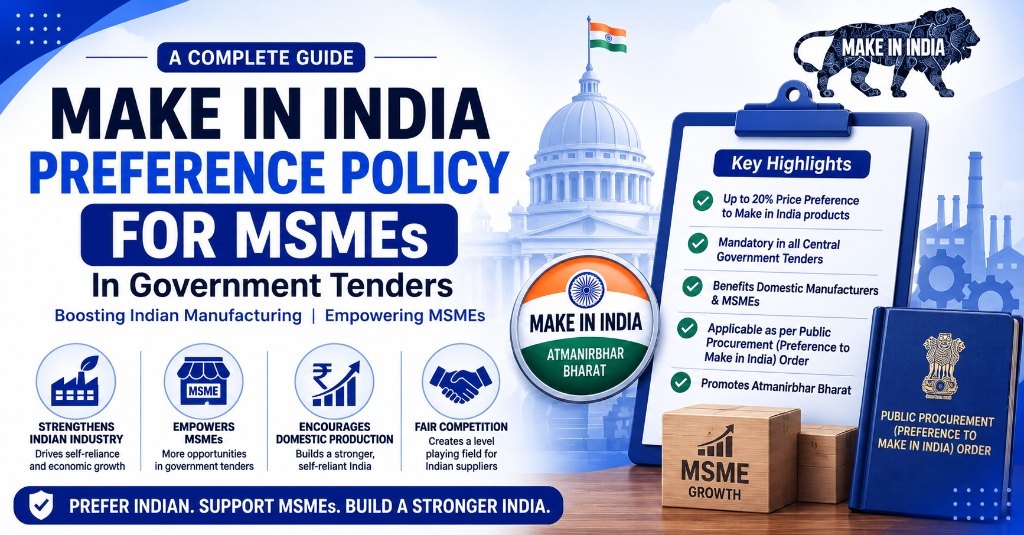
Quick Answer: The Public Procurement (Preference to Make in India) Order 2017 — revised by DPIIT on 19 July 2024 — mandates that all central government procurements above ₹5 lakh (₹50 lakh for scientific institutions) give purchase preference to Class-I local suppliers (≥50% local content). Class-I suppliers can match L1 prices within a 20% margin and secure up to 50% of the contract quantity. In 2024, DPIIT flagged 259 tenders as non-compliant with PPP-MII norms out of 867 scrutinized — a 29.8% non-compliance rate.
menu_book Table of Contents
What Is the Make in India Preference Policy?
The Make in India Preference Policy is India's flagship procurement framework designed to promote domestic manufacturing, enhance local value addition, and reduce import dependence in government purchases. Enacted through the Public Procurement (Preference to Make in India) Order, 2017 (PPP-MII Order), it mandates that all central government ministries, departments, PSUs, and autonomous bodies prioritize locally manufactured goods and services in their procurement decisions. To understand foundational rules, refer to our MSME benefits in government tenders.
Definition Box: Public Procurement (Preference to Make in India) Order, 2017 — A statutory order issued by the Department for Promotion of Industry and Internal Trade (DPIIT) under Rule 153(iii) of GFR 2017, mandating purchase preference for suppliers meeting prescribed local content thresholds in all government procurements exceeding specified exemption limits.
Why This Policy Matters in 2026
- GeM cumulative GMV crossed ₹14.77 lakh crore by July 2025, with domestic supplier registrations growing 40%+ year-on-year.
- MSEs captured 37.87% of total GeM order value in FY 2024–25, surpassing the 25% statutory mandate.
- DPIIT scrutinized 3,103 tenders worth ₹1,61,839 crore for PPP-MII compliance, finding 1,366 non-compliant.
- The policy is a cornerstone of Atmanirbhar Bharat (Self-Reliant India) and directly impacts ₹5+ lakh crore in annual government procurement.

Get the MSME Advantage Toolkit
Claim every statutory exemption, track document renewals, and enforce price preferences.
- ✓ 150-Point Pre-Submission Checklist (PDF)
- ✓ Document Expiry & Renewal Tracker (Excel)
- ✓ GST / PAN / TAN Cross-Verification Guide
- ✓ MSME EMD Exemption Claim Kit (4 Letters)
🔒 256-Bit Secure Razorpay Checkout · Lifetime Access · Instant Digital Delivery
DPIIT PPP-MII Order 2017: The Legal Foundation
The PPP-MII Order was first issued on 15 June 2017 by the erstwhile Department of Industrial Policy and Promotion (DIPP). It has since been revised multiple times:
| Revision Date | Key Changes |
|---|---|
| 15.06.2017 | Original Order issued |
| 28.05.2018 | First revision — clarified definitions and applicability |
| 29.05.2019 | Second revision — enhanced local content requirements |
| 04.06.2020 | Third revision — introduced self-certification and auditor verification |
| 16.09.2020 | Fourth revision — strengthened nodal ministry framework |
| 19.07.2024 | Fifth revision — comprehensive overhaul (current law) |
Legal Basis
The Order is issued under Rule 153(iii) of the General Financial Rules (GFR) 2017, which empowers the government to issue orders for preference to domestic suppliers in public procurement.
Applicability
The Order applies to:
- All Central Ministries and Departments
- Attached and subordinate offices
- Autonomous bodies controlled by the Government of India
- Government companies (as defined in the Companies Act)
- State governments and local bodies procuring under Central Schemes
Source: DPIIT Order No. P-45021/2/2017-PP(BE-II)-Part(4)Vol.II dated 19.07.2024.
July 2024 Revision: What Changed & Why It Matters
The 19 July 2024 revision is the most significant overhaul of the PPP-MII framework. Here's what changed:
1. Minimum Local Content Requirements (Standardized)
| Supplier Category | Minimum Local Content | Nodal Ministry Can Prescribe Higher? |
|---|---|---|
| Class-I Local Supplier | 50% | Yes (only higher, never lower) |
| Class-II Local Supplier | 20% | Yes (only higher, never lower) |
| Non-Local Supplier | <20% | N/A |
Previous ambiguity resolved: Earlier revisions had varying percentages across sectors. The July 2024 revision establishes a uniform floor: 50% for Class-I and 20% for Class-II, while allowing nodal ministries to prescribe only higher percentages.
2. Margin of Purchase Preference Fixed at 20%
The margin within which Class-I local suppliers can match L1 is now uniformly 20% across all sectors.
3. Exemption Limit Clarified
- Standard exemption: Procurement below ₹5 lakh is exempt from PPP-MII.
- Scientific/Research Institutions: Exemption raised to ₹50 lakh (OM dated 08.07.2025).
- Splitting prohibition: Procurement cannot be split to avoid the Order.
4. Closed Systems Exemption (New)
Paragraph 4A introduces a new exemption:
"Procurement of spare parts, consumables for closed systems and Maintenance/Service contracts with Original Equipment Manufacturer/Original Equipment Supplier/Original Part Manufacturer shall be exempted from this Order."
This protects OEMs supplying proprietary spare parts from being forced to meet local content requirements for non-manufacturable components.
5. JV Provisions for Foreign Companies (Paragraph 13A)
For items where nodal ministries have NOT notified sufficient local capacity, foreign companies must enter into a Joint Venture (JV) with an Indian company for procurements above a threshold value. Such JVs may be exempted from minimum local content requirements initially, with phased increases mandated.
6. PLI Scheme Integration
Manufacturers under the Production Linked Incentive (PLI) scheme who have received incentives are treated as deemed Class-II local suppliers for specified products and periods. This incentivizes new manufacturing investments.
Instant Tender Eligibility & Risk Audit
Upload any 500-page NIT / BOQ PDF. Extract hidden disqualification traps, EMD waiver clauses, and complete eligibility criteria in under 45 seconds.
Class-I vs. Class-II vs. Non-Local Suppliers: The Three Tiers
The PPP-MII Order creates a three-tier supplier classification system that determines bidding eligibility and purchase preference.
Class-I Local Supplier (≥50% Local Content)
Status: Premium tier — eligible for purchase preference.
Benefits:
- Can match L1 price within 20% margin and win contract.
- For divisible contracts: Can receive up to 50% of quantity when L1 is non-Class-I.
- For non-divisible contracts: Entire contract can be awarded if L1 is Class-I.
- In sectors with sufficient local capacity: Only Class-I suppliers may bid (exclusive eligibility).
Requirements:
- Minimum 50% local content (or higher if nodal ministry prescribes).
- Self-certification in Form-1 at time of bidding.
- For contracts > ₹10 crore: Auditor/certified accountant verification required.
Class-II Local Supplier (20%–49% Local Content)
Status: Secondary tier — eligible to bid but NO purchase preference.
Key Rules:
- Can participate in bidding alongside Class-I and non-local suppliers.
- Does NOT get purchase preference in any procurement.
- Useful for companies transitioning to higher local content.
- PLI recipients may be deemed Class-II for specified periods.
Non-Local Supplier (<20% Local Content)
Status: Lowest tier — restricted participation.
Restrictions:
- Can bid only when nodal ministry has NOT notified sufficient local capacity.
- For contracts < ₹200 crore: Global tender enquiries (GTE) are banned unless competent authority approves.
- Cannot claim local value addition from services (transportation, installation, AMC) to inflate local content.
- Imported items sourced locally from resellers/distributors are excluded from local content calculation.
Quick Reference Table
| Parameter | Class-I Local | Class-II Local | Non-Local |
|---|---|---|---|
| Min. Local Content | 50% | 20% | <20% |
| Purchase Preference | ✅ Yes (20% margin) | ❌ No | ❌ No |
| Exclusive Bidding | ✅ In notified sectors | ❌ No | ❌ No |
| GeM Marking | ✅ Class-I filter | ✅ Class-II filter | ❌ No filter |
| Contract > ₹10 Cr | Auditor verification | Auditor verification | Auditor verification |
| PLI Deemed Status | Possible | Yes (specified items) | N/A |
Local Content Calculation: The Exact Formula
Local content is the heart of the PPP-MII Order. Getting the calculation wrong can lead to disqualification, blacklisting, or recovery of payments.
The Formula
Local Content (%) =
    Total Value of Item Procured (excluding net domestic indirect taxes)
    ─────────────────────────────────────────────────────────────────
    Minus Value of Imported Content (including all customs duties)
    ─────────────────────────────────────────────────────────────────
    Divided by Total Value of Item Procured (excluding net domestic indirect taxes)
    ─────────────────────────────────────────────────────────────────
    Multiplied by 100
What Counts as "Local Content"
| Inclusion | Exclusion |
|---|---|
| ✅ Raw materials sourced from India | ❌ Imported raw materials (including CIF + customs duty) |
| ✅ Indian labor wages | ❌ License fees/royalties paid outside India |
| ✅ Indian manufacturing overheads | ❌ Technical charges paid to foreign entities |
| ✅ Indian design and engineering | ❌ Imported items sourced locally from resellers |
| ✅ Domestic indirect taxes (net) | ❌ Repackaged/rebranded/refurbished imported products |
| ✅ Local transportation and insurance | ❌ Value of services (installation, AMC) for imported goods |
Practical Example: Calculating Local Content for a CNC Machine
Scenario: A manufacturer bids to supply a CNC lathe machine to a Central PSU.
| Component | Source | Value (₹) |
|---|---|---|
| Cast iron bed (Indian foundry) | Local | 4,50,000 |
| Servo motors (imported from Japan) | Imported | 3,20,000 |
| Controller (imported from Germany) | Imported | 2,80,000 |
| Indian labor & assembly | Local | 1,50,000 |
| Indian overhead & profit | Local | 2,00,000 |
| Total Value | 14,00,000 |
Calculation:
- Total Value = ₹14,00,000
- Imported Content = ₹3,20,000 + ₹2,80,000 = ₹6,00,000
- Local Content = ₹14,00,000 – ₹6,00,000 = ₹8,00,000
- Local Content % = (8,00,000 / 14,00,000) × 100 = 57.14%
Result: This supplier qualifies as a Class-I Local Supplier (≥50%).
Weighted Average for Multi-Item Contracts
For contracts involving multiple items, a weighted average of all items is taken while calculating local content.
Weighted Average LC% =
    Σ (Item Value × Item LC%)
    ─────────────────────────
    Σ (Item Value)
Critical Exclusion: The Reseller Trap
"Imported items sourced locally from resellers/distributors shall be excluded from calculation of local content."
What this means: If you import a product and sell it through your Indian warehouse, you cannot count the product's value as local content. Only your margin (if any value addition occurs) may count.
Documentation required:
- OEM certificate for country of origin.
- Break-up of license/royalties paid outside India.
- Cost of locally-sourced imported items (inclusive of taxes).
Purchase Preference Mechanics: How Bids Are Awarded
The purchase preference mechanism is where the policy translates into real competitive advantage for domestic manufacturers.
Scenario 1: Divisible Goods/Works (Most Common)
Rule: If L1 is NOT a Class-I local supplier, 50% of the order quantity is awarded to L1, and the remaining 50% is offered to Class-I local suppliers.
Step-by-Step Process:
- All bids opened. L1 identified (lowest responsive bid).
- If L1 is Class-I: Full contract awarded to L1. End of process.
- If L1 is NOT Class-I:
- 50% quantity awarded to L1 at their quoted price.
- Lowest Class-I local supplier invited to match L1 price.
- If their quoted price falls within L1 + 20% margin, they can match L1 and receive the remaining 50%.
- If they decline or cannot match, next Class-I supplier within margin is invited.
- If no Class-I supplier matches, the remaining 50% may also go to L1.
Example:
| Bidder | Quoted Price (₹/unit) | Class | Status |
|---|---|---|---|
| M/s. ChinaTech | 1,00,000 | Non-Local | L1 |
| M/s. BharatMfg | 1,15,000 | Class-I | Within 20% margin |
| M/s. IndoTech | 1,25,000 | Class-I | Within 20% margin |
| M/s. GlobalInc | 1,40,000 | Non-Local | Outside margin |
Award:
- 50% quantity → M/s. ChinaTech at ₹1,00,000/unit
- 50% quantity → M/s. BharatMfg at ₹1,00,000/unit (matched L1)
Scenario 2: Non-Divisible Goods/Works or Services
Rule: If L1 is NOT Class-I, the lowest Class-I local supplier is invited to match L1 price within the 20% margin.
Process:
- L1 identified.
- If L1 is Class-I → Awarded to L1.
- If L1 is NOT Class-I → Lowest Class-I supplier invited to match L1.
- If they match → Entire contract awarded to them.
- If they decline → Next Class-I supplier invited, and so on.
- If no Class-I supplier matches → Contract may be awarded to L1.
Scenario 3: Multiple Bidder Awards (Rate Contracts)
For tenders where contracts are awarded to multiple bidders (e.g., rate contracts, panel contracts):
- If sufficient local capacity is notified → Only Class-I suppliers are eligible.
- In other cases → Class-II and non-local may participate, but Class-I gets preference.
- The objective: Ensure Class-I suppliers collectively receive at least 50% of the tendered quantity.
The "20% Margin" Explained
The margin of purchase preference is the maximum extent to which a Class-I local supplier's quoted price may exceed L1 and still be eligible for preference.
Maximum Acceptable Price for Class-I = L1 Price × 1.20
Example:
- L1 (non-Class-I) quotes: ₹10,00,000
- Maximum Class-I price for preference: ₹10,00,000 × 1.20 = ₹12,00,000
- Any Class-I supplier quoting up to ₹12,00,000 can match L1 and win.
GeM Implementation: Local Content Marking & Automated Comparison
The Government e-Marketplace (GeM) is the primary execution platform for the PPP-MII Order. GeM has integrated Make in India compliance into its core bidding infrastructure.
GeM Local Content Features
Golden Filter for Local Content
- Buyers can filter products by "Make in India" status.
- Class-I and Class-II suppliers are marked with distinct badges.
Automated Comparison
- GeM provides automated comparison with purchase preference and without purchase preference.
- Buyers can see both scenarios before awarding.
Self-Certification Upload
- Sellers upload Form-1 self-certification during product registration.
- For bids > ₹10 crore: Auditor/certified accountant certificate mandatory.
Consent Mechanism
- When purchase preference is to be exercised, GeM obtains consent from the Class-I local supplier to match L1 price.
- This prevents forced price matching.
How to Register as a Make in India Supplier on GeM
Step 1: Complete Standard GeM Registration
- Udyam Registration, GST, PAN, Bank Account, DSC.
Step 2: Upload Local Content Documentation
- Form-1 Self-Certification (for all products).
- Auditor/CA certificate (for products likely to be procured above ₹10 crore).
- OEM Country of Origin Certificate (if applicable).
- Break-up of imported vs. local components.
Step 3: Mark Products with Local Content Percentage
- During catalogue creation, declare exact local content %.
- GeM validates against declared category norms.
Step 4: Maintain Updated Records
- Renew certifications annually.
- Update if local content changes due to supply chain shifts.
GeM Statistics: Make in India Impact
| Metric | Value (FY 2024–25 / As of 2025) |
|---|---|
| Total GeM GMV (cumulative) | ₹14.77 lakh crore |
| Orders processed (FY 2024–25) | 72+ lakh |
| MSE share of order value | 37.87% (exceeds 25% mandate) |
| Registered sellers | 22.5+ lakh |
| Verified MSE sellers | 10+ lakh |
| Class-I local supplier contracts (est.) | 320+ major infrastructure contracts |
Source: GeM data as reported by Bidz365 and government publications.
Exemptions & Special Cases
Not all procurements fall under PPP-MII. Understanding exemptions is critical for both buyers and bidders.
1. Small Purchases Exemption
| Category | Exemption Limit |
|---|---|
| Standard Procurements | Below ₹5 lakh |
| Scientific & Research Institutions | Below ₹50 lakh (w.e.f. 08.07.2025) |
Important: Procurement cannot be split to stay below the threshold. CAG actively audits for splitting.
2. Closed Systems Exemption (New in July 2024)
The following are exempt from PPP-MII:
- Spare parts for closed/proprietary systems.
- Consumables for closed systems.
- Maintenance/Service contracts with OEM/OES/OPM.
Rationale: Forcing local content on proprietary spare parts would make maintenance impossible.
3. Emergency Procurement
Procurements under Rule 166(ii) of GFR 2017 (genuine emergency) may be exempted with competent authority approval and recorded justification.
4. Single Tender Enquiry (STE/PAC)
Proprietary procurements under Rule 166(i) and 166(iii) where only one manufacturer exists are exempt, provided a valid PAC is issued.
5. Global Tender Enquiry (GTE) Exemption
For procurements above ₹200 crore, global tenders may be floated with competent authority approval. Below ₹200 crore, GTE is effectively banned for items with local capacity.
6. Land Border Sharing Country Restrictions
Under Rule 144(xi) of GFR 2017 and the DPIIT Order, bidders from countries sharing a land border with India (or Indian bidders with ToT arrangements with such countries) must register with the Competent Authority to be eligible.
Nodal Ministry Notifications: Sector-Specific Rules
Nodal ministries are designated to notify items with sufficient local capacity and local competition. Once notified, only Class-I local suppliers can bid for those items.
Key Nodal Ministries & Their Domains
| Nodal Ministry | Sector | Key Items Notified |
|---|---|---|
| Ministry of Heavy Industries | Heavy engineering, automobiles | Automotive components, industrial machinery |
| Ministry of Electronics & IT (MeitY) | Electronics, IT hardware | Servers, laptops, tablets, networking equipment |
| Ministry of Communications (DoT) | Telecom | Routers, switches, optical equipment, 5G gear |
| Ministry of Railways | Railway equipment | Coaches, signaling systems, track materials |
| Ministry of Power | Power equipment | Transformers, switchgear, solar panels |
| Ministry of Defence | Defence equipment | Ammunition, armored vehicles, avionics |
| Ministry of Petroleum & Natural Gas | Oil & gas equipment | Drilling equipment, pipelines, refinery components |
How Nodal Ministry Notifications Work
- Nodal ministry assesses domestic manufacturing capacity for specific items.
- If capacity is sufficient → Issues notification that only Class-I suppliers are eligible.
- Procuring entities must follow the notification in their tenders.
- Non-compliance is a major audit violation.
Example: DoT's September 2024 notification for telecom products requires TEC GR/IR compliance and specifies minimum local content for 90+ telecom items including routers, switches, DWDM, and 5G equipment.
How MSMEs Can Dominate Make in India Tenders
For MSMEs, the PPP-MII Order is not just a compliance requirement — it's a competitive weapon.
Strategy 1: Achieve Class-I Status
- Audit your supply chain. Identify imported components that can be sourced locally.
- Partner with Indian component manufacturers.
- Invest in local assembly, testing, and packaging to push local content above 50%.
- Document every rupee of local value addition.
Strategy 2: Leverage Concurrent MSME + Make in India Benefits
Under the concurrent application framework (MoF OM dated 18.05.2023):
| Benefit | Make in India | MSME Policy | Combined Impact |
|---|---|---|---|
| Price Preference | 20% margin to match L1 | 15% margin to match L1 | Stronger position |
| Quantity Reservation | Up to 50% for Class-I | 25% for MSEs | Potential 50%+ allocation |
| EMD Exemption | Standard rules | Full exemption | Zero blocked capital |
| Turnover Relaxation | As per tender | 50% relaxation | Easier eligibility |
Key Rule: MSMEs who are also Class-I local suppliers get both benefits — they can match L1 under either framework, whichever is more advantageous.
Strategy 3: Target Nodal Ministry-Notified Items
- Focus on items where your nodal ministry has notified sufficient local capacity.
- In these tenders, non-local bidders are excluded — competition is restricted to Class-I suppliers.
- Monitor nodal ministry notifications through TenderFlow Pro alerts.
Strategy 4: Use the GeM Make in India Filter
- Ensure your GeM products are marked with accurate local content percentages.
- Use the "Make in India" badge in your product listings.
- Target buyers who actively filter for Class-I suppliers.
Strategy 5: Build a Local Supply Chain
- Map your Bill of Materials (BOM) against Indian suppliers.
- Even a 5% increase in local content can move you from Class-II to Class-I.
- Consider JV partnerships with foreign technology providers (per Paragraph 13A) to meet local content while accessing advanced technology.
Self-Certification vs. Auditor Verification
The PPP-MII Order requires different levels of documentation depending on contract value.
Form-1: Self-Certification (All Values)
All bidders must submit Form-1 at the time of bidding, specifying:
- Item(s) offered and local content percentage.
- Details of location(s) where local value addition is made.
- Self-certification that the item meets minimum local content.
Template Structure:
FORM-1: SELF-CERTIFICATION OF LOCAL CONTENT

1. Name of Bidder: ___________________
2. Tender Reference: ___________________
3. Item Description: ___________________
4. Local Content (%): ___________________
5. Locations of Local Value Addition:
   a) ___________________
   b) ___________________
6. Declaration: I certify that the above information is true and correct.

Signature: _____________ Date: _____________
Auditor Verification (Contracts > ₹10 Crore)
For high-value contracts, the self-certification must be backed by:
| Entity Type | Certifying Authority |
|---|---|
| Companies | Statutory Auditor or Cost Auditor |
| Non-Companies | Practicing Cost Accountant or Chartered Accountant |
What the auditor certifies:
- The local content percentage has been calculated correctly.
- The methodology follows the PPP-MII Order.
- Supporting documents (invoices, BOM, wage records) have been verified.
Random Verification by DPIIT
The Standing Committee has directed that self-declarations and auditor certificates be verified on a random basis. Non-compliance can lead to:
- Blacklisting from future tenders.
- Recovery of excess payments.
- Legal action for fraudulent certification.
DPIIT Compliance Scrutiny: 259 Non-Compliant Tenders in 2024
DPIIT actively monitors compliance with the PPP-MII Order. The data reveals significant enforcement action.
2024 Scrutiny Results
"In 2024, DPIIT scrutinised 867 tenders on a random basis. Of these, 259 tenders were found to be non-compliant with the provisions of Public Procurement (Preference to Make in India) Order, 2017." — Minister of State Jitin Prasada, Rajya Sabha, February 2025.
Non-Compliance Rate: 29.8% (259 out of 867)
Cumulative Scrutiny Data
| Metric | Value |
|---|---|
| Total tenders scrutinized | 3,103 |
| Total value scrutinized | ₹1,61,839 crore |
| Non-compliant tenders | 1,366 |
| Non-compliant value | ₹60,276 crore |
Top Reasons for Non-Compliance
| Violation | Number of Non-Compliant Tenders |
|---|---|
| PPP-MII Order not incorporated | 910 |
| Specific brands mentioned | 369 |
| Restrictive turnover criteria | 133 |
| Foreign certification required | 40 |
| Global tender without approval | 36 |
| Nodal ministry notification ignored | 20 |
| Restrictive prior experience | 27 |
| Specific experience (country/entity) | 15 |
Source: DPIIT Standing Committee Minutes, 16th Meeting.
What This Means for Bidders
- 910 tenders didn't even mention PPP-MII applicability — bidders who knew the law could have challenged these.
- 369 tenders mentioned specific brands — a direct violation of competitive bidding principles.
- If you encounter a non-compliant tender, you can file a grievance through the PMIIG portal.
Filing Grievances & Complaints
If you believe a tender violates the PPP-MII Order, you have the right to file a grievance.
Grievance Mechanism
Portal: pmiig.dpiit.gov.in
Process:
- Register on the PMIIG (Public Procurement Make in India Grievance) portal.
- Submit grievance with tender details and specific violation.
- DPIIT forwards the grievance to the procuring entity and concerned ministry.
- The procuring entity must respond within 15 days.
- If unresolved, the Standing Committee reviews.
Complaint Fee (For Some Sectors)
Under Clause 9(f) of the July 2024 Order (e.g., DoT notification):
- Complaint fee: ₹2 lakh or 1% of procurement value (whichever is higher, max ₹5 lakh).
- Fee is forfeited if the complaint is found incorrect.
- Fee is refunded if the complaint is upheld.
What to Include in Your Grievance
- Tender ID and publishing authority.
- Specific PPP-MII provision violated.
- Evidence (screenshots, tender document excerpts).
- Your Class-I/II status and how the violation affects you.
- Recommended corrective action.
Case Study: How a Chennai Manufacturer Won ₹4.2 Cr Using Class-I Status
Company: Sri Venkateswara Engineering Works, Chennai (Udyam-registered MSME) Sector: Electrical Switchgear & Distribution Panels Tender: Supply of LT switchgear panels to a Central PSU (Railways) Value: ₹4.2 Crore
The Challenge
The tender attracted 8 bidders, including 2 Chinese manufacturers who quoted aggressively low prices. The Chinese firms quoted ₹3.8 crore (L1) and ₹3.95 crore.
The Strategy
Step 1: Class-I Certification
- Sri Venkateswara had invested in local sheet metal fabrication and Indian-made MCCB components.
- Their local content was 62%, well above the 50% threshold.
- Submitted Form-1 self-certification with detailed BOM breakdown.
Step 2: Competitive but Sustainable Pricing
- Quoted ₹4.5 crore — 18.4% above L1, within the 20% margin.
- Knew they could match L1 if invited under purchase preference.
Step 3: MSME + Class-I Dual Advantage
- As an MSE, they were also eligible for 15% MSME price preference.
- Combined with 20% Make in India margin, they had a 35% effective buffer.
The Result
- L1 was a Chinese manufacturer at ₹3.8 crore (non-Class-I).
- Under PPP-MII divisible goods rules:
- 50% quantity (₹2.1 crore) → Awarded to L1 at ₹3.8 crore.
- 50% quantity (₹2.1 crore) → Offered to Sri Venkateswara to match L1.
- Sri Venkateswara matched L1 at ₹3.8 crore for their 50% share.
- Total contract value: ₹2.1 crore (at matched price) + additional AMC worth ₹2.1 crore over 5 years.
Key Takeaway
"Without Class-I status, we would have been L3 and lost entirely. The 20% purchase preference margin turned a losing bid into a ₹4.2 crore contract. The investment in local manufacturing paid for itself in one tender." — Mr. R. Venkatesh, Proprietor, Sri Venkateswara Engineering Works
Make in India vs. MSME Preference: Concurrent Application
A common confusion is whether Make in India and MSME preferences can be applied together. The answer is yes — but with specific rules.
The Legal Framework
The Ministry of Finance issued OM No. F.1/4/2021-PPD dated 18.05.2023 clarifying concurrent application:
| Scenario | Application |
|---|---|
| Both policies apply | When a tender is for goods/services covered by both PPP-MII and the Public Procurement Policy for MSEs |
| MSME is also Class-I | Gets benefits under BOTH frameworks |
| MSME is Class-II or Non-Local | Gets MSME benefits but NOT Make in India purchase preference |
| Class-I but not MSME | Gets Make in India preference but NOT MSME benefits |
Practical Impact on Bid Evaluation
Example Tender: Supply of office furniture worth ₹50 lakh
| Bidder | Quote | MSME? | Class-I? | Outcome |
|---|---|---|---|---|
| M/s. Global Furniture | ₹45L | No | No | L1, but non-local — may be excluded if nodal ministry notified |
| M/s. Bharat Seating (MSE) | ₹50L | Yes | Yes | Can match L1 under MSPE (15% margin) OR MII (20% margin) |
| M/s. LocalWood (Large) | ₹48L | No | Yes | Can match L1 under MII (20% margin) |
| M/s. SmallCraft (MSE) | ₹52L | Yes | No | Can match L1 under MSPE (15% margin) only |
Best Position: MSME + Class-I = maximum flexibility and preference eligibility.
The Standing Committee & Future Policy Direction
DPIIT has constituted a Standing Committee to oversee PPP-MII implementation and recommend policy changes.
Current Standing Committee Members
| Position | Designation |
|---|---|
| Chairman | Secretary, DPIIT |
| Member | Secretary, Ministry of Commerce |
| Member | Secretary, Ministry of Electronics & IT |
| Member | Joint Secretary (Public Procurement), Department of Expenditure |
| Member-Convenor | Joint Secretary, DPIIT |
Key Directions from the 16th Standing Committee Meeting
Increase Minimum Local Content: Proposal to raise Class-I from 50% to 70% and Class-II from 20% to 50% (under consideration by most ministries).
Vendor Development Programs: All nodal ministries directed to conduct VDPs regularly and report outcomes to DPIIT.
Global Tender Consolidation: Instead of each procuring entity seeking GTE approval separately, nodal ministries should consolidate lists and seek blanket approvals.
GeM Data Analysis: GeM directed to analyze procurement data across all categories and report Class-I/II/non-local split to DPIIT.
Monthly Compliance Reports: All ministries must submit monthly Action Taken Reports (ATR) on grievances to DPIIT.
Future Outlook
- Higher local content thresholds likely in 2026–2027.
- Sector-specific notifications expanding to more product categories.
- Stricter verification of self-certifications through random audits.
- Integration with PLI schemes to incentivize new manufacturing capacity.
Frequently Asked Questions (FAQ)
Q1. What is the current minimum local content for Class-I and Class-II suppliers?
A: As per the DPIIT Order dated 19.07.2024, the minimum local content is 50% for Class-I and 20% for Class-II. Nodal ministries may prescribe higher percentages but cannot go below these floors.
Q2. Does the PPP-MII Order apply to state government tenders?
A: The Order directly applies to Central government entities. However, it also applies to state governments and local bodies when procuring under Central Schemes or Central Sector Schemes where funding is fully or partially from the Central government.
Q3. Can a trader or reseller claim Make in India preference?
A: No. Traders and resellers offering products manufactured by another OEM cannot claim Make in India purchase preference. The policy is designed for manufacturers and service providers who create local value addition. Only the OEM/manufacturer can claim Class-I/II status.
Q4. What documents are required to prove local content?
A:
- Form-1 Self-Certification (mandatory for all bids).
- Auditor/CA Certificate (for contracts > ₹10 crore).
- OEM Country of Origin Certificate (for items with imported components).
- BOM with local/imported break-up.
- GST invoices proving local sourcing.
- Manufacturing location details.
Q5. How is local content calculated for services?
A: For services, local content includes:
- Salaries of Indian employees.
- Overheads incurred in India.
- Indian subcontractors.
- Excludes: Payments to foreign entities, royalties, technical fees paid abroad.
Q6. What happens if my local content is audited and found incorrect?
A: Consequences include:
- Cancellation of contract.
- Blacklisting from future government tenders.
- Recovery of excess payments with interest.
- Legal action for fraudulent certification.
- Reputational damage.
Q7. Are imports from ASEAN or other FTA countries treated differently?
A: No. The PPP-MII Order does not distinguish between imports from FTA countries and non-FTA countries. All imported content is treated equally for local content calculation. However, FTA benefits may apply to customs duty, which affects the "value of imported content" calculation.
Q8. Can I claim local content for design and R&D done in India?
A: Yes. Design, engineering, and R&D activities conducted in India count as local content, provided they are part of the deliverable and properly documented. However, license fees paid to foreign entities for technology are excluded.
Q9. What is the complaint fee for PPP-MII grievances?
A: For some sectors (e.g., telecom under DoT), the complaint fee is ₹2 lakh or 1% of procurement value (whichever is higher, maximum ₹5 lakh). The fee is refunded if the complaint is upheld and forfeited if found incorrect. Check your sector-specific notification.
Q10. How do I check if my product category has a nodal ministry notification?
A:
- Visit the DPIIT website (dpiit.gov.in).
- Check the "Public Procurement (Preference to Make in India)" section.
- Review nodal ministry notifications for your product category.
- Use TenderFlow Pro's nodal ministry notification tracker for automated alerts.
Conclusion & 30-Day Action Plan
The Make in India Preference Policy is no longer a "nice-to-have" — it is the defining framework of Indian government procurement. The July 2024 revision has tightened rules, standardized thresholds, and expanded enforcement. For domestic manufacturers and MSMEs, this represents the greatest procurement opportunity in India's history.
The data is clear: 1,366 non-compliant tenders worth ₹60,276 crore were identified. That means thousands of tenders were either improperly structured or deliberately skewed against local suppliers. The bidders who understand the law, document their local content meticulously, and challenge non-compliance are the ones who will capture this market.
Your 30-Day Make in India Action Plan
| Week | Action |
|---|---|
| Week 1 | Audit your supply chain. Calculate exact local content % for your top 10 products. Identify import substitution opportunities. |
| Week 2 | Prepare Form-1 self-certifications for all products. For high-value items, engage a CA/Cost Accountant for verification. |
| Week 3 | Update your GeM catalogue with accurate local content percentages. Ensure Udyam registration is current. |
| Week 4 | Identify 5 active tenders where you qualify as Class-I. File your first bid with complete documentation. Monitor for non-compliance in competitor tenders. |
The Long Game
- Month 3: Achieve Class-I status for 80%+ of your product portfolio.
- Month 6: Win your first major contract using purchase preference.
- Month 12: Build a reputation as a reliable Class-I supplier — buyers will seek you out.
- Month 18: Local content becomes your primary competitive moat.
"Make in India is not a slogan on a banner — it's a mathematical advantage in every government tender. The 20% margin, the 50% quantity split, the exclusive bidding in notified sectors — these are not abstract policies. They are rupee-for-rupee competitive weapons. Use them."
Claim Your 20% L1 Make-in-India Price Preference Legally
Upload your tender document to automatically verify Class-I local content eligibility, calculate price margins, and extract statutory clauses.
Generate MII Compliance Matrix Free → Access Free MII Templates & Checklists →Related Articles
- Proprietary Article Certificate (PAC): GFR 166 Complete Guide
- Limited Tender Enquiry (LTE): Rules, Eligibility & Supplier Registration
- Corrigendum in Tenders: How to Track Changes & Protect Your Bid
- GeM Portal Bidding: The Complete MSME Guide 2026
- GFR 2017 Procurement Methods: Open, Limited & Single Source Explained
Disclaimer: This article is for informational purposes only and does not constitute legal advice. The PPP-MII Order is subject to amendment. Always verify current rules from DPIIT and relevant nodal ministries before bidding. Local content calculations should be validated by a qualified accountant for high-value contracts.
© 2026 TenderFlow Pro. All rights reserved.