Proprietary Article Certificate (PAC) in Tender Procurement: The Definitive GFR 166 Guide for MSMEs & Government Buyers
Last Updated: July 17, 2026 | Reading Time: 18 minutes | Author: TenderFlow Pro Procurement Intelligence Team For the comprehensive end-to-end framework, consult our government tender guide for MSMEs.
Quick Answer: A Proprietary Article Certificate (PAC) is a mandatory approval document under GFR 2017 Rule 166 that allows Indian government departments to procure goods from a single source when no substitute exists. It requires technical justification, finance concurrence, and competent authority approval. On GeM, PAC buying mandates bidding above ₹25,000 and demands extra due diligence on price reasonableness under Rule 149.
menu_book Table of Contents
What Is a Proprietary Article Certificate (PAC)?
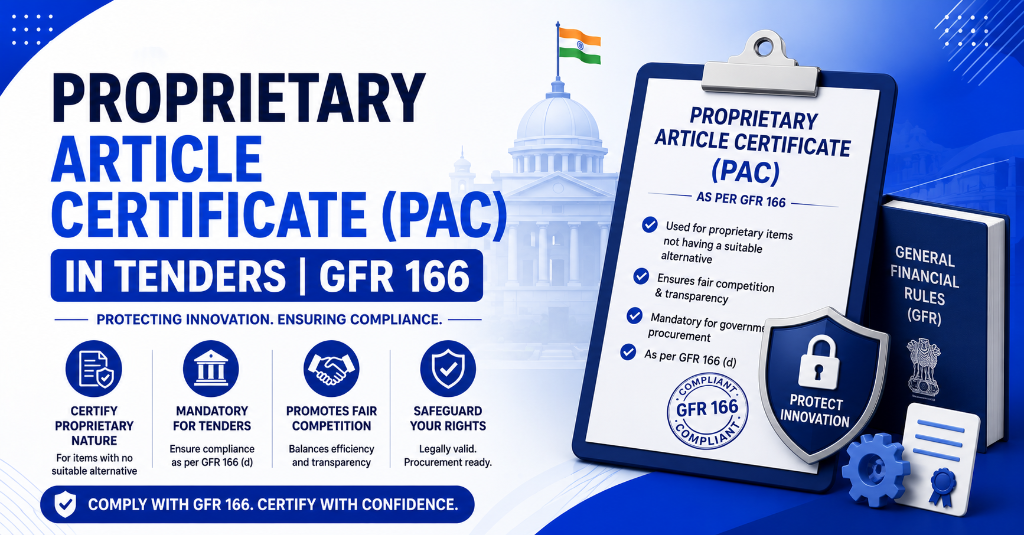
A Proprietary Article Certificate (PAC) is a statutory declaration issued by a competent authority within a government department or ministry, certifying that a specific product or equipment is manufactured by only one firm (the Original Equipment Manufacturer, or OEM) and that no other make or model is acceptable for technical, compatibility, or standardization reasons.
Under India's public procurement framework — governed by the General Financial Rules (GFR) 2017 — competitive bidding is the default. PAC is the exception. It permits Single Tender Enquiry (STE) under Rule 166, bypassing open or limited competition. Because it removes the price-discovery mechanism of competitive markets, PAC is one of the most audited and scrutinized procurement methods in India.
Why PAC Matters in 2026
- GeM GMV crossed ₹5.43 lakh crore in FY 2024–25, with proprietary purchases forming a significant subset of high-value transactions.
- CAG audit reports consistently flag improper PAC usage as a top compliance violation, leading to recoveries and disciplinary action.
- For MSMEs holding OEM authorizations, PAC tenders represent low-competition, high-margin opportunities — if they understand the rules.
Definition Box: Proprietary Article Certificate (PAC) — A written certificate under GFR 2017 Rule 166(i) and 166(iii), signed by the indenting officer and approved by the competent authority, declaring that goods are available from only one manufacturer and no substitute exists.

Get the GFR Compliance Toolkit
Know every GFR rule, protect deposits, and challenge restrictive clauses with confidence.
- ✓ 150-Point Pre-Submission Checklist (PDF)
- ✓ EMD & BG Format Verification Guide + Checker
- ✓ 5 Post-Rejection Appeal Letters (GFR 171)
- ✓ Corrigendum Monitoring & Response Checklist
🔒 256-Bit Secure Razorpay Checkout · Lifetime Access · Instant Digital Delivery
GFR 2017 Rule 166: The Legal Foundation
Rule 166 of GFR 2017 governs Single Tender Enquiry — the procurement method that relies on PAC. The rule states:
"Procurement from a single source may be resorted to in the following circumstances: (i) It is in the knowledge of the user department that only a particular firm is the manufacturer of the required goods; (ii) In a case of emergency, the required goods are necessarily to be purchased from a particular source and the reason for such decision is to be recorded and approval of competent authority obtained; (iii) For standardisation of machinery or spare parts to be compatible to the existing sets of equipment (on the advice of a competent technical expert and approved by the competent authority), the required item is to be purchased only from a selected firm."
Key Legal Nuances
| Aspect | Requirement | Consequence of Non-Compliance |
|---|---|---|
| Rule 166(i) — Proprietary | PAC mandatory; must prove sole manufacturer status | Tender void; CAG objection; recovery |
| Rule 166(ii) — Emergency | Written emergency justification + competent authority approval | Audit objection; potential blacklisting |
| Rule 166(iii) — Standardization | Technical expert advice + compatibility proof | Bid challenge; contract cancellation |
| Finance Concurrence | Mandatory under all three sub-rules | Financial irregularity |
| Competent Authority | Must be higher than normal purchasing authority | Ultra vires decision |
Source: General Financial Rules 2017, Ministry of Finance, Department of Expenditure.
The 3 Legal Grounds for PAC Procurement
1. Sole Manufacturer (Rule 166(i))
This is the most common PAC ground. The user department must demonstrate that:
- Only one firm manufactures the required goods globally or in India.
- No generic, reverse-engineered, or compatible substitute meets the technical requirement.
- The product is protected by patents, copyrights, or trade secrets.
Example: A DRDO lab requires a specific spectrometer manufactured only by Thermo Fisher Scientific. No Indian or alternative OEM produces a device with the same wavelength accuracy.
2. Genuine Emergency (Rule 166(ii))
Emergency PAC does not require a Proprietary Article Certificate in the strict sense, but it requires:
- A recorded written justification explaining why delay would cause operational harm.
- Approval from the competent authority before procurement (not retrospective).
- Evidence that the emergency was unforeseeable and not created by departmental delay.
Red Flag: CAG audits frequently reject "self-created emergencies" where poor planning led to last-minute procurement.
3. Standardization & Compatibility (Rule 166(iii))
Used for spare parts, upgrades, or expansions of existing systems. Requirements:
- A competent technical expert (not the indenting officer) must certify incompatibility with other brands.
- The expert's report must be attached to the PAC.
- The competent authority must approve the recommendation.
Example: Indian Railways procuring brake pads compatible only with existing LHB coach specifications.
Instant Tender Eligibility & Risk Audit
Upload any 500-page NIT / BOQ PDF. Extract hidden disqualification traps, EMD waiver clauses, and complete eligibility criteria in under 45 seconds.
Standard PAC Format & Mandatory Fields
A valid PAC must contain the following fields. Missing any field renders the certificate defective:
Proprietary Article Certificate Template
PROPRIETARY ARTICLE CERTIFICATE
(Under GFR 2017 Rule 166)

(i) Name of Equipment / Item: _________________________________
    (Equipment Name) through Single Tender Enquiry (GFR-166)

(ii) The indented goods are only Manufactured by M/s.: _______________________

(iii) No other make or model is acceptable for the following reasons:
      a) ___________________________________________________________
      b) ___________________________________________________________
      c) ___________________________________________________________

(iv) Concurrence of finance wing to the proposal: Yes / No
     (Vide Office Order / U.O. No.: _____________ Dated: _____________)

(v) Approval of the Competent Authority: Yes / No
     (Vide Office Order / U.O. No.: _____________ Dated: _____________)

(Signature with date & Designation of the Indenting Officer)

RECOMMENDATION OF PROPRIETARY ITEM COMMITTEE

The Committee after scrutiny found that ________________________________
(Equipment Name) is a *Proprietary / is not a proprietary item of M/s. ___________
and hence, *recommends / does not recommend the Purchase of ______________
through single tender inquiry (GFR-166).

(Member)              (Member)              (Member)
(Member)              (Chairman)

Approved / Not Approved

DIRECTOR / HEAD OF DEPARTMENT
(Strike out whichever is not applicable)
Mandatory Attachments to PAC
- Technical Justification Note — Why no substitute exists.
- Market Survey Report — Evidence of non-availability from other sources.
- Finance Concurrence — Signed by FA/CAO.
- Competent Authority Approval — One level above normal purchasing authority.
- OEM Authorization Letter (if buying through dealer/distributor).
- Manufacturer's Certificate — Confirming proprietary status.
GeM PAC Buying Process: Step-by-Step (2024–2025)
The Government e-Marketplace (GeM) has specific rules for PAC buying under its General Terms and Conditions (Version 1.21, 2025). Here's the updated workflow:
Step 1: Buyer Identifies Proprietary Need
The buyer department determines that the required item is proprietary and not available through competitive GeM listing.
Step 2: Internal PAC Generation
- The indenting officer prepares the PAC in the prescribed format.
- Finance wing concurrence is obtained.
- Competent authority approves.
- Proprietary Item Committee reviews and recommends.
Step 3: PAC Upload on GeM
The buyer uploads the PAC to GeM with:
- Product details and exact make/model
- Manufacturer information
- Technical justification
- Scanned signed PAC document
Step 4: GeM Review & Approval
GeM authorities review the PAC for:
- Compliance with GFR 166
- Adequacy of justification
- Non-availability of substitutes on the platform
Step 5: Bid Creation
Once approved, the buyer creates:
- PAC Bid restricted to the specific make/model
- Bid Duration: Minimum 10 days (15 days recommended for Central Govt)
- Bid Type: Single Packet or Two Packet
Step 6: Bidding & Price Discovery
| Value Threshold | Mandatory Process |
|---|---|
| Up to ₹25,000 | Direct purchase possible (with price reasonableness check) |
| Above ₹25,000 | Bidding is mandatory; Reverse Auction (RA) may follow |
| Above ₹10 lakh | RA typically mandatory for PAC items with multiple authorized sellers |
Step 7: Order Placement
The lowest valid bid (L1) wins. If multiple authorized sellers exist, RA drives the price down further.
Critical GeM PAC Rule (2025 Update)
"In case of all PAC procurements, the Buyers will have to carry out extra due diligence in establishing the reasonableness of prices before placement of contract as per Para (vii) of Rule 149 of GFR-2017."
Source: GeM General Terms and Conditions Version 1.21
How MSMEs Can Win PAC-Based Tenders
For MSMEs, PAC tenders are a strategic goldmine — competition is naturally restricted to OEMs and their authorized resellers. Here's how to dominate:
1. Secure OEM Authorizations Early
- Contact manufacturers in your product domain.
- Obtain GeM-compliant authorization letters with exact make/model listings.
- Ensure the authorization covers the entire tender period + 6 months.
2. Optimize Your GeM Catalogue
- List the exact make and model that buyers specify in PAC bids.
- Use GeM's "Golden Parameters" to match buyer specifications precisely.
- Upload OEM authorization letters in the document section.
3. Monitor PAC-Specific Tenders
Use TenderFlow Pro's AI-powered tender scanner to:
- Filter live GeM tenders by "PAC" tag.
- Match your authorized make/model against buyer requirements.
- Get instant alerts when a PAC tender matching your portfolio goes live.
4. Price Strategically for Reverse Auctions
- Set your floor price before entering RA.
- Remember: winning at a loss is worse than not bidding.
- Factor in MSME price preference (15% margin to match L1 if within range).
5. Challenge Invalid PACs
If you believe a PAC was issued without proper justification:
- File a challenge through GeM's grievance mechanism.
- Submit technical documentation proving your product is equivalent.
- Engage the buyer department with demo videos and spec sheets.
MSME Benefits on PAC Bids:
- ✅ EMD exemption (if buyer allows)
- ✅ 15% price preference for matching L1
- ✅ 25% quantity reservation
- ✅ Relaxed turnover criteria for DPIIT-recognized startups
PAC vs. Open Tender vs. LTE: Comparison
| Parameter | Open Tender (Rule 161) | Limited Tender (Rule 162) | PAC / Single Tender (Rule 166) |
|---|---|---|---|
| Competition | High — all eligible bidders | Medium — 3+ invited suppliers | None — single source |
| Value Threshold | ₹50 lakh & above (post-July 2024) | Up to ₹50 lakh (post-July 2024) | No value limit |
| Advertisement | CPPP + GeM + newspapers | CPPP + GeM + direct invite | No public advertisement |
| PAC Required | No | No | Yes — mandatory |
| Approval Level | Standard competent authority | Standard + approval if <3 bids | Higher than normal authority |
| Audit Risk | Low | Medium | High |
| Timeline | 4–6 weeks | 2–3 weeks | 1–2 weeks |
| Best For | Infrastructure, bulk supply | Specialized services, recurring | OEM equipment, spares, emergency |
| MSME Opportunity | High volume, high competition | Moderate, relationship-driven | Low volume, very high margin |
Source: GFR 2017 (as amended July 2024), Ministry of Finance OM dated 10.07.2024.
Common PAC Mistakes That Lead to Audit Objections
Based on CAG audit findings and CVC guidelines, these are the top PAC errors:
❌ Mistake 1: Generic Items Disguised as Proprietary
The Error: Declaring standard items (printers, toner, office furniture) as proprietary to favor a vendor.
The Consequence: CAG objection, recovery of excess payment, disciplinary action under CCS (CCA) Rules.
The Fix: Conduct a genuine market survey. If 3+ suppliers exist, PAC is invalid.
❌ Mistake 2: Retrospective Approval
The Error: Procuring first and obtaining PAC approval later.
The Consequence: Expenditure is treated as "unauthorized" and recoverable from the officer.
The Fix: PAC must be approved before issuing the tender or purchase order.
❌ Mistake 3: Missing Finance Concurrence
The Error: Technical officer signs PAC without FA/CAO concurrence.
The Consequence: Financial irregularity; payment may be withheld.
The Fix: Always obtain finance wing concurrence before competent authority approval.
❌ Mistake 4: Stale Supplier Lists
The Error: Using a 5-year-old registered supplier list for LTE/PAC hybrid procurements.
The Consequence: CAG treats this as restrictive practice favoring known vendors.
The Fix: Update registered supplier lists annually with due publicity.
❌ Mistake 5: Inadequate Price Justification
The Error: Accepting OEM's quoted price without benchmarking.
The Consequence: Rule 149(vii) violation; excess payment recovery.
The Fix: Use GeM price trends, past purchase data, and third-party quotes to establish reasonableness.
The Proprietary Item Committee: Role & Composition
Many ministries and PSUs mandate a Proprietary Item Committee to review PAC requests. While GFR 2017 does not explicitly mandate this committee, organizations like NIAMT, IISc, and DRDO have institutionalized it as a safeguard.
Typical Committee Composition
| Role | Responsibility |
|---|---|
| Chairman | Head of Department / Director — Final approver |
| Technical Member | Subject matter expert — Validates technical justification |
| Finance Member | FA/CAO representative — Certifies fund availability |
| Procurement Member | Purchase officer — Checks procedural compliance |
| Independent Member | External expert (in some organizations) — Unbiased review |
Committee Checklist
- Verified OEM's sole manufacturer claim through independent sources
- Reviewed technical specifications for obsolescence or over-specification
- Checked GeM for equivalent products
- Validated finance concurrence
- Ensured competent authority is one level above normal
- Recorded minutes with signatures of all members
Price Reasonableness & Rule 149 Compliance
Rule 149(vii) of GFR 2017 mandates that buyers must certify the reasonableness of rates in all procurements. For PAC — where there is no competition — this becomes critical.
Methods to Establish Price Reasonableness
- GeM Price Benchmarking: Compare against similar products on GeM.
- Last Purchase Price (LPP): Check if the price is within 10% of the last identical purchase.
- Third-Party Quotations: Obtain informal quotes from 2–3 other suppliers (even if they can't supply the exact item) to benchmark.
- OEM Price List: Use the manufacturer's published price list as a ceiling.
- Reverse Auction: If multiple authorized sellers exist, RA establishes market price.
Price Reasonableness Certificate Template
PRICE REASONABLENESS CERTIFICATE

I certify that the rate of Rs. _________ per unit for ____________________
is reasonable based on:

[ ] GeM benchmark price
[ ] Last Purchase Price (Ref: __________ Dated: _________)
[ ] Third-party quotations (attached)
[ ] OEM published price list (attached)
[ ] Reverse Auction result

The price is within acceptable variance and represents fair value
for the exchequer.

Signature: _________________
Designation: _________________
Date: _______________________
Case Study: How a Jaipur MSME Won a ₹1.2 Cr PAC Tender
Company: Rajshree Scientific Solutions Pvt. Ltd., Jaipur (Udyam-registered MSME) Sector: Laboratory Equipment Tender: PAC-based procurement of HPLC system for Rajasthan State Pollution Control Board Value: ₹1.2 Crore
The Challenge
The Pollution Control Board issued a PAC tender for an Agilent HPLC system, citing proprietary detection technology. Rajshree Scientific was an authorized reseller for Agilent but faced competition from another authorized dealer in Delhi.
The Strategy
- Catalogue Precision: Ensured their GeM listing matched the exact Agilent model number (1260 Infinity II) with all golden parameters.
- Documentation: Uploaded a current OEM authorization letter valid through 2027.
- Technical Engagement: Submitted a pre-bid clarification request highlighting their local service center in Jaipur — a value-add not offered by the Delhi competitor.
- RA Discipline: Entered the Reverse Auction with a floor price of ₹1.18 Cr. Stopped bidding at ₹1.195 Cr when the competitor dropped to ₹1.192 Cr.
- MSME Preference: Invoked 15% price preference. Since their bid was within 15% of L1, they matched the L1 price and won 100% of the contract under MSME reservation.
The Result
- Won the contract at ₹1.192 Cr (matched L1)
- Saved the buyer 8% compared to the estimated cost
- Established a recurring relationship — 3 AMC contracts won subsequently
Key Takeaway: PAC tenders aren't just about price. Local service capability, documentation discipline, and MSME preference rules can turn a #2 bid into a winning contract.
Free Download: PAC Template & Checklist
📥 Download Proprietary Article Certificate Template + 20-Point Compliance Checklist
Includes:
- Editable PAC format (Word + PDF)
- Price Reasonableness Certificate
- Proprietary Item Committee minutes template
- Pre-PAC market survey checklist
- CAG audit defense documentation list
Frequently Asked Questions (FAQ)
Q1. Is PAC mandatory for all single-source procurements?
A: Yes. For procurements under Rule 166(i) and 166(iii), a PAC is mandatory. For emergency procurements under Rule 166(ii), a written emergency justification replaces the PAC, but the approval threshold is equally strict.
Q2. Can a department issue a PAC for services?
A: PAC is primarily for goods. For proprietary services (e.g., patented software licenses), a similar justification note is required, though the term "PAC" is technically specific to physical goods under GFR 166.
Q3. What happens if a PAC is challenged on GeM?
A: GeM has a grievance redressal mechanism. A seller can challenge a PAC if they believe their product is technically equivalent. GeM may suspend the bid pending review. If the challenge is upheld, the buyer must either justify the PAC or convert to an open tender.
Q4. Does PAC procurement require bidding on GeM?
A: For values up to ₹25,000, direct purchase is permitted with a price reasonableness check. Above ₹25,000, bidding is mandatory. If multiple authorized sellers exist, a Reverse Auction is typically conducted.
Q5. Who is the "competent authority" for PAC approval?
A: The competent authority for accepting a single tender offer is one level higher than the authority normally competent to accept tenders for that value. For example, if a Director normally approves tenders up to ₹50 lakh, the PAC for any value requires approval at the Secretary/Additional Secretary level.
Q6. Can an MSME challenge a PAC favoring a large OEM?
A: Yes. If the MSME can demonstrate that its product meets the technical specifications and is functionally equivalent, it can file a challenge. However, the MSME must provide technical documentation — not just a claim.
Q7. How long is a PAC valid?
A: A PAC is valid for the specific procurement for which it is issued. It cannot be reused for subsequent procurements. Each tender requires a fresh PAC unless the department has a blanket approval for recurring proprietary items (rare and audit-sensitive).
Q8. What is the role of the Proprietary Item Committee?
A: While not mandated by GFR 2017, many organizations (especially PSUs, IITs, and research institutions) require a Proprietary Item Committee to scrutinize PAC requests. The committee reviews technical justification, verifies OEM claims, and recommends approval or rejection.
Q9. Is price preference for MSMEs applicable in PAC tenders?
A: Yes. MSME price preference (15% margin to match L1) applies to PAC bids on GeM, provided the MSME is Udyam-registered and the buyer has enabled MSE purchase preference in the tender.
Q10. What documents should an MSME upload for a PAC bid on GeM?
A:
- Udyam Registration Certificate
- OEM Authorization Letter (current and GeM-compliant)
- GST Registration
- PAN Card
- Technical Brochure matching the exact make/model
- Past supply experience certificates (if required by buyer)
Conclusion & Action Plan
The Proprietary Article Certificate is one of the most powerful — and most dangerous — tools in Indian public procurement. Used correctly, it ensures mission-critical equipment reaches government departments without compromise. Used incorrectly, it invites CAG objections, recoveries, and disciplinary action.
For buyers, the mantra is: Document everything. Justify every line. Benchmark every price.
For MSMEs, the opportunity is clear: PAC tenders have restricted competition, higher margins, and predictable demand. The key is OEM authorization, catalogue precision, and understanding the MSME preference framework.
Your 7-Day Action Plan
| Day | Action |
|---|---|
| Day 1 | Audit your current product portfolio. Identify which items are OEM-authorized. |
| Day 2 | Contact 3 manufacturers in your domain. Request GeM-compliant authorization letters. |
| Day 3 | Update your GeM catalogue with exact make/model numbers and golden parameters. |
| Day 4 | Set up TenderFlow Pro alerts for PAC tenders in your product category. |
| Day 5 | Review past CAG audit reports on PAC misuse. Learn from others' mistakes. |
| Day 6 | Prepare a "PAC Challenge Kit" — technical docs proving equivalence for your top 5 products. |
| Day 7 | Bid on one live PAC tender. Treat it as a learning exercise, not just a revenue play. |
Audit Your Tender RFP Before Technical Bid Evaluation
Upload your tender PDF to scan for restrictive PAC clauses, EMD exemption eligibility, and GFR 2017 disqualification traps in 30 seconds.
Scan My Tender Document Free → Access Free Official PAC Formats →Related Articles
- Limited Tender Enquiry (LTE): Rules, Eligibility & Supplier Registration
- Corrigendum in Tenders: How to Track Changes & Protect Your Bid
- GeM Portal Bidding: The Complete MSME Guide 2026
- GFR 2017 Procurement Methods: Open, Limited & Single Source Explained
Disclaimer: This article is for informational purposes only and does not constitute legal advice. Procurement officers should consult their departmental finance wing and legal cell before issuing PACs. MSMEs should verify current GeM and GFR rules at the time of bidding.
© 2026 TenderFlow Pro. All rights reserved.