Limited Tender Enquiry (LTE): The Definitive Guide to Rules, Eligibility, Supplier Registration & Winning Strategies
Last Updated: July 17, 2026 | Reading Time: 20 minutes | Author: TenderFlow Pro Procurement Intelligence Team For the comprehensive end-to-end framework, consult our ultimate guide to Indian government tenders.
Quick Answer: Limited Tender Enquiry (LTE) under GFR 2017 Rule 162 is a semi-competitive procurement method for goods up to ₹50 lakh (post-July 2024 amendment). It requires inviting bids from a pre-selected list of registered suppliers (minimum 3) without public advertisement. LTE is not appropriate for GeM-available items. MSMEs can win LTE contracts by registering on departmental supplier lists and maintaining active GeM presence.
menu_book Table of Contents
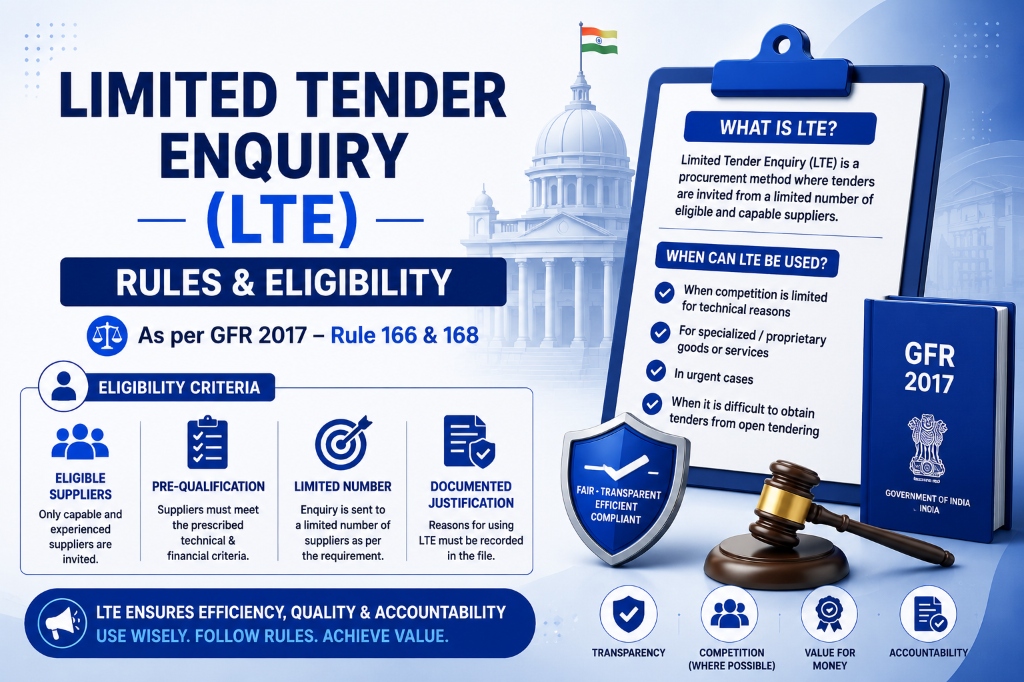
What Is Limited Tender Enquiry (LTE)?
A Limited Tender Enquiry (LTE) is a procurement method under Chapter 6 of the General Financial Rules (GFR) 2017, specifically Rule 162. It allows government departments and PSUs to procure goods by sending bid documents directly to a pre-selected list of registered suppliers rather than advertising publicly.
LTE occupies the middle ground in India's procurement spectrum:
- More competitive than Single Tender Enquiry (STE/PAC) — requires 3+ suppliers.
- Less competitive than Advertised Tender Enquiry (Open Tender) — no public advertisement.
- Faster than open tendering but with adequate checks against favoritism.
Definition Box: Limited Tender Enquiry (LTE) — A procurement method under GFR 2017 Rule 162 where bid documents are sent directly to registered/known suppliers (minimum three) for goods valued up to ₹50 lakh, without public advertisement but with mandatory publication on GeM-CPPP and the department's website.
Why LTE Matters for MSMEs in 2026
- GeM processed 72+ lakh orders in FY 2024–25, but many specialized procurements still happen through offline/LTE modes.
- 44.72% of GeM order value goes to MSEs, and LTE is a major channel for non-GeM specialized goods.
- The July 2024 amendment doubled the LTE threshold from ₹25 lakh to ₹50 lakh, opening significantly more opportunities.
- Being on a departmental registered supplier list is the #1 predictor of LTE success — yet most MSMEs neglect this.

Get the GFR Compliance Toolkit
Know every GFR rule, protect deposits, and challenge restrictive clauses with confidence.
- ✓ 150-Point Pre-Submission Checklist (PDF)
- ✓ EMD & BG Format Verification Guide + Checker
- ✓ 5 Post-Rejection Appeal Letters (GFR 171)
- ✓ Corrigendum Monitoring & Response Checklist
🔒 256-Bit Secure Razorpay Checkout · Lifetime Access · Instant Digital Delivery
GFR 2017 Rule 162: Complete Legal Framework
Rule 162 of GFR 2017 establishes the conditions, thresholds, and procedural requirements for LTE.
Original Rule 162 (Pre-July 2024)
"This method may be adopted when estimated value of the goods to be procured is up to Rupees Twenty five Lakhs. Copies of the bidding document should be sent directly by speed post/registered post/courier/email to firms which are borne on the list of registered suppliers... The number of supplier firms in Limited Tender Enquiry should be more than three."
Amended Rule 162 (Post-July 2024)
"This method may be adopted when estimated value of the goods to be procured is up to Rupees Fifty Lakhs. Copies of the bidding document should be sent directly by speed post/registered post/courier/email to firms which are borne on the list of registered suppliers... The number of supplier firms in Limited Tender Enquiry should be more than three."
Source: Ministry of Finance OM dated 10.07.2024, Amendment in GFR 2017.
Core Requirements of Rule 162
| Requirement | Details | Penalty for Non-Compliance |
|---|---|---|
| Value Threshold | Up to ₹50 lakh (post-July 2024) | CAG objection; tender may be voided |
| Minimum Suppliers | More than 3 (i.e., 4 or more invited) | Violation of competition principle |
| Supplier List | Registered/known suppliers per Rule 150 | Audit objection for favoritism |
| Publication | GeM-CPPP + Department website | Lack of transparency; CVC flag |
| Bid Opening | All bids opened simultaneously | Selective opening is prohibited |
| L1 Principle | Lowest responsive bid accepted | Higher bid acceptance needs documented justification |
| GeM Precedence | LTE only if item NOT available on GeM | Rule 149 violation |
July 2024 Amendment: New Thresholds & Rules
The Ministry of Finance issued a landmark amendment on 10 July 2024 that significantly changed procurement thresholds. Here's what changed for LTE:
Threshold Changes Comparison
| Parameter | Pre-July 2024 | Post-July 2024 | Impact |
|---|---|---|---|
| LTE Threshold | Up to ₹25 lakh | Up to ₹50 lakh | 100% increase in LTE-eligible value |
| Open Tender Threshold | ₹25 lakh & above | ₹50 lakh & above | More high-value tenders now open |
| GeM Direct Purchase | Up to ₹25,000 | Up to ₹50,000 | Faster low-value buying |
| GeM Lowest-Price Purchase | ₹25,000 – ₹5 lakh | ₹50,000 – ₹10 lakh | Expanded GeM competitive range |
| LPC (Local Purchase Committee) | ₹25,000 – ₹2.5 lakh | ₹25,000 – ₹2.5 lakh (unchanged for non-GeM) | No change |
New Publication Requirements for LTE
The July 2024 amendment introduced mandatory GeM publication for LTEs:
- Before: LTEs were published on CPPP (eprocure.gov.in) and the department website.
- After: LTEs must be published on GeM-CPPP and the department website. CPPP alone is no longer sufficient.
Source: MoF OM dated 10.07.2024, Amendment in GFR 2017 Rule 162.
What This Means for MSMEs
- More LTE Opportunities: Double the value threshold means more tenders in the "sweet spot" where MSMEs can compete without facing large corporate bidders.
- GeM Presence Is Mandatory: If you're not on GeM, you're invisible to buyers who must publish LTEs there.
- Registered Supplier Lists Are Gold: With higher values at stake, departments will scrutinize their supplier lists more carefully — making early registration critical.
Instant Tender Eligibility & Risk Audit
Upload any 500-page NIT / BOQ PDF. Extract hidden disqualification traps, EMD waiver clauses, and complete eligibility criteria in under 45 seconds.
When LTE Is Appropriate — And When It Is Not
Appropriate Use Cases for LTE
| Scenario | Justification |
|---|---|
| Value ≤ ₹50 lakh | Within statutory threshold |
| Item not on GeM | Rule 149 mandates GeM for available items |
| Specialized/technical goods | Limited number of capable suppliers |
| Urgent but not emergency | Faster than open tender; more competitive than single tender |
| Recurring procurement | Known suppliers reduce evaluation time |
| Few known sources | Open tender would attract few or zero bids |
Inappropriate Use Cases (Audit Red Flags)
| Scenario | Risk |
|---|---|
| Item available on GeM | Rule 149 violation; mandatory GeM procurement |
| Value > ₹50 lakh without justification | Requires open tender; LTE is irregular |
| Same 3 suppliers invited repeatedly | Stale list; CAG treats as restrictive practice |
| No registered supplier list exists | Violates Rule 150; favoritism risk |
| Splitting a ₹60 lakh requirement into two ₹30 lakh LTEs | Rule 163 prohibition on splitting |
| No publication on GeM-CPPP | Post-July 2024 violation |
The "Stale Supplier List" Trap
CAG audits consistently flag departments that maintain static supplier lists for years. If your department has been inviting the same 4 firms for LTEs since 2020, auditors will question whether the list was updated transparently.
Best Practice: Update registered supplier lists annually with due publicity, open application windows, and transparent evaluation criteria.
Supplier Registration: The Gateway to LTE
Rule 150 of GFR 2017 governs supplier registration — the foundation of LTE participation.
Rule 150 Requirements
"With a view to establishing reliable sources for procurement of goods commonly required for Government use, the Central Purchase Organisation (e.g. DGS&D) will prepare and maintain item-wise lists of eligible and capable suppliers. Such approved suppliers will be known as 'Registered Suppliers'."
Who Can Register Suppliers?
| Authority | Scope |
|---|---|
| DGS&D / Central Purchase Organisation | Common-use goods across all ministries |
| Head of Department | Department-specific goods and services |
| GeM SPV | GeM seller verification and onboarding |
Registration Criteria (What Departments Verify)
- Credentials — PAN, GST, Udyam, incorporation documents.
- Manufacturing Capability — Factory inspection, production capacity, quality control.
- Past Performance — Supply experience with government/PSU/private sector.
- After-Sales Service — Service network, spare parts availability, response time.
- Financial Background — Turnover, audited accounts, banking history.
- Quality Certifications — ISO, BIS, industry-specific certifications.
Registration Period
- Suppliers are registered for a fixed period of 1 to 3 years depending on the nature of goods.
- Renewal: Suppliers must apply afresh before expiry.
- New entrants: Can be considered anytime if they fulfill conditions.
Post-July 2024 Update to Rule 150
The amendment clarifies that for goods/services not available on GeM, Heads of Departments may register suppliers. However, such registered suppliers must be boarded on GeM as and when the item/service gets listed.
LTE Eligibility Criteria for Bidders
To participate in an LTE, a bidder must meet both general and tender-specific eligibility criteria.
General Eligibility
| Criterion | Document Required | MSME Benefit |
|---|---|---|
| Udyam Registration | Udyam Certificate | Mandatory for MSME benefits; free registration |
| GST Registration | GST Certificate | Required for taxable goods/services |
| PAN | PAN Card | Mandatory for all bidders |
| GeM Seller ID | GeM Registration | Mandatory post-July 2024 for visibility |
| DSC | Class 3 Digital Signature | Required for e-bidding |
| Bank Account | Cancelled cheque / Bank statement | For payment processing |
Tender-Specific Eligibility (Typical)
| Criterion | Typical Requirement | MSME Relaxation |
|---|---|---|
| Turnover | ₹1 Cr – ₹10 Cr (varies by tender) | 50% relaxation for MSMEs in some tenders |
| Past Experience | 3 similar completed orders | Reduced to 1-2 for MSMEs/startups |
| EMD | 2% of estimated value | Full exemption for MSMEs |
| Performance Bank Guarantee | 5-10% of contract value | Reduced for MSMEs in some departments |
| Technical Capability | Manufacturing license, test reports | Startup/DPIIT recognition may substitute |
The "Registered Supplier" Advantage
Being on a department's registered supplier list provides:
- Direct invitation to LTEs without searching for opportunities.
- Bid security exemption (ordinarily exempt from EMD for registered suppliers).
- Faster evaluation — pre-verified credentials reduce scrutiny time.
- Relationship leverage — repeat business and AMC contracts.
The LTE Process: Step-by-Step for Buyers & Bidders
For Government Buyers
Step 1: Need Identification
- Determine estimated value.
- Check if item is available on GeM. If yes, use GeM (Rule 149). If no, proceed to LTE.
Step 2: Supplier List Verification
- Verify registered supplier list is current (updated within 12 months).
- Ensure minimum 4 suppliers are invited ("more than three" per Rule 162).
- If insufficient registered suppliers, conduct emergency registration or justify open tender.
Step 3: Bid Document Preparation
- Prepare technical specifications, delivery terms, payment terms, penalty clauses.
- Include MSME preference clauses if applicable.
Step 4: Publication
- Publish on GeM-CPPP (mandatory post-July 2024).
- Publish on department website.
- Send bid documents directly to invited suppliers via email/speed post.
Step 5: Bid Receipt & Opening
- All bids opened simultaneously on specified date.
- Technical evaluation first (for Two-Packet bids).
- Financial evaluation of technically qualified bidders.
Step 6: Award
- L1 (lowest responsive bid) is awarded.
- If higher bid is selected, documented justification + competent authority approval required.
For Bidders (MSMEs)
Step 1: Get on the Supplier List
- Identify 5-10 target departments that procure your product category.
- Submit vendor registration applications with complete documentation.
- Follow up quarterly to check application status.
Step 2: Monitor LTE Notices
- Check GeM-CPPP "Limited Tender" section daily.
- Use TenderFlow Pro alerts for LTEs in your category.
- Check department websites for direct invitations.
Step 3: Evaluate the LTE
- Check if you meet eligibility criteria.
- Assess delivery timeline feasibility.
- Calculate pricing with MSME benefits factored in.
Step 4: Prepare & Submit Bid
- Upload technical documents (compliance statement, brochures, certifications).
- Submit financial bid (competitive but sustainable pricing).
- Ensure EMD exemption is claimed (attach Udyam certificate).
Step 5: Post-Submission
- Track corrigenda (see our Corrigendum Tracking Guide).
- Attend bid opening (physical or virtual).
- Be prepared for price negotiation or Reverse Auction.
LTE vs. Open Tender vs. PAC: Complete Comparison
| Parameter | Advertised Tender Enquiry (Open) | Limited Tender Enquiry (LTE) | Single Tender Enquiry (PAC) |
|---|---|---|---|
| GFR Rule | Rule 161 | Rule 162 | Rule 166 |
| Value Threshold | ₹50 lakh & above | Up to ₹50 lakh | No limit |
| Competition Level | High — open to all | Medium — invited suppliers only | None — single source |
| Advertisement | CPPP + GeM + newspapers + website | GeM-CPPP + website + direct invite | No advertisement |
| Minimum Bidders | No minimum | More than 3 invited | 1 |
| Timeline | 4–6 weeks | 2–3 weeks | 1–2 weeks |
| EMD | 2–5% (MSME exempt) | 2–5% (MSME exempt; registered suppliers often exempt) | 2–5% (MSME exempt) |
| Audit Risk | Low | Medium | High |
| MSME Opportunity | High volume, high competition | Moderate volume, lower competition | Low volume, very high margin |
| Best For | Infrastructure, bulk commodities | Specialized goods, recurring supply | OEM equipment, emergency, spares |
| GeM Mandate | Must publish on GeM | Must publish on GeM-CPPP | PAC process on GeM for proprietary |
Source: GFR 2017 (as amended July 2024), Ministry of Finance.
MSME Advantages in LTE Tenders
1. EMD Exemption
MSMEs registered under Udyam are exempt from Earnest Money Deposit in most LTEs. This means:
- No blocked working capital.
- Ability to bid on multiple LTEs simultaneously.
- Reduced financial risk if bid is unsuccessful.
2. Price Preference
Under the Public Procurement Policy for MSEs:
- If an MSE quotes within 15% of L1, it can be invited to match the L1 price and secure the order.
- In some categories, 25% quantity reservation applies.
3. Relaxed Eligibility
Many departments offer:
- 50% turnover relaxation for MSMEs.
- Reduced past experience requirements.
- Exemption from prior turnover criteria for DPIIT-recognized startups.
4. Local Purchase Committee (LPC) Access
For non-GeM items between ₹25,000 and ₹2.5 lakh, LPC purchases offer MSMEs quick wins without complex bidding.
5. National SC-ST Hub Support
The National SC-ST Hub (NSSH) provides:
- Handholding for SC/ST MSMEs to register on GeM and departmental lists.
- Vendor Development Programs connecting SC/ST MSMEs with CPSEs.
- Conclaves and awareness programs.
Achievement: SC/ST MSE procurement share increased 17-fold from ₹99.37 crore (0.07%) in 2015–16 to ₹1,757.26 crore (1.03%) in 2023–24.
Source: Ministry of MSME Annual Report 2024–25.
Common LTE Mistakes & Audit Traps
For Buyers (Government Departments)
❌ Mistake 1: Using LTE for GeM-Available Items
The Error: Floating an LTE for items readily available on GeM.
The Consequence: Rule 149 violation; CAG objection; tender cancellation.
The Fix: Always check GeM first. If the item exists, use GeM Direct Purchase, L1 Purchase, or Bidding.
❌ Mistake 2: Inviting Only 3 Suppliers
The Error: Interpreting "more than three" loosely as "three."
The Consequence: CAG treats this as restrictive practice; favoritism allegations.
The Fix: Invite minimum 4 suppliers. Ideally 5–6 to ensure 3+ responsive bids.
❌ Mistake 3: Not Publishing on GeM-CPPP
The Error: Publishing only on the department website or CPPP (old practice).
The Consequence: Post-July 2024 procedural violation; lack of transparency.
The Fix: Publish on both GeM-CPPP and department website simultaneously.
❌ Mistake 4: Splitting Requirements
The Error: Breaking a ₹60 lakh requirement into two ₹30 lakh LTEs to avoid open tender.
The Consequence: Rule 163 violation; all purchase orders treated as irregular.
The Fix: Aggregate annual requirement before selecting procurement method.
For Bidders (MSMEs)
❌ Mistake 1: Not Being on Registered Supplier Lists
The Error: Waiting for LTE notices to appear on public portals instead of proactively registering.
The Consequence: You never see the invitation. 70% of LTEs are invisible to non-registered vendors.
The Fix: Register with every relevant department. Update registration annually.
❌ Mistake 2: Ignoring "More Than 3" Requirement
The Error: Assuming low competition means you can quote high prices.
The Reality: Even with 4 invited suppliers, L1 pressure is real. Government buyers expect competitive pricing.
The Fix: Price for L1, not for monopoly.
❌ Mistake 3: Missing GeM-CPPP Publication
The Error: Checking only the department website for LTEs.
The Consequence: Missed opportunities — post-July 2024, many LTEs are only on GeM-CPPP.
The Fix: Monitor GeM-CPPP "Limited Tender" section daily.
How to Get on Departmental Registered Supplier Lists
Step 1: Identify Target Departments
Make a list of:
- Central ministries that procure your product category.
- PSUs in your sector (e.g., ONGC for oilfield supplies, BHEL for power equipment).
- State departments with recurring needs.
- Autonomous bodies (IITs, CSIR labs, hospitals).
Step 2: Find Registration Portals
| Organization Type | Where to Register |
|---|---|
| Central Ministries | CPPP vendor registration + department-specific portals |
| PSUs | Each PSU has its own vendor empanelment portal |
| Defence (DGS&D) | DGS&D online vendor registration |
| State Governments | Respective state e-procurement portals |
| IITs / Universities | Tender pages often have "Vendor Registration" links |
Step 3: Prepare Documentation
- Udyam Registration Certificate
- GST Registration
- PAN Card
- Audited Financial Statements (last 3 years)
- ISO / BIS / Industry Certifications
- Past Supply Experience Certificates (government preferred)
- Factory / Infrastructure Photographs
- Quality Control Process Documentation
Step 4: Submit & Follow Up
- Submit online application with all documents.
- Follow up every 30 days — vendor registration desks are often understaffed.
- Attend Vendor Development Programs organized by DGS&D, NSIC, or NSSH.
- Request a factory inspection if the department offers it.
Step 5: Maintain Active Status
- Renew registration before expiry.
- Update contact details, bank details, and certifications annually.
- Respond to department inquiries promptly.
- Participate in pre-bid meetings to build visibility.
Case Study: How a Pune MSME Won 12 LTE Contracts in 18 Months
Company: Vardhan Industrial Solutions Pvt. Ltd., Pune (Udyam-registered MSME) Sector: Industrial Safety Equipment (PPE, helmets, gloves, safety shoes) Challenge: Competing against large traders in open tenders with low margins.
The Strategy
Phase 1: Supplier List Domination (Months 1–3)
- Identified 8 target buyers: 3 PSUs (BHEL, NTPC, SAIL), 2 state PWDs, 3 municipal corporations.
- Submitted vendor registration applications to all 8 simultaneously.
- Attended 4 Vendor Development Programs organized by NSIC.
- Result: Registered with 6 out of 8 buyers by Month 3.
Phase 2: LTE Monitoring (Months 4–6)
- Set up TenderFlow Pro alerts for "Safety Equipment" + "LTE" across target buyers.
- Checked GeM-CPPP "Limited Tender" section every morning at 9 AM.
- Result: Identified 23 relevant LTEs in 3 months.
Phase 3: Bid Preparation (Months 7–12)
- Created a standardized bid kit: compliance matrices, technical brochures, price templates.
- Leveraged EMD exemption to bid on 15 LTEs simultaneously.
- Used MSME price preference strategically — quoted within 12% of estimated cost to ensure L1 competitiveness.
- Result: Won 7 LTE contracts worth ₹3.2 crore.
Phase 4: Relationship Building (Months 13–18)
- Delivered all 7 contracts on time with zero quality complaints.
- Proactively offered AMC and replenishment services.
- Result: Won 5 repeat LTE contracts without competitive bidding (recurring supply mode).
Key Metrics
| Metric | Result |
|---|---|
| Total LTEs Bid | 18 |
| Win Rate | 66.7% (12/18) |
| Total Contract Value | ₹5.8 Crore |
| Average Contract Size | ₹48.3 Lakh (near the LTE threshold) |
| EMD Saved | ₹14.5 Lakh (across 18 bids) |
| Repeat Business | 42% of total value |
The Secret Sauce
"We stopped chasing open tenders where we were one of 50 bidders. Instead, we became the go-to vendor for 6 departments' LTEs. The registration effort was front-loaded, but the ROI was extraordinary." — Mr. Sanjay Vardhan, Director, Vardhan Industrial Solutions
Free Download: LTE Compliance Checklist & Supplier Registration Tracker
📥 Download LTE Compliance Checklist + Supplier Registration Tracker
Includes:
- 25-point LTE buyer compliance checklist
- 20-point bidder compliance checklist
- Departmental supplier registration tracker (Excel)
- MSME benefit claim template
- EMD exemption request letter format
- Post-July 2024 threshold quick reference card
Frequently Asked Questions (FAQ)
Q1. What is the current threshold for LTE after the July 2024 amendment?
A: After the Ministry of Finance OM dated 10.07.2024, LTE can be used for goods of estimated value up to ₹50 lakh (revised from the earlier ₹25 lakh). The threshold for open (advertised) tender is now ₹50 lakh and above.
Q2. Can LTE be used for services, or only for goods?
A: While Rule 162 specifically mentions "goods," the principles are often applied to services through departmental manuals. However, GeM and GFR 2017 increasingly treat services through separate frameworks. Check the specific tender's governing rules.
Q3. How many suppliers must be invited in an LTE?
A: Rule 162 states the number of supplier firms "should be more than three." This means minimum 4 suppliers must be invited. If fewer than 3 bids are received, the competent authority must give explicit approval to proceed.
Q4. Is it mandatory to publish LTE on GeM?
A: Yes. The July 2024 amendment mandates that LTEs must be published on GeM-CPPP in addition to the department's website. Publishing only on CPPP or the department website is now non-compliant.
Q5. Can I participate in an LTE if I'm not on the registered supplier list?
A: Technically, no. LTEs are sent directly to registered/known suppliers. However, some departments allow "known suppliers" who are not formally registered but have supplied before. The best strategy is to get formally registered.
Q6. What happens if only 2 bids are received in an LTE?
A: The competent authority must approve proceeding with 2 bids. Some departments may re-tender with a wider supplier list. If the 2 bids are unreasonably priced, the buyer may reject both and switch to open tender.
Q7. Do MSME benefits apply to LTE tenders?
A: Yes. MSMEs enjoy EMD exemption, price preference (15% margin to match L1), and relaxed eligibility in LTEs, just as in open tenders. Udyam registration is required to claim these benefits.
Q8. Can a department use LTE for a ₹60 lakh procurement?
A: Only with specific justification and competent authority approval. Rule 162 allows LTE above ₹50 lakh in limited circumstances: urgent requirement, very few known sources, or when open tender would be wasteful. Such exceptions are heavily audited.
Q9. How is L1 decided in an LTE?
A: The lowest responsive bid among technically qualified bidders is L1. "Responsive" means the bid meets all technical, commercial, and documentary requirements. Price alone does not determine L1 if technical compliance is lacking.
Q10. What is the difference between "registered suppliers" and "GeM sellers"?
A: Registered suppliers are approved by specific departments or DGS&D for LTE purposes. GeM sellers are registered on the Government e-Marketplace for online procurement. The July 2024 amendment requires convergence — departmental registered suppliers should be boarded on GeM when possible.
Conclusion & 30-Day Action Plan
Limited Tender Enquiry is the hidden highway of Indian government procurement. While open tenders grab headlines with their massive values, LTEs represent the steady, predictable revenue stream that builds sustainable government contracting businesses.
The July 2024 amendment — doubling the threshold to ₹50 lakh — has made LTE more relevant than ever. For MSMEs, this is a once-in-a-decade opportunity to establish themselves as preferred vendors before large competitors reorient their strategies.
Your 30-Day LTE Domination Plan
| Week | Action |
|---|---|
| Week 1 | Identify 10 departments/PSUs that buy your product. Download their vendor registration forms. |
| Week 2 | Submit vendor registration applications to all 10. Ensure Udyam, GST, and GeM registration are current. |
| Week 3 | Set up TenderFlow Pro alerts for LTEs in your category. Start daily monitoring of GeM-CPPP. |
| Week 4 | Prepare a standardized bid template kit. Bid on your first LTE. Treat it as a learning exercise. |
The Long Game
- Month 3: Be registered with 5+ departments.
- Month 6: Win your first LTE contract.
- Month 12: Build recurring supply relationships.
- Month 18: LTE becomes 40%+ of your revenue.
"The MSMEs that win in Indian public procurement are not necessarily the cheapest or the biggest. They are the ones who show up where others don't — and LTE is where most don't show up."
Related Articles
- Proprietary Article Certificate (PAC): GFR 166 Complete Guide
- Corrigendum in Tenders: How to Track Changes & Protect Your Bid
- GeM Portal Bidding: The Complete MSME Guide 2026
- GFR 2017 Procurement Methods: Open, Limited & Single Source Explained
- MSME Samadhaan: Resolving Payment Delays in Government Contracts
Disclaimer: This article is for informational purposes only and does not constitute legal advice. Procurement rules are subject to amendment. Always verify current GFR 2017 provisions and departmental circulars before bidding or issuing tenders.
© 2026 TenderFlow Pro. All rights reserved.