How to Write a Technical Bid for Government Tenders in India (2026): The Complete MSME Guide
Published: July 12, 2026 | Author: TenderFlow Pro Editorial Team | Category: Government Procurement ---menu_book Table of Contents
Tired of spending 8+ hours formatting technical proposals? Use our AI Technical Bid Writer to generate a 100% GFR 2017 & CPWD compliant technical bid in 15 minutes.
Write My Technical Bid →Need to prepare your rate analysis? You can extract BOQ automatically from multi-page tender PDFs into structured Excel sheets with pre-built formulas.
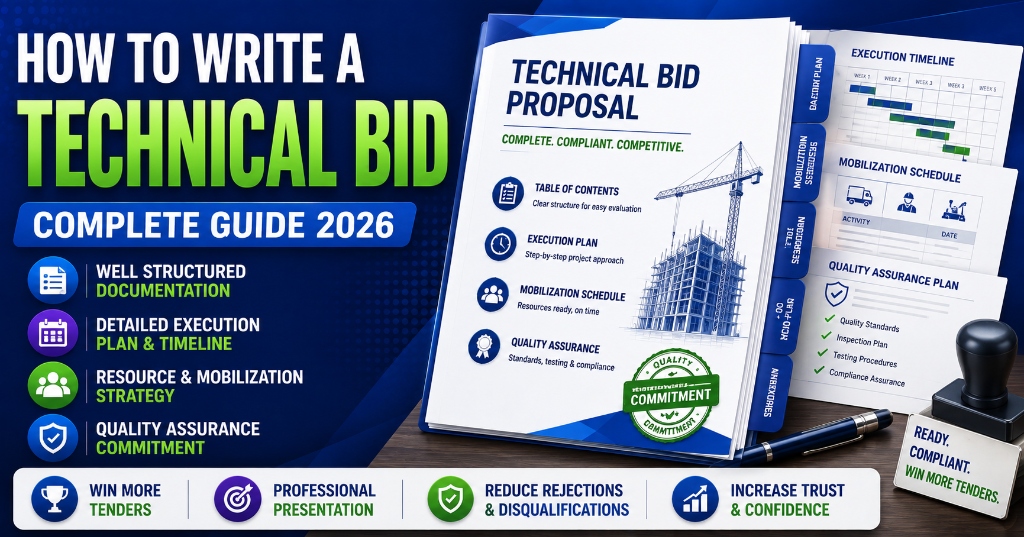
The ₹25 Lakh Crore Opportunity: Why Technical Bids Make or Break Your Success
India's public procurement market is estimated at ₹20–25 lakh crore annually—roughly 15–20% of GDP. In a single week of June 2026, over 64,000 fresh tenders worth ₹1.85 lakh crore were posted across central ministries, state portals, and GeM. Yet, 86.7% of these tenders fall under ₹1 crore—making them accessible to MSMEs and emerging contractors. For the comprehensive end-to-end framework, consult our step-by-step government tender bidding process. To understand foundational rules, refer to our how to read a tender document. (See also: 20 Strategic Pre-Bid Meeting Questions Guide). (See also: Tender Performance Tracking & SLA Execution Guide). (See also: Two-Bid System Protocol & Two-Packet Rules Guide). (See also: 50-Point Tender Eligibility Decision Checklist).
But here's the brutal truth: your financial bid is irrelevant if your technical bid doesn't clear the minimum qualifying threshold.
Most government tenders in India use a two-stage evaluation where technical bids are scored first. Only bidders achieving 70–75% of the maximum technical score proceed to financial bid opening. A technically perfect bid at a higher price can win under QCBS (Quality and Cost Based Selection), while a cheap bid with a weak technical score gets rejected before price is even considered.
Key Insight: Technical bid evaluation is the single most important gate in Indian government procurement. Understanding how evaluators score your proposal isn't optional—it's the difference between consistent wins and perpetual rejection.---

Get the Bid Mastery Toolkit
From document download to token submission — every checklist, tracker, and milestone planner.
- ✓ 150-Point Pre-Submission Checklist (PDF)
- ✓ 50-Point Technical Bid Compliance Audit
- ✓ 30-Point Financial Bid Verification
- ✓ Bid Submission Timeline & Deadline Planner (Excel)
🔒 256-Bit Secure Razorpay Checkout · Lifetime Access · Instant Digital Delivery
What Is a Technical Bid? The Foundation of Government Procurement
A technical bid is the non-financial component of your tender submission that demonstrates your eligibility, technical capability, compliance readiness, and operational capacity to execute the contract. It answers one fundamental question: *Can this bidder actually deliver what the government needs?*
Unlike the financial bid (which contains pricing), the technical bid focuses entirely on:
| Dimension | What Evaluators Look For |
|---|---|
| Legal Eligibility | Company registration, PAN, GST, Udyam, licenses |
| Financial Health | Audited turnover, solvency, net worth |
| Past Performance | Similar completed projects, completion certificates |
| Technical Capacity | Equipment, manpower, methodology, QA systems |
| Compliance | Adherence to every specification in the tender document |
The Two-Envelope System: How Technical Evaluation Actually Works
Indian government tenders predominantly use the two-envelope (or two-cover) system (for a complete comparison, check out our Technical Bid vs Financial Bid Guide):
- Envelope 1 – Technical Bid: Contains all capability and compliance documents
- Envelope 2 – Financial Bid: Contains pricing, BOQ, and commercial terms
The Opening Sequence
| Stage | Action | Outcome |
|---|---|---|
| Technical Bid Opening | All technical bids are opened on the scheduled date | Bidder names and basic details recorded |
| Technical Evaluation | Committee evaluates against published criteria | Shortlist of technically qualified bidders |
| Financial Bid Opening | Only qualified bidders' financial bids opened | Price comparison and ranking |
This separation exists to prevent price from influencing technical judgment. If both were opened simultaneously, evaluators might unconsciously favor the lowest bidder's technical proposal or let cost considerations bias capability assessment.
Pro Tip: During the technical evaluation period (typically 2–4 weeks), stay hyper-responsive. Evaluation committees often issue clarification requests with 24–48 hour deadlines. Slow responses reduce your technical score or trigger disqualification.---
Instant Tender Eligibility & Risk Audit
Upload any 500-page NIT / BOQ PDF. Extract hidden disqualification traps, EMD waiver clauses, and complete eligibility criteria in under 45 seconds.
Technical Bid Scoring Decoded: The Math Behind Qualification
Every government tender publishes a technical evaluation matrix in the tender document. Understanding this matrix before you write a single word is the key to maximizing your score.
Typical Weighted Criteria Breakdown
| Criterion | Weight | What Wins Maximum Marks |
|---|---|---|
| Relevant Experience | 25–30% | Largest similar contract value, number of completed projects |
| Technical Methodology | 20–25% | Detailed execution plan, innovation, quality assurance |
| Team Qualifications | 15–20% | Key personnel education, certifications, years of experience |
| Equipment & Resources | 10–15% | Ownership vs. hiring, equipment condition, capacity |
| Compliance & Certifications | 10–15% | BIS, ISO, sector-specific licenses, environmental clearances |
| Financial Capacity | 5–10% | Turnover, solvency certificate, banking arrangements |
Common Scoring Formulas
1. Point-Based System (0–100 scale)- Each criterion carries defined marks
- Bidders are scored against pre-defined benchmarks
- Example: "Experience of single contract above ₹1.5 Cr = 25/25 marks; above ₹1.2 Cr = 18/25 marks"
- Certain criteria are binary (yes/no)
- Failure on any mandatory criterion = disqualification
- Remaining criteria are scored comparatively
- Technical score contributes 70–80% of final score
- Financial score contributes 20–30%
- Formula: Final Score = (Technical Score × 0.7) + (Financial Score × 0.3)
Strategic Insight: In QCBS tenders, a bidder with a strong technical score (85/100) and moderate pricing can beat a technically weaker bidder (72/100) even if the latter quotes 10% lower. This makes technical bid optimization your highest-ROI activity.---
The Complete Technical Bid Document Checklist
Use this master checklist for every CPPP, GeM, or state portal tender. Missing even one document typically results in disqualification.
Tier 1: Mandatory Legal Documents
- Company Registration Certificate (ROC/Partnership Deed/Proprietorship proof)
- PAN Card copy (self-attested)
- GST Registration Certificate
- Udyam Registration Certificate (for MSME benefits, get it as detailed in our Udyam Registration Complete Guide)
- Digital Signature Certificate (Class 3, registered on the portal)
Tier 2: Financial Qualification Documents
- Audited Balance Sheets & P&L Statements (last 3 years)
- Turnover Certificate from Chartered Accountant
- Solvency Certificate from Bank (typically 5–10% of tender value)
- Net Worth Certificate
- Income Tax Returns (last 3 years)
Tier 3: Experience & Performance Records
- Work Experience Certificates from previous clients
- Completion Certificates for similar projects
- Work Orders/LOAs with value and duration clearly stated
- Client appreciation letters (if available)
- Photographic evidence of completed works
Tier 4: Technical Capability Documents
- Technical Compliance Matrix (filled and signed)
- Detailed Project Methodology/Execution Plan
- Quality Assurance Plan
- Manpower deployment chart with CVs of key personnel
- Equipment list with ownership proof or hiring agreements
- Site organization chart
- Safety plan (for construction/works tenders)
Tier 5: Sector-Specific Certifications
- BIS/ISI certification (for goods/manufacturing)
- ISO 9001, 14001, 45001 (as required)
- FSSAI license (for food products)
- Electrical license (for electrical works)
- Pollution Control Board clearance (for industrial projects)
- NSIC registration (if applicable)
Tier 6: Tender-Specific Documents
- EMD details (if not exempt — see our EMD Complete Guide and EMD Exemption Guide)
- Tender fee payment proof
- Integrity Pact (for high-value tenders)
- Affidavit of non-blacklisting
- Power of Attorney for authorized signatory
How to Build a Bulletproof Compliance Matrix
A compliance matrix is your secret weapon for technical bid success. It transforms dense tender documents into a trackable, verifiable roadmap that evaluators can audit in minutes.
The Compliance Matrix Structure
| S.No. | Tender Reference | Requirement Summary | Compliance Status | Response Location | Evidence Attached |
|---|---|---|---|---|---|
| 1 | Section 3.1 | Bidder must be registered company for 5+ years | Fully Compliant | Company Profile, Page 1 | ROC Certificate |
| 2 | Section 4.2 | Minimum average turnover ₹5 Cr over 3 years | Fully Compliant | Financial Documents | CA Turnover Certificate |
| 3 | Section 5.1 | Must have completed 3 similar projects | Fully Compliant | Experience Certificate | Work Completion Certificates |
| 4 | Section 6.3 | Key personnel must hold BE (Civil) degree | Fully Compliant | Manpower Details | CV of Project Manager |
How to Build It (Step-by-Step)
Step 1: Extract Every RequirementRead the tender document line-by-line. Capture every mandatory deliverable, technical specification, formatting rule, and eligibility criterion. Assign each a unique reference number tied to the clause/section.
Step 2: Map Your ResponseFor each requirement, identify exactly where in your bid you address it. Use page numbers, section titles, and appendix references.
Step 3: Attach EvidenceEvery claim needs proof. If you claim "5 years of experience," attach the ROC certificate showing incorporation date. If you claim "ISO 9001 certified," attach the valid certificate.
Step 4: Flag Gaps EarlyMark requirements as "Fully Compliant," "Partially Compliant," or "Non-Compliant." If you find gaps early, you have time to arrange joint ventures, hire key personnel, or acquire certifications before bid submission.
Expert Tip: Teams using compliance matrices report up to 50% higher win rates because the matrix forces complete coverage and makes evaluation effortless for the committee.---
Step-by-Step: Writing Your Technical Bid from Scratch
Phase 1: Pre-Writing Intelligence (Days 1–3)
- Download and parse the complete tender document including NIT, technical specifications, BOQ, and all annexures
- Create your compliance matrix before writing any original content
- Check for corrigenda—bidding on superseded documents is an instant disqualification
- Research the procuring entity's past awards to understand their evaluation priorities
Phase 2: Document Assembly (Days 4–7)
- Gather standard documents from your "My Space" on CPPP or document repository
- Update all certificates to ensure validity extends beyond contract completion
- Prepare experience evidence—ensure certificates explicitly mention tender-relevant scope
- Draft the methodology section tailored to the specific project, not generic copy-paste
Phase 3: Technical Writing (Days 8–12)
- Covering Letter: Reference tender number, accept all terms unconditionally, name authorized signatory
- Company Profile: Legal status, years of operation, core competencies, organizational structure
- Technical Methodology: Step-by-step execution plan, quality checkpoints, risk mitigation, timeline
- Manpower Plan: Key personnel CVs, roles, qualifications, deployment schedule
- Equipment Plan: List with capacities, ownership proof, maintenance records
- Compliance Matrix: Complete mapping as detailed above
Phase 4: Review & Submission (Days 13–15)
- Internal review by a second person—fresh eyes catch compliance gaps
- Verify no pricing data leaked into technical documents
- Digital sign all PDFs with your Class 3 DSC
- Upload 24–48 hours before deadline to avoid portal congestion
- Freeze the bid (on CPPP) and confirm submission receipt
Technical Bid Format Templates by Tender Type
Template A: Works/Civil Construction Tender
| Section | Content | Weight |
|---|---|---|
| Covering Letter | Tender reference, acceptance, signatory details | Mandatory |
| Company Profile | Legal status, turnover, plant & machinery | 10% |
| Experience Record | Similar completed works with values & dates | 25% |
| Methodology | Construction sequence, quality control, safety | 25% |
| Manpower | Key personnel CVs, labor deployment plan | 15% |
| Equipment | Owned/hired machinery list, capacity proof | 10% |
| Compliance Matrix | Point-by-point specification adherence | 15% |
Template B: Goods/Supply Tender
| Section | Content | Weight |
|---|---|---|
| Covering Letter | Tender reference, acceptance, signatory | Mandatory |
| Manufacturer's Profile | Production capacity, quality systems | 15% |
| Technical Specifications | Detailed product specs matching tender requirements | 30% |
| Test Reports | NABL/ILAC lab reports, BIS certificates | 25% |
| Past Supplies | Supply orders to government/PSU clients | 20% |
| After-Sales Service | Warranty, service network, spare parts availability | 10% |
Template C: Services/Consultancy Tender
| Section | Content | Weight |
|---|---|---|
| Covering Letter | Tender reference, acceptance, signatory | Mandatory |
| Firm Profile | Establishment, domain expertise, team size | 15% |
| Understanding of Scope | Interpretation of TOR, key challenges identified | 20% |
| Methodology | Approach, work plan, deliverables schedule | 30% |
| Team Composition | CVs of proposed experts, their roles | 25% |
| Similar Assignments | Relevant past consultancy completions | 10% |
7 Deadly Mistakes That Kill Technical Bids (And How to Avoid Them)
Mistake 1: Including Pricing in the Technical Bid
Impact: Immediate disqualification Fix: Run a "Ctrl+F" search for price-related terms in your technical PDF before upload. Ensure zero financial data exists.Mistake 2: Missing Mandatory Documents
For a list of reasons why bids get disqualified at evaluation, see our Technical Bid Rejection Reasons.
Impact: Disqualification at document-checking stage Fix: Use the master checklist above. Print it. Check every item physically.Mistake 3: Generic Copy-Paste Methodologies
Impact: Low technical score (evaluators spot template content instantly) Fix: Customize every methodology section to the specific project location, scope, and constraints.Mistake 4: Expired Certificates
Impact: Non-compliance on mandatory criteria Fix: Create a certificate expiry tracker. Renew DSCs, ISO certificates, and licenses 30 days before expiry.Mistake 5: Weak Experience Evidence
Impact: Lost marks on experience criteria (often 25–30% of total) Fix: Ensure completion certificates explicitly state the work value, duration, and similarity to the current tender.Mistake 6: Ignoring Corrigenda
Impact: Bidding on outdated requirements Fix: Check for corrigenda daily during the bid preparation period. Subscribe to automated alerts.Mistake 7: Last-Minute Submission
Impact: Portal errors, DSC issues, incomplete uploads Fix: Submit 48 hours early. Use the final 24 hours only for verification. ---Case Study: How a Pune-Based Contractor Improved Win Rate by 40%
Company: Shivneri Infra Solutions Pvt. Ltd., Pune Sector: Civil Works & Road Construction Challenge: Despite bidding on 60+ tenders annually, their win rate was stuck at 8%. Technical bids were consistently scoring 65–68%—just below the 70% qualifying threshold. Diagnosis:- Technical bids used generic templates with minimal customization
- No compliance matrix was included
- Experience certificates lacked specific work value mentions
- Methodology sections were copied from previous bids without addressing site-specific conditions
- Implemented Compliance Matrix Protocol: Every bid now starts with a full requirement mapping before writing
- Customized Methodologies: Each technical proposal addresses specific soil conditions, traffic management, and monsoon challenges for the project location
- Strengthened Evidence: Revisited all past clients to obtain detailed completion certificates with exact values and scope descriptions
- Added Visual Evidence: Included before/after photographs of completed projects with geotags and dates
- Technical scores improved from 65–68% to 78–84%
- Annual win rate jumped from 8% to 14.5% (40+ relative improvement)
- Contract value won increased from ₹4.2 crore to ₹11.7 crore in 12 months
- Bid preparation time actually decreased by 20% due to standardized templates
Key Takeaway: Technical bid improvement isn't about writing more—it's about structuring evidence precisely against the evaluator's scoring rubric.---
Platform-Specific Technical Bid Requirements: CPPP vs GeM vs State Portals
| Feature | CPPP (eprocure.gov.in) | GeM (gem.gov.in) | State Portals |
|---|---|---|---|
| Bid Type | Two-cover technical + financial | Catalogue-based or BoQ-based | Varies (two-cover common) |
| Technical Documents | Detailed PDF uploads | Product specs, images, certifications | Similar to CPPP |
| DSC Requirement | Class 3 (Signing + Encryption) | Class 3 (Signing) | Class 3 (usually) |
| EMD | 2–3% of tender value | Caution money (₹5K–25K) | 2–5% of tender value |
| Evaluation Time | 2–8 weeks | 2–7 days (for bids) | 2–6 weeks |
| Corrigenda Handling | Published on portal only | Dashboard notifications | Portal-specific |
| Startup Exemptions | Experience & EMD waiver | Caution money benefits | Varies by state |
- Technical bids are uploaded as separate PDF documents
- "My Space" feature allows storing standard documents for reuse
- GePNIC system requires specific file naming conventions
- Product listings act as technical bids for direct purchases
- For formal bids above ₹5 lakh, technical compliance is checked against catalogue specifications
- Seller ratings directly influence buyer decisions—maintain 4.5+ stars
TenderFlow Pro: Automate Your Technical Bid Compliance
Writing technical bids manually across 64,000+ annual tenders is operationally impossible for lean MSME teams. TenderFlow Pro solves this through:
🔍 Compliance Matrix Auto-GeneratorUpload any tender PDF and our AI extracts every requirement, maps it against your document repository, and flags gaps in minutes—not days.
📄 Smart Document ManagementStore all certificates, experience proofs, and CVs in one centralized vault. Auto-check expiry dates 30 days in advance.
⚡ Corrigenda AlertsNever miss a tender amendment. Real-time alerts when any procuring entity issues a corrigendum to tenders in your watchlist.
📊 Technical Score PredictorOur engine analyzes your bid against the tender's published evaluation criteria and predicts your likely technical score before submission.
🎯 MSME Benefit OptimizerAutomatically identifies where you can claim Udyam preferences, EMD exemptions, and Startup India waivers.
👉 Start Your Free TenderFlow Pro Trial — Build your first compliance matrix in under 10 minutes. ---FAQs: Technical Bid Mastery
Q1. What is a technical bid in government tendering?A technical bid is the non-financial component demonstrating your eligibility, capability, and compliance. It is evaluated before financial bids are opened.
Q2. What is the minimum qualifying score for technical bids in India?Most tenders set the threshold at 70–75%. Scoring below this means disqualification regardless of your price competitiveness.
Q3. What documents are required in a technical bid?Standard documents include company registration, PAN, GST, Udyam, audited financials (3 years), experience certificates, technical compliance matrix, project methodology, manpower details, and sector-specific licenses.
Q4. Can I include pricing information in the technical bid?Absolutely not. Any financial data in the technical bid results in immediate disqualification under the two-envelope system.
Q5. What is a compliance matrix in tender bidding?A compliance matrix maps every tender requirement to your response, showing exactly where and how you address each specification. It is the single most effective tool for ensuring complete coverage.
Q6. How is technical bid scoring calculated?Evaluators use weighted criteria: experience (25–30%), methodology (20–25%), team qualifications (15–20%), equipment (10–15%), and compliance (10–15%).
Q7. What is the two-envelope bid system?Bidders submit technical and financial bids separately. Technical bids are opened and evaluated first. Only qualified bidders' financial bids are opened later.
Q8. How can startups bid without prior experience?DPIIT-registered startups can claim exemptions from prior experience and turnover requirements on CPPP and many state portals, plus EMD waivers.
Q9. What is the most common reason for technical bid rejection?Missing mandatory documents or failure to meet eligibility criteria. Other top causes: incomplete experience certificates, missing signatures, and absent compliance matrices.
Q10. How long does technical bid evaluation take?Standard tenders: 2–4 weeks. Complex infrastructure/consultancy: 4–8 weeks. Stay responsive to clarification requests.
---Your 30-Day Technical Bid Action Plan
Week 1: Foundation- Audit all existing certificates and documents for validity
- Create a digital document repository organized by category
- Register/obtain Class 3 DSC if not already done
- Complete Udyam registration for MSME benefits
- Build compliance matrix template in Excel/Google Sheets
- Create standardized company profile and methodology frameworks
- Collect and organize all past project evidence with values and dates
- Prepare CV templates for key personnel
- Select a live tender under ₹50 lakh in your domain
- Complete full compliance matrix for this tender
- Write customized methodology addressing site-specific conditions
- Assemble all documents using the master checklist
- Internal review by team member or consultant
- Submit 48 hours before deadline
- Document lessons learned for template improvement
- Set up automated tender alerts for your categories
Conclusion
Technical bid writing is not a creative exercise—it is a structured compliance engineering process. The bidders who win consistently are not necessarily the biggest or the cheapest; they are the ones who understand that evaluators work from scoring rubrics, not intuition.
By mastering compliance matrices, understanding weighted scoring, and maintaining rigorous document discipline, you transform technical bid preparation from a gamble into a predictable, repeatable system.
Your next step: Apply the 30-day action plan above. And when you're ready to scale beyond manual tracking, TenderFlow Pro automates the compliance intelligence that separates winning bidders from the rest. --- Related Articles: