Technical Bid vs Financial Bid: The Complete Difference Guide
menu_book Table of Contents
Writing your non-commercial proposal? Leverage our technical bid writer AI to structure methodology, manpower matrices, and equipment charts.
Financial bidding starts with quantity accuracy. Use the AI BOQ Extractor to parse BOQ schedules directly from scanned or digital PDFs.
Quick Answer Summary
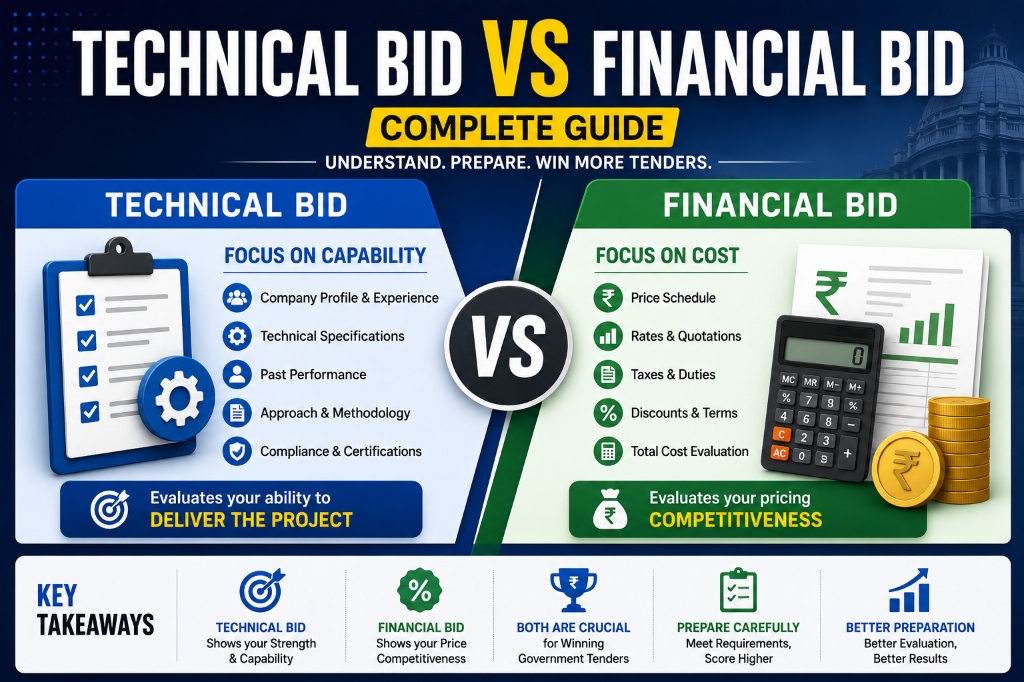
Quick answer: A technical bid proves you can do the work — it covers eligibility, experience, certifications, and methodology, with zero pricing information. A financial bid states what you will charge — a priced Bill of Quantities or rate schedule, with zero technical justification. In almost every Indian government tender, the technical bid is opened and scored first. Only bidders who clear the technical stage get their financial bid opened at all. For the comprehensive end-to-end framework, consult our ultimate guide to Indian government tenders. To understand foundational rules, refer to our BOQ analysis for government tenders. (See also: Tender Pricing Strategy to Win L1 Profitably). (See also: Two-Bid System Protocol & Two-Packet Rules Guide).
If you've downloaded a Notice Inviting Tender (NIT) and seen instructions to submit "Cover 1" and "Cover 2," or "Envelope A" and "Envelope B," this is exactly what that split means. Get the separation wrong — even accidentally mentioning your price inside the technical cover — and the tendering authority can reject your entire bid without ever comparing it on merit.
This guide breaks down what each bid contains, how the evaluation sequence actually works, the difference between L1 selection and QCBS scoring, and a document-by-document checklist you can use before you hit submit.

Get the Bid Mastery Toolkit
From document download to token submission — every checklist, tracker, and milestone planner.
- ✓ 150-Point Pre-Submission Checklist (PDF)
- ✓ 50-Point Technical Bid Compliance Audit
- ✓ 30-Point Financial Bid Verification
- ✓ Bid Submission Timeline & Deadline Planner (Excel)
🔒 256-Bit Secure Razorpay Checkout · Lifetime Access · Instant Digital Delivery
What Is a Technical Bid?
A technical bid (also called a technical proposal or Cover 1) is the part of your tender submission that answers one question for the evaluation committee: can this bidder actually deliver what's being asked for, to the standard required, on time? Learn the exact steps to prepare this document in our Technical Bid Writing Guide, and ensure your technical proposal meets all standards by reading our comprehensive Technical Bid Rejection Guide.
It typically demonstrates four things:
| Area | What it proves | Typical documents |
|---|---|---|
| Eligibility | You're a legitimate, registered entity | Certificate of incorporation, PAN, GST registration, Udyam/MSME certificate |
| Financial standing | You can absorb the project's cash-flow demands | Audited balance sheets, turnover statements, solvency certificate |
| Past experience | You've done similar work before | Work orders, completion certificates, client references |
| Technical capability | Your solution meets the specification | Compliance statement, methodology note, equipment/team details, ISO or product certifications |
A technical bid must never contain price information. Tender documents in India explicitly disqualify bids where pricing is disclosed anywhere in the technical cover, since it defeats the purpose of blind technical evaluation. If you're bidding through an e-procurement portal, this separation is usually enforced structurally — the technical and financial documents are uploaded to different tabs and opened by the system on different dates.
What Is a Financial Bid?
A financial bid (Cover 2, Price Bid, or BOQ) is the commercial half of your submission. It states the price at which you're willing to execute the work, supply the goods, or deliver the service — nothing more. To avoid pricing disqualifications at the final hurdle, read our detailed guide on Financial Bid Rejection Reasons & Solutions.
Depending on the tender type, this means:
- Goods tenders: a priced Bill of Quantities (BOQ) listing unit rates, quantities, and line totals
- Works/construction tenders: an item-rate or lump-sum price schedule matching the department's BOQ format (commonly CPWD, PWD, or MES formats)
- Service tenders: an annual or per-unit service cost, sometimes broken down by manpower category
The financial bid must clearly state whether rates are inclusive or exclusive of GST — tender documents specify this, and quoting in the wrong format is one of the most common reasons a technically strong bid gets rejected at the financial stage. To structure your pricing accurately, follow the step-by-step instructions in our Financial Bid Preparation Guide.
Instant Tender Eligibility & Risk Audit
Upload any 500-page NIT / BOQ PDF. Extract hidden disqualification traps, EMD waiver clauses, and complete eligibility criteria in under 45 seconds.
How the Two-Bid (Two-Envelope) System Works
Most Indian government tenders of any real value use what's called the two-bid or two-envelope system (mandated under the GFR 2017 Rules Guide, specifically GFR Rule 163). Here's the sequence:
- Submission: Bidders submit the technical bid and financial bid as separate sealed envelopes (physical tenders) or separate uploads (e-procurement portals like GeM and CPPP).
- Technical bid opening: On the scheduled date, technical bids are opened first. Bidder names and basic details are recorded publicly.
- Technical evaluation: A tender evaluation committee checks eligibility, experience, and compliance against the criteria published in the NIT.
- Qualified bidder list: Bidders who pass technical evaluation are notified; those who don't are eliminated at this stage.
- Financial bid opening: Only the financial bids of technically qualified bidders are opened. The financial bids of disqualified bidders are returned unopened — this protects their commercial confidentiality.
- Financial evaluation and award: Financial bids are compared, the winner is determined (L1 or QCBS score, depending on method), and a Letter of Acceptance is issued. For MSMEs quoting within L1+15%, they can claim price matching as detailed in our MSME Price Preference Guide. For MSMEs quoting within L1+15%, they can claim price matching as detailed in our MSME Price Preference Guide.
This sequencing exists specifically so that price can never unconsciously bias a technical judgment. If bids were opened together, an evaluator could — even without meaning to — favour the technical proposal of the cheapest bidder.
L1 Selection vs QCBS: Two Different Ways to Pick a Winner
Not every tender picks a winner the same way. Knowing which method applies before you price your bid changes your entire strategy.
L1 (Lowest Cost Selection)
Used for most goods, works, and straightforward service contracts. Once bidders clear technical evaluation on a pass/fail basis, the contract goes to whoever quoted the lowest total price — the "L1" bidder. There's no scoring nuance here: if you're technically compliant and cheapest, you win. This makes precise, realistic pricing the single biggest lever you control.
QCBS (Quality and Cost Based Selection)
Used for consultancy, IT systems, research, audit, and professional service tenders, where quality of approach matters as much as price. Under QCBS:
- Your technical proposal is scored out of 100 against defined sub-criteria (team qualifications, methodology, past experience)
- Only bidders crossing a minimum technical cut-off — commonly 70–75 marks — have their financial bids opened at all
- A combined score is calculated using a weighting formula, commonly:
- 70:30 (Technical:Financial) — the most common split for consultancy tenders
- 80:20 — used when quality is critical and price is secondary
- 60:40 — used in non-consulting service contracts where cost carries more weight
Under QCBS, a bidder scoring 91/100 technically can afford to price higher than a competitor scoring 83/100 and still win on combined score. Always check Section 1 of the tender document to confirm which method — L1 or QCBS — applies before you decide your pricing strategy.
Document Checklist: What Goes Where
| Document | Technical Bid | Financial Bid |
|---|---|---|
| PAN, GST, incorporation certificate | ✅ | ❌ |
| EMD instrument / exemption proof | ✅ | ❌ |
| Turnover statements, audited balance sheets | ✅ | ❌ |
| Work completion certificates | ✅ | ❌ |
| Technical compliance statement | ✅ | ❌ |
| ISO / product certifications | ✅ | ❌ |
| Manufacturer authorisation (if reseller) | ✅ | ❌ |
| Priced BOQ / rate schedule | ❌ | ✅ |
| GST-inclusive/exclusive price declaration | ❌ | ✅ |
| Payment terms acceptance | ❌ | ✅ |
Common Mistakes That Cause Rejection
- Mentioning price anywhere in the technical cover — even a reference like "cost-effective solution at competitive rates" in a methodology note has caused disqualification in some tenders. Keep the technical bid strictly non-commercial.
- Missing the EMD instrument or exemption declaration. If you're a Udyam-registered MSME, you're generally exempt from EMD under Rule 170 of the GFR 2017 — but you must upload your certificate and formally claim the exemption; it isn't automatic. Review EMD amounts and accepted formats in our Earnest Money Deposit (EMD) Complete Guide. Review EMD amounts and accepted formats in our Earnest Money Deposit (EMD) Complete Guide.
- Quoting in the wrong GST format in the financial bid — inclusive when the tender specifies exclusive, or vice versa.
- Mismatched entity names across PAN, GST, and bid documents (a "Pvt Ltd" vs "Private Limited" discrepancy is a surprisingly common rejection reason).
- Assuming the two-bid system applies universally — some GeM catalogue purchases and single-tender awards don't use it. Always confirm the evaluation method in the NIT before assuming.
MSME and Startup Advantages Across Both Bids
If you're Udyam-registered, the two-bid structure works in your favour at multiple points:
- EMD exemption under GFR 2017 Rule 170, once you upload your Udyam certificate and formally claim it
- 15% price-matching window — MSEs quoting within 15% of L1 are often given a chance to match L1 and share a portion of the order quantity (typically split among up to five eligible bidders)
- Relaxed turnover and prior-experience criteria in many tenders, provided technical/quality specifications are still met
None of these are applied automatically — you must submit the certificate and the exemption declaration inside your technical bid every single time.
Frequently Asked Questions
Q1: What is the difference between a technical bid and a financial bid?
A: A technical bid proves capability and compliance — eligibility, experience, and methodology. A financial bid states price. The technical bid is evaluated first; only qualified bidders' financial bids are opened.
Q2: What is the two-bid system in Indian tenders?
A: It's the requirement to submit technical and financial bids as separate sealed covers or separate portal uploads, opened at different times, so price cannot influence technical scoring.
Q3: What is L1 in tendering?
A: L1 is the lowest-priced bid among all technically qualified bidders — the standard basis for contract award in most goods and works tenders.
Q4: What is QCBS in government tenders?
A: Quality and Cost Based Selection — used for consultancy and professional service tenders, where a weighted combination of technical score and price (commonly 70:30) decides the winner.
Q5: Can a financial bid be opened before technical qualification?
A: No — in a properly run two-bid tender, a technically disqualified bidder's financial bid is never opened.
Q6: What documents go in a technical bid?
A: Registration and eligibility documents, EMD proof, experience certificates, technical compliance statements, and certifications — with no pricing.
Q7: What documents go in a financial bid?
A: The priced BOQ or rate schedule, GST treatment declaration, and payment terms — with no technical justification repeated.
Q8: Do MSMEs get any advantage in bid evaluation?
A: Yes — EMD exemption under GFR 2017 Rule 170, and a 15% price-matching opportunity against L1 in many tenders, provided the exemption and MSME status are formally claimed with documentation.
Conclusion: From Rejection to Winning
Tender rejection is not a reflection of your business capability. It is a reflection of a process that is too complex for manual execution. With 500-page documents, 50+ mandatory requirements, and zero tolerance for errors, even the most diligent team will miss something.
The solution is not to work harder. It is to work smarter.
AI-powered tender analysis tools like TenderFlow Pro don't replace your expertise — they amplify it. By automating document parsing, eligibility checking, compliance tracking, and risk detection, we free you to focus on what humans do best: strategy, relationships, and execution.
From Rejection to Winning: The AI Advantage
Manual compliance checking across 500-page documents is impossible. TenderFlow Pro's AI does it in 45 seconds — every time, every tender, zero errors.
Write Your Technical Bid Now → See How It Works →Related Resources:
- 🔗 GeM Registration Complete Guide 2026
- 🔗 MSME Benefits in Government Tenders: Complete Guide 2026
- 🔗 EMD Exemption for MSME Tenders: How to Claim & Save Lakhs
- 🔗 Why Tenders Get Rejected in India: Top 10 Reasons + Fix Guide 2026
Disclaimer: This guide is for informational purposes only. Tender rejection policies vary by department and portal. Always refer to the specific tender document and official portal guidelines. TenderFlow Pro is an independent tool and does not guarantee bid acceptance.