GeM vs CPPP: Complete Difference Guide (2026) — Which Portal Wins for Your Business?
Breadcrumb: Home > Blog > GeM vs CPPP Difference ---menu_book Table of Contents
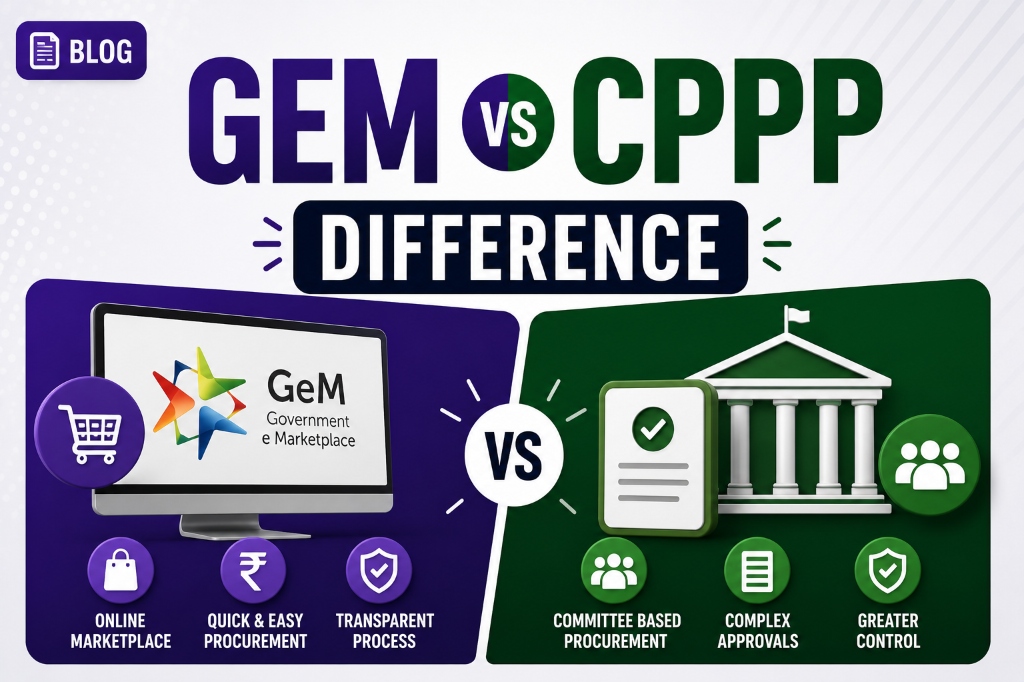
The Parallel Rails of Indian Procurement: An Overview
India's public procurement ecosystem is not a single highway—it is a network of parallel rails, each designed for different types of buyers, sellers, and transactions. At the center of this network stand two giants: For the comprehensive end-to-end framework, consult our full tender bidding process explained. To understand foundational rules, refer to our complete GeM portal guide.
- GeM (Government e-Marketplace): A transactional marketplace processing ₹4+ lakh crore in cumulative GMV
- CPPP (Central Public Procurement Portal): A tender publication engine handling ₹10+ lakh crore annually in contract value
They are not competitors. They are complementary systems serving different procurement needs. Understanding which rail your business should ride—and when to switch between them—is the foundation of government contracting success in India.
---
Get the GeM Success Toolkit
Register, list, bid, and win on GeM without losing a single rupee in deposits or caution money.
- ✓ 150-Point Pre-Submission Checklist (PDF)
- ✓ EMD & BG Format Verification Guide + Excel Checker
- ✓ GST / PAN / TAN Cross-Verification Guide
- ✓ MSME EMD Exemption Claim Letters (4 Formats)
🔒 256-Bit Secure Razorpay Checkout · Lifetime Access · Instant Digital Delivery
What Is GeM? The Marketplace Model
GeM is India's only transactional marketplace for government procurement. Think of it as Amazon for government buyers—but with procurement rules, MSME quotas, and reverse auctions built in.
Core Mechanics
| Feature | How It Works |
|---|---|
| Direct Purchase | Buyers order directly from catalogues for transactions ≤₹25,000 |
| L1 Bidding | For purchases ₹25,000–₹5 lakh, buyers compare prices among lowest 3 sellers |
| Reverse Auction | Live price competition for mid-tier purchases; sellers bid downward in real-time |
| Formal Bid | For purchases >₹5 lakh, structured bid with technical and financial evaluation |
What Makes GeM Unique
- Catalogue-Driven: Your product listing IS your bid. Buyers search, compare, and order without traditional tender documentation.
- Rating Visibility: Buyers see seller ratings before prices. A 4.5+ star seller with 50+ orders often outranks a cheaper but unproven listing.
- Speed: Direct purchases complete in days. Reverse auctions finish in hours.
- MSE-First: 25% mandatory procurement from MSEs, with 3% women-owned and 4% SC/ST sub-quotas.
What Is CPPP? The Tender Publication Engine
CPPP (eprocure.gov.in) is India's institutional backbone for complex public procurement. It is not a marketplace—it is a publication and submission platform where central ministries, PSUs, and autonomous bodies publish formal tenders.
Core Mechanics
| Feature | How It Works |
|---|---|
| e-Publishing | Mandatory publication of all central tenders ≥₹25 lakh (historically; now ₹2 lakh+) |
| e-Procurement | End-to-end digital bid submission, opening, and evaluation |
| Two-Cover System | Separate technical and financial bid submission with sequential evaluation |
| Contract Award | Public posting of award details, reducing disputes and RTIs |
What Makes CPPP Unique
- High-Value Focus: Routinely handles contracts from ₹10 crore to ₹10,000 crore
- Works & Consultancy: Civil, electrical, mechanical, EPC, HAM, BOT—contracts that don't fit catalogues
- Complex Evaluation: QCBS, two-envelope, three-envelope, and committee-based scoring
- Legal Mandate: GFR 2017 makes CPPP mandatory for central government bodies above threshold limits
Instant Tender Eligibility & Risk Audit
Upload any 500-page NIT / BOQ PDF. Extract hidden disqualification traps, EMD waiver clauses, and complete eligibility criteria in under 45 seconds.
Side-by-Side Comparison: 20 Key Differences
| # | Parameter | GeM | CPPP |
|---|---|---|---|
| 1 | Full Name | Government e-Marketplace | Central Public Procurement Portal |
| 2 | URL | gem.gov.in | eprocure.gov.in |
| 3 | Operator | DGS&D / GeM SPV | NIC, Dept. of Expenditure, Ministry of Finance |
| 4 | Primary Purpose | End-to-end marketplace for goods & services | Tender publication & e-procurement for complex contracts |
| 5 | Transaction Model | Catalogue-based, direct purchase, reverse auction | Classical tendering with BOQ, technical evaluation |
| 6 | Typical Contract Value | ₹5,000 to ₹5 crore (direct/formal) | ₹10 lakh to ₹10,000 crore |
| 7 | Annual GMV | ₹4+ lakh crore cumulative | ₹10+ lakh crore |
| 8 | Who Can Buy | Central, state govts, PSUs, armed forces | Central ministries, CPSUs, autonomous bodies |
| 9 | Who Can Sell | Any registered seller (MSMEs, startups, large) | Any eligible bidder with DSC |
| 10 | Registration | Seller onboarding with GST, PAN, bank | Bidder enrollment + Class 3 DSC |
| 11 | DSC Requirement | Class 3 (Signing) | Class 3 (Signing + Encryption) |
| 12 | EMD/Caution Money | Caution money ₹5K–25K based on turnover | EMD 2–3% of tender value (see our EMD Complete Guide) |
| 13 | Bid Types | Direct purchase, L1, reverse auction, formal bid | Open, limited, EOI, two-cover, QCBS |
| 14 | Technical Bid | Product specs in catalogue (for formal bids) | Detailed PDF submission with compliance matrix |
| 15 | Financial Bid | Catalogue price or bid price in portal | Encrypted BOQ (Excel) upload |
| 16 | Evaluation Time | 2–7 days (for bids) | 2–8 weeks |
| 17 | Startup Exemptions | Simplified onboarding, caution money benefits | Experience, turnover, EMD exemptions |
| 18 | MSME Preference | 25% mandatory; L1 price matching | EMD exemption (see our EMD Exemption Guide); purchase preference |
| 19 | Best For | Standardized goods, services, MSME products | Works, infrastructure, consultancy, complex procurement |
| 20 | Integration | PFMS, e-invoice, DigiLocker | e-BG (NeSL), Entity Locker, GeM (GeMARPTS) |
Architecture Deep Dive: How Transactions Actually Work
GeM Transaction Flow
Buyer Need → Search Catalogue → Compare Listings → Add to Cart → Place Order → Seller Accepts → Deliver → Invoice → Payment (PFMS)
Key Characteristics:- Buyers search by category, brand, specification
- Seller ratings influence search ranking
- Payment processed through PFMS (Public Financial Management System)
- e-Invoice auto-generated for compliant sellers
CPPP Transaction Flow
Buyer Need → Create NIT → Publish on CPPP → Bidders Download → Prepare Technical Bid → Submit Technical Bid → Technical Evaluation → Open Financial Bids (Qualified Only) → Financial Evaluation → Award Contract → Upload AOC
Key Characteristics:- Tender documents are downloaded as PDF + Excel BOQ
- Bids encrypted with PKI technology
- Two authorized bid openers decrypt with DSCs
- Contract award published publicly
Bid Mechanics: Direct Purchase vs Two-Cover System
GeM Bid Mechanics
| Purchase Value | Mechanism | Seller Action |
|---|---|---|
| ≤₹25,000 | Direct Purchase | Maintain accurate catalogue; competitive pricing |
| ₹25,000 – ₹5 lakh | L1 + Reverse Auction | Respond to bid invites; participate in live auctions |
| >₹5 lakh | Formal Bid (GeM Bid) | Submit technical compliance; price in bid interface |
CPPP Bid Mechanics
| Stage | Buyer Action | Bidder Action |
|---|---|---|
| NIT Publication | Publish tender with specifications | Download documents; check corrigenda |
| Pre-Bid Meeting | Clarify scope (optional) | Attend; submit written queries |
| Technical Bid Submission | — | Upload compliance documents; sign with DSC |
| Technical Opening | Open bids; record names | Verify presence; respond to clarifications |
| Technical Evaluation | Score against criteria | Wait; respond to clarification requests |
| Financial Opening | Decrypt qualified bidders' BOQs | Verify rates; understand ranking |
| Financial Evaluation | Compare prices; check abnormally low bids | Defend pricing if scrutinized |
| Contract Award | Publish award; sign contract | Execute agreement; submit performance guarantee |
Registration Requirements: What You Need for Each Portal
GeM Registration Checklist
| Requirement | Details | Priority |
|---|---|---|
| PAN Card | Business PAN | Mandatory |
| GST Registration | Active GSTIN | Mandatory |
| Bank Account | Current account for settlements | Mandatory |
| Aadhaar | For proprietorships | Mandatory (2026 update) |
| Udyam Registration | MSME certificate | Highly Recommended |
| Caution Money | ₹5K–25K based on turnover | Mandatory |
| Product Images | 1000×1000 px, white background | For listing |
CPPP Registration Checklist
| Requirement | Details | Priority |
|---|---|---|
| Class 3 DSC | Signing + Encryption combo | Mandatory |
| PAN Card | Business PAN | Mandatory |
| GST Registration | Active GSTIN | Mandatory |
| Company Documents | Registration certificate, MOA/AOA | Mandatory |
| Email & Mobile | For OTP and notifications | Mandatory |
| Bank Details | For EMD refund | Mandatory |
| Udyam/Startup | For exemptions | Recommended |
Transaction Values & Market Size
| Portal | Estimated Annual Value | Average Transaction | Growth Rate |
|---|---|---|---|
| GeM | ₹4+ lakh crore (cumulative) | ₹12–15 lakh | 40%+ annually |
| CPPP | ₹10+ lakh crore | ₹4–5 crore | 15–20% annually |
| State Portals | ₹6+ lakh crore (aggregated) | ₹1–2 crore | 10–15% annually |
| IREPS | ₹2.5+ lakh crore | ₹5–10 crore | Steady |
| MSTC | ₹1.5+ lakh crore | ₹2–5 crore | Steady |
MSME & Startup Benefits on Both Portals
GeM MSME Benefits
| Benefit | Details |
|---|---|
| 25% Mandatory Procurement | Central govt buyers must buy 25% from MSEs annually (see our 25% Procurement Reservation Guide) |
| Price Matching | MSEs quoting within L1 + 15% can get order at L1 price (see our MSME Price Preference Guide) |
| Direct Purchase Access | Orders up to ₹25,000 without competition |
| Caution Money Exemption | Significant reduction for Udyam-registered sellers |
| Startup Onboarding | Simplified; exemptions from prior turnover/experience |
CPPP MSME/Startup Benefits
| Benefit | Details |
|---|---|
| EMD Exemption | For Udyam-registered MSMEs on qualifying tenders |
| Turnover Exemption | Startups exempt from minimum turnover requirements |
| Experience Exemption | Startups exempt from prior experience requirements |
| Purchase Preference | Price preference in L1 evaluation for MSEs |
| Make in India | Domestic manufacturers get preference in certain categories |
The GeMARPTS Connection: How GeM and CPPP Integrate
Many sellers don't realize that GeM and CPPP are integrated through a mechanism called GeMARPTS.
How It Works
- When a central government body wants to publish a tender on CPPP for goods/services, they must first check if the item is available on GeM.
- If the item is listed on GeM at a competitive price, the buyer may be directed to procure through GeM instead.
- If not available or suitable on GeM, the buyer obtains a GeMARPTS ID (GeM Availability Report and Price Transparency Statement).
- This GeMARPTS ID is referenced in the CPPP tender document, proving GeM was checked.
Decision Framework: Which Portal Should You Prioritize?
Step 1: Classify What You Sell
| Your Product/Service | Primary Portal | Secondary Portal |
|---|---|---|
| Standardized goods (IT, furniture, stationery, vehicles) | GeM | CPPP (for bulk CPSE orders) |
| Civil works ₹1–10 Cr | State Portal | CPPP (central schemes) |
| Civil works ₹10 Cr+ | CPPP | NHAI, state PWD |
| Consultancy/DPR/QCBS | CPPP | State portals |
| Railway supplies/works | IREPS | — |
| Defence supplies | Defence Portal | IREPS (RDSO items) |
| Scrap/surplus/coal | MSTC | — |
| IT services/manpower | GeM | CPPP (large projects) |
Step 2: Classify Your Business Maturity
| Business Profile | Recommended Focus |
|---|---|
| New startup, turnover <₹50 lakh | GeM (low barrier, fast orders) |
| Growing MSME, turnover ₹50 lakh–₹5 Cr | GeM + 1 State Portal |
| Established contractor, turnover ₹5–₹50 Cr | CPPP + GeM + State Portal |
| Large EPC, turnover >₹50 Cr | CPPP + IREPS + NHAI + State |
Step 3: Match Your Team Capacity
| Team Size | Realistic Portal Mix |
|---|---|
| 1–2 people | 1 portal (GeM for products; State for works) |
| 3–5 people | 2 portals (GeM + CPPP or GeM + State) |
| 6–10 people | 3–4 portals with aggregation tools |
| 10+ people | Multi-portal with dedicated bid managers |
Case Study A: MSME Manufacturer Winning on GeM
Company: Bharat Electricals Pvt. Ltd., Indore Product: LED Street Lights and Solar Lamps Turnover: ₹3.2 crore Strategy:- Listed 45 SKUs on GeM with complete BIS certifications
- Priced 8% below market to capture initial orders
- Enabled delivery to all 28 states
- Maintained 4.8-star rating through rapid fulfillment
- Direct purchase orders: 312 orders worth ₹1.1 crore
- Bid wins: 8 formal bids worth ₹2.4 crore
- Total GeM revenue: ₹3.5 crore (109% of previous annual turnover)
- Buyer base: 45 government departments across 12 states
Key Insight: GeM rewards operational excellence. Once catalogue and ratings are established, orders become predictable and repeatable.---
Case Study B: Infrastructure Contractor Winning on CPPP
Company: Shivalik Construction Consortium, Chandigarh Sector: Road Construction & Bridge Maintenance Turnover: ₹28 crore Challenge:- GeM doesn't handle ₹15+ crore infrastructure works
- State portals were saturated with local competitors
- Needed access to centrally-sponsored schemes (PMGSY, NHAI)
- Registered on CPPP with Class 3 DSC and complete document repository
- Focused on CPWD and Ministry of Road Transport tenders
- Built technical bid templates customized for highway construction
- Used compliance matrices for every submission
- Bids submitted: 34
- Technical qualification rate: 91% (up from 65%)
- Contracts won: 4 contracts worth ₹31 crore
- Win rate: 11.7% (industry average: 6–8%)
Key Insight: On CPPP, technical bid discipline separates winners from the 60% of bidders who get disqualified at the first stage.---
The Hybrid Strategy: Why Serious Bidders Use Both
The most successful government contractors in India don't choose between GeM and CPPP—they master both.
The Hybrid Model
| Revenue Stream | Portal | Purpose |
|---|---|---|
| Baseline Revenue | GeM | Predictable, recurring orders for standard products |
| Growth Revenue | CPPP | High-value, strategic contracts |
| Market Expansion | State Portals | Geographic depth |
| Niche Opportunities | IREPS/MSTC/Defence | Specialized, lower-competition segments |
Resource Allocation Framework
| Activity | GeM | CPPP | Time Split |
|---|---|---|---|
| Daily Monitoring | Catalogue updates, order fulfillment | Tender search, corrigenda tracking | 40% GeM / 60% CPPP |
| Weekly Activity | Price adjustments, inventory sync | Bid preparation, document updates | 30% GeM / 70% CPPP |
| Monthly Strategy | New product launches, rating analysis | Pipeline review, win/loss analysis | 20% GeM / 80% CPPP |
TenderFlow Pro: Unified Portal Intelligence
Tracking 2–4 portals manually is operationally exhausting. TenderFlow Pro unifies your procurement intelligence:
🔍 Cross-Portal Tender DiscoveryOne search across GeM, CPPP, and 500+ state/PSU portals. No more switching between 15 tabs.
📧 Smart AlertsGet notified when tenders matching your credentials are published—on any portal. Corrigenda tracked automatically.
📄 Unified Document VaultStore certificates, CVs, and compliance documents once. Auto-populate into GeM listings and CPPP bid submissions.
🎯 Opportunity ScoringOur AI ranks opportunities by your win probability, considering your turnover, experience, and past performance.
📊 Competitor IntelligenceSee who won similar contracts, at what price, and with what credentials. Benchmark your bids against real market data.
👉 See Unified Portal Tracking ---FAQs: GeM vs CPPP Clarity
Q1. What is the difference between GeM and CPPP?GeM is a transactional marketplace for goods and services. CPPP is a tender publication platform for complex, high-value contracts including works and consultancy.
Q2. Which is better for MSMEs: GeM or CPPP?GeM is generally better for MSMEs selling standardized products due to lower barriers and 25% mandatory procurement. CPPP suits MSMEs with specialized capabilities for larger contracts.
Q3. Is GeM mandatory for all government procurement?No. Works above ₹5 crore, construction, and most consultancy are exempt and run on CPPP or specialized portals.
Q4. Do I need separate registrations for GeM and CPPP?Yes. GeM requires seller onboarding. CPPP requires bidder enrollment with Class 3 DSC. Both must be registered independently.
Q5. What is the transaction value difference?GeM: cumulative ₹4+ lakh crore, individual transactions typically under ₹50 lakh. CPPP: ₹10+ lakh crore annually, handling tenders up to ₹10,000 crore.
Q6. Can I use the same DSC for GeM and CPPP?Yes. One Class 3 DSC works across both, but must be mapped separately on each portal.
Q7. What is GeMARPTS?GeMARPTS is a GeM-generated ID proving items were checked on GeM before publishing a CPPP tender, ensuring price transparency.
Q8. Which portal has lower competition?CPPP high-value tenders have fewer bidders due to stringent eligibility. GeM has more competition but higher transaction volume.
Q9. Are startups eligible for both GeM and CPPP?Yes. Startups get exemptions on experience, turnover, and EMD on CPPP, plus simplified onboarding on GeM.
Q10. Should I track both GeM and CPPP?Most serious contractors track both. GeM for standardized goods/services, CPPP for high-value works and consultancy.
---Your 30-Day Dual-Portal Action Plan
Week 1: Foundation- Complete GeM seller registration (GST, PAN, bank, Aadhaar)
- Complete CPPP bidder enrollment (Class 3 DSC, company documents)
- Complete Udyam registration for MSME benefits
- Set up document vault with all certificates and CVs
- List 10–20 priority products with complete specs and images
- Request brand approval if needed
- Set competitive pricing based on market research
- Enable delivery to maximum locations
- Search 20 active tenders matching your credentials
- Download and analyze 3 tender documents thoroughly
- Build compliance matrix for 1 target tender
- Prepare technical bid template for your domain
- Submit first GeM bid or optimize catalogue for direct purchases
- Submit first CPPP technical bid (if ready)
- Set up automated alerts for both portals
- Document lessons learned and refine templates
Conclusion
GeM and CPPP are not rivals—they are the yin and yang of Indian government procurement. GeM delivers speed, volume, and accessibility for standardized needs. CPPP delivers scale, complexity, and strategic value for bespoke requirements.
The question is not "Which portal should I use?" The question is "What percentage of my attention should each portal receive based on what I sell and where I am in my growth journey?"
For most MSMEs, the answer is: Start with GeM, graduate to CPPP, and eventually master both.
Ready to dominate both portals? Get TenderFlow Pro and manage GeM catalogues, CPPP bids, and 500+ state portals from a single intelligence dashboard. --- Related Articles: Meta Tags: