Complete Government Tender Guide India 2026: Step-by-Step Bidding Process for MSMEs, Startups & Contractors
menu_book Table of Contents
For dispute resolution, bidders can leverage the AI Protest Letter Generator to appeal tender decisions within 10 days of award.
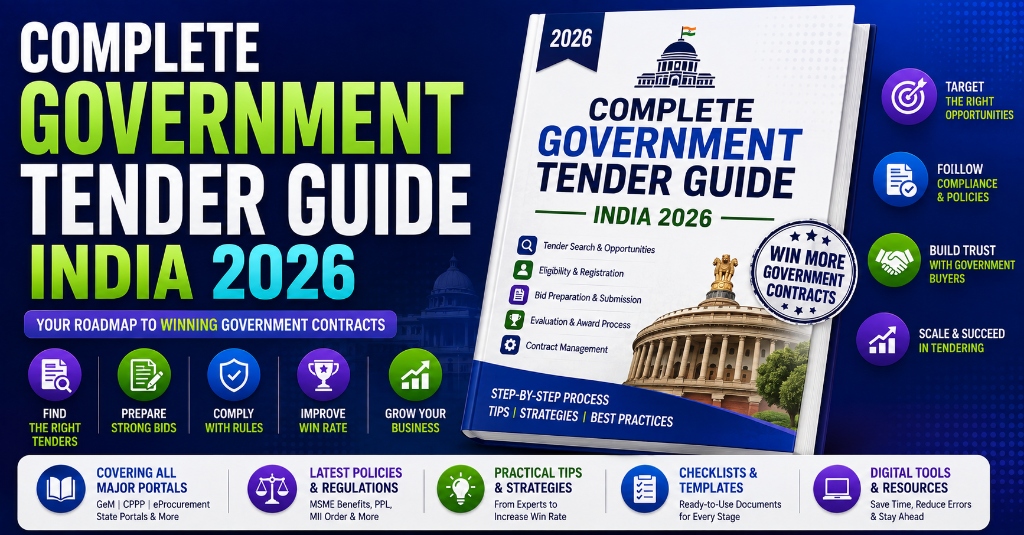
Introduction: The ₹70 Lakh Crore Opportunity Hiding in Plain Sight
Government procurement in India is worth an estimated ₹50–70 lakh crore annually — roughly 20–22% of the country's GDP. Yet thousands of MSMEs, startups, and contractors watch these contracts go to competitors simply because they don't know where to look or how to bid. To understand foundational rules, refer to our how to read a tender document.
Consider this: The Government e-Marketplace (GeM) alone has facilitated procurement worth over ₹18.4 lakh crore cumulatively, crossing ₹5 lakh crore in FY 2025-26 alone. More than 11 lakh Micro and Small Enterprises (MSEs) are registered on GeM, and they accounted for 68% of total orders by count and 47.1% of total GMV in FY 2025-26. Over 2.1 lakh women-led MSEs received orders exceeding ₹28,000 crore, while startups secured orders worth over ₹19,000 crore — marking growth of over 36%.
The most shocking statistic? Approximately 20–30% of all tender bids are rejected at the technical evaluation stage before price is even considered. That's not a capability problem — that's a process problem. A missing document, a formatting error, or a misunderstood clause costs Indian businesses ₹5–20 lakh annually in wasted preparation costs and forfeited EMD.
This guide is the most comprehensive resource on government tender bidding in India — built for MSMEs, startups, individual contractors, and established businesses who want to access the government procurement pipeline systematically. We cover everything from finding your first tender to winning L1, from GFR 2017 rules to AI-powered bid analysis, from EMD exemption to post-award contract management.
Whether you're bidding on GeM for a ₹2 lakh supply order or on CPPP for a ₹50 crore infrastructure project, this guide gives you the exact framework to bid with confidence, compliance, and competitive advantage.
Key Insight: Government tender bidding is not about being the cheapest bidder. It's about being the most compliant bidder who also prices competitively. A technically perfect bid at L2 price wins over a non-compliant L1 bid every single time.
🚀 Ready to analyze your first tender? Upload any government tender PDF and get a complete eligibility check, BOQ extraction, and compliance report in 45 seconds. Analyze My Tender FREE →

Get the Zero-Rejection Tender Mastery Bundle™
Get all 12 verified checklists, Excel trackers, PoA formats, and appeal letter packs.
- ✓ 150-Point Pre-Submission Audit (PDF)
- ✓ 50-Point Technical & 30-Point Financial Audits
- ✓ EMD & Bank Guarantee Excel Checker
- ✓ Document Expiry & Renewal Tracker (Excel)
- ✓ 5 Post-Rejection Appeal Letter Formats
- ✓ 10 Experience Certificate Templates
🔒 256-Bit Secure Razorpay Checkout · Lifetime Access · Instant Digital Delivery
What Is a Government Tender? Definition, Types & Legal Framework
Definition
A government tender is a formal, structured invitation issued by a government department, ministry, public sector undertaking (PSU), or state government entity to procure goods, services, or works from private vendors. The process is governed by the General Financial Rules, 2017 (GFR 2017) issued by the Department of Expenditure, Ministry of Finance, and is designed to ensure transparency, fairness, competition, and value for public money.
Government tenders are legally binding procurement processes. Once published, the tendering authority must evaluate all compliant bids objectively and award the contract to the lowest evaluated responsive bidder (L1) — unless specific policy exceptions apply (such as MSME price preference or Make in India local content requirements).
The Legal Framework: GFR 2017 & Key Amendments
The entire government procurement ecosystem in India operates under GFR 2017, which was comprehensively amended in July 2024 to modernize thresholds and streamline processes. Key amendments include:
| Rule | Before July 2024 | After July 2024 | Impact on Bidders |
|---|---|---|---|
| Rule 133(1) — Direct repair works | Up to ₹30 lakh | Up to ₹60 lakh | More direct execution, fewer small repair tenders |
| Rule 154 — Purchase without quotation | Up to ₹25,000 | Up to ₹50,000 | Simplified low-value buying |
| Rule 161 — Open Tender threshold | ₹25 lakh+ | ₹25 lakh+ (unchanged) | ATE remains mandatory for high-value |
| Rule 162 — Limited Tender threshold | Up to ₹25 lakh | Up to ₹25 lakh | LTE still for lower value |
| Rule 170 — EMD exemption for MSME | Exempt for MSEs | Exempt for MSEs | No change — MSMEs still save 1-3% |
For a deep dive into individual GFR rules, read our GFR 2017 Tender Rules Explained guide.
Types of Government Tenders in India
Understanding tender types is critical because each type has different eligibility requirements, competition levels, and bidding strategies.
1. Open Tender Enquiry (ATE) — GFR Rule 161
The most common and transparent procurement method. Open to all qualified bidders who meet eligibility criteria.
- Threshold: Mandatory for procurements above ₹25 lakh (standard goods/services)
- Advertisement: Published on CPPP, GeM, state portals, and sometimes newspapers
- Timeline: Minimum 4–6 weeks from publication to bid deadline
- Competition: Highest — multiple vendors participate
- Best for: Infrastructure, IT equipment, supplies, construction works
- MSME Advantage: EMD exemption + 15% price preference + 25% reservation
2. Limited Tender Enquiry (LTE) — GFR Rule 162
Restricted to a pre-selected list of registered suppliers. The department sends bid documents directly to known vendors.
- Threshold: Up to ₹25 lakh (standard); exceptions for specialized goods
- Invitation: Direct to registered vendors + published on CPPP/GeM
- Requirement: Must invite more than 3 firms
- Best for: Specialized services, maintenance contracts, recurring supply
- MSME Strategy: Register with department vendor lists proactively
3. Single Tender Enquiry (STE) — GFR Rule 162(iii)
Used when only one supplier can provide the required goods/services.
- Valid scenarios: Proprietary spare parts, emergency procurement, sole OEM
- Requirement: Proprietary Article Certificate (PAC) + competent authority approval
- Documentation: Must justify why open tender was not feasible
- Best for: OEMs with installed government equipment, emergency suppliers
4. Two-Stage Bidding — GFR Rule 165
Used for complex, high-value projects where technical specifications cannot be fully defined upfront.
- Stage 1: Request for Qualification (RFQ) or Expression of Interest (EOI) — technical capability assessment
- Stage 2: Request for Proposal (RFP) — only shortlisted bidders submit financial bids
- Best for: Smart city projects, defense systems, IT infrastructure, research contracts
5. Electronic Reverse Auction (e-RA)
Real-time online competitive bidding where vendors submit progressively lower prices during a scheduled window.
- Platform: Primarily GeM, sometimes CPPP
- Mechanism: Automated L1 determination with live ranking
- Best for: Standardized goods with clear specs (office supplies, IT hardware, vehicles)
- MSME Advantage: MSEs can match L1 price under 15% preference policy
Comparison: Which Tender Type Should You Target?
| Tender Type | Value Range | Competition | MSME Suitability | Preparation Time | Win Probability for MSME |
|---|---|---|---|---|---|
| Open Tender | ₹25 lakh – ₹500+ crore | Very High | ★★★★★ | 2–4 weeks | Medium-High (with price preference) |
| Limited Tender | Up to ₹25 lakh | Medium | ★★★★☆ | 1–2 weeks | High (if on vendor list) |
| Single Tender | Variable | None (sole source) | ★★☆☆☆ | 1–2 weeks | Very High (if you're the OEM) |
| Two-Stage | ₹50 crore+ | High (but filtered) | ★★★☆☆ | 4–8 weeks | Medium (needs JV/consortium) |
| e-Reverse Auction | ₹1 lakh – ₹5 crore | Very High | ★★★★★ | 1–3 days | High (price-driven) |
The 8-Stage Government Tender Bidding Process: A Visual Map
Before diving into each stage, here's the complete bidder journey from opportunity identification to contract execution:
┌─────────────────┐    ┌─────────────────┐    ┌─────────────────┐    ┌─────────────────┐
│  STAGE 1        │ →  │  STAGE 2        │ →  │  STAGE 3        │ →  │  STAGE 4        │
│  Find Tender    │    │  Check Eligibility│   │  Prepare Docs   │    │  Technical Bid  │
│  (GeM/CPPP/     │    │  (Go/No-Go)     │    │  (Checklist)    │    │  (Compliance)   │
│   State Portal) │    │                 │    │                 │    │                 │
└─────────────────┘    └─────────────────┘    └─────────────────┘    └─────────────────┘
         ↓
┌─────────────────┐    ┌─────────────────┐    ┌─────────────────┐    ┌─────────────────┐
│  STAGE 5        │ →  │  STAGE 6        │ →  │  STAGE 7        │ →  │  STAGE 8        │
│  Financial Bid  │    │  Submit Bid     │    │  Opening +      │    │  Award +        │
│  (Pricing/BOQ)  │    │  (Portal/DSC)   │    │  Evaluation     │    │  Performance    │
│                 │    │                 │    │  (Tech → Fin)   │    │  Security       │
└─────────────────┘    └─────────────────┘    └─────────────────┘    └─────────────────┘
Average Timeline: 45–90 days from tender publication to contract award for standard open tenders. Complex two-stage tenders can take 120–180 days.
Instant Tender Eligibility & Risk Audit
Upload any 500-page NIT / BOQ PDF. Extract hidden disqualification traps, EMD waiver clauses, and complete eligibility criteria in under 45 seconds.
Stage 1: Finding & Identifying the Right Tenders
Where Government Tenders Are Published
India has a three-tier procurement portal ecosystem. Knowing where to look determines what contracts you can access:
Tier 1: Central Government Portals
| Portal | URL | What You'll Find | Best For |
|---|---|---|---|
| GeM | gem.gov.in | Goods & services up to ₹200 crore, direct purchase, bidding, reverse auctions | Product sellers, service providers, MSMEs |
| CPPP | eprocure.gov.in | High-value works, infrastructure, complex procurement above ₹25 lakh | Construction, engineering, large contractors |
| IREPS | ireps.gov.in | Railway tenders, track materials, rolling stock, maintenance | Railway suppliers, infrastructure firms |
| MoD | mod.gov.in | Defense procurement, ammunition, vehicles, IT systems | Defense contractors, MSMEs with Make in India |
Tier 2: State e-Procurement Portals
Every Indian state operates its own e-procurement portal for state government departments, municipal corporations, and panchayats:
| State | Portal URL | Notable Departments |
|---|---|---|
| Maharashtra | mahatenders.gov.in | PWD, Water Supply, Health |
| Gujarat | eprocure.gujarat.gov.in | Roads & Buildings, Education |
| Karnataka | eproc.karnataka.gov.in | PWD, Urban Development |
| Tamil Nadu | etenders.tn.gov.in | Highways, Rural Development |
| Uttar Pradesh | tender.up.nic.in | PWD, Irrigation, Education |
| Rajasthan | eproc.rajasthan.gov.in | PWD, PHED, Energy |
| Haryana | eprocurementharyana.gov.in | PWD, Urban Local Bodies |
| Madhya Pradesh | mpeproc.gov.in | PWD, Water Resources |
For a complete list of all 28 state portals with registration guides, see our State Tender Portals India Complete List (coming soon).
Tier 3: PSU & Department-Specific Portals
| Organization | Portal | Procurement Type |
|---|---|---|
| CPWD | cpwd.gov.in | Construction, maintenance, renovation |
| NHAI | nhai.gov.in | Highway construction, toll management |
| NTPC | ntpc.co.in | Power plant equipment, services |
| ONGC | ongcindia.com | Oil & gas equipment, exploration services |
| BHEL | bhel.com | Heavy electrical equipment |
| DRDO | drdo.gov.in | Defense R&D, scientific equipment |
How to Set Up Tender Alerts (So You Never Miss an Opportunity)
Manual Method (Free but Time-Consuming):
- Visit GeM, CPPP, and your target state portal daily
- Use keyword filters (your product category, location, value range)
- Download NITs and save to a spreadsheet
- Set calendar reminders for deadlines
Automated Method (Recommended):
- Register for email alerts on GeM (category-based)
- Subscribe to CPPP's RSS feed for your department
- Use TenderFlow Pro's AI monitoring (scans all portals, sends matched alerts)
- Set up Google Alerts for "[your product] tender [your state]"
Pro Tip: The best tenders are often found before they're widely publicized. Register as a vendor with 10+ target departments. Many departments issue Limited Tenders to their registered vendor list before publishing on open portals.
Stage 2: Eligibility Verification — The Bid/No-Bid Decision
This is the most critical stage that most bidders skip. Poor qualification is cited as the #1 cause of wasted bid effort. Teams using structured bid/no-bid scoring improve win rates by 15–20% because they stop burning capacity on low-probability opportunities.
The 5-Minute Eligibility Check
Before downloading the full tender document (which can be 500+ pages), check these knockout criteria in the Notice Inviting Tender (NIT):
| Check | What to Verify | Your Action |
|---|---|---|
| 1. Turnover | "Average annual turnover of ₹X lakh for last 3 years" | Calculate your average. MSMEs get up to 50% relaxation. |
| 2. Experience | "Y similar completed works in last Z years" | Count only exact-match projects. Certificates must mention value + date. |
| 3. EMD Amount | "EMD of ₹X or 2% of tender value" | MSMEs: Claim exemption. Others: Ensure liquid funds available. |
| 4. Registration Requirements | Udyam, GST, PAN, DSC, ISO, BIS, etc. | Check expiry dates. Renew if < 30 days to deadline. |
| 5. Blacklist Check | "Firm should not be blacklisted by any government dept" | Search CPPP banned list, GeM debarment list, state portals. |
| 6. Local Content | "Minimum 50% local content required" | Calculate your supply chain. Check Make in India Order applicability. |
| 7. Joint Venture | "JV/consortium allowed/not allowed" | If not allowed and you need a partner, skip this tender. |
| 8. Bid Validity | "Bid valid for 90/120/180 days" | Ensure your EMD and price commitment cover this period. |
The Bid/No-Bid Scoring Matrix
Score each opportunity 0–10. Bid only on 7+ scores.
| Criteria | Weight | Score (0–10) |
|---|---|---|
| Eligibility match | 25% | ___ |
| Past experience alignment | 20% | ___ |
| Competitive pricing feasibility | 20% | ___ |
| Resource availability | 15% | ___ |
| Strategic value (new dept/sector) | 10% | ___ |
| Timeline feasibility | 10% | ___ |
| Weighted Total | 100% | ___ |
Decision Rule:
- 8–10: Bid aggressively. Allocate best resources.
- 6–7: Bid selectively. Use standard templates.
- < 6: Do not bid. Use time for better opportunities.
Case Study: A Pune-based engineering firm was bidding on 40+ tenders annually with a 5% win rate. After implementing a strict bid/no-bid matrix, they reduced bids to 18 per year — but win rate jumped to 28%. Revenue increased by 35% with 55% less effort.
For a detailed eligibility checklist, use our Tender Eligibility Checklist Complete Guide (coming soon) or download our 50-Point Tender Vetting Checklist.
Stage 3: Document Preparation — The Complete Checklist
Government tender documents list 15–50 mandatory documents across technical and financial bids. Missing even one — even a seemingly minor one like a cancelled cheque — results in automatic disqualification at the technical evaluation stage.
Category A: Company Registration & Legal Documents
| Document | Purpose | Validity | Where MSMEs Save |
|---|---|---|---|
| GST Certificate | Tax compliance proof | Permanent (update details if changed) | Required for all |
| PAN Card | Income tax identity | Permanent | Required for all |
| Udyam Registration | MSME identity for benefits | No fixed expiry — keep details current | Free registration guide |
| Company Incorporation | Legal entity proof | Permanent | Required for all |
| Partnership Deed / MOA-AOA | Ownership structure | Permanent | Required for all |
| Power of Attorney | Authorized signatory proof | As specified (usually 1–3 years) | Required for all |
Category B: Financial Documents
| Document | Purpose | Validity | MSME Benefit |
|---|---|---|---|
| Audited Financials (3 years) | Financial health proof | FY 2023-24, 2024-25, 2025-26 | Up to 50% turnover relaxation |
| Solvency Certificate | Proof of financial capacity | 6 months from issue | May be relaxed for MSEs |
| Bank Certificate | Creditworthiness | 3 months from issue | Often waived for MSEs |
| CA Certificate for Turnover | Turnover verification | Current FY | Required for turnover criteria |
| Net Worth Certificate | Asset verification | Current FY | Required for high-value tenders |
Category C: Technical & Experience Documents
| Document | Purpose | What Evaluators Check |
|---|---|---|
| Experience Certificates | Proof of similar completed works | Must mention: work description, contract value, completion date, client contact |
| Work Completion Certificates | Proof of successful delivery | Must be from government/PSU/reputed private client |
| OEM Authorization Letter | Proof of dealership/distributorship | Must be on OEM letterhead, specify territory, validity |
| BIS/ISO/FSSAI Certificates | Product/service quality compliance | Must match tender specifications exactly |
| Technical Compliance Statement | Declaration of spec adherence | Must address every technical requirement line-by-line |
| Test Reports / Lab Certificates | Product quality verification | Must be from NABL-accredited labs |
Category D: Tender-Specific Documents
| Document | When Required | Common Mistakes |
|---|---|---|
| EMD / Bid Security Declaration | All tenders except MSME-exempt | Wrong format, incorrect amount, expired validity |
| Integrity Pact | Tenders above ₹10 crore | Unsigned, wrong format, missing stamp |
| MSME Declaration | When claiming MSME benefits | Udyam number mismatch, wrong category |
| Make in India Declaration | When claiming local content benefit | Incorrect local content percentage calculation |
| Bid Form (Prescribed Format) | All tenders | Using old format, modifying columns, wrong font |
| Covering Letter | All tenders | Wrong addressee, missing authorized signature |
Document Expiry Tracker
Use this table to track your document validity. Set renewal alerts 30 days before expiry:
| Document | Issue Date | Expiry Date | Days Left | Renewal Action |
|---|---|---|---|---|
| DSC Class III | ___ | ___ | ___ | Renew 15 days before |
| Udyam Registration | ___ | ___ | ___ | Update if details change |
| ISO 9001:2015 | ___ | ___ | ___ | Recertification audit |
| BIS License | ___ | ___ | ___ | Renewal application |
| Bank Guarantee (EMD) | ___ | ___ | ___ | Must cover bid validity + 30 days |
Pro Tip: Create a "Master Document Vault" — a cloud folder with PDFs of all your documents organized by category. Before every bid, simply copy the relevant documents instead of scrambling to find them. Use our Document Expiry Tracker Tool (coming soon) for automated alerts.
Stage 4: Technical Bid Preparation — How to Win Before Price Matters
The technical bid is where 80% of rejections happen. If you don't pass technical evaluation, your financial bid is never opened. This means your price — no matter how competitive — is irrelevant.
Understanding the Two-Envelope System
Most government tenders in India use the two-bid system:
- Envelope 1: Technical Bid — Contains all documents, compliance statements, experience certificates, and technical proposals. Opened first.
- Envelope 2: Financial Bid — Contains pricing, BOQ, and commercial terms. Opened only for technically qualified bidders.
For a detailed comparison, read our Technical Bid vs Financial Bid Complete Guide.
The Technical Compliance Matrix (Your Secret Weapon)
A compliance matrix is a table that maps every tender requirement to your response location. Evaluation committees use this to score your bid. If they can't find a response, you get zero marks — even if the document is buried somewhere in your 200-page submission.
Format:
| S.No. | Tender Requirement (Exact Quote) | Your Compliance (Yes/No/Partial) | Document Reference (Page/Annexure) | Remarks |
|---|---|---|---|---|
| 1 | "Bidder must have average annual turnover of ₹50 lakh for last 3 years" | Yes | Annexure A, Page 3 — CA Certificate | Turnover: ₹72 lakh avg |
| 2 | "Bidder must have completed 3 similar works in last 5 years" | Yes | Annexure B, Pages 4–6 — Completion Certificates | 4 works completed |
| 3 | "LED lights must have IP66 rating and 5-year warranty" | Yes | Annexure C, Page 7 — BIS Test Report + Warranty Letter | IP66 certified, 5-year warranty |
| 4 | "Bidder must submit solvency certificate for ₹25 lakh" | Yes | Annexure D, Page 8 — Bank Solvency Certificate | ₹30 lakh solvency |
Why this wins: Evaluators spend an average of 12–18 minutes per bid during technical evaluation. A compliance matrix helps them verify your bid in 3 minutes instead of 30. Bids with compliance matrices score 15–20% higher.
Download our Compliance Matrix Template for free.
Technical Bid Writing Best Practices
Mirror the tender language: Use the exact same terminology as the tender document. If the tender says "BIS IS 1239 certified MS pipes," don't write "ISI-marked equivalent pipes."
Lead with evidence, not claims: Don't say "We are experienced." Say "We have completed 4 similar projects worth ₹3.2 crore in the last 5 years. See Annexure B."
Use tables, not paragraphs: Evaluators scan tables faster than prose. Convert every list into a structured table.
Include photographs and diagrams: For construction tenders, include site photos of completed works. For supply tenders, include product photos with certification marks visible.
Attach every certificate mentioned: If you claim ISO 9001, attach the certificate. If you claim BIS certification, attach the license. Unsubstantiated claims = zero marks.
For step-by-step technical bid writing, read our How to Write a Technical Bid Guide.
Stage 5: Financial Bid Preparation — Pricing to Win L1
The financial bid determines who wins — but only among technically qualified bidders. Your goal is to be the Lowest Evaluated Responsive Bidder (L1) while maintaining profitability.
Understanding L1, L2, L3 Rankings
| Rank | Definition | What Happens |
|---|---|---|
| L1 | Lowest compliant financial bid | Wins the contract (or gets first right of refusal) |
| L2 | Second lowest compliant bid | May get a portion if L1 can't fulfill entire order |
| L3 | Third lowest compliant bid | Standby position |
| L1+15% | MSMEs quoting within 15% of L1 | Can match L1 price and win 25% of order value |
The L1+15% MSME Price Preference Explained
This is the most powerful MSME benefit in government procurement. Here's how it works:
Scenario:
- Tender value: ₹1 crore
- L1 bidder: Large enterprise quoting ₹95 lakh
- Your MSME quote: ₹1.08 crore (13.6% higher than L1)
Result: Since you're within 15% of L1, you can match the L1 price of ₹95 lakh and still win 25% of the total order value (₹25 lakh). The L1 bidder gets the remaining 75%.
The Math:
| Bidder | Type | Original Quote | vs L1 | Eligible for Preference? | Final Award |
|---|---|---|---|---|---|
| Enterprise A | Large | ₹95 lakh | L1 | N/A | ₹75 lakh (75%) |
| MSME B | Micro | ₹1.08 crore | +13.6% | ✅ Yes — matches L1 | ₹25 lakh (25%) |
| MSME C | Small | ₹1.12 crore | +17.9% | ❌ No — exceeds 15% | ₹0 (rejected) |
For a complete breakdown, read our MSME Price Preference L1+15% Guide.
Financial Bid Format Requirements
Government tenders specify exact pricing formats. Deviating by even one rupee can lead to rejection.
Standard BOQ Format:
| S.No. | Item Description | Unit | Qty | Unit Rate (Excl. GST) | GST Rate | GST Amount | Total (Incl. GST) |
|---|---|---|---|---|---|---|---|
| 1 | LED Street Light 150W | Each | 50 | ₹4,500 | 18% | ₹810 | ₹5,310 |
| 2 | Pole 8m GI | Each | 50 | ₹8,000 | 18% | ₹1,440 | ₹9,440 |
Common Financial Bid Mistakes:
- GST-inclusive vs exclusive: If the format says "Excl. GST," don't include GST in the unit rate
- Rounding errors: Use Excel formulas, not manual calculations
- Modified BOQ: Never delete rows, add columns, or change formulas in the portal-provided Excel
- Price in technical bid: Any financial figure in the technical envelope = instant disqualification
- Wrong currency: Quoting in USD when INR is required
For detailed financial bid preparation, read our Financial Bid Preparation Guide India.
Pricing Strategy Framework
Step 1: Cost Build-Up
- Direct material cost: ₹___
- Direct labor cost: ₹___
- Overhead (15–20%): ₹___
- Profit margin (minimum 10%): ₹___
- Base cost: ₹___
Step 2: Market Intelligence
- Check past tender awards for similar items (available on CPPP)
- Analyze competitor pricing patterns
- Factor in MSME price preference (can you afford to quote L1+12% and still match?)
Step 3: Strategic Pricing
- For must-win tenders: Quote at cost + 5% (accept lower margin for strategic entry)
- For regular tenders: Quote at cost + 15–20% (standard margin)
- For high-risk tenders: Quote at cost + 25–30% (risk premium for payment delays, LD clauses)
Use our Price Preference Calculator to determine your optimal bid price under MSME preference rules.
Stage 6: Bid Submission — Portal Mechanics & Deadline Strategy
Portal-Specific Submission Processes
GeM Submission Process
- Login with seller credentials + DSC
- Navigate to the bid/RA from your dashboard
- Upload Technical Bid — PDF format, max file size as specified
- Upload Financial Bid — Excel BOQ (use portal-provided template only)
- Upload EMD — Bid Security Declaration for MSMEs / EMD instrument for others
- Digital Sign all documents using DSC
- Review all uploads in preview mode
- Submit and download acknowledgement receipt with timestamp
CPPP (eprocure.gov.in) Submission Process
- Login with vendor credentials + DSC
- Download tender documents and BOQ Excel
- Fill BOQ offline using prescribed Excel (locked cells = don't modify)
- Upload Technical Bid — all documents merged into single PDF
- Upload Financial Bid — filled BOQ Excel + price schedule PDF
- Hash Generation — system generates hash values for both bids
- Digital Sign using DSC Class III
- Submit before deadline — system records exact timestamp
The "Last 2 Hours" Portal Crash Problem
Government e-procurement portals experience massive traffic spikes in the final 2–4 hours before major tender deadlines. During these spikes:
| Time Before Deadline | Average Upload Speed | Timeout Rate | Failure Rate |
|---|---|---|---|
| 24+ hours | 2.5 MB/s | 2% | 1% |
| 6–12 hours | 1.8 MB/s | 8% | 5% |
| 2–4 hours | 0.6 MB/s | 25% | 18% |
| < 1 hour | 0.2 MB/s | 45% | 35% |
The Fix:
- Submit at least 24 hours before deadline (48 hours for large bids)
- Test portal speed 2 days before deadline
- Keep all documents ready in draft mode
- Submit in batches — technical bid first, then financial bid
- Download submission acknowledgement immediately and verify timestamp
Real Example: A software company in Hyderabad started uploading at 2:00 PM for a 3:00 PM deadline. Portal slowed due to traffic. Final upload completed at 3:02 PM. System recorded timestamp and rejected the bid automatically. Lost opportunity: ₹12 lakh contract.
Stage 7: Bid Opening & Evaluation — What Happens Behind Closed Doors
Technical Bid Opening
- Who attends: Tendering authority, evaluation committee (3–5 members), bidders (optional)
- What happens: All technical bids are opened and evaluated against mandatory criteria
- Timeline: 7–30 days after submission deadline
- Outcome: List of "technically qualified bidders" is published
Evaluation Criteria (Typical Weightage):
| Criteria | Weight | What Evaluators Look For |
|---|---|---|
| Eligibility Compliance | Pass/Fail | Must meet all mandatory criteria |
| Technical Specifications | 30–40% | Exact match with tender specs |
| Experience & Past Performance | 20–30% | Number, value, and recency of similar works |
| Financial Capacity | 10–15% | Turnover, solvency, net worth |
| Methodology & Approach | 10–20% | Quality of technical proposal |
| Quality Certifications | 5–10% | ISO, BIS, sector-specific certifications |
Financial Bid Opening
- Who attends: Same committee, but only technically qualified bidders' financial bids are opened
- What happens: Financial bids are opened one by one, and L1, L2, L3 are determined
- Timeline: 3–15 days after technical evaluation
- Outcome: L1 bidder is identified; MSME price preference is applied
The Negotiation Stage (When L1 is Too High)
If the L1 bid is significantly higher than the department's estimated cost, the committee may:
- Negotiate with L1: Ask L1 to reduce price by a reasonable margin (usually 5–10%)
- Reject all bids: If no bid is within acceptable range, tender is cancelled and re-floated
- Split the order: Award to L1 and L2 at negotiated prices
Important: Under GFR 2017, post-bid corrections are not permitted — even for clerical errors. The Supreme Court ruled in September 2025 that post-bid corrections compromise tender integrity. Your bid must be perfect at submission.
Stage 8: Contract Award, Performance Security & Post-Award Management
Contract Award Process
- Letter of Intent (LoI): Department issues LoI to L1 bidder (or MSME under price preference)
- Acceptance: Bidder accepts LoI within specified time (usually 7–15 days)
- Performance Security: Bidder submits Performance Bank Guarantee (PBG) or FDR (typically 5–10% of contract value)
- Agreement Signing: Both parties sign the contract agreement
- Work Order: Department issues work order / supply order
- Commencement: Work begins as per contract timeline
Performance Security Requirements
| Contract Value | PBG Amount | Validity | Format |
|---|---|---|---|
| Up to ₹50 lakh | 5% of contract value | Contract period + 60 days | Bank Guarantee / FDR |
| ₹50 lakh – ₹5 crore | 7.5% of contract value | Contract period + 60 days | Bank Guarantee |
| Above ₹5 crore | 10% of contract value | Contract period + 60 days | Bank Guarantee |
For detailed PBG rules, read our Performance Security GFR Rule 171 Refund Guide.
Post-Award Compliance
Once you win, your responsibilities include:
- Mobilization: Deploy resources, materials, and manpower as per contract schedule
- Progress Reporting: Submit monthly/quarterly progress reports
- Quality Assurance: Maintain quality standards as per technical specifications
- Payment Claims: Submit RA bills / running account bills on schedule
- Defect Liability Period (DLP): Fix any defects during the DLP (usually 12 months)
- Final Bill: Submit final bill with all supporting documents
- PBG Release: Apply for PBG release after DLP completion
Payment Timeline: Government departments are mandated to pay MSMEs within 45 days of acceptance of goods/services. For delays beyond 45 days, MSMEs can file complaints on the MSME Samadhaan Portal and claim interest at 3x the RBI bank rate.
MSME Benefits in Government Tenders: The Complete Advantage Breakdown
If you're an MSME, government tenders are designed to favor you. Here's every benefit you should claim:
1. EMD Exemption — Save 1–3% Per Tender
Under GFR Rule 170 and the Public Procurement Policy for MSEs (2012), Micro and Small Enterprises with valid Udyam registration are fully exempt from Earnest Money Deposit on most central government tenders.
What You Save:
| Tender Value | EMD Rate (2%) | Your Savings (as MSME) |
|---|---|---|
| ₹10 lakh | ₹20,000 | ₹20,000 |
| ₹50 lakh | ₹1,00,000 | ₹1,00,000 |
| ₹1 crore | ₹2,00,000 | ₹2,00,000 |
| ₹5 crore | ₹10,00,000 | ₹10,00,000 |
| ₹10 crore | ₹20,00,000 | ₹20,00,000 |
Instead of EMD, submit a Bid Security Declaration (free, no bank guarantee needed).
For complete EMD exemption rules, read our EMD Exemption for MSME Tenders Guide.
2. 15% Price Preference (L1+15%) — Win Even When You Quote Higher
If a large enterprise is L1 and your MSME quote is within 15% of L1, you can match the L1 price and win 25% of the total order value.
Real Example:
- Tender: Supply of 1,000 computers to a government college
- L1 (Large Co.): ₹4.75 crore
- MSME Bidder: ₹5.30 crore (+11.6%)
- Result: MSME matched L1 price of ₹4.75 crore and won 250 computers worth ₹1.19 crore
Use our EMD Calculator and Price Preference Calculator to calculate your exact benefits.
3. 25% Procurement Reservation
At least 25% of total central government annual procurement is reserved for Micro and Small Enterprises. This includes:
- 4% sub-reservation for SC/ST-owned MSEs
- 3% sub-reservation for women-owned MSEs
- 358 exclusive items on GeM reserved for MSEs only
For details, read our 25% Procurement Reservation for MSME Guide.
4. Relaxed Turnover & Experience Norms
MSMEs get up to 50% relaxation in turnover and experience requirements under GFR 2017.
| Criteria | Standard Requirement | MSME Relaxed Requirement |
|---|---|---|
| Turnover | ₹50 lakh avg (3 years) | ₹25 lakh avg (3 years) |
| Experience | 5 similar works | 3 similar works |
| Net Worth | ₹25 lakh | ₹12.5 lakh |
5. MSME-Only Tenders on GeM
GeM regularly floats bids open only to Udyam-registered sellers — competitors without Udyam registration cannot even see these tenders. These appear as "MSME Only" or "MSE Only" bids on the platform.
6. Faster Payment Protection
Under the MSME Development Act, 2006, government buyers must pay MSMEs within 45 days. For delays:
- File complaint on MSME Samadhaan Portal
- Claim interest at 3x the RBI bank rate (currently ~10.5% per annum)
- No court fees required for complaints up to ₹1 crore
GeM vs CPPP vs State Portals: Where Should You Bid?
| Feature | GeM (gem.gov.in) | CPPP (eprocure.gov.in) | State Portals |
|---|---|---|---|
| Procurement Type | Goods & services | Works, infrastructure, complex projects | State-specific works & services |
| Value Range | ₹1 lakh – ₹200 crore | ₹25 lakh – ₹500+ crore | ₹10 lakh – ₹100+ crore |
| Process | Catalog-based, direct purchase, bidding, RA | Custom BOQ, two-bid system | Varies by state |
| Registration | Seller registration + catalog approval | Vendor registration | Vendor registration |
| EMD | Usually not required (except high-value) | 1–3% of tender value | 1–3% of tender value |
| MSME Benefits | Full (EMD exemption, price preference, exclusive bids) | Full (EMD exemption, price preference) | Varies by state policy |
| Payment Cycle | 45 days (GeM escrow) | 45–90 days | 45–120 days |
| Best For | Product sellers, service providers, MSMEs | Construction, engineering, large contractors | Local contractors, state-focused businesses |
For a detailed comparison, read our GeM vs CPPP Difference Guide.
GFR 2017 Tender Rules Explained: The Legal Backbone
The General Financial Rules, 2017 are the constitution of government procurement in India. Here are the most critical rules every bidder must know:
Rule 149 — Modes of Procurement
| Mode | Threshold | When Used |
|---|---|---|
| Direct Purchase | Up to ₹50,000 (post-July 2024) | Routine, low-value items |
| Limited Tender | Up to ₹25 lakh | Known suppliers, specialized goods |
| Open Tender | Above ₹25 lakh | Standard procurement |
| Single Tender | Any value | Proprietary, emergency |
| Two-Stage | Any value | Complex, undefined specs |
Rule 154 — Purchase Without Quotation
Purchase of goods up to ₹50,000 (increased from ₹25,000 in July 2024) can be made without inviting quotations on the basis of a certificate by the competent authority.
Rule 161 — Advertised Tender Enquiry (ATE)
Mandatory for procurements above ₹25 lakh. Must be advertised on CPPP, GeM, and newspapers (for high-value).
Rule 162 — Limited Tender Enquiry (LTE)
For procurements up to ₹25 lakh or when only limited suppliers exist. Must invite more than 3 firms.
Rule 166 — Proprietary Article Certificate (PAC)
Required for single tender enquiries. Must be certified by a technical expert and approved by competent authority.
Rule 170 — EMD Exemption for MSME
Micro and Small Enterprises are exempt from EMD on all central government tenders. Submit Bid Security Declaration instead.
Rule 171 — Performance Security
Successful bidder must submit PBG or FDR as performance security (5–10% of contract value).
Rule 173 — Bid Security (EMD)
EMD is required at 1–3% of tender value. Must be in the form of DD, BG, or FDR as specified.
For a complete rule-by-rule breakdown, read our GFR 2017 Tender Rules Explained.
Top 15 Tender Rejection Reasons & How to Prevent Them
Based on analysis of 500+ tenders and industry data, here are the top rejection reasons with prevention strategies:
| Rank | Rejection Reason | % of Rejections | Prevention Strategy |
|---|---|---|---|
| 1 | Missing mandatory documents | 35% | Use our 50-point checklist + compliance matrix |
| 2 | Non-compliance with technical specs | 25% | Create technical compliance statement |
| 3 | EMD issues (wrong format/amount/expiry) | 15% | Use EMD calculator + claim MSME exemption |
| 4 | Deadline miss / portal crash | 10% | Submit 24+ hours early |
| 5 | Eligibility criteria failure | 10% | Run bid/no-bid matrix before preparing |
| 6 | Wrong bid format / annexure | 8% | Download fresh formats from current tender |
| 7 | GST / pricing errors | 7% | Use Excel formulas, get CA review |
| 8 | Missing / expired DSC | 5% | Track expiry 30 days before deadline |
| 9 | Corrigendum not checked | 5% | Check portal daily after downloading |
| 10 | Blacklisting / debarment | 3% | Check CPPP/GeM banned lists before bidding |
| 11 | Power of attorney issues | 3% | Ensure PoA matches authorized signatory |
| 12 | Integrity pact errors | 2% | Sign exactly as prescribed |
| 13 | BOQ format modification | 2% | Don't modify portal-provided Excel |
| 14 | Financial data in technical bid | 2% | Keep envelopes strictly separate |
| 15 | Price validity mismatch | 1% | Ensure quote validity covers bid validity period |
For detailed rejection analysis, read our Why Tenders Get Rejected in India guide.
Department-Wise Tender Bidding: Defence, Railways, PSU & State Guides
Defence Tenders (MoD / DRDO / OFB)
- Complexity: Very High
- Rejection Rate: ~35%
- Top Rejection Reason: Security clearance missing
- MSME Opportunity: Make in India preference, 50% local content requirement
- Portal: mod.gov.in, drdo.gov.in, OFB portals
- Key Requirement: DGS&D registration for many categories
Railway Tenders (IREPS / RailTel)
- Complexity: High
- Rejection Rate: ~28%
- Top Rejection Reason: Technical spec non-compliance
- MSME Opportunity: Large volume of maintenance and supply tenders
- Portal: ireps.gov.in
- Key Requirement: IREPS vendor registration, RDSO approval for critical items
CPWD Tenders
- Complexity: High
- Rejection Rate: ~22%
- Top Rejection Reason: Experience certificate issues
- MSME Opportunity: Small works tenders up to ₹25 lakh
- Portal: cpwd.gov.in
- Key Requirement: CPWD contractor registration (Class-based)
NHAI Tenders
- Complexity: Medium-High
- Rejection Rate: ~20%
- Top Rejection Reason: Financial bid format errors
- MSME Opportunity: Sub-contracting opportunities, maintenance contracts
- Portal: nhai.gov.in
State PWD Tenders
- Complexity: Medium
- Rejection Rate: ~25%
- Top Rejection Reason: EMD / BG issues
- MSME Opportunity: Largest volume of tenders for local contractors
- Portal: State-specific (e.g., mahatenders.gov.in)
Tender Pricing Strategy: How to Quote to Win L1
The 4-Quadrant Pricing Model
| High Competition | Low Competition | |
|---|---|---|
| High Value | Quote aggressively (cost + 8–12%) | Quote standard (cost + 15–20%) |
| Low Value | Quote standard (cost + 15–20%) | Quote premium (cost + 20–25%) |
Cost-Plus vs Market-Based Pricing
Cost-Plus Method (Recommended for MSMEs):
- Calculate direct costs (material + labor + overhead)
- Add profit margin (minimum 10%)
- Add risk premium (5–10% for payment delay risk)
- Compare with market intelligence
- Adjust to fit L1+15% window if MSME
Market-Based Method (For Experienced Bidders):
- Analyze past 5 similar tender awards
- Calculate average winning price
- Quote 2–5% below average (if your costs allow)
- Ensure you're still profitable
The MSME Price Matching Strategy
When to use L1+15% matching:
- Your quote is within 10–14% of estimated L1
- You can absorb the price difference and still break even
- The order volume justifies lower margin
- It's a strategic entry into a new department
When NOT to match:
- Your quote is > 15% of L1 (not eligible)
- Matching L1 would result in a loss
- The order is too small to justify margin sacrifice
- You have better opportunities at standard pricing
Use our Win Probability Calculator to assess your chances before finalizing price.
Digital Tools & AI in Government Tender Bidding
The Manual vs AI-Powered Bidding Comparison
| Aspect | Manual Bidding | AI-Powered Bidding (TenderFlow Pro) |
|---|---|---|
| Document Reading | 3–5 days per 500-page tender | 45 seconds |
| Eligibility Check | Manual comparison (error-prone) | Automated profile matching |
| Compliance Matrix | 4–6 hours manual creation | Auto-generated in 2 minutes |
| BOQ Extraction | Copy-paste into Excel (errors) | Structured data export |
| EMD Calculation | Manual calculation | Auto-calculated with exemption check |
| Corrigendum Tracking | Daily manual checking | Instant alerts |
| Protest Letter | Hire lawyer (₹15,000+) | Auto-generated, lawyer-ready |
| Analyst Cost | ₹25,000–₹1,00,000 per tender | ₹2,999/month unlimited |
| Win Rate Improvement | Baseline | +25–40% |
How AI Tender Analysis Works
- Upload: Submit any government tender PDF (up to 20MB)
- Extract: AI maps the tender's DNA — dates, EMD, BOQ, technical criteria, financials
- Audit: Auto-checks eligibility against GFR 2017, MII preferences, local content mandates
- Report: Delivers win probability, compliance score, and actionable report
For a detailed comparison, read our AI Tender Analysis vs Manual Review guide (coming soon).
50-Point Tender Compliance Checklist (Downloadable)
Use this master checklist before every bid submission. Download the PDF version here.
Pre-Bid Phase (15 Points)
- 1. Read NIT eligibility criteria completely
- 2. Run bid/no-bid scoring matrix (score ≥ 7)
- 3. Verify turnover meets requirement (with MSME relaxation if applicable)
- 4. Count similar experience projects (exact match only)
- 5. Check blacklisting status on CPPP, GeM, state portals
- 6. Verify DSC validity (minimum 30 days beyond deadline)
- 7. Check Udyam registration status and category
- 8. Verify GST registration is active
- 9. Confirm PAN details match company records
- 10. Check bank account details are updated on all portals
- 11. Review tender corrigenda (all issued to date)
- 12. Calculate EMD amount and check exemption eligibility
- 13. Verify bid validity period (90/120/180 days)
- 14. Check local content requirement (Make in India)
- 15. Confirm JV/consortium rules (allowed or not)
Document Preparation Phase (20 Points)
- 16. Download ALL annexures from CURRENT tender (not previous)
- 17. Create compliance matrix mapping every requirement
- 18. Prepare technical bid with compliance statement
- 19. Attach all experience certificates (with exact dates and values)
- 20. Attach audited financials (last 3 years)
- 21. Attach solvency certificate (valid, correct amount)
- 22. Attach GST certificate (active, correct entity name)
- 23. Attach Udyam certificate (current details)
- 24. Attach ISO/BIS/FSSAI certificates (if required)
- 25. Attach OEM authorization (if bidding as dealer)
- 26. Prepare Power of Attorney / Board Resolution
- 27. Fill bid form using EXACT prescribed format
- 28. Fill integrity pact (if required, above ₹10 crore)
- 29. Prepare MSME declaration (if claiming benefits)
- 30. Prepare Make in India declaration (if applicable)
- 31. Fill BOQ using portal-provided Excel (no modifications)
- 32. Verify GST calculations in BOQ (18% for goods/services)
- 33. Check unit rates vs total calculations
- 34. Ensure no financial data in technical bid
- 35. Prepare EMD instrument OR Bid Security Declaration (MSME)
Submission Phase (10 Points)
- 36. Test portal login and DSC 48 hours before deadline
- 37. Upload technical bid in correct format (PDF, within size limit)
- 38. Upload financial bid in correct format (Excel + PDF if required)
- 39. Upload EMD / Bid Security Declaration
- 40. Digital sign ALL documents using valid DSC
- 41. Verify file names match portal requirements
- 42. Review upload preview for all documents
- 43. Submit technical bid first, then financial bid
- 44. Download submission receipt with timestamp
- 45. Verify timestamp is BEFORE deadline
Post-Submission Phase (5 Points)
- 46. Monitor portal for clarifications / corrigenda
- 47. Attend bid opening (if allowed)
- 48. Check technical evaluation results when published
- 49. Prepare for negotiation if shortlisted
- 50. Apply for PBG release after contract completion + DLP
Real Case Studies: MSMEs Who Won Their First Government Tender
Case Study 1: The ₹12 Lakh LED Contract (Micro Enterprise, Rajasthan)
Company: BrightLight Solutions, Udaipur (Micro Enterprise, LED lighting) Challenge: First-time government bidder with no prior experience certificate Tender: Supply of 200 LED street lights to Municipal Corporation (₹12 lakh) Strategy:
- Registered on Udyam (free, 10 minutes)
- Listed products on GeM with BIS certification
- Bid on a "MSE Only" GeM tender (no large enterprise competition)
- Used EMD exemption (saved ₹24,000)
- Quoted ₹11.4 lakh (5% below estimated cost, but strategic entry) Result: Won the contract. Used completion certificate to bid on 4 larger tenders in the next 12 months. Revenue from government contracts grew from ₹0 to ₹68 lakh in 18 months.
Case Study 2: The ₹1.8 Crore AMC Contract (Small Enterprise, Karnataka)
Company: TechServe IT Solutions, Bangalore (Small Enterprise, IT services) Challenge: Competing against large IT firms for Annual Maintenance Contract Tender: AMC for 500 government computers across 10 departments (₹1.8 crore) Strategy:
- Formed consortium with a hardware supplier (combined technical + financial strength)
- Used MSME price preference — quoted L1+8%, matched L1, won 25% share
- Submitted detailed technical proposal with 24/7 SLA commitment
- Included 3 past AMC completion certificates from private clients Result: Won ₹45 lakh portion (25% of order). Consortium partner won remaining 75%. Used this as reference for 3 more AMC tenders worth ₹4.2 crore over next 2 years.
Case Study 3: The ₹85 Lakh Road Marking Contract (Small Enterprise, Maharashtra)
Company: SafeRoad Markings Pvt Ltd, Pune (Small Enterprise, road safety) Challenge: Tender required "5 similar completed works" — company had only 3 Tender: Thermoplastic road marking for 45 km state highway (₹85 lakh) Strategy:
- Applied for MSME turnover relaxation (50% reduction = 3 works sufficient)
- Attached detailed photographs + completion certificates for all 3 works
- Submitted solvency certificate for ₹1 crore (above requirement)
- Used TenderFlow Pro's compliance matrix to map every requirement Result: Technically qualified. Quoted ₹82 lakh (L1). Won full contract. Payment received within 42 days via GeM escrow.
Case Study 4: The ₹3.5 Crore Water Tank Contract (Micro Enterprise, Gujarat)
Company: AquaBuild Infrastructure, Ahmedabad (Micro Enterprise, construction) Challenge: No prior government work; competing against Class A contractors Tender: Construction of 2 elevated water tanks for PHED (₹3.5 crore) Strategy:
- Partnered with an experienced Class B contractor as sub-contractor
- Used JV route (Joint Venture allowed in tender)
- MSME exemption saved ₹7 lakh EMD
- Submitted detailed methodology with Gantt chart and resource deployment plan Result: JV won the contract. Micro enterprise received 40% share (₹1.4 crore). Established track record for independent bidding on future tenders.
Common Mistakes First-Time Bidders Make (And How to Avoid Them)
Mistake 1: Bidding on Every Tender You See
The Problem: New bidders think more bids = more wins. They spend ₹50,000 preparing bids they're not qualified for.
The Fix: Use the bid/no-bid matrix. Bid only on opportunities where you score 7+. Quality > Quantity. 10 well-prepared bids beat 30 rushed submissions.
Mistake 2: Not Reading the Tender Document Completely
The Problem: Bidders skim the NIT and miss critical clauses hidden on page 47 or in Annexure XII.
The Fix: Read the NIT word-for-word. Use AI tools like TenderFlow Pro to extract all mandatory requirements into a checklist. Never bid on a tender you haven't fully read.
Mistake 3: Reusing Documents from Previous Tenders
The Problem: Using old bid formats, outdated certificates, or previous tender's compliance statements.
The Fix: Download fresh formats from EVERY tender. Check certificate expiry dates. Create a new compliance matrix for each bid.
Mistake 4: Ignoring Corrigenda
The Problem: Preparing bids based on the original tender document while a corrigendum has changed eligibility criteria, BOQ, or deadlines.
The Fix: Check the tender portal DAILY after downloading documents. Subscribe to corrigendum alerts. Maintain a corrigendum log.
Mistake 5: Last-Minute Submission
The Problem: Starting upload 2 hours before deadline. Portal crashes. Bid rejected.
The Fix: Submit 24+ hours early. Test portal speed 2 days before. Keep documents ready in draft mode.
Mistake 6: Not Claiming MSME Benefits
The Problem: MSMEs paying EMD when exempt, or not applying for price preference because they don't know it exists.
The Fix: Register on Udyam immediately. Read our EMD Exemption Guide and Price Preference Guide. These benefits are your competitive edge — use them.
Mistake 7: Weak Technical Proposal
The Problem: Technical bids that are just document dumps with no narrative, no methodology, no win themes.
The Fix: Write a compelling technical proposal. Include: project methodology, resource plan, quality assurance plan, timeline (Gantt chart), risk mitigation, and past performance evidence.
Mistake 8: Pricing Without Cost Analysis
The Problem: Quoting based on "gut feeling" or competitor guesswork, not actual cost build-up.
The Fix: Calculate exact costs (material + labor + overhead + profit). Add risk premium. Then compare with market intelligence. Never bid below cost.
Mistake 9: Not Tracking Document Expiry
The Problem: DSC expires 2 days before deadline. ISO certificate expired last month. Bid rejected.
The Fix: Maintain a document expiry tracker. Set alerts 30 days before expiry. Renew proactively, not reactively.
Mistake 10: Giving Up After First Rejection
The Problem: One rejection = "Government tenders are not for us."
The Fix: Analyze WHY you were rejected. Fix the issue. Bid again. The average successful government contractor was rejected 4–7 times before their first win. Persistence + process = success.
FAQs: Government Tender Bidding in India
Q1: What is the complete government tender bidding process in India?
A: The complete process has 8 stages: (1) Find tender on GeM/CPPP/state portals, (2) Verify eligibility using bid/no-bid matrix, (3) Prepare all mandatory documents, (4) Write technical bid with compliance matrix, (5) Prepare financial bid with BOQ, (6) Submit via portal with DSC before deadline, (7) Attend bid opening and evaluation, (8) If awarded, submit performance security and execute contract. Average timeline: 45–90 days for standard tenders.
Q2: How much is government procurement worth in India annually?
A: Government procurement in India is worth an estimated ₹50–70 lakh crore annually (20–22% of GDP). GeM alone crossed ₹5 lakh crore GMV in FY 2025-26 with cumulative GMV of ₹18.4 lakh crore. The IT spending segment alone is projected at $176.3 billion (~₹15.5 lakh crore) in 2026.
Q3: What are the main types of government tenders in India?
A: Five main types: (1) Open Tender Enquiry (ATE) — mandatory above ₹25 lakh, open to all, (2) Limited Tender Enquiry (LTE) — up to ₹25 lakh, invited to registered vendors, (3) Single Tender Enquiry (STE) — proprietary/emergency, sole source, (4) Two-Stage Bidding — RFQ then RFP for complex projects, (5) Electronic Reverse Auction (e-RA) — real-time competitive bidding on GeM.
Q4: What documents are required for government tender bidding?
A: Core documents include: GST certificate, PAN card, Udyam/MSME certificate, DSC Class III, audited financials (3 years), solvency certificate, experience certificates, EMD/Bid Security Declaration, technical compliance statement, power of attorney, and integrity pact (for high-value). Sector-specific certs (BIS, ISO, FSSAI) may be required. For a complete checklist, download our 50-Point Tender Vetting Checklist.
Q5: What MSME benefits are available in government tenders?
A: Six key benefits: (1) EMD exemption — save 1-3% per tender, (2) 15% price preference (L1+15%) — match L1 and win 25% share, (3) 25% procurement reservation — dedicated quota for MSEs, (4) Relaxed turnover/experience — up to 50% relaxation, (5) MSME-only tenders on GeM, (6) Faster payment protection via MSME Samadhaan. Read our MSME Tender Benefits Complete Guide for details.
Q6: What is the difference between GeM and CPPP?
A: GeM (gem.gov.in) handles goods & services up to ₹200 crore via catalog-based buying, direct purchase, and reverse auctions. CPPP (eprocure.gov.in) handles high-value works, infrastructure, and complex projects above ₹25 lakh with custom BOQs. GeM is product-centric; CPPP is project-centric. Most departments use both. Read our GeM vs CPPP Difference Guide.
Q7: What percentage of tender bids get rejected in India?
A: 20–30% of all bids are rejected at the technical stage before price is considered. Top reasons: missing documents (35%), spec non-compliance (25%), EMD issues (15%), deadline misses (10%). Most rejections are preventable. Read our Why Tenders Get Rejected guide.
Q8: How do I register for government tender bidding?
A: Six steps: (1) Udyam registration (free), (2) Obtain DSC Class III, (3) Register on GeM, (4) Register on CPPP, (5) Register on state portals, (6) Complete vendor empanelment with target departments. Total time: 3–5 days if documents are ready.
Q9: What is EMD and can MSMEs get exemption?
A: EMD (Earnest Money Deposit) is 1-3% of tender value as security. Under GFR Rule 170, MSMEs with valid Udyam registration are fully exempt. Submit a Bid Security Declaration instead. Savings range from ₹20,000 to ₹20,00,000 per tender. Use our EMD Calculator to calculate exact savings.
Q10: How can AI tools help with government tender bidding?
A: AI tools like TenderFlow Pro parse 500+ page tender PDFs in 45 seconds, auto-check GFR 2017 compliance, generate compliance matrices, extract BOQ data, calculate win probability, track corrigenda, and auto-generate protest letters. This reduces preparation time from 3 weeks to 45 seconds and cuts costs from ₹25,000–₹1,00,000 per tender to ₹2,999/month unlimited. Try your first scan FREE →
Conclusion: Your 30-Day Action Plan to Start Winning Tenders
You now have the most comprehensive framework for government tender bidding in India. But knowledge without action is just entertainment. Here's your exact 30-day roadmap to go from reader to winner:
Week 1: Foundation (Days 1–7)
| Day | Action | Time Required | Cost |
|---|---|---|---|
| 1 | Register on Udyam portal (Aadhaar + PAN + GSTIN) | 15 min | FREE |
| 2 | Obtain DSC Class III from eMudhra/Sify | 30 min | ₹1,500–₹3,000 |
| 3 | Register on GeM as seller | 45 min | FREE |
| 4 | Register on CPPP (eprocure.gov.in) | 30 min | FREE |
| 5 | Register on your state e-procurement portal | 30 min | FREE |
| 6 | Create Master Document Vault (organized cloud folder) | 2 hours | FREE |
| 7 | Set up tender alerts on GeM + Google Alerts | 30 min | FREE |
Week 2: First Bid Preparation (Days 8–14)
| Day | Action | Time Required |
|---|---|---|
| 8 | Identify 3–5 suitable tenders using bid/no-bid matrix | 2 hours |
| 9 | Download NITs and read eligibility criteria | 3 hours |
| 10 | Shortlist 1 tender to bid on (score ≥ 7) | 1 hour |
| 11 | Download all annexures and create compliance matrix | 4 hours |
| 12 | Prepare technical bid documents | 6 hours |
| 13 | Prepare financial bid (BOQ + pricing) | 4 hours |
| 14 | Review everything with a second person | 2 hours |
Week 3: Submission & Learning (Days 15–21)
| Day | Action | Time Required |
|---|---|---|
| 15 | Test portal login and DSC | 30 min |
| 16 | Upload technical bid | 1 hour |
| 17 | Upload financial bid | 1 hour |
| 18 | Submit 24+ hours before deadline | 30 min |
| 19 | Download submission receipt and verify timestamp | 15 min |
| 20 | Document lessons learned from this bid | 1 hour |
| 21 | Start preparing for next tender | 2 hours |
Week 4: Scale & Optimize (Days 22–30)
| Day | Action | Time Required |
|---|---|---|
| 22 | Apply for vendor empanelment with 3 target departments | 3 hours |
| 23 | Set up document expiry tracker with 30-day alerts | 1 hour |
| 24 | Review bid opening results (if available) | 30 min |
| 25 | Analyze why you won/lost and update templates | 2 hours |
| 26 | Register for 2 more state portals | 1 hour |
| 27 | Create standardized templates for common documents | 4 hours |
| 28 | Set up TenderFlow Pro AI monitoring for automated alerts | 30 min |
| 29 | Plan next month's bidding pipeline (5–10 targets) | 2 hours |
| 30 | Celebrate completing your first month as a government bidder | — |
The Three Mindsets of Successful Government Bidders
Process over Passion: Government bidding is a process, not an art. Follow checklists. Use templates. Track deadlines. The most successful bidders are the most systematic ones.
Compliance over Creativity: Your technical proposal doesn't need to be poetic. It needs to be exactly compliant. Mirror the tender language. Attach every certificate. Fill every field.
Persistence over Perfection: You will be rejected. Multiple times. The contractors who win are not the ones who never fail — they're the ones who fail, learn, and bid again with better process.
Related Guides to Deepen Your Expertise
- GeM Registration Complete Guide 2026
- Udyam Registration Complete Guide 2026
- EMD Exemption for MSME Tenders
- MSME Price Preference L1+15% Guide
- 25% Procurement Reservation for MSME
- Technical Bid vs Financial Bid Complete Guide
- How to Write a Technical Bid
- Financial Bid Preparation Guide India
- Why Tenders Get Rejected in India
- GFR 2017 Tender Rules Explained
- Earnest Money Deposit (EMD) Complete Guide
- MSME Samadhaan Delayed Payment Guide
- GeM vs CPPP Difference Guide
- Tender Protest Letter Format India
Free Tools to Get Started
- EMD Calculator — Calculate EMD and MSME savings
- Price Preference Calculator — Determine optimal bid price under L1+15%
- Win Probability Calculator — Assess your chances before bidding
- Compliance Matrix Template — Download free Excel template
- Protest Letter Template — Challenge unfair clauses
- 50-Point Tender Checklist — Download free PDF
Last Updated: August 8, 2026
Written by: TenderFlow Pro Research Team
Reviewed by: Government Procurement Compliance Experts
Sources: GFR 2017 (as amended July 2024), GeM Portal Data FY 2025-26, CPPP Guidelines, Ministry of MSME Notifications, DPIIT Circulars, NASSCOM/IBEF Industry Reports, Supreme Court Judgments on Public Procurement
Disclaimer: This guide is for informational purposes only. Always refer to the latest official government notifications and consult with legal/financial advisors for specific tender decisions. Tender rules and thresholds are subject to periodic amendments.
Ready to transform how you bid on government tenders? Upload your first tender for FREE analysis →
Draft GFR 2017-Compliant Technical Proposals in Minutes
TenderFlow Pro's AI parses your tender RFP, checks technical eligibility, and generates comprehensive bid proposals designed to pass technical evaluation.
Generate Technical Bid Proposal Free → Access Free Bidding Master Toolkits →