Financial Bid Preparation Guide for Indian Government Tenders (2026): Pricing Strategies That Win
Breadcrumb: Home > Blog > Financial Bid Preparation Guide for India ---menu_book Table of Contents
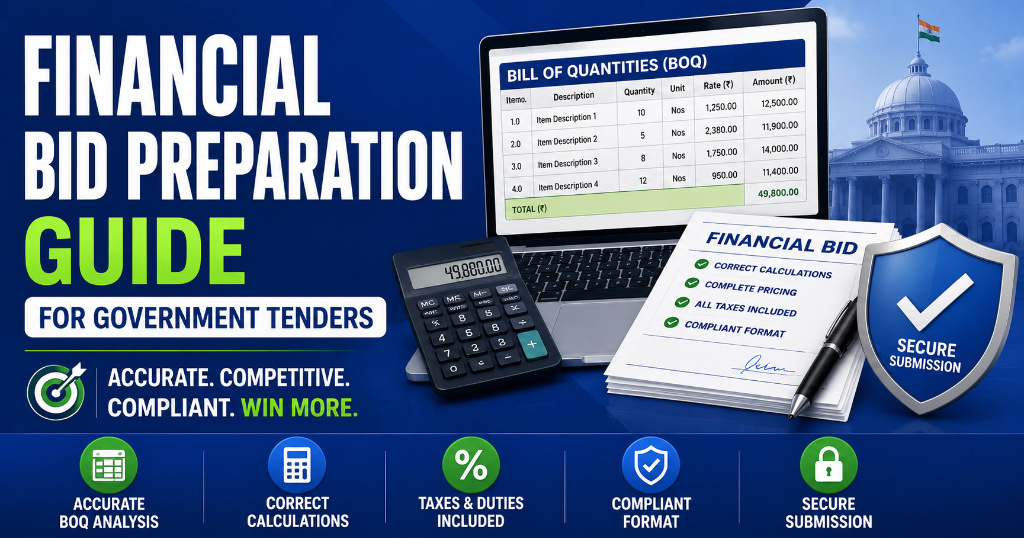
The Financial Bid Reality: Why Price Alone Doesn't Win
India's government procurement market processes over ₹1.25 lakh crore monthly through CPPP alone, with GeM adding another ₹4+ lakh crore in cumulative GMV. Every rupee represents a contract opportunity—but the lowest price rarely tells the full story. For the comprehensive end-to-end framework, consult our complete government tender guide India. To understand foundational rules, refer to our BOQ analysis for government tenders. (See also: Tender Pricing Strategy to Win L1 Profitably). (See also: Performance Bank Guarantee (PBG) Requirements Guide). (See also: Tender Competitor Analysis & Market Intelligence Guide). (See also: Two-Bid System Protocol & Two-Packet Rules Guide).
In 2026, procurement is evolving. While L1 (Lowest Bidder) remains the default selection methodology under GFR 2017, an increasing share of high-value tenders uses QCBS (Quality and Cost Based Selection)—where technical excellence can justify a price premium. A bidder scoring 85/100 technically needs only to be within 15–20% of the lowest price to win under 70:30 QCBS weighting.
Strategic Insight: Financial bid preparation is not about being the cheapest. It's about being the *most justifiable* price that covers your costs, manages risk, and aligns with the evaluation methodology.---

Get the Bid Mastery Toolkit
From document download to token submission — every checklist, tracker, and milestone planner.
- ✓ 150-Point Pre-Submission Checklist (PDF)
- ✓ 50-Point Technical Bid Compliance Audit
- ✓ 30-Point Financial Bid Verification
- ✓ Bid Submission Timeline & Deadline Planner (Excel)
🔒 256-Bit Secure Razorpay Checkout · Lifetime Access · Instant Digital Delivery
What Is a Financial Bid? Structure & Components
A financial bid is the sealed commercial offer containing your pricing and commercial terms for executing the tender contract. It is opened only after technical qualification is confirmed.
Core Components of Every Financial Bid
| Component | Description | Criticality |
|---|---|---|
| Quoted Price | Item-wise or lump-sum rate as per BOQ | Mandatory |
| Tax Details | GST rate, HSN code, inclusive/exclusive breakdown | Mandatory |
| Price Validity | Period during which prices remain binding | Mandatory |
| Total Tender Value | Final amount in figures and words | Mandatory |
| Commercial Terms | Payment terms, delivery schedule, warranty | Conditional |
| Cost Breakup | Material, labor, overheads, profit (if demanded) | Conditional |
The Golden Rule
Your financial bid must strictly follow the prescribed format provided in the tender document. Any deviation—custom templates, modified BOQ files, or alternate pricing structures—results in disqualification.
---The Two-Envelope System: When Financial Bids Get Opened
Understanding the sequence protects your commercial confidentiality:
| Phase | Timeline | What Happens |
|---|---|---|
| Technical Bid Opening | Day 0 | All technical bids opened; names recorded |
| Technical Evaluation | Day 1–21 | Committee evaluates; shortlists qualified bidders |
| Financial Bid Opening | Day 21+ | Only technically qualified bidders' financial bids decrypted and opened |
| Financial Evaluation | Day 21–28 | Price comparison, ranking, abnormally low bid scrutiny |
Instant Tender Eligibility & Risk Audit
Upload any 500-page NIT / BOQ PDF. Extract hidden disqualification traps, EMD waiver clauses, and complete eligibility criteria in under 45 seconds.
Never miss an item rate or miscalculate GST breakdown. Extract all BOQ schedule items into an editable, auditable structure using the AI BOQ Extractor.
Launch AI BOQ Extractor →BOQ Mastery: The #1 Reason Financial Bids Get Rejected
The Bill of Quantities (BOQ) is the standard pricing template provided by the procuring entity. It is the single most common failure point in financial bid submission.
BOQ Rules That Cannot Be Broken
- Do Not Modify the Template: Never alter formulas, protected cells, column structures, or file names. Any modification = instant rejection.
- Fill Only White Cells: Complete only the unprotected/designated cells with your rates and bidder name.
- Use Exact File Name: Save and submit with the original file name provided.
- Rate in Figures AND Words: Many BOQs require amounts in both formats.
- Include All Items: Never leave items blank. Quote "0" or "Not Applicable" with justification if required.
Sample BOQ Structure (Works Tender)
| Item No. | Description | Quantity | Unit | Rate (₹) | Amount (₹) |
|---|---|---|---|---|---|
| 1 | Earthwork excavation | 1,250 | m³ | [Your Rate] | [Auto-calculated] |
| 2 | PCC M15 grade | 450 | m³ | [Your Rate] | [Auto-calculated] |
| 3 | RCC M25 grade | 890 | m³ | [Your Rate] | [Auto-calculated] |
| 4 | Reinforcement steel | 12,500 | kg | [Your Rate] | [Auto-calculated] |
| Total | [Auto-sum] |
Pro Tip: Download the BOQ immediately when you decide to bid. Open it in Excel, enable macros if required, and test that calculations work correctly before filling rates.---
L1 vs QCBS: Choosing the Right Pricing Strategy
L1 (Least Cost Selection)
| Attribute | Details |
|---|---|
| Selection Criteria | Lowest price among technically qualified bidders |
| Best For | Standardized goods, routine services, civil works with clear specs |
| Risk | Race to the bottom; thin margins; quality compromise |
| Strategy | Optimize costs ruthlessly; leverage economies of scale; minimize overheads |
Target Price = (Direct Costs + Indirect Costs + Contingency) × (1 + Minimum Viable Margin)
QCBS (Quality and Cost Based Selection)
| Attribute | Details |
|---|---|
| Selection Criteria | Weighted combination of technical and financial scores |
| Common Weighting | 70:30 or 80:20 (Technical:Financial) |
| Best For | Consultancy, complex infrastructure, IT systems, design-build |
| Strategy | Maximize technical score first; price competitively but not necessarily lowest |
Final Score = (Technical Score × Technical Weight) + (Financial Score × Financial Weight)

Where Financial Score is typically calculated as:

Financial Score = (Lowest Bid Price / Your Bid Price) × 100
- Bidder A: Technical 88/100, Price ₹4.5 Cr
- Bidder B: Technical 72/100, Price ₹4.0 Cr
- Under 70:30 QCBS:
- Bidder A Final = (88 × 0.7) + (88.9 × 0.3) = 88.3
- Bidder B Final = (72 × 0.7) + (100 × 0.3) = 80.4
- Result: Bidder A wins despite being 12.5% more expensive.
Cost Estimation Framework for Government Tenders
The 5-Layer Cost Model
| Layer | Components | Typical % of Total |
|---|---|---|
| Direct Costs | Materials, labor, equipment, subcontractor fees | 60–70% |
| Indirect Costs | Site overheads, admin, supervision, utilities | 10–15% |
| Contingency | Risk buffer for price escalation, delays, scope changes | 5–10% |
| Financing Cost | EMD blocking, working capital interest, delayed payment impact | 2–5% |
| Profit Margin | Return on investment, business sustainability | 8–15% |
Government-Specific Cost Factors
1. Delayed Payment CyclesGovernment departments typically pay within 30–60 days of invoice submission, but delays of 90–120 days are common. If payments are delayed, you can file a complaint under our MSME Samadhaan Delayed Payment Guide. Factor working capital costs at 12–18% annualized interest for the delay period.
2. Retention Money5–10% of each bill is retained as security until defect liability period (typically 12 months) ends. This affects your cash flow planning.
3. Price Variation ClauseFor contracts exceeding 18 months, check if the tender includes a price variation clause for steel, cement, or fuel. If absent, build escalation risk into your margin.
4. GST Implications- Goods: 5%, 12%, 18%, or 28% depending on HSN code
- Services: 18% typically
- Works contracts: 12% or 18% depending on classification
- Ensure your GST registration and filing are current—payment is often conditional on valid GST invoices.
EMD, Tender Fees & Working Capital Planning
Earnest Money Deposit (EMD)
| Parameter | Standard Requirement |
|---|---|
| Amount | 2–3% of estimated tender value |
| Forms Accepted | Demand Draft, Bank Guarantee, e-BG via NeSL |
| Refund | Typically within 30 days of contract award to unsuccessful bidders |
| Forfeiture | If you withdraw after deadline or fail to sign contract |
If you bid on 10 tenders averaging ₹5 crore each with 2% EMD:
- Total EMD blocked: ₹1 crore
- If 5 are active simultaneously: ₹50 lakh blocked
- Solution: Use Bank Guarantees instead of cash to preserve liquidity.
Tender Fees
- CPPP: Generally zero for document download; processing fee may apply
- State portals: Varies; some charge ₹1,000–₹5,000 per tender
- GeM: No tender fees; caution money applies (₹5,000 for turnover <₹1 Cr)
MSME & Startup Exemptions
| Category | EMD Exemption | Turnover Exemption | Experience Exemption |
|---|---|---|---|
| Udyam-Registered MSME | Yes (on qualifying tenders) | No | No |
| DPIIT-Recognized Startup | Yes | Yes | Yes |
| Women-Owned MSE | Yes (under 3% sub-quota) | No | No |
| SC/ST-Owned MSE | Yes (under 4% sub-quota) | No | No |
Tax Structure: GST, TDS & Invoicing Compliance
GST in Government Tenders
| Contract Type | GST Rate | Key Compliance |
|---|---|---|
| Supply of Goods | 5% / 12% / 18% / 28% | HSN code must match; e-invoicing mandatory for >₹5 Cr turnover |
| Construction Works | 12% (affordable housing) / 18% (commercial) | SAC code 9954; input tax credit availability |
| Consultancy Services | 18% | SAC code 9983; RCM may apply for legal services |
| Manpower Supply | 18% | SAC code 9985; composite vs. mixed supply classification |
TDS on Government Contracts
- TDS @ 2% (CGST + SGST each) for payments exceeding ₹2.5 lakh to suppliers
- TDS @ 1% (under Income Tax Section 194C) for works contracts
- Ensure your PAN is linked and TDS credits reflect in your 26AS
Invoicing Best Practices
- Issue tax invoice within 30 days of supply completion
- Include all mandatory fields: PO number, contract reference, HSN/SAC, tax amounts
- Upload e-invoice on IRP if turnover exceeds ₹5 crore
- Submit invoices in duplicate/triplicate as specified in the contract
Price Validity, Escalation Clauses & Risk Management
Price Validity Periods
| Tender Type | Standard Validity | Extension Protocol |
|---|---|---|
| Goods Supply | 90 days | May be extended by mutual consent once |
| Works Contracts | 90–180 days | Often extended for complex evaluation |
| Consultancy | 180 days | Usually fixed; rebidding if expired |
Escalation Clauses
For contracts >18 months, check for:
- Material Price Variation: Based on RBI/WPI indices or actual price certificates
- Fuel Adjustment: For earthmoving and transportation-heavy contracts
- Labor Escalation: Rare in government contracts; build into initial pricing
Force Majeure & Risk Allocation
Standard government contracts place most risks on the contractor. Ensure your pricing covers:
- Delayed payment financing costs
- Statutory compliance changes
- Geological/site condition risks (for works)
MSME Price Preference: How to Use the 25% Quota
Under the Public Procurement Policy for MSEs (Ministry of MSME):
| Policy | Details |
|---|---|
| Mandatory Procurement | 25% of annual central government procurement from MSEs |
| Sub-Quotas | 3% for women-owned MSEs; 4% for SC/ST-owned MSEs |
| Price Matching | If MSE quotes within L1 + 15%, order can be placed on MSE at L1 price |
| EMD Exemption | Available for MSEs on qualifying tenders |
- Ensure your Udyam registration is active (see our Udyam Registration Complete Guide) and linked to your bidding profile
- In competitive L1 tenders, your slightly higher price may still win under price matching
- Highlight MSE status prominently in your technical bid for maximum visibility
7 Costly Financial Bid Mistakes (With Real Examples)
Mistake 1: Modifying the BOQ Template
Example: A Hyderabad-based IT contractor modified column widths in the Excel BOQ to fit longer item descriptions. Result: Disqualified at financial bid opening. Fix: Never alter structure. Use abbreviations or attach annexures if descriptions are too long.Mistake 2: Arithmetic Errors in Totals
Example: A construction bidder quoted ₹1,25,000 per unit but the Excel auto-sum calculated based on ₹12,500 due to misplaced decimal. Result: Bid accepted at 10% of intended price; company faced massive losses or contract default. Fix: Double-check every total manually. Cross-verify figures and words.Mistake 3: Ignoring Price Validity
Example: A supplier quoted 90-day validity. Evaluation took 120 days. Bid expired. Disqualified despite being L1. Fix: Quote 180-day validity for complex tenders. Monitor evaluation timelines.Mistake 4: Unrealistic L1 Pricing
Example: A new bidder quoted 40% below market rate to win. Procuring entity invoked "abnormally low bid" scrutiny. Could not justify costs. Bid rejected. Fix: Price at sustainable levels. If you must be aggressive, ensure you can defend every cost component.Mistake 5: Wrong GST Rate Application
Example: A furniture supplier applied 5% GST instead of 18% for office chairs. Post-award, tax liability exceeded contract margin. Fix: Verify HSN codes and GST rates with a CA before every bid.Mistake 6: Missing EMD Details
Example: Bidder uploaded EMD proof in technical bid instead of financial bid section. Result: Financial bid rejected for incomplete EMD. Fix: Follow the exact document upload structure specified in the tender.Mistake 7: Currency & Unit Confusion
Example: Contractor quoted per-meter rate when BOQ expected per-kilometer. Price appeared 1000x higher than intended. Fix: Verify units of measurement for every line item before filling rates. ---Case Study: How an MSME Won a ₹3.2 Cr Tender by Pricing Smart
Company: GreenTech Solar Solutions Pvt. Ltd., Jaipur Sector: Solar PV Installation & Commissioning Tender: Rajasthan Renewable Energy Corporation, 500 kW Rooftop Solar Project Challenge:- 14 bidders participated; 9 technically qualified
- Market rates for similar projects: ₹3.5–3.8 crore
- GreenTech's cost structure: ₹2.9 crore (direct + indirect)
- Technical Score Maximization: Instead of racing to L1, they invested in maximizing their technical score (proposed superior panels, 25-year warranty, local service center)
- QCBS Advantage: The tender used 80:20 QCBS weighting
- Strategic Pricing: Quoted ₹3.25 crore (8% above expected L1) but achieved technical score of 92/100 vs. L1 bidder's 74/100
- Final Score Calculation:
- GreenTech: (92 × 0.8) + (85 × 0.2) = 90.6
- L1 Bidder: (74 × 0.8) + (100 × 0.2) = 79.2
- Result: Won by 11.4 points despite being ₹25 lakh more expensive
Platform-Specific Financial Bid Formats: CPPP vs GeM vs State
| Aspect | CPPP | GeM | State Portals |
|---|---|---|---|
| Financial Bid Format | Encrypted Excel BOQ | Catalogue price / Bid price | Varies (Excel/PDF) |
| Tax Inclusion | Must specify GST exclusive/inclusive | Auto-calculated at checkout | As per tender |
| Price Discovery | L1 or QCBS | L1, Reverse Auction, Direct Purchase | L1 predominantly |
| EMD | 2–3% of tender value | Caution money (₹5K–25K) | 2–5% of value |
| Payment Terms | 30–60 days post-bill | PFMS integrated | Varies by state |
| e-BG Integration | Yes (NeSL) | No | Limited |
- Financial bids are encrypted using PKI technology
- Only authorized bid openers can decrypt with DSC
- "Freeze Bid" button must be clicked to complete submission
- For direct purchases (<₹25,000), your catalogue price is your bid
- For bidding above ₹5 lakh, price is entered in the bid interface
- Reverse auctions require real-time pricing strategy
TenderFlow Pro: Financial Bid Intelligence & Pricing Analytics
Manual financial bid preparation across hundreds of tenders is a recipe for arithmetic errors and missed opportunities. TenderFlow Pro provides:
📊 Historical Award Pricing DatabaseSee what similar contracts actually awarded for across 8+ years of tender history. Stop guessing and start pricing from real market data.
🧮 BOQ Auto-ValidatorUpload your filled BOQ and our engine checks for formula integrity, cell modifications, and arithmetic errors before you submit.
💰 Cost Estimation WorkbenchInput your material, labor, and equipment costs. The tool auto-calculates indirect costs, contingency, and suggests competitive margins based on historical L1 data.
⚠️ Abnormally Low Bid AlertBefore submission, our AI compares your price against historical award ranges for the same tender category. If you're pricing too low (risking scrutiny) or too high (risking elimination), you get instant warnings.
📈 QCBS Score SimulatorModel different technical and price combinations to see your probability of winning under various QCBS weightings.
👉 Explore TenderFlow Pro Pricing Intelligence ---FAQs: Financial Bid Mastery
Q1. What is a financial bid in government tendering?A financial bid contains your price quotation and commercial terms for executing the contract. It is opened only after technical qualification.
Q2. What is BOQ in tender financial bid?BOQ (Bill of Quantities) is the standard pricing template listing all items with quantities. You must fill only designated cells without modifying the template.
Q3. How is EMD calculated for government tenders?EMD is typically 2–3% of estimated contract value. MSMEs and startups may be exempt on qualifying tenders.
Q4. What is the L1 principle in government procurement?L1 awards the contract to the technically qualified bidder with the lowest commercial price. It is the default under GFR 2017.
Q5. Can I modify the BOQ file provided in the tender?No. Any structural modification results in immediate disqualification.
Q6. What is QCBS in tender evaluation?QCBS (Quality and Cost Based Selection) combines technical and financial scores (commonly 70:30 or 80:20), allowing superior technical bids to win at higher prices.
Q7. How do I calculate the right margin for a government tender?Sum direct costs, indirect costs, and contingency (5–10%). Add financing costs for delayed payments. Apply profit margin of 8–15% depending on competition.
Q8. What is price validity in a financial bid?The period your quoted prices remain binding, typically 90–180 days. If evaluation exceeds this, your bid may become invalid.
Q9. Are MSMEs eligible for price preference?Yes. MSEs quoting within L1 + 15% may receive the order under price matching. 25% of central procurement is reserved for MSEs.
Q10. What happens if I quote unrealistically low prices?The procuring entity may demand detailed cost justification. Failure to justify leads to rejection under "abnormally low bid" scrutiny.
---Your 30-Day Financial Bid Optimization Plan
Week 1: Cost Database Development- Build item-wise cost database for your top 50 work/supply items
- Update with current market rates (materials, labor, equipment)
- Document GST rates and HSN codes for each item category
- Calculate your true overhead percentage
- Create standardized BOQ filling checklist
- Set up Excel validation rules for your internal cost sheets
- Register for e-BG facility with your bank to reduce EMD cash blocking
- Review 10 historical awarded tenders in your category to benchmark pricing
- Identify which tender types in your domain use L1 vs QCBS
- For QCBS tenders, invest in technical score maximization
- For L1 tenders, identify cost reduction levers (bulk purchasing, subcontractor rates)
- Build contingency models for 5%, 10%, and 15% risk scenarios
- Select 2 active tenders and prepare full financial bids
- Run internal review for arithmetic accuracy and BOQ compliance
- Submit first bid 48 hours before deadline
- Document lessons learned for template refinement
Conclusion
Financial bid preparation is where engineering meets economics. The winners are not those who guess the lowest number, but those who build repeatable cost estimation systems, understand evaluation methodologies, and price with precision.
Master the BOQ. Respect the format. Calculate your true costs. And remember—in an increasingly QCBS-driven market, technical excellence gives you pricing power.
Ready to stop losing tenders on price? Get TenderFlow Pro and access historical award intelligence that tells you exactly where to price for maximum win probability. --- Related Articles: Meta Tags: