Price Preference L1+15% for MSME in Government Tenders India 2026: Complete Guide with Examples
Home → Blog → Price Preference L1+15% Guide For the comprehensive end-to-end framework, consult our step-by-step government tender bidding process. (See also: 4% SC/ST MSME Tender Reservation Guide). (See also: 3% Women Entrepreneur Procurement Quota Guide). (See also: MSME Sambandh Procurement Analytics Dashboard). (See also: DPIIT Startup Zero-Experience Tender Benefits). (See also: MSME Price Preference Legal Precedents Guide).
Last Updated: July 11, 2026 · Reading Time: 26 minutes · Written by: TenderFlow Pro Research Team
menu_book Table of Contents
Introduction: The ₹50 Lakh Crore Opportunity MSMEs Are Missing
India's central government spends approximately ₹50–70 lakh crore annually on procurement of goods and services. Under the Public Procurement Policy for Micro and Small Enterprises (2012), a significant portion of this is deliberately reserved for MSMEs — not just through the 25% procurement reservation, but through a powerful mechanism that most bidders don't fully understand: price preference. To understand foundational rules, refer to our MSME benefits in government tenders.
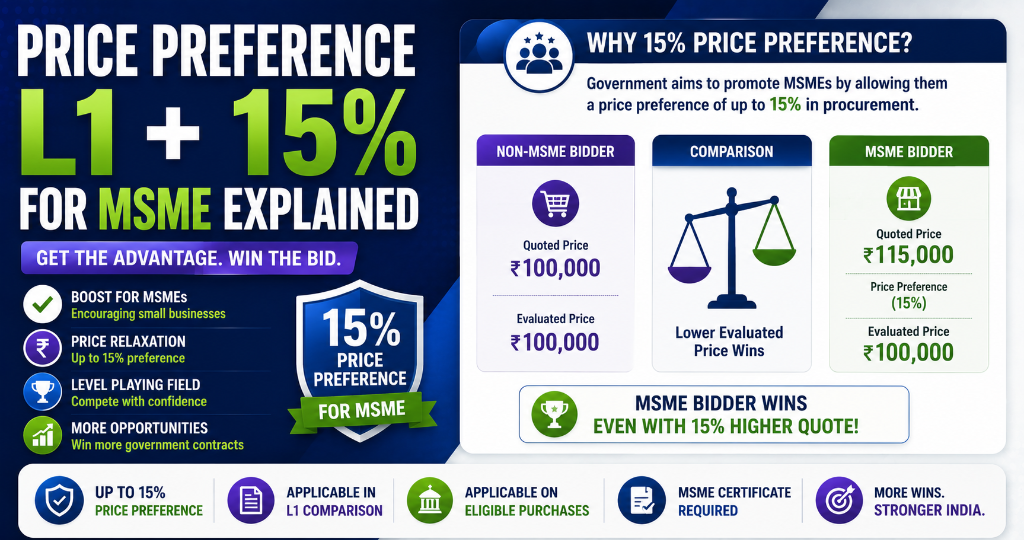
Here's the game-changer: If you are a Micro or Small Enterprise and you quote within 15% of the lowest bidder (L1), you can match the L1 price and win the contract — even though your original quote was higher. This means you don't have to be the cheapest to win. You just have to be close enough.
Yet, industry surveys suggest that over 70% of eligible MSEs never use price preference because they don't understand how it works, don't know they're eligible, or don't structure their bids strategically. This guide changes that.
📈
Calculate Your Price Preference Winning Range
Enter your estimated cost and see the optimal bid price to win through L1+15% price preference. FREE calculator — no email required.
Calculate My Bid →

Get the MSME Advantage Toolkit
Claim every statutory exemption, track document renewals, and enforce price preferences.
- ✓ 150-Point Pre-Submission Checklist (PDF)
- ✓ Document Expiry & Renewal Tracker (Excel)
- ✓ GST / PAN / TAN Cross-Verification Guide
- ✓ MSME EMD Exemption Claim Kit (4 Letters)
🔒 256-Bit Secure Razorpay Checkout · Lifetime Access · Instant Digital Delivery
What Is L1+15% Price Preference? Understanding the Policy
L1+15% price preference is a government procurement mechanism that gives Micro and Small Enterprises a competitive advantage in bidding, even when they are not the lowest bidder.
The Core Concept:
In standard government tendering, L1 (Lowest Bidder) wins the contract. But under the price preference policy:
- If the L1 bidder is a non-MSE (large enterprise, foreign company, etc.)
- And an MSE quotes within 15% of the L1 price
- The MSE is invited to match the L1 price
- If the MSE agrees, it is awarded a portion of the contract (up to 25%)
Why This Policy Exists:
The Government of India recognized that MSEs often cannot compete with large enterprises on price due to:
- Smaller scale of operations
- Higher per-unit costs
- Limited bargaining power with suppliers
- Lack of bulk purchase discounts
Price preference levels the playing field by allowing MSEs to win at competitive prices without sacrificing their already-thin margins.
The Legal Framework: Public Procurement Policy 2012 & GFR 2017
Price preference is not a discretionary benefit — it is legally mandated under two frameworks:
1. Public Procurement Policy for Micro and Small Enterprises (2012)
Issued by the Ministry of MSME under Section 11 of the MSME Development Act, 2006:
"In tender, participating Micro and Small Enterprises quoting price within price band of L1+15% shall also be allowed to supply a portion of requirement by bringing down their price to L1 price in a situation where L1 price is from someone other than a Micro and Small Enterprise."
Key Provisions:
| Provision | Specification |
|---|---|
| Price Band | L1 + 15% |
| Eligible Entities | Micro and Small Enterprises only |
| Quantity Allocation | Up to 25% of total tendered value |
| Multiple MSEs | Shared proportionately |
| Non-Splitable Items | Full contract may be awarded |
| Sub-Reservation | 4% for SC/ST MSEs, 3% for Women MSEs |
2. GFR 2017 Rule 170
Reinforces the policy under the General Financial Rules (learn more in our GFR 2017 Tender Rules Explained guide):
"Micro and Small Enterprises shall be entitled to price preference as per the Public Procurement Policy for Micro and Small Enterprises."
3. Amendment History:
| Year | Change | Impact |
|---|---|---|
| 2012 | Original policy notified | 20% procurement target; L1+15% price preference |
| 2015 | Mandatory implementation | 20% target became compulsory |
| 2018 | Revised thresholds | MSME classification updated |
| 2020 | Udyam integration | Price preference linked to Udyam registration |
| Current | 25% target | Increased from 20% to 25% procurement reservation |
📊
[Infographic: Price Preference Legal Framework Timeline]
Timeline showing the evolution of MSME price preference policy from 2012 to 2026.
Instant Tender Eligibility & Risk Audit
Upload any 500-page NIT / BOQ PDF. Extract hidden disqualification traps, EMD waiver clauses, and complete eligibility criteria in under 45 seconds.
Who Is Eligible for 15% Price Preference?
Not every bidder can claim price preference. The eligibility is strictly defined:
Eligible Entities:
| Entity Type | Udyam Classification | Price Preference Eligible? |
|---|---|---|
| Micro Enterprise | Investment ≤ ₹1 Cr, Turnover ≤ ₹5 Cr | ✅ Yes |
| Small Enterprise | Investment ≤ ₹10 Cr, Turnover ≤ ₹50 Cr | ✅ Yes |
| Medium Enterprise | Investment ≤ ₹50 Cr, Turnover ≤ ₹250 Cr | ❌ No |
| Large Enterprise | Above Medium thresholds | ❌ No |
| DPIIT Startup | Recognized startup (also Udyam-registered as MSE) | ✅ Yes |
| Foreign Company | Any foreign entity | ❌ No |
Additional Eligibility Requirements:
- Valid Udyam Registration: Must have active URN linked to the bidding entity
- Technical Qualification: Must meet ALL technical criteria of the tender
- Quote Within L1+15%: Original quoted price must be ≤ L1 × 1.15
- Willingness to Match L1: Must agree to supply at the L1 price if invited
- Not Blacklisted: Must not be on any debarment list
Important: If your enterprise is registered as "Medium" on Udyam, you CANNOT claim price preference even if you were previously "Small." Classification is based on current Udyam status.
Learn more about Udyam classification in our complete Udyam registration guide.
How L1+15% Price Preference Works: Step-by-Step Process
Understanding the exact process helps you prepare bids strategically and track outcomes.
Stage 1: Tender Publication
- Department publishes tender on CPPP/GeM with MSE price preference clause
- MSEs submit bids along with non-MSE bidders
- All bids are sealed until technical opening
Stage 2: Technical Evaluation
- Technical bids opened and evaluated
- Bidders checked for compliance with specifications, documents, and eligibility
- Only technically qualified bidders proceed to financial evaluation
Stage 3: Financial Bid Opening
- Financial bids of technically qualified bidders opened
- L1 (lowest) bidder identified
- If L1 is a non-MSE, price preference check is triggered
Stage 4: Price Preference Identification
- System checks if any MSE quoted within L1+15%
- MSEs within the price band are identified and ranked
- MSEs are invited to match the L1 price
Stage 5: Price Matching & Award
- Qualifying MSEs indicate willingness to match L1 price
- Contract awarded to:
- L1 bidder for 75% of value (if MSEs take 25%)
- MSE(s) for up to 25% of value at L1 price
- For non-divisible items, full contract may go to qualifying MSE
Stage 6: Contract Execution
- L1 bidder and MSE(s) sign separate contracts
- Delivery/execution as per tender terms
- Payment within 45 days (MSME Samadhaan protection applies)
📅
[Infographic: L1+15% Price Preference Process Flowchart]
Visual 6-stage flow from tender publication to contract execution showing price preference mechanics.
Will your MSME bid qualify for the L1+15% price band and 25% purchase order split? Check your tender eligibility score and compliance standing in seconds with the AI Bid Scorer.
Check Bid Qualification Score →L1+15% Calculation Examples: Real-World Scenarios
Scenario 1: Single MSE Qualifies for Price Preference
| Bidder | Type | Quoted Price (₹) | Within L1+15%? | Action |
|---|---|---|---|---|
| ABC Ltd | Large Enterprise | 10,00,000 (L1) | — | Wins at own price |
| XYZ Enterprises | Small Enterprise | 11,30,000 | ✅ Yes (13% higher) | Invited to match L1 |
| PQR Solutions | Medium Enterprise | 11,50,000 | ❌ No (MSE only) | Not eligible |
| LMN Corp | Large Enterprise | 12,00,000 | ❌ No (not MSE) | Rejected |
Outcome:
- ABC Ltd wins 75% of contract = ₹7,50,000 at ₹10,00,000
- XYZ Enterprises wins 25% of contract = ₹2,50,000 at matched L1 price of ₹10,00,000
- XYZ's original quote was ₹11,30,000 but they supply at ₹10,00,000
XYZ's Profit Impact:
- Original margin at ₹11,30,000: ₹1,30,000
- Margin at matched ₹10,00,000: ₹0 (break-even or small profit)
- Strategic value: Government client, future contracts, credibility boost
Scenario 2: Multiple MSEs Qualify — Proportionate Sharing
| Bidder | Type | Quoted Price (₹) | % Above L1 |
|---|---|---|---|
| BigCorp | Large Enterprise | 20,00,000 (L1) | — |
| MSE-A | Micro Enterprise | 22,00,000 | 10% |
| MSE-B | Small Enterprise | 22,50,000 | 12.5% |
| MSE-C | Micro Enterprise | 23,00,000 | 15% |
L1+15% Upper Limit: ₹20,00,000 × 1.15 = ₹23,00,000
All three MSEs qualify. The 25% reserved quantity (₹5,00,000) is shared proportionately:
| MSE | Share Calculation | Amount at L1 Price |
|---|---|---|
| MSE-A | (22,50,000+23,00,000) / Total | ~₹1,85,000 |
| MSE-B | (22,00,000+23,00,000) / Total | ~₹1,70,000 |
| MSE-C | (22,00,000+22,50,000) / Total | ~₹1,45,000 |
(Exact proportion depends on evaluation committee formula)
Scenario 3: MSE Just Outside 15% — Missed Opportunity
| Bidder | Type | Quoted Price (₹) | % Above L1 | Qualifies? |
|---|---|---|---|---|
| MegaCorp | Large Enterprise | 15,00,000 (L1) | — | — |
| SmallTech | Small Enterprise | 17,30,000 | 15.3% | ❌ No |
L1+15% Upper Limit: ₹15,00,000 × 1.15 = ₹17,25,000
SmallTech quoted ₹17,30,000 — just ₹5,000 over the limit. No price preference applies. SmallTech loses the tender.
Strategic Lesson: If your cost structure allows, quote at L1+14% or lower to ensure you qualify for price preference. The difference between 14% and 16% can be the difference between winning and losing.
Scenario 4: Non-Splitable Item — Full Contract to MSE
| Bidder | Type | Quoted Price (₹) | % Above L1 |
|---|---|---|---|
| GiantInfra | Large Enterprise | 1,00,00,000 (L1) | — |
| BuildSmall | Small Enterprise | 1,14,00,000 | 14% |
Item: Single turnkey construction project (non-divisible)
Outcome: Since the project cannot be split, BuildSmall is invited to match L1 price. If BuildSmall agrees, the FULL contract of ₹1 crore is awarded to BuildSmall at the matched L1 price.
BuildSmall's Decision:
- Original quote: ₹1.14 crore (expected profit: ₹14 lakh)
- Matched price: ₹1.00 crore (expected profit: ₹0 or small loss)
- Recommendation: Accept if the contract opens doors to future government work, establishes credibility, or provides cash flow during lean periods.
📊
[Infographic: L1+15% Price Preference Calculator]
Interactive calculator showing winning scenarios across different bid prices and L1 values.
Quantity Allocation: How Much Can an MSE Supply?
Under the current Public Procurement Policy, the quantity allocation for price preference works as follows:
Standard Allocation:
| Scenario | L1 Bidder (Non-MSE) | MSE(s) Under Price Preference |
|---|---|---|
| Splitable contract | 75% of total value | Up to 25% of total value |
| Non-splitable contract | May get 0% | Up to 100% of total value |
| Multiple qualifying MSEs | 75% of total value | 25% shared proportionately |
Proportionate Sharing Formula (Multiple MSEs):
When multiple MSEs qualify for the 25% reserved portion, the sharing is typically based on:
MSE Share = (25% Total Value) × (1 / MSE's Rank by Price)
Or alternatively, inverse proportion to quoted price:
MSE Share = (25% Total Value) × (L1 Price / MSE's Quoted Price)
Example:
| MSE | Quoted Price | Inverse Factor | Share of 25% |
|---|---|---|---|
| MSE-1 | ₹11,00,000 | 1.10 | ~37% |
| MSE-2 | ₹11,30,000 | 1.13 | ~36% |
| MSE-3 | ₹11,50,000 | 1.15 | ~27% |
(Exact formula varies by department and is specified in tender evaluation criteria)
Non-Splitable Items: Full Contract Award to MSEs
One of the most powerful but underutilized aspects of price preference is the full contract award for non-splitable items.
What Is a Non-Splitable Item?
A non-splitable (or non-divisible) item is one that cannot be practically divided among multiple suppliers:
| Category | Examples |
|---|---|
| Plant & Machinery | Single boiler, turbine, generator set |
| IT Systems | Integrated software platform, data center |
| Turnkey Projects | Complete building construction, road project |
| Vehicles | Single bus, ambulance, fire tender |
| Medical Equipment | MRI machine, CT scanner |
Full Award Rule:
"In case of tender item is non-splitable or non-divisible, MSE quoting price within price band L1+15% may be awarded for full/complete supply of total tendered value to MSE."
Strategic Implications:
- For MSEs: Bid aggressively on non-splitable items. Even if you're 14% higher than L1, you can win the ENTIRE contract.
- For Large Enterprises: You may lose the entire contract to an MSE even if you're L1, if the item is non-splitable.
- For Departments: Must clearly specify in tender whether items are splitable or non-splitable.
Price Preference for SC/ST & Women-Owned MSEs
The Public Procurement Policy includes sub-reservations within the price preference framework (learn how this fits into the broader 25% Procurement Reservation for MSMEs policy):
Sub-Reservation Breakdown:
| Category | Reservation | Within 25% MSE Quota |
|---|---|---|
| General MSEs | 18% (of total procurement) | Part of 25% |
| SC/ST-Owned MSEs | 4% (of total procurement) | Sub-quota within 25% |
| Women-Owned MSEs | 3% (of total procurement) | Sub-quota within 25% |
How Sub-Reservation Works with Price Preference:
- The 4% SC/ST sub-target is first offered to SC/ST-owned MSEs under price preference
- If no SC/ST MSE qualifies, the 4% is met from other qualifying MSEs
- Similarly, the 3% women-owned target is offered to women-owned MSEs first
Eligibility for Sub-Reservation:
| Ownership Type | Eligibility Criteria |
|---|---|
| SC/ST Proprietorship | Proprietor must be SC/ST |
| SC/ST Partnership | SC/ST partners must hold ≥51% shares |
| SC/ST Private Limited | SC/ST promoters must hold ≥51% shares |
| Women Proprietorship | Proprietor must be woman |
| Women Partnership | Women partners must hold ≥51% shares |
| Women Private Limited | Women promoters must hold ≥51% shares |
Strategic Bidding: How to Use Price Preference to Win
Price preference is not just a rule — it's a bidding strategy. Here's how to use it:
Strategy 1: The "Safe Zone" Bid
Goal: Ensure you qualify for price preference while maximizing margin.
Method:
- Estimate the likely L1 price based on market rates and competitor analysis
- Calculate L1 × 1.14 (14% above L1) — this is your "safe zone"
- Bid at this price to guarantee qualification for price preference
- If invited to match L1, decide based on your cost structure
Example:
- Estimated L1: ₹10,00,000
- Your safe zone bid: ₹10,00,000 × 1.14 = ₹11,40,000
- You qualify for price preference (within 15%)
- If invited to match L1 at ₹10,00,000, you decide whether to accept
Strategy 2: The "Non-Splitable Gambit"
Goal: Win full contracts on non-splitable items despite not being L1.
Method:
- Identify tenders for non-splitable items (machinery, turnkey projects, vehicles)
- Bid within L1+15% even if your margin is thin
- If you're the only qualifying MSE, you win the full contract at L1 price
- Accept if the strategic value (credibility, future work) outweighs thin margins
Strategy 3: The "Multiple MSE" Positioning
Goal: Maximize your share when multiple MSEs qualify.
Method:
- Quote as close to L1 as possible (e.g., L1+5% or L1+8%)
- Higher-ranked MSEs (closer to L1) get larger proportionate shares
- Even a small price difference can mean a significantly larger contract share
Strategy 4: The "Break-Even Acceptance"
Goal: Use government contracts for cash flow and credibility, not immediate profit.
Method:
- Calculate your true cost to execute the contract
- Bid at L1+14% to qualify for price preference
- If invited to match L1 and the matched price is at or near break-even, ACCEPT
- Benefits: Cash flow during lean periods, government client reference, GeM rating boost
Common Price Preference Mistakes & How to Avoid Them
| Mistake | Impact | How to Avoid |
|---|---|---|
| Not checking if tender has price preference clause | Miss opportunity to bid strategically | Always read NIT for MSE price preference mention |
| Quoting just above 15% | Disqualified from price preference | Bid at L1+14% or lower to create safety margin |
| Not linking Udyam to GeM | Cannot claim MSE benefits on GeM | Link Udyam to GeM profile before bidding |
| Refusing to match L1 without analysis | Lose contract unnecessarily | Calculate break-even before refusing |
| Assuming price preference applies to all tenders | Some tenders exempt (defence, specialized) | Check tender-specific clauses |
| Not understanding proportionate sharing | Expect full 25% but get small share | Research competitor landscape before bidding |
| Ignoring non-splitable opportunity | Miss full contract awards | Identify non-splitable items in tender description |
| Bidding too low to be L1 | Sacrifice margin unnecessarily | Bid at L1+10% and use price preference |
| Not updating Udyam classification | Lose MSE status, lose price preference | Update investment/turnover figures annually |
| Missing SC/ST or women sub-reservation | Miss additional quota benefits | Check ownership structure and claim if eligible |
Price Preference vs Other MSME Benefits
Price preference works alongside other MSME benefits. Here's how they interact:
| Benefit | What It Does | Works With Price Preference? |
|---|---|---|
| EMD Exemption | Saves 2-5% of tender value upfront | ✅ Yes — independent benefit |
| Tender Fee Exemption | Saves ₹500-₹5,000 per tender | ✅ Yes — independent benefit |
| 25% Procurement Reservation | 25% of annual procurement reserved for MSEs | ✅ Yes — price preference is part of this |
| Turnover Relaxation | Up to 50% relaxation in experience/turnover | ✅ Yes — helps qualify technically |
| Direct Purchase (≤₹5L) | Direct orders without bidding | ❌ No — separate mechanism |
| Startup Benefits | Relaxed criteria for DPIIT startups | ✅ Yes — if also Udyam-registered MSE |
| MSME Samadhaan | Payment protection within 45 days | ✅ Yes — applies to all MSE contracts |
Key Insight: These benefits are cumulative, not mutually exclusive. An MSE can claim EMD exemption, tender fee exemption, price preference, AND turnover relaxation on the SAME tender.
Learn about all MSME benefits in our complete MSME tender benefits guide.
State-wise Price Preference Policies
While the Public Procurement Policy applies to central government, most states have adopted similar price preference frameworks:
| State | Price Preference for MSEs? | Special Notes |
|---|---|---|
| Maharashtra | ✅ L1+15% | Additional 5% price preference (total L1+20%) |
| Karnataka | ✅ L1+15% | Startup fund for first-time MSME bidders |
| Tamil Nadu | ✅ L1+15% | SC/ST MSEs get additional reservation |
| Gujarat | ✅ L1+15% | Interest subsidy on GeM orders for MSMEs |
| Delhi | ✅ L1+15% | Women-owned MSMEs get priority |
| Telangana | ✅ L1+15% | T-Hub integration for tech startups |
| Rajasthan | ✅ L1+15% | Artisan product MSMEs get additional benefits |
| Uttar Pradesh | ✅ L1+15% | ODOP (One District One Product) scheme |
| West Bengal | ✅ L1+15% | MSME credit card scheme |
| Madhya Pradesh | ✅ L1+15% | Tribal MSME special packages |
Note: Maharashtra offers the most generous price preference — L1+20% instead of the central L1+15%. If you bid on Maharashtra state tenders, you have an even wider winning margin.
Real-World Case Studies: MSEs Who Won Through Price Preference
Case Study 1: IT Services MSE Wins at L1+12%
Business: Small IT services company in Bangalore Tender: Government department software development, estimated ₹15 lakh Bidders:
- Large Enterprise A: ₹12,00,000 (L1)
- MSE (our case study): ₹13,44,000 (12% above L1)
- Large Enterprise B: ₹14,50,000
Outcome:
- MSE was within L1+15% (upper limit: ₹13,80,000)
- MSE invited to match L1 at ₹12,00,000
- MSE accepted and was awarded 25% of contract = ₹3,75,000
- Result: Won government contract despite not being lowest bidder
Key Learning: Price preference turned a losing bid into a winning contract.
Case Study 2: Manufacturer Wins Full Non-Splitable Contract
Business: Micro manufacturing unit in Gujarat Tender: Supply of industrial boiler (non-splitable), estimated ₹50 lakh Bidders:
- Large Enterprise: ₹45,00,000 (L1)
- MSE: ₹51,00,000 (13.3% above L1)
Outcome:
- Since boiler is non-splitable, MSE invited to match L1
- MSE accepted ₹45,00,000
- Full contract of ₹45 lakh awarded to MSE
- MSE's original quote was ₹51 lakh — accepted ₹6 lakh lower margin
- Strategic value: First government contract, reference for future tenders
Case Study 3: Maharashtra's L1+20% Advantage
Business: Small construction contractor in Maharashtra Tender: PWD road repair, estimated ₹25 lakh Bidders:
- Large Enterprise: ₹22,00,000 (L1)
- MSE: ₹26,18,000 (19% above L1)
Central L1+15% limit: ₹22,00,000 × 1.15 = ₹25,30,000 ❌ MSE would NOT qualify Maharashtra L1+20% limit: ₹22,00,000 × 1.20 = ₹26,40,000 ✅ MSE QUALIFIES
Outcome:
- Because Maharashtra offers L1+20%, the MSE qualified for price preference
- MSE matched L1 at ₹22,00,000 and won 25% of contract
- Without Maharashtra's additional 5%, this MSE would have lost
Case Study 4: Multiple MSEs Share the Pie
Tender: Supply of office furniture (splitable), estimated ₹40 lakh Bidders:
- Large Enterprise: ₹35,00,000 (L1)
- MSE-A: ₹38,50,000 (10% above L1)
- MSE-B: ₹39,50,000 (12.9% above L1)
- MSE-C: ₹40,00,000 (14.3% above L1)
L1+15% limit: ₹35,00,000 × 1.15 = ₹40,25,000 All three MSEs qualify.
Outcome:
- 25% reserved portion = ₹10,00,000
- Shared proportionately:
- MSE-A (closest to L1): ~₹4,00,000
- MSE-B: ~₹3,50,000
- MSE-C: ~₹2,50,000
- All three MSEs won government contracts they would have otherwise lost
Did you know? Over 60% of MSMEs find tender document analysis the most time-consuming part of government bidding. TenderFlow Pro reduces this from days to minutes.
How TenderFlow Pro's L1+15% Calculator Maximizes Your Wins
TenderFlow Pro is built to help MSEs exploit price preference strategically:
1. Automatic Price Preference Detection
Upload any tender PDF and our AI instantly:
- Flags if the tender includes price preference clauses
- Identifies whether the item is splitable or non-splitable
- Calculates the exact L1+15% price band
- Alerts you if you're eligible as an MSE
2. Strategic Bid Price Calculator
Enter your cost structure and competitor estimates:
- Calculates optimal bid price (L1+14% for safety)
- Projects profit margin at original quote vs. matched L1 price
- Recommends whether to bid based on break-even analysis
- Shows potential contract share for splitable items
3. Competitor Price Intelligence
Our database tracks historical L1 prices across departments:
- Estimates likely L1 price for your tender category
- Shows price distribution of past bidders
- Identifies departments where MSEs frequently win via price preference
4. Non-Splitable Item Alert
Our AI scans tender descriptions for non-splitable indicators:
- Single unit machinery
- Turnkey project language
- Integrated system requirements
- Vehicle/equipment purchases
- Alerts you to full-contract opportunities
5. SC/ST & Women Sub-Reservation Checker
If your MSE is SC/ST or women-owned:
- Identifies tenders with sub-reservation quotas
- Calculates additional winning probability
- Tracks sub-target achievement by department
Optimize Your Bidding Strategy
Calculate your L1+15% margin automatically. Scan tender documents instantly to confirm MSME price preference clauses. Start bidding smarter today.
Calculate Your Price Preference Now →FAQs About L1+15% Price Preference
Q1: What is L1+15% price preference for MSMEs?
A: L1+15% price preference is a government procurement policy that allows Micro and Small Enterprises (MSEs) to win tenders even when their quoted price is up to 15% higher than the lowest bidder (L1). If the L1 bidder is a non-MSE and an MSE quotes within 15% of the L1 price, the MSE can match the L1 price and be awarded a portion (up to 25%) of the tendered value. This is mandated under the Public Procurement Policy for MSEs (2012) and GFR 2017.
Q2: How does price preference work in government tenders?
A: In government tenders, L1 is the lowest bidder among technically qualified bidders. Under the price preference policy: (1) If L1 is a non-MSE and an MSE quotes within L1+15%, the MSE is invited to match the L1 price; (2) If the MSE agrees to match L1, it is awarded up to 25% of the total tendered value; (3) If multiple MSEs qualify, the 25% is shared proportionately; (4) For non-divisible items, the full contract may be awarded to the qualifying MSE.
Q3: Who is eligible for 15% price preference?
A: Only Micro and Small Enterprises (MSEs) with valid Udyam registration are eligible for the 15% price preference. The enterprise must be registered as Micro or Small (not Medium) under the Udyam portal. Medium Enterprises, Large Enterprises, and non-MSMEs cannot claim this benefit. The MSE must also meet all technical qualification criteria of the tender.
Q4: Can an MSE win the full tender under price preference?
A: Yes, in specific cases. If the tender item is non-splitable or non-divisible (e.g., a single piece of machinery, a turnkey project, a vehicle), an MSE quoting within L1+15% may be awarded the FULL contract value if it agrees to match the L1 price. This is explicitly allowed under the Public Procurement Policy for MSEs to promote MSME participation in government procurement.
Q5: What percentage of the tender can an MSE supply under price preference?
A: Under the current Public Procurement Policy, MSEs qualifying under L1+15% price preference can supply up to 25% of the total tendered value. If multiple MSEs qualify, this 25% is shared proportionately among them based on their quoted prices. For non-divisible items, the full contract may be awarded to a single qualifying MSE.
Q6: How is the L1+15% price band calculated?
A: The L1+15% price band is calculated as: L1 Price × 1.15. For example, if the L1 (lowest) bid is ₹10,00,000, the upper limit of the price preference band is ₹10,00,000 × 1.15 = ₹11,50,000. Any MSE quoting ₹11,50,000 or less qualifies for price preference. The MSE must then agree to supply at the L1 price of ₹10,00,000.
Q7: Does price preference apply to all government tenders?
A: Price preference applies to tenders issued by central government ministries, departments, and Central Public Sector Undertakings (CPSUs) under the Public Procurement Policy for MSEs. Most state governments have adopted similar policies. However, defence armament imports and certain specialized procurements are exempt. Always check the tender NIT for specific price preference clauses.
Q8: What happens if multiple MSEs qualify for price preference?
A: If multiple MSEs quote within the L1+15% price band, the 25% reserved quantity is shared proportionately among them. The sharing is typically based on their quoted prices relative to each other — MSEs closer to L1 get larger shares. The exact proportion is determined by the tender evaluation committee and may be specified in the tender document.
Q9: Can I claim both price preference and EMD exemption?
A: Yes. Price preference and EMD exemption are independent benefits under the Public Procurement Policy for MSEs. You can claim EMD exemption (saving 2-5% of tender value upfront) AND qualify for price preference (helping you win despite higher quotes) on the same tender. Learn how to claim EMD exemption in our EMD Exemption Guide and review standard guidelines in the Earnest Money Deposit (EMD) Complete Guide. These are separate provisions under GFR 2017 Rule 170 and the Public Procurement Policy.
Q10: How do I know if a tender has price preference for MSMEs?
A: Look for these indicators in the tender document: (1) Clause titled "Price Preference for MSEs" or "MSE Purchase Preference"; (2) Reference to Public Procurement Policy for MSEs (2012); (3) Mention of L1+15% price band; (4) On GeM, filter tenders by "MSE" category; (5) The NIT may specify "MSEs quoting within L1+15% shall be allowed to match L1 price". TenderFlow Pro's AI automatically detects these clauses in any tender PDF.
Conclusion: Bid Smarter, Not Just Lower
The biggest myth in government tendering is that the lowest price always wins. For Micro and Small Enterprises, the truth is different: you can win at L1 price even when you quoted 15% higher.
Price preference is not a loophole — it is a deliberate policy designed to level the playing field for MSMEs. The government WANTS you to win. The policy EXISTS to help you. The only question is whether you use it.
Your action plan:
- Before every bid: Check if the tender has a price preference clause
- When pricing: Calculate L1+14% as your "safe zone" bid price
- For non-splitable items: Bid aggressively — you could win the full contract
- If invited to match L1: Analyze break-even before refusing; strategic value often outweighs thin margins
- As an SC/ST or women-owned MSE: Claim sub-reservation benefits in addition to price preference
- Always: Use TenderFlow Pro's AI to detect price preference clauses, calculate optimal bid prices, and track competitor intelligence
The businesses that master price preference don't just win more tenders — they win them at sustainable margins while their competitors race to the bottom.
Win Tenders Without Being the Cheapest
TenderFlow Pro's AI detects price preference clauses, calculates your optimal L1+15% bid price, and identifies non-splitable contract opportunities. Stop underpricing. Start winning strategically.