25% Procurement Reservation for MSME in Government Tenders India 2026: Complete Policy Guide
Home → Blog → 25% Procurement Reservation Guide For the comprehensive end-to-end framework, consult our complete government tender guide India. (See also: 4% SC/ST MSME Tender Reservation Guide). (See also: 3% Women Entrepreneur Procurement Quota Guide). (See also: MSME Sambandh Procurement Analytics Dashboard). (See also: MSME Turnover Calculation & Thresholds Guide). (See also: DPIIT Startup Zero-Experience Tender Benefits). (See also: Consortium Bidding Strategy for Government Tenders). (See also: AMC & Service Tender Bidding Strategy Guide). (See also: MSME Price Preference Legal Precedents Guide).
Last Updated: July 11, 2026 · Reading Time: 25 minutes · Written by: TenderFlow Pro Research Team
menu_book Table of Contents
Introduction: The ₹10 Lakh Crore Market Reserved for MSMEs
India's central government and its PSUs spend approximately ₹50–70 lakh crore annually on procurement of goods and services. Of this massive expenditure, at least 25% is legally reserved for Micro and Small Enterprises (MSEs) — a market worth ₹12.5–17.5 lakh crore that only MSEs can access. To understand foundational rules, refer to our MSME benefits in government tenders.
Yet, despite this enormous reserved market, over 60% of eligible MSEs never participate in government procurement. They don't know about the reservation, don't know how to find reserved tenders, or don't understand how to qualify. The result? Government departments often struggle to meet their 25% targets, and MSEs miss out on contracts worth lakhs of crores.
This guide is the definitive resource on the 25% procurement reservation policy — who it covers, how it works, how to find reserved tenders, and how to claim your share of this reserved market.
📊
Find MSME-Reserved Tenders Instantly
TenderFlow Pro scans 500+ government portals and alerts you the moment an MSE-reserved tender matching your business is published. First alert is FREE.
Find My Reserved Tenders →

Get the MSME Advantage Toolkit
Claim every statutory exemption, track document renewals, and enforce price preferences.
- ✓ 150-Point Pre-Submission Checklist (PDF)
- ✓ Document Expiry & Renewal Tracker (Excel)
- ✓ GST / PAN / TAN Cross-Verification Guide
- ✓ MSME EMD Exemption Claim Kit (4 Letters)
🔒 256-Bit Secure Razorpay Checkout · Lifetime Access · Instant Digital Delivery
What Is the 25% Procurement Reservation Policy?
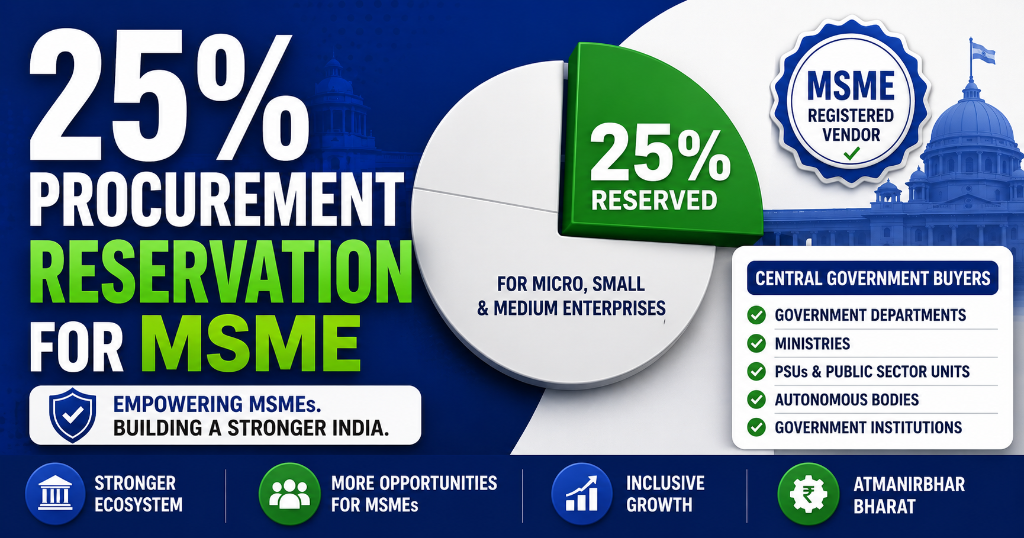
The 25% procurement reservation is a mandatory government policy that requires all central government ministries, departments, and Central Public Sector Undertakings (CPSUs) to procure a minimum of 25% of their total annual purchases of goods and services from Micro and Small Enterprises (MSEs).
Key Facts About the Policy:
| Aspect | Specification |
|---|---|
| Policy Name | Public Procurement Policy for Micro and Small Enterprises (2012) |
| Legal Basis | Section 11 of MSME Development Act, 2006 |
| Target | Minimum 25% of total annual procurement from MSEs |
| Applicable To | Central ministries, departments, CPSUs |
| Effective From | April 1, 2015 (mandatory) |
| Sub-Reservations | 4% for SC/ST MSEs, 3% for women-owned MSEs |
| Exclusive Items | 358 items reserved for MSE-only purchase |
| Monitoring | MSME Sambandh portal |
Evolution of the Policy:
| Year | Milestone |
|---|---|
| March 23, 2012 | Policy notified by Ministry of MSME |
| April 1, 2012 | Voluntary implementation begins with 20% target |
| April 1, 2015 | 20% target becomes mandatory |
| 2018 | MSME classification thresholds revised |
| 2020 | Udyam Registration replaces Udyog Aadhaar |
| Current | Target increased to 25% with enhanced monitoring |
The Legal Framework: MSME Development Act & Public Procurement Policy 2012
The 25% procurement reservation is not a recommendation — it is legally binding under two frameworks:
1. MSME Development Act, 2006 (Section 11)
"The Central Government may, by notification, specify the goods and services which shall be procured by it and its attached or subordinate offices and the companies owned or controlled by it, from micro and small enterprises."
This section empowers the government to mandate procurement from MSEs. The Public Procurement Policy of 2012 was issued under this provision.
2. Public Procurement Policy for MSEs (2012)
The detailed policy specifies:
"Every Central Ministry or Department or Public Sector Undertaking shall set an annual goal of procurement from MSEs with the objective of achieving an overall procurement of minimum 25% of total annual purchases of products produced and services rendered by MSEs."
3. GFR 2017 Rule 153
Under the GFR 2017 Tender Rules Explained (specifically GFR Rule 153):
"Ministry of Micro, Small and Medium Enterprises have notified procurement policy under section 11 of the Micro, Small and Medium Enterprises Development Act, 2006."
This integrates the Public Procurement Policy into the standard government procurement framework.
📊
[Infographic: 25% Reservation Legal Framework]
Diagram showing the flow from MSME Development Act → Public Procurement Policy → GFR 2017 → Department Compliance.
Instant Tender Eligibility & Risk Audit
Upload any 500-page NIT / BOQ PDF. Extract hidden disqualification traps, EMD waiver clauses, and complete eligibility criteria in under 45 seconds.
Who Must Comply? Covered Entities & Exemptions
Entities REQUIRED to Meet 25% Target:
| Entity Type | Compliance Status |
|---|---|
| Central Government Ministries | Mandatory |
| Central Government Departments | Mandatory |
| Central Public Sector Undertakings (CPSUs) | Mandatory |
| Autonomous Bodies (Central) | Mandatory |
| Statutory Bodies (Central) | Mandatory |
Exemptions:
| Category | Exemption Reason |
|---|---|
| Defence Armament Imports | National security |
| Defence Equipment | Weapon systems, missiles (out of purview) |
| Specialized Procurement | Review Committee may grant case-by-case exemption |
Important Clarification:
"Policy is applicable to all the Government Ministries / Departments / CPSUs irrespective of volume and nature of procurement."
Even departments with small procurement budgets must meet the 25% target proportionally.
The 25% Breakdown: How the Quota Is Allocated
The 25% procurement reservation is not a single block — it is composed of multiple mechanisms that work together:
Composition of the 25% MSE Procurement:
| Mechanism | Share of 25% | How It Works |
|---|---|---|
| Direct Purchase from MSEs | Majority | MSEs win tenders through open competition |
| Price Preference (L1+15%) | Significant portion | MSEs match L1 price and win up to 25% of value |
| MSE-Only Tenders | Substantial | Tenders exclusively for MSE participation |
| Subcontracting to MSEs | Variable | Large contractors subcontract to MSEs |
| 358 Reserved Items | Fixed portion | Only MSEs can supply these items |
Visual Breakdown:
Total Government Procurement: 100%
├─ Reserved for MSEs: 25%
│  ├─ General MSE Procurement: 18% (of total)
│  ├─ SC/ST MSE Sub-Quota: 4% (of total)
│  └─ Women MSE Sub-Quota: 3% (of total)
└─ Open to All (including MSEs): 75%
📊
[Infographic: 25% Procurement Reservation Pie Chart]
Visual pie chart showing the breakdown of 25% MSE reservation into general, SC/ST, and women-owned quotas.
Sub-Reservations: 4% for SC/ST & 3% for Women-Owned MSEs
Within the 25% MSE quota, the policy mandates specific sub-reservations for socially disadvantaged groups:
Sub-Reservation Breakdown:
| Category | Reservation | Calculation |
|---|---|---|
| General MSEs | 18% of total procurement | 72% of the 25% MSE quota |
| SC/ST-Owned MSEs | 4% of total procurement | 16% of the 25% MSE quota |
| Women-Owned MSEs | 3% of total procurement | 12% of the 25% MSE quota |
How Sub-Reservations Work:
- First Offer: The 4% SC/ST sub-target is FIRST offered to SC/ST-owned MSEs
- Fallback: If SC/ST MSEs don't participate or don't qualify, the 4% is met from other MSEs
- Same Process: The 3% women-owned target follows the same pattern
- Cumulative: An SC/ST women-owned MSE can contribute to BOTH sub-quotas
Eligibility for Sub-Reservation:
| Ownership Structure | SC/ST Eligibility | Women Eligibility |
|---|---|---|
| Proprietorship | Proprietor must be SC/ST | Proprietor must be woman |
| Partnership | SC/ST partners ≥51% | Women partners ≥51% |
| Private Limited | SC/ST promoters ≥51% | Women promoters ≥51% |
| LLP | SC/ST designated partners ≥51% | Women designated partners ≥51% |
Special Support for SC/ST & Women MSEs:
- Special Vendor Development Programmes organized by departments
- Buyer-Seller Meets exclusively for SC/ST and women entrepreneurs
- NSIC Special Window under Single Point Registration Scheme
- Priority in GeM catalog approval for women-owned MSEs
- Interest subsidies and credit schemes with lower rates
The 358 Items Reserved for Exclusive Purchase from MSMEs
In addition to the 25% overall reservation, the government has identified 358 specific items that can ONLY be purchased from MSEs by central government departments and CPSUs.
What Are the 358 Items?
The 358 reserved items span across multiple NIC code categories:
| Category (NIC Code) | Examples of Reserved Items |
|---|---|
| Food Products (10) | Bakery items, spices, processed foods |
| Textiles (13, 14) | Handloom fabrics, garments, made-ups |
| Wood Products (16) | Furniture, wooden crates, handicrafts |
| Paper Products (17) | Stationery, paper bags, packaging |
| Chemicals (20, 21) | Cleaning agents, adhesives, paints |
| Rubber & Plastic (22) | Plastic containers, rubber products |
| Fabricated Metal (25) | Metal furniture, tools, hardware |
| Machinery (28) | Small machinery, pumps, motors |
| Electrical Equipment (27) | Cables, switches, lighting fixtures |
| Furniture (31) | Office furniture, school furniture |
| Other Manufacturing (32) | Sports goods, toys, medical instruments |
How the 358-Item List Works:
- Exclusive Purchase: Only MSEs can supply these 358 items to government
- No Competition from Large Enterprises: Large companies cannot bid on these items
- MSE-to-MSE Competition: Only MSEs compete with each other
- Review Committee: The list is reviewed continuously and updated as needed
Strategic Implication for MSEs:
If your product falls within the 358 reserved items, you face zero competition from large enterprises. Your only competitors are other MSEs. This is the easiest path to winning government contracts.
How to check if your product is in the 358 list:
- Visit the Ministry of MSME website
- Download the latest list of 358 reserved items
- Match your NIC codes and product descriptions
- If listed, prioritize government tendering for these products
How the 25% Target Is Monitored: MSME Sambandh Portal
The MSME Sambandh portal (sambandh.msme.gov.in) is the official monitoring mechanism for the 25% procurement reservation policy.
What Is MSME Sambandh?
MSME Sambandh is an online portal launched by the Ministry of MSME to:
- Track procurement targets and achievements by all CPSUs
- Provide transparency in MSE procurement
- Enable MSEs to verify procurement data
- Facilitate grievance redressal for non-compliance
Key Features of the Portal:
| Feature | Description |
|---|---|
| Target Setting | CPSUs set annual MSE procurement targets |
| Achievement Reporting | Quarterly reporting of actual procurement from MSEs |
| Public Dashboard | Real-time data on procurement by department/PSU |
| MSE Verification | MSEs can check if their supplies are counted |
| Grievance Filing | MSEs can file complaints for non-compliance |
Latest Procurement Data (FY 2023-24):
| Metric | Value |
|---|---|
| Total Procurement Reported | ₹1,03,139.37 crore |
| Procurement from MSEs | ₹35,671.42 crore |
| Achievement Rate | 34.59% (exceeds 25% target) |
| Number of MSEs Benefited | 1,23,853 |
| CPSUs Reporting | 110 + 1 Department |
📊
[Infographic: MSME Sambandh Portal Dashboard]
Visual representation of the portal showing procurement targets vs. achievements by department.
Key Insight: CPSUs are not just meeting the 25% target — they are exceeding it at 34.59%. This means the demand for MSE suppliers is strong and growing.
Procurement Achievement Data: Are Targets Being Met?
The data shows that the 25% reservation policy is working — but there is massive room for more MSE participation.
Year-wise Procurement from MSEs:
| Financial Year | Total Procurement (₹ Cr) | MSE Procurement (₹ Cr) | Achievement % |
|---|---|---|---|
| 2015-16 | ~45,000 | ~9,000 | 20% |
| 2016-17 | ~55,000 | ~13,750 | 25% |
| 2017-18 | ~65,000 | ~18,200 | 28% |
| 2018-19 | ~72,000 | ~21,600 | 30% |
| 2019-20 | ~80,000 | ~26,400 | 33% |
| 2020-21 | ~85,000 | ~28,900 | 34% |
| 2021-22 | ~92,000 | ~32,200 | 35% |
| 2022-23 | ~98,000 | ~34,300 | 35% |
| 2023-24 | 1,03,139 | 35,671 | 34.59% |
Department-wise Achievement (Sample):
| Department/PSU | MSE Procurement (₹ Cr) | % of Total |
|---|---|---|
| Indian Railways | ~8,500 | ~38% |
| Defence PSUs | ~6,200 | ~32% |
| Power PSUs | ~4,800 | ~36% |
| Oil & Gas PSUs | ~3,900 | ~35% |
| Steel PSUs | ~2,400 | ~33% |
| Telecom PSUs | ~1,800 | ~37% |
The Opportunity: With ₹35,671 crore already being procured from MSEs, and the target growing, there is enormous potential for new MSE entrants.
How to Access MSME-Reserved Tenders
Finding MSE-reserved tenders requires knowing where to look. Here are all the channels:
Channel 1: Government e-Marketplace (GeM)
- Log in to your GeM seller account
- Go to "Bids & RA" section
- Apply filter: "MSE Purchase Preference" or "MSE Only"
- Browse tenders matching your product/service category
- Set up alerts for new MSE-reserved tenders
Channel 2: Central Public Procurement Portal (CPPP)
- Visit eprocure.gov.in
- Search tenders with keywords: "MSE", "MSME", "Reservation"
- Check NIT for "Reservation for MSEs" clause
- Download tender documents for eligible opportunities
Channel 3: MSME Sambandh Portal
- Visit sambandh.msme.gov.in
- View public dashboard for procurement opportunities
- Check department-wise targets and gaps
- Identify departments falling short of targets (more opportunities)
Channel 4: State E-Procurement Portals
Most states have adopted similar MSE reservation policies:
- Maharashtra: maharashtra.gov.in
- Karnataka: eproc.karnataka.gov.in
- Tamil Nadu: etenders.tn.gov.in
- Gujarat: eprocure.gujarat.gov.in
- Delhi: eprocure.delhi.gov.in
Channel 5: TenderFlow Pro's AI Scanner
TenderFlow Pro monitors 500+ portals including:
- GeM and CPPP
- All state e-procurement portals
- PSU-specific portals (IREPS, EIL, etc.)
- Municipal corporation portals
Our AI automatically:
- Detects MSE-reserved tenders
- Matches them to your NIC codes and Udyam profile
- Sends instant alerts when relevant tenders are published
- Flags departments with MSE procurement gaps (higher win probability)
MSE-Only Tenders vs Price Preference Tenders
Not all MSE-reserved tenders work the same way. Understanding the difference is critical:
| Feature | MSE-Only Tenders | Price Preference Tenders |
|---|---|---|
| Who Can Bid | Only MSEs | All bidders (MSEs get preference) |
| Competition | MSE vs MSE only | MSE vs Large Enterprise |
| Winning Mechanism | Lowest MSE bid wins | L1+15% matching |
| Quantity Reserved | 100% of tender | Up to 25% of tender |
| EMD | Exempt (BSD) Read EMD Guide | Exempt (BSD) Read EMD Guide |
| Typical Value | Up to ₹25 lakh | Any value |
| Where Found | GeM MSE category, CPPP | All tender portals |
When to Target MSE-Only Tenders:
- You want to avoid competition from large enterprises entirely
- Your product is in the 358 reserved items list
- You are a new MSE with limited experience
- The tender value is relatively small (up to ₹25 lakh)
When to Use Price Preference:
- The tender is open to all bidders
- You can quote within 15% of estimated L1
- The item is non-splitable (potential full contract)
- You want to compete for larger contracts
Learn more about price preference in our L1+15% price preference guide.
Subcontracting: How Large Enterprises Can Help MSEs
An often-overlooked aspect of the 25% reservation is subcontracting. Large enterprises that win government tenders can subcontract work to MSEs, and those payments count toward the 25% target.
How Subcontracting Works:
- Large enterprise wins a government tender
- Large enterprise subcontracts a portion to an MSE
- Payment to the MSE is counted as "procurement from MSE"
- Both the large enterprise and the department meet their targets
What Counts as Subcontracting:
| Arrangement | Counts Toward 25%? |
|---|---|
| Component supply | ✅ Yes |
| Assembly work | ✅ Yes |
| Service outsourcing | ✅ Yes |
| Consortia with MSEs | ✅ Yes |
| Trading by MSE | ❌ No (must be manufacturing/service) |
How MSEs Can Benefit:
- Register as subcontractors with large enterprises
- Join NSIC consortia for collective bidding
- Partner with aggregators appointed by Ministry of MSME
- List your capabilities on GeM as a subcontractor
- Leverage additional benefits such as EMD exemptions, tender cost waivers, and price preference. Learn more in our MSME Tender Benefits 2026 guide.
Important: The main contractor must ensure the subcontractor is a genuine MSE. Fraudulent subcontracting claims can lead to blacklisting.
State-wise Procurement Reservation Policies
While the 25% target applies to central government, most states have adopted similar or enhanced policies:
| State | MSE Reservation | Special Features |
|---|---|---|
| Maharashtra | 25% + additional 5% price preference | L1+20% for MSEs |
| Karnataka | 25% | Startup fund for MSE bidders |
| Tamil Nadu | 25% | SC/ST MSE additional reservation |
| Gujarat | 25% | Interest subsidy on GeM orders |
| Delhi | 25% | Women MSE priority processing |
| Telangana | 25% | T-Hub tech startup integration |
| Rajasthan | 25% | Artisan MSE special benefits |
| Uttar Pradesh | 25% | ODOP scheme integration |
| West Bengal | 25% | MSE credit card scheme |
| Madhya Pradesh | 25% | Tribal MSE packages |
Pro Tip: Register on your state's MSME portal IN ADDITION to central portals. State tenders often have less competition and faster processing.
Common Misconceptions About 25% Reservation
| Misconception | Reality |
|---|---|
| "25% reservation means 25% of every tender" | ❌ No — it's 25% of TOTAL ANNUAL procurement, not each tender |
| "Only manufacturing MSEs benefit" | ❌ No — services are also included |
| "Medium Enterprises can claim reservation" | ❌ No — only Micro and Small Enterprises |
| "Trading MSEs qualify" | ❌ No — must manufacture goods or render services |
| "The 25% is automatically given" | ❌ No — MSEs must bid and win tenders |
| "Subcontracting doesn't count" | ❌ No — subcontract payments DO count |
| "All 358 items are low-value" | ❌ No — includes machinery, equipment, and high-value goods |
| "State governments don't have reservation" | ❌ No — most states have adopted similar policies |
| "If SC/ST quota isn't filled, it lapses" | ❌ No — it reverts to general MSE quota |
| "Only GeM has MSE tenders" | ❌ No — CPPP, state portals, and PSU portals also have them |
Real-World Impact: How 25% Reservation Changed MSME Businesses
Case Study 1: From Zero to ₹50 Lakh in Government Contracts
Business: Micro textile manufacturer in Rajasthan Before Reservation Awareness: Zero government contracts, 100% B2B private sales Action: Registered on Udyam, listed products in 358 reserved items (textiles), started bidding on MSE-only tenders on GeM Result: Won 8 MSE-only tenders in 18 months totaling ₹48 lakh Key Learning: The 358 reserved items list eliminated competition from large textile manufacturers.
Case Study 2: SC/ST MSE Wins Through Sub-Reservation
Business: Small construction material supplier in Tamil Nadu, SC-owned Challenge: Could not compete with large suppliers on price in open tenders Action: Targeted tenders with SC/ST sub-reservation, used price preference where applicable Result: Won 5 tenders through SC/ST sub-reservation totaling ₹32 lakh Key Learning: Sub-reservation creates a dedicated market segment with minimal competition.
Case Study 3: Women-Owned MSE Benefits from Dual Quota
Business: Small food processing unit in Maharashtra, women-owned Advantage: Qualified for BOTH women sub-reservation (3%) AND general MSE quota Action: Bid on women-reserved tenders AND general MSE tenders Result: Won contracts worth ₹28 lakh in 12 months Key Learning: Women-owned MSEs should exploit BOTH the 3% women quota and the general 18% quota.
Case Study 4: Subcontracting Route for New MSE
Business: Micro electronics component manufacturer in Bangalore Challenge: No prior government experience, ineligible for direct tenders Action: Partnered with a large IT PSU as subcontractor for hardware components Result: ₹15 lakh annual subcontract, counted toward PSU's 25% target Key Learning: Subcontracting is an excellent entry point for new MSEs without tendering experience.
Did you know? Over 60% of MSMEs find tender document analysis the most time-consuming part of government bidding. TenderFlow Pro reduces this from days to minutes.
How TenderFlow Pro Finds Reserved Tenders Automatically
TenderFlow Pro is built to ensure MSEs never miss a reserved tender opportunity:
1. MSE-Reserved Tender Detection
Our AI scans every tender across 500+ portals and instantly flags:
- MSE-only tenders
- Tenders with MSE price preference clauses
- Tenders for 358 reserved items
- SC/ST and women-reserved tenders
- Subcontracting opportunities
2. Department Gap Analysis
Our system tracks which departments are falling short of their 25% targets:
- Identifies departments with MSE procurement gaps
- Prioritizes tenders from these departments (higher win probability)
- Alerts you when departments issue urgent MSE-only tenders to meet year-end targets
3. NIC Code Matching
Enter your Udyam NIC codes once. Our AI:
- Matches your codes to tender requirements
- Filters out irrelevant tenders
- Shows only MSE-reserved tenders you can actually supply
4. Udyam-GeM Link Verification
Before bidding, our system checks:
- Whether your GeM profile is linked to Udyam
- Whether your Udyam classification is current
- Whether you're eligible for the specific reservation type
- Alerts you to fix issues BEFORE bid submission
5. Sub-Reservation Opportunity Alerts
If your MSE is SC/ST or women-owned:
- Dedicated alerts for sub-reserved tenders
- Tracking of sub-target achievement by department
- Priority notification when sub-quotas are undersubscribed
Don't Miss Out on Reserved Tenders
Our AI scans 500+ portals daily to find MSE-reserved contracts matching your NIC codes. Win more government orders.
Calculate Your Price Preference Now →FAQs About 25% Procurement Reservation
Q1: What is the 25% procurement reservation for MSMEs?
A: The 25% procurement reservation is a mandatory policy under the Public Procurement Policy for Micro and Small Enterprises (2012), notified under the MSME Development Act, 2006. It requires all central government ministries, departments, and Central Public Sector Undertakings (CPSUs) to procure a minimum of 25% of their total annual purchases of goods and services from Micro and Small Enterprises. This was increased from the original 20% target set in 2012.
Q2: Who is covered under the 25% MSME procurement reservation?
A: The 25% procurement reservation applies to all central government ministries, departments, and Central Public Sector Undertakings (CPSUs). It is mandatory as notified under Section 11 of the MSME Development Act, 2006. State governments have also adopted similar policies, though percentages may vary. The policy does not apply to defence armament imports and certain specialized procurements.
Q3: What are the sub-reservations within the 25% MSME quota?
A: Within the 25% procurement reservation for MSEs, there are two sub-reservations: (1) 4% of total annual procurement (which is 16% of the 25% MSE quota) is reserved for MSEs owned by SC/ST entrepreneurs; and (2) 3% of total annual procurement (which is 12% of the 25% MSE quota) is reserved for MSEs owned by women entrepreneurs. If SC/ST or women-owned MSEs do not participate, their sub-quota is met from other qualifying MSEs.
Q4: What are the 358 items reserved for exclusive purchase from MSMEs?
A: The government has reserved 358 items for exclusive purchase from Micro and Small Enterprises. These items span multiple categories including food products, textiles, wood products, paper products, chemicals, rubber and plastic products, fabricated metal products, machinery and equipment, furniture, and other manufactured goods. Only MSEs can supply these items to central government departments and CPSUs — large enterprises are completely excluded.
Q5: How is the 25% MSME procurement target monitored?
A: The 25% MSME procurement target is monitored through the MSME Sambandh portal (sambandh.msme.gov.in). All central ministries, departments, and CPSUs must register on this portal and report their annual procurement targets and achievements. As of FY 2023-24, CPSUs achieved 34.59% procurement from MSEs against the 25% target, benefiting 1,23,853 MSEs with procurement worth ₹35,671.42 crore.
Q6: How can I find MSME-reserved tenders?
A: You can find MSME-reserved tenders through: (1) GeM portal — filter tenders by "MSE" category; (2) CPPP (eprocure.gov.in) — look for "Reservation for MSEs" in tender NIT; (3) MSME Sambandh portal — tracks procurement opportunities; (4) State e-procurement portals — many have MSE-specific sections; (5) TenderFlow Pro's AI scanner — automatically detects MSE-reserved tenders across 500+ portals.
Q7: Can Medium Enterprises benefit from the 25% reservation?
A: No. Medium Enterprises are NOT eligible for the 25% procurement reservation, which is exclusively for Micro and Small Enterprises. However, Medium Enterprises can still bid on general (non-reserved) tenders and may benefit from other policies such as the Make in India initiative and domestic preference for sub-₹200 crore tenders under GFR 2017. Medium Enterprises can also participate as subcontractors to MSEs in reserved tenders.
Q8: What happens if a department fails to meet the 25% target?
A: If a central ministry, department, or CPSU fails to meet the 25% procurement target from MSEs, they must report the shortfall in their Annual Report with detailed reasons. The Review Committee under the Ministry of MSME monitors compliance and may consider requests for exemption on a case-to-case basis. However, exemptions are rare and require strong justification. Persistent non-compliance may attract administrative scrutiny.
Q9: Does the 25% reservation include services or only goods?
A: The 25% procurement reservation applies to BOTH goods and services produced/rendered by Micro and Small Enterprises. The Public Procurement Policy explicitly states "products produced and services rendered by MSEs." However, the policy is NOT meant for trading activities — an MSE must actually manufacture the goods or provide the services to qualify. Pure trading by MSEs does not count toward the 25% target.
Q10: How does subcontracting work under the 25% reservation policy?
A: Under the Public Procurement Policy, the 25% annual procurement goal includes sub-contracts to MSE units by large enterprises. If a large company wins a tender and sub-contracts work to an MSE, the payment made to the MSE counts toward the procuring entity's 25% target. This provision is particularly useful for turnkey projects and complex procurements where the main contractor is a large enterprise but components can be sourced from MSEs.
Conclusion: Claim Your Share of the Reserved Market
The 25% procurement reservation is not a favor — it is your legal right as a Micro or Small Enterprise. The Government of India has reserved a market worth ₹12.5–17.5 lakh crore annually exclusively for MSEs. The data shows departments are eager to meet their targets (achieving 34.59% against 25%). The only missing piece is you.
Your action plan:
- Today: Verify your Udyam registration is active and correctly classified as Micro or Small
- This week: Register on GeM and link your Udyam profile
- This month: Check if your products are in the 358 reserved items list
- Ongoing: Set up alerts for MSE-reserved tenders on GeM, CPPP, and state portals
- Strategic: If SC/ST or women-owned, target sub-reserved tenders for lower competition
- Entry route: Consider subcontracting with large enterprises if you're new to government procurement
- Always: Use TenderFlow Pro's AI to scan 500+ portals, detect MSE-reserved tenders, and match them to your profile automatically
The 25% reservation exists because the government WANTS MSEs to succeed. The market is reserved. The targets are being exceeded. The only question is whether you show up to claim what's yours.
Never Miss an MSE-Reserved Tender Again
TenderFlow Pro scans 500+ government portals, detects MSE-reserved tenders instantly, matches them to your Udyam profile, and alerts you before deadlines. Stop missing opportunities. Start winning reserved contracts.