Earnest Money Deposit (EMD) in Government Tenders India 2026: Complete Guide to Amount, Format, Exemption & Refund
Home → Blog → EMD Complete Guide For the comprehensive end-to-end framework, consult our master government tender guide 2026. (See also: Performance Bank Guarantee (PBG) Requirements Guide). (See also: Tender Bid Withdrawal Rules & Penalties Guide).
Last Updated: July 11, 2026 · Reading Time: 24 minutes · Written by: TenderFlow Pro Research Team
menu_book Table of Contents
Introduction: Why EMD Is the First Hurdle in Every Government Tender
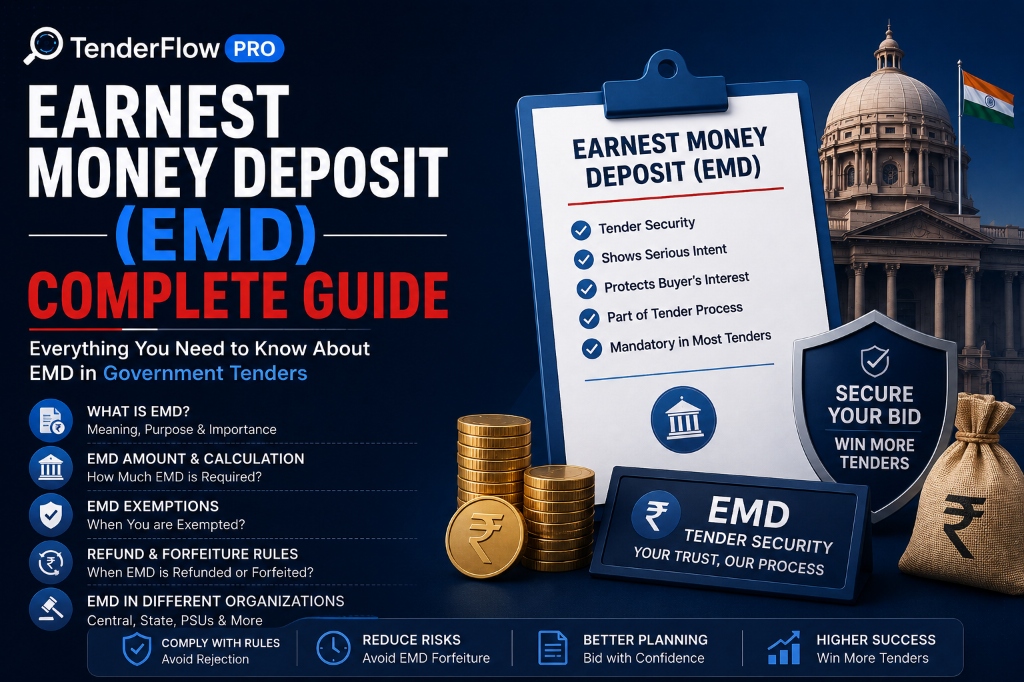
Earnest Money Deposit (EMD) is the first financial gate you must cross before your bid is even opened. It is a refundable security deposit — typically 2% to 5% of the estimated contract value — that proves your seriousness as a bidder. Submit the wrong amount, use the wrong format, or miss the validity period, and your bid is automatically rejected before evaluation begins.
According to procurement industry data, EMD-related issues account for approximately 15% of all technical rejections in Indian government tenders. For an MSME bidding on a ₹5 crore contract, a 2% EMD of ₹10 lakh represents significant working capital. Getting it wrong doesn't just cost the bid — it locks up your money for months.
This guide covers everything about EMD in Indian government tenders: exact calculation methods, accepted formats, MSME exemption rules, refund timelines, forfeiture conditions, and how to never lose money to an EMD error again.
💰
Calculate Your EMD & MSME Savings Instantly
Upload any tender PDF and TenderFlow Pro's AI extracts the exact EMD amount, detects MSME exemption eligibility, and auto-generates the Bid Security Declaration. First scan is FREE.
Analyze My Tender FREE →

Get the Bid Mastery Toolkit
From document download to token submission — every checklist, tracker, and milestone planner.
- ✓ 150-Point Pre-Submission Checklist (PDF)
- ✓ 50-Point Technical Bid Compliance Audit
- ✓ 30-Point Financial Bid Verification
- ✓ Bid Submission Timeline & Deadline Planner (Excel)
🔒 256-Bit Secure Razorpay Checkout · Lifetime Access · Instant Digital Delivery
What Is Earnest Money Deposit (EMD)?
Earnest Money Deposit (EMD) is a financial guarantee that bidders submit along with their tender bid to demonstrate commitment and financial capability. It serves three critical purposes:
- Deters frivolous bidding: Prevents non-serious participants from cluttering the process
- Protects the buyer: Covers losses if a winning bidder withdraws or refuses to sign the contract
- Ensures bid validity: Bidders are financially motivated to keep their bids valid for the required period
Key Characteristics of EMD:
| Feature | Specification |
|---|---|
| Nature | Refundable security deposit |
| Amount | 2% to 5% of estimated tender value (GFR 2017 Rule 170) |
| Format | Bank Guarantee, DD, FDR, NEFT/RTGS, or BSD (for MSMEs) |
| Validity | Must exceed bid validity by minimum 45 days |
| Forfeiture | Applies if bidder withdraws, refuses contract, or submits false info |
| Refund | Within 30 days for unsuccessful bidders; after contract signing for winner |
Important: EMD is NOT the same as Performance Security. EMD is submitted WITH the bid; Performance Security is submitted AFTER winning the contract. We explain the difference in detail later in this guide.
Legal Framework: GFR 2017 Rule 170 & EMD Requirements
GFR 2017 Rule 170 (Bid Security) is the governing provision for EMD in all central government tenders. Here are the exact requirements:
GFR 2017 Rule 170 — Key Provisions:
"The earnest money deposit shall ordinarily be between two per cent to five per cent of the estimated value of the goods to be procured. The exact amount of earnest money deposit should be determined accordingly by the department and indicated in the bidding documents."
What Rule 170 Mandates:
| Requirement | Rule 170 Specification |
|---|---|
| EMD Percentage | 2% to 5% of estimated contract value |
| EMD Format | Demand Draft, Bank Guarantee, Fixed Deposit Receipt, or online transfer |
| EMD Validity | Must be valid for at least 45 days beyond bid validity period |
| MSME Exemption | Micro & Small Enterprises exempt; submit BSD instead |
| Forfeiture Grounds | Withdrawal, refusal to sign contract, false information |
| Refund Timeline | Within 30 days for unsuccessful bidders |
EMD in State Government Tenders:
While GFR 2017 applies directly to central government, most states have adopted similar EMD rules. However, state tender values and EMD percentages may vary. Always check the specific state e-procurement portal for exact requirements.
Learn more about the complete GFR 2017 framework in our detailed GFR 2017 rules guide.
Instant Tender Eligibility & Risk Audit
Upload any 500-page NIT / BOQ PDF. Extract hidden disqualification traps, EMD waiver clauses, and complete eligibility criteria in under 45 seconds.
How Much Is EMD? Calculation Formula & Examples
The EMD amount is calculated as a percentage of the estimated tender value specified in the Notice Inviting Tender (NIT).
EMD Calculation Formula:
EMD Amount = Estimated Tender Value × EMD Percentage
Standard EMD Percentages by Tender Value:
| Tender Value Range | Typical EMD % | Reason |
|---|---|---|
| Up to ₹10 lakh | 2% – 3% | Higher % for smaller tenders to deter casual bidding |
| ₹10 lakh – ₹1 crore | 1.5% – 2.5% | Standard range for most tenders |
| ₹1 crore – ₹100 crore | 1% – 2% | Lower % to encourage participation |
| Above ₹100 crore | 1% | Reduced to avoid discouraging large bidders |
EMD Calculation Examples:
| Estimated Tender Value | EMD % | EMD Amount (₹) |
|---|---|---|
| ₹5,00,000 | 2% | ₹10,000 |
| ₹25,00,000 | 2% | ₹50,000 |
| ₹50,00,000 | 2% | ₹1,00,000 |
| ₹1,00,00,000 | 2% | ₹2,00,000 |
| ₹5,00,00,000 | 2% | ₹10,00,000 |
| ₹25,00,00,000 | 1.5% | ₹37,50,000 |
| ₹100,00,00,000 | 1% | ₹1,00,00,000 |
📊
[Infographic: EMD Amount Calculator]
Interactive calculator showing EMD amounts across different tender values and percentages.
Where to Find the EMD Amount in Tender Documents:
- NIT (Notice Inviting Tender): Front page typically lists EMD amount
- Instructions to Bidders (ITB): Section on "Bid Security" or "Earnest Money Deposit"
- General Conditions of Contract (GCC): Financial terms section
- Bid Form/Annexure: May include EMD calculation worksheet
Pro Tip: Always verify the EMD amount from the NIT AND the ITB section. Some tenders specify EMD in the NIT but provide a different calculation method in the detailed instructions.
Accepted EMD Formats: BG, DD, FDR & Online Payment
Government tenders accept EMD in specific formats only. Using an unaccepted format results in automatic rejection.
Accepted EMD Formats (Ranked by Common Usage):
| Format | Best For | Processing Time | Cost |
|---|---|---|---|
| Bank Guarantee (BG) | Large tenders (₹10L+) | 2–5 working days | 0.5%–1% of BG value |
| Demand Draft (DD) | Small to medium tenders | Same day at bank | ₹50–₹500 bank charges |
| Fixed Deposit Receipt (FDR) | When cash is already parked | Immediate (if existing FDR) | No additional cost |
| NEFT/RTGS Online | E-procurement portals | Same day | ₹5–₹25 transaction fee |
| Insurance Surety Bond | Selected tenders only | 3–7 working days | 1%–2% of bond value |
| Bid Security Declaration | MSMEs (zero cost) | Immediate | FREE |
Format 1: Bank Guarantee (BG)
Most common for tenders above ₹10 lakh.
Requirements:
- Must be from a scheduled commercial bank (SBI, PNB, ICICI, HDFC, etc.)
- Must be in favor of the exact authority named in the tender
- Validity must cover bid validity + 45 days minimum
- Must be unconditional and irrevocable
- Some departments require BG from nationalized banks only
Sample BG Format:
To,
The [Tendering Authority Name]
[Department/PSU Name]

Bank Guarantee No.: _______
Date: _______

In consideration of [Buyer Name] having invited bids for [Work Description]
under Tender No. [Reference Number], we, [Bank Name], hereby guarantee
the sum of ₹[Amount] (Rupees [Amount in Words]) as Earnest Money Deposit.

This guarantee shall remain valid up to [Date] and shall be extended on
request. We undertake to pay the guaranteed amount on first written demand
without any demur or dispute.
Format 2: Demand Draft (DD)
Common for smaller tenders and state government bids.
Requirements:
- Drawn in favor of the exact payee named in the tender
- Payable at the specified location
- Must be from a scheduled bank
- Date should be within validity period
Sample DD Details:
Payable to: "The Director, [Department Name]"
Amount: ₹[EMD Amount]
Bank: [Scheduled Commercial Bank]
Branch: [City/Branch Name]
Date: [Within validity period]
Format 3: Fixed Deposit Receipt (FDR)
Used when you already have an FDR and want to pledge it.
Requirements:
- FDR must be pledged in favor of the procuring authority
- Must be from a scheduled bank
- Maturity date must extend beyond bid validity + 45 days
- Some departments require FDR from nationalized banks only
Format 4: Online Payment (NEFT/RTGS)
Increasingly used on e-procurement portals like GeM and CPPP.
Requirements:
- Transfer to the specified bank account
- Attach transaction receipt/reference number
- Ensure transfer is completed before bid submission deadline
- Some portals auto-verify online payments
Format 5: Insurance Surety Bond
Emerging alternative in select government tenders.
Requirements:
- Must be from an IRDAI-registered insurance company
- Must cover the full EMD amount
- Validity must match tender requirements
- Check if the specific tender accepts surety bonds
📋
[Infographic: EMD Format Comparison Table]
Side-by-side comparison of all 5 EMD formats with requirements, costs, and best-use scenarios.
EMD Validity Period: How Long Must It Cover?
EMD validity is a critical compliance parameter. An EMD that expires before the required date results in bid rejection.
EMD Validity Rules Under GFR 2017:
| Parameter | Standard Requirement |
|---|---|
| Bid Validity Period | 90 days (standard); extendable to 180 days |
| EMD Validity Minimum | Bid validity period + 45 days |
| Standard EMD Validity | 135 days (90 + 45) |
| Extended EMD Validity | 225 days (180 + 45) |
EMD Validity Calculation Example:
- Bid Submission Deadline: January 15, 2026
- Bid Validity Period: 90 days (until April 15, 2026)
- Minimum EMD Validity Required: April 15 + 45 days = May 30, 2026
- Your BG Validity: Must be valid until at least May 30, 2026
Critical Warning: If the buyer extends bid validity (e.g., from 90 to 120 days), you must extend your EMD validity accordingly. Failure to do so results in bid rejection.
Bank Guarantee Validity Checklist:
- BG issue date is before bid submission deadline
- BG expiry date is at least 45 days after bid validity expiry
- BG is from a scheduled commercial bank
- BG is unconditional and irrevocable
- BG amount matches exact EMD requirement
- BG is in favor of the correct authority
- BG reference number is recorded in bid documents
EMD Exemption for MSMEs: Bid Security Declaration (BSD)
This is the most financially significant EMD provision for Micro and Small Enterprises.
GFR 2017 Rule 170 — MSME Exemption:
"No earnest money deposit shall be required to be deposited by Micro and Small Enterprises."
Under the Public Procurement Policy for MSEs (2012), Micro and Small Enterprises with valid Udyam registration are fully exempt from EMD on central government tenders.
What MSMEs Submit Instead of EMD:
Bid Security Declaration (BSD) — A self-declaration form stating:
- The enterprise is a registered Micro or Small Enterprise
- The enterprise accepts all tender terms and conditions
- The enterprise agrees to standard forfeiture rules (withdrawal, non-signing, etc.)
- The declaration is submitted on company letterhead with authorized signature
BSD Format (Standard Template):
[Your Company Letterhead]

Date: ___________

To,
The Tender Inviting Authority
[Department/PSU Name]

Subject: BID SECURITY DECLARATION IN LIEU OF EARNEST MONEY DEPOSIT
         TENDER REF: [Tender Reference Number]

We, _________________________ (Name of Company), a [Micro/Small]
Enterprise registered under Udyam Registration Number _________________,
hereby declare as follows:

1. We are a Micro/Small Enterprise as per MSME classification criteria.
2. We have valid Udyam Registration and are eligible for EMD exemption
   under GFR 2017 Rule 170.
3. We accept all terms and conditions of the tender.
4. We understand that EMD exemption does not exempt us from:
   a) Forfeiture for bid withdrawal during validity period
   b) Forfeiture for refusal to sign contract after winning
   c) Blacklisting for false information

Yours faithfully,

_________________________
[Authorized Signatory Name]
[Designation]
[Company Seal]
EMD Savings for MSMEs:
| Tender Value | EMD (2%) | MSME Savings |
|---|---|---|
| ₹10,00,000 | ₹20,000 | ₹20,000 |
| ₹50,00,000 | ₹1,00,000 | ₹1,00,000 |
| ₹1,00,00,000 | ₹2,00,000 | ₹2,00,000 |
| ₹5,00,00,000 | ₹10,00,000 | ₹10,00,000 |
| ₹25,00,00,000 | ₹50,00,000 | ₹50,00,000 |
📊
[Infographic: MSME EMD Savings Calculator]
Interactive grid showing EMD savings across tender values for Micro and Small Enterprises.
Who Qualifies for EMD Exemption:
| Enterprise Type | EMD Exemption? | Document Required |
|---|---|---|
| Micro Enterprise | ✅ Full exemption | Udyam Certificate + BSD |
| Small Enterprise | ✅ Full exemption | Udyam Certificate + BSD |
| Medium Enterprise | ❌ No exemption | Must pay full EMD |
| Large Enterprise | ❌ No exemption | Must pay full EMD |
| DPIIT-Recognized Startup | ✅ Full exemption | DPIIT Certificate + BSD |
| NSIC-Registered MSE | ✅ Full exemption | NSIC Certificate + BSD |
Important: To claim EMD exemption, review our step-by-step EMD Exemption Claim Guide. Your Udyam registration must be linked to your GeM profile (for GeM tenders) or submitted with your bid documents (for CPPP/state tenders).
Learn more about Udyam registration in our complete Udyam guide.
EMD Refund Process: When & How You Get Your Money Back
Understanding the EMD refund timeline helps you plan working capital and follow up when delays occur.
EMD Refund Scenarios:
| Scenario | Refund Timeline | Process |
|---|---|---|
| Unsuccessful bidder | Within 30 days of contract award | Automatic refund by department |
| Winning bidder (after contract signing) | After furnishing Performance Security | Adjusted against Performance Security or refunded |
| Tender cancelled | Within 30 days of cancellation notice | Refunded to all bidders |
| No bids received / Retendered | Within 30 days of retender decision | Refunded to all bidders |
| Bid withdrawn before deadline | Within 30 days of withdrawal | Full refund (no forfeiture) |
EMD Refund Process Step-by-Step:
- Contract Award Published: Department announces successful bidder
- Unsuccessful Bidders Notified: List of technically qualified but not awarded bidders
- Refund Initiation: Department processes refund within 30 days
- BG Release: If BG was submitted, bank receives release letter from department
- DD/FDR Return: Physical instruments returned via registered post or collected
- Online Refund: NEFT/RTGS refunds processed to registered bank account
What to Do If EMD Refund Is Delayed:
- Day 45: Send first follow-up email to tendering authority
- Day 60: Send formal letter requesting refund status
- Day 75: File RTI application for refund status
- Day 90: If MSME, file complaint on MSME Samadhaan portal for delayed payment
- Day 120: Consider legal notice for recovery
Learn about filing delayed payment complaints in our MSME Samadhaan guide.
EMD Forfeiture: 5 Situations Where You Lose Your Deposit
EMD forfeiture is the penalty for violating tender terms. Here are the exact situations where your EMD is forfeited:
Situation 1: Bid Withdrawal During Validity Period
If you withdraw your bid after submission but before the bid validity period expires, your EMD is forfeited. This prevents bidders from manipulating the process by submitting low bids and then withdrawing.
Exception: You can withdraw BEFORE the bid submission deadline without penalty.
Situation 2: Refusal to Sign Contract After Winning
If you are declared the successful bidder (L1) but refuse to sign the contract within the stipulated time (usually 15–30 days), your EMD is forfeited.
Common reasons for refusal:
- Realized the contract is unprofitable after winning
- Unable to furnish Performance Security
- Discovered restrictive clauses post-award
Situation 3: Failure to Furnish Performance Security
If you win but fail to submit the required Performance Security (5%–10% of contract value) within the specified timeframe, your EMD is forfeited.
Situation 4: Submission of False Information
If post-award verification reveals that you submitted false documents, incorrect turnover figures, or fake certifications, your EMD is forfeited AND you may be blacklisted.
Situation 5: Modification of Bid After Opening
If you attempt to modify your bid (price, technical specs, or documents) after the bid opening without authorization, your EMD is forfeited.
EMD Forfeiture vs BSD Forfeiture for MSMEs:
Even though MSMEs don't deposit actual EMD, the BSD makes them liable to the same forfeiture conditions. If an MSME withdraws or refuses the contract, they face:
- Blacklisting on CPPP/GeM
- Debarment from future tenders
- Legal action for breach of declaration
EMD vs Performance Security: What's the Difference?
Many bidders confuse EMD with Performance Security. They serve different purposes at different stages.
| Parameter | Earnest Money Deposit (EMD) | Performance Security |
|---|---|---|
| When Submitted | With the bid | After winning, before contract signing |
| Purpose | Prove bid seriousness | Guarantee contract execution |
| Amount | 2%–5% of tender value | 5%–10% of contract value |
| Format | BG, DD, FDR, NEFT, BSD | BG, DD, FDR |
| Refund | After contract award (unsuccessful) or after Performance Security submission (winner) | After defect liability period + 60 days |
| Forfeiture | For withdrawal, refusal, false info | For non-performance, delay, quality issues |
| GFR Rule | Rule 170 | Rule 171 |
📊
[Infographic: EMD vs Performance Security Comparison]
Visual comparison showing the lifecycle of both securities from bid to contract completion.
Common EMD Mistakes & How to Avoid Them
| Mistake | Impact | How to Avoid |
|---|---|---|
| Wrong EMD amount | Bid rejected as non-responsive | Calculate from NIT; double-check before submission |
| Wrong format | Bid rejected | Use ONLY the format specified in tender ITB |
| Expired EMD validity | Bid rejected | Ensure validity covers bid period + 45 days |
| BG from non-scheduled bank | Bid rejected | Use SBI, PNB, ICICI, HDFC, or other scheduled banks |
| EMD not in buyer's name | Bid rejected | Use EXACT payee name from tender document |
| Missing EMD entirely | Automatic rejection | Include EMD/BSD in correct bid envelope |
| Submitting EMD as MSME | Unnecessary capital blocked | Claim exemption; submit BSD instead |
| Not extending EMD on validity extension | Bid rejected | Monitor for buyer's validity extension requests |
| Lost DD/BG receipt | Cannot track refund | Scan and save all EMD instrument copies |
| Not following up on refund | Capital stuck for months | Set calendar reminders for Day 45 post-award |
Avoid these and other disqualification reasons by reviewing our tender rejection prevention guide.
EMD State-wise Variations for MSMEs
While GFR 2017 Rule 170 mandates EMD exemption for central government tenders, state governments have adopted this at different levels:
| State | EMD Exemption for MSEs? | Special Notes |
|---|---|---|
| Maharashtra | ✅ Full exemption | Additional 5% price preference beyond central 15% |
| Karnataka | ✅ Full exemption | Startup fund available for first-time MSME bidders |
| Tamil Nadu | ✅ Full exemption | SC/ST MSMEs get additional EMD relaxation |
| Gujarat | ✅ Full exemption | Interest subsidy on GeM orders for MSMEs |
| Delhi | ✅ Full exemption | Women-owned MSMEs get priority processing |
| Telangana | ✅ Full exemption | T-Hub integration for tech startups |
| Rajasthan | ✅ Full exemption | Artisan product MSMEs get additional benefits |
| West Bengal | ✅ Partial | Some municipal tenders still require EMD |
| Bihar | ✅ Full exemption | Special MSME cell for grievance redressal |
| Odisha | ✅ Full exemption | Tribal MSMEs get dedicated reservation |
Pro Tip: Always check the specific state e-procurement portal rules. Some states require additional documentation beyond the central BSD format.
Real-World Case Studies: EMD Wins & Losses
Case Study 1: ₹10 Lakh EMD Saved Through MSME Exemption
Business: Small manufacturing unit in Maharashtra Tender: PWD road construction, estimated value ₹5 crore EMD Required: ₹10 lakh (2%) Action: Submitted Bid Security Declaration with Udyam certificate instead of EMD Outcome: Bid accepted for technical evaluation. Saved ₹10 lakh working capital. Key Learning: Always check EMD exemption eligibility before arranging funds.
Case Study 2: EMD Forfeited Due to Withdrawal
Business: Medium construction company in Delhi Tender: CPWD building contract, estimated value ₹8 crore EMD Submitted: ₹16 lakh (Bank Guarantee) Action: Bid submitted, then discovered inability to meet technical specs. Withdrew bid during validity period. Outcome: EMD of ₹16 lakh forfeited. Company also received warning for future tenders. Key Learning: Conduct thorough eligibility check BEFORE submitting bid and EMD.
Case Study 3: Wrong EMD Format Causes Rejection
Business: IT services company in Bangalore Tender: GeM software development, estimated value ₹50 lakh EMD Required: ₹1 lakh (Demand Draft) Action: Submitted EMD via NEFT instead of DD as specified in tender Outcome: Bid rejected as non-responsive at technical evaluation stage Key Learning: Read the ITB section carefully for prescribed EMD format. Never assume.
Case Study 4: Delayed EMD Refund Recovered
Business: Small supplier in Gujarat Tender: PSU equipment supply, estimated value ₹2 crore EMD Submitted: ₹4 lakh (DD) Issue: Tender awarded to competitor on Day 45, but EMD not refunded by Day 90 Action: Filed MSME Samadhaan complaint on Day 91 Outcome: MSEFC issued notice. EMD refunded with ₹8,500 interest within 15 days Key Learning: Track refund timelines actively. Use Samadhaan for delayed EMD refunds.
How TenderFlow Pro Automates EMD Detection & Compliance
TenderFlow Pro's AI engine eliminates EMD guesswork from your bidding process:
1. Automatic EMD Amount Extraction
Upload any tender PDF and our AI instantly extracts:
- Exact EMD percentage and amount
- Prescribed EMD format
- EMD validity requirements
- Payee name and bank details
2. MSME Exemption Auto-Detection
Our system checks your Udyam profile against every tender:
- ✅ Confirms if EMD exemption applies
- 📝 Auto-generates Bid Security Declaration
- 📋 Verifies Udyam-GeM linkage for GeM tenders
- 💰 Calculates exact savings from exemption
3. EMD Format Validation
Before submission, TenderFlow Pro validates:
- BG is from scheduled bank
- Validity covers required period
- Amount matches tender specification
- Format matches ITB requirements
4. Refund Tracking
For submitted bids, our system:
- Tracks contract award dates
- Sends refund follow-up reminders at Day 45
- Auto-generates follow-up letters
- Flags delayed refunds for Samadhaan filing
5. EMD Cost Calculator
Plan your bidding budget with our interactive calculator:
- Total EMD required for upcoming tenders
- MSME savings projection
- Working capital impact analysis
- Refund timeline forecasting
Get Your Bid Security Advantage
Use TenderFlow Pro's AI tool to scan tenders for MSME exemptions, price preferences, and reservations in seconds. Join the thousands of MSEs winning more contracts.
Calculate Your EMD Now →FAQs About Earnest Money Deposit
Q1: What is Earnest Money Deposit (EMD) in government tenders?
A: Earnest Money Deposit (EMD) is a refundable security deposit that bidders must submit with their tender bid to prove their seriousness and financial commitment. It typically ranges from 2% to 5% of the estimated contract value under GFR 2017 Rule 170. EMD is forfeited if the bidder withdraws during bid validity or fails to sign the contract after winning.
Q2: How is EMD calculated in government tenders?
A: EMD is calculated as a percentage of the estimated tender value specified in the NIT. Under GFR 2017 Rule 170, the standard formula is: EMD Amount = Estimated Tender Value × EMD Percentage (2%–5%). For example, a ₹50 lakh tender with 2% EMD requires a deposit of ₹1,00,000. Some high-value tenders above ₹100 crore may use 1%.
Q3: What are the accepted formats for EMD submission?
A: Accepted EMD formats include: (1) Bank Guarantee (BG) from a scheduled commercial bank — most common for large tenders; (2) Fixed Deposit Receipt (FDR) pledged in favor of the procuring authority; (3) Demand Draft (DD) drawn in favor of the specified officer; (4) Online payment via NEFT/RTGS on e-procurement portals; (5) Insurance Surety Bonds in some tenders; and (6) Bid Security Declaration for MSMEs instead of cash deposit.
Q4: Are MSMEs exempt from EMD in government tenders?
A: Yes. Under GFR 2017 Rule 170, Micro and Small Enterprises (MSEs) with valid Udyam registration are fully exempt from submitting EMD in government tenders. Instead of EMD, MSEs submit a Bid Security Declaration (BSD) — a self-declaration form stating they accept the tender terms and standard forfeiture rules. This exemption does not apply to Medium Enterprises. This EMD exemption is part of a larger MSME procurement ecosystem designed to help small businesses participate. Learn about other benefits in our 25% Procurement Reservation Guide and how you can combine this with the L1+15% price preference policy in our Price Preference Guide.
Q5: When is EMD refunded to bidders?
A: EMD is refunded in these scenarios: (1) Unsuccessful bidders — within 30 days of contract award as per GFR norms; (2) Winning bidder — after furnishing Performance Security and signing the contract; (3) Tender cancelled — returned to all bidders. In practice, government departments may take 30–60 days. Follow up actively after the award is published.
Q6: When can EMD be forfeited?
A: EMD can be forfeited if: (1) The bidder withdraws the bid during the bid validity period; (2) The bidder wins but refuses to sign the contract; (3) The bidder fails to furnish Performance Security within the stipulated time; (4) The bidder provided false information in the bid; or (5) The bidder modifies the bid after opening without authorization.
Q7: What is a Bid Security Declaration (BSD)?
A: A Bid Security Declaration (BSD) is a self-declaration form that Micro and Small Enterprises submit in lieu of Earnest Money Deposit under GFR 2017 Rule 170. The BSD states that the MSE accepts the tender terms and agrees to standard forfeiture rules (withdrawal, non-signing of contract, etc.) without depositing actual money. It is a zero-cost alternative to EMD for eligible MSMEs.
Q8: What is the validity period of EMD?
A: Under GFR 2017, the EMD must remain valid for at least 45 days beyond the bid validity period. Standard bid validity is 90 days, so EMD validity should be at least 135 days from the bid submission deadline. If bid validity is extended to 180 days, EMD validity must be extended accordingly. Bank Guarantees must cover this entire period.
Q9: Can EMD be submitted in cash?
A: No. Cash is generally not accepted as EMD in government tenders. Accepted modes are Bank Guarantee, Fixed Deposit Receipt, Demand Draft, NEFT/RTGS online transfer, and Insurance Surety Bonds. Some e-procurement portals accept online payments through integrated payment gateways. Always check the specific tender document for prescribed modes.
Q10: What happens if I submit less EMD than required?
A: Submitting less than the required EMD amount results in automatic disqualification of your bid at the technical evaluation stage. The bid is declared non-responsive and rejected without further consideration. Always calculate the exact EMD amount from the tender NIT and verify before submission. Never round down or estimate.
Conclusion: Never Lose Money to an EMD Error Again
EMD is not just a financial formality — it is a strategic element of every government tender. The businesses that master EMD compliance save lakhs in working capital, avoid disqualification, and maintain healthy cash flow. The businesses that don't lose bids, lose money, and lose time.
Your action plan:
- Before every bid: Use TenderFlow Pro's AI to extract exact EMD requirements in 45 seconds
- If you're an MSME: Always claim EMD exemption with a Bid Security Declaration — never pay EMD unnecessarily
- When submitting EMD: Verify format, amount, validity, and payee name against the ITB section
- After bid submission: Track refund timelines and follow up at Day 45 if not received
- If refund is delayed: File MSME Samadhaan complaint for recovery + interest
EMD errors are 100% preventable. The tools exist. The rules are clear. The only question is whether you use them.
Never Miscalculate EMD Again
TenderFlow Pro's AI extracts exact EMD amounts, validates formats, detects MSME exemption eligibility, and auto-generates Bid Security Declarations. Every tender, every time, zero errors.