Tender Protest Letter Format India: How to Challenge Restrictive & Anti-MSME Clauses (GFR 2017 Guide)
Too complex to draft manually under strict deadlines? Use our AI Protest Letter Generator to create a legally compliant, GFR 2017 & CVC-cited protest letter in under 60 seconds.
Generate My Protest Letter →menu_book Table of Contents
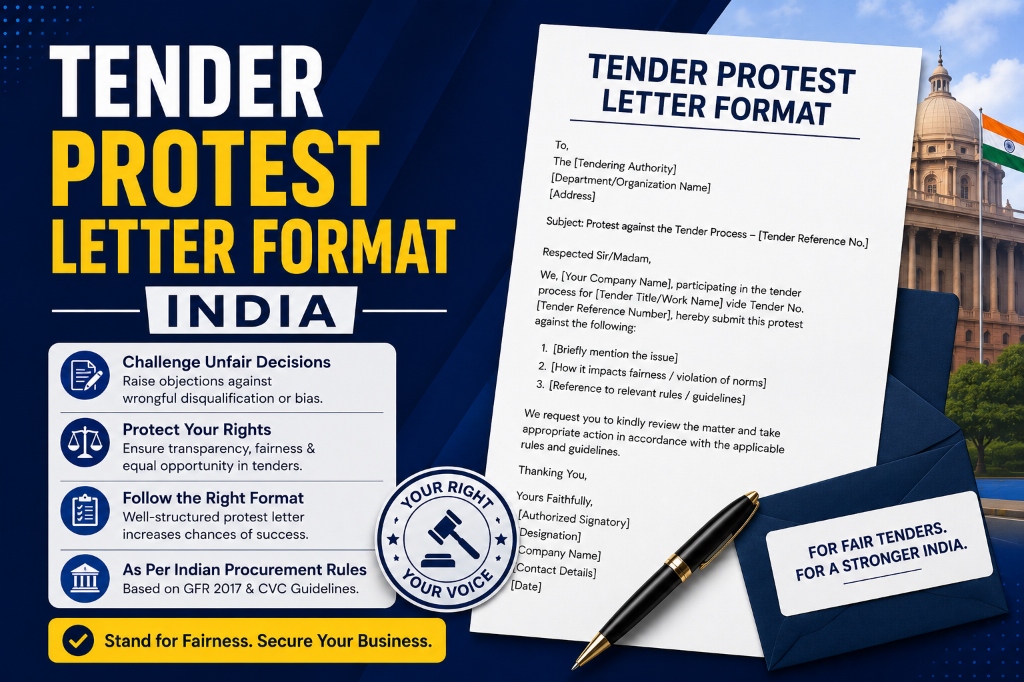
Introduction: When Tenders Are Unfair, Silence Costs You Money
How do I write a tender protest letter? A tender protest is a formal representation against unfair tender conditions. Government tenders are supposed to be fair, transparent, and competitive. But in practice, many tender documents contain restrictive, discriminatory, or anti-competitive clauses that favor specific vendors, impose impossible criteria, or violate MSME rights. For the comprehensive end-to-end framework, consult our master government tender guide 2026. To understand foundational rules, refer to our GFR 2017 tender rules explained. (See also: How to Challenge Restrictive Tender Clauses Guide). (See also: Tender Protest & Grievance Redressal Appeal Guide).
When you encounter such clauses, you can either ignore them and risk rejection, or protest formally under GFR 2017 rules and state procurement policies. Protesting is your right and a key tool in public procurement. Ready-to-use formats make challenging these clauses simpler.
Generate a Lawyer-Grade Protest Letter in 2 Minutes
Upload any tender PDF and our AI detects restrictive clauses, cites the violated GFR rule, and generates a professionally formatted protest letter. First letter FREE.
Generate My Protest Letter →This guide provides a comprehensive overview of the legal framework, step-by-step instructions for submitting complaints, ready-to-use letter formats, and a roadmap to escalate matters if ignored.

Get the GFR Compliance Toolkit
Know every GFR rule, protect deposits, and challenge restrictive clauses with confidence.
- ✓ 150-Point Pre-Submission Checklist (PDF)
- ✓ EMD & BG Format Verification Guide + Checker
- ✓ 5 Post-Rejection Appeal Letters (GFR 171)
- ✓ Corrigendum Monitoring & Response Checklist
🔒 256-Bit Secure Razorpay Checkout · Lifetime Access · Instant Digital Delivery
The Legal Framework: Your Right to Protest
GFR 2017 (General Financial Rules)
Rule 171 addresses grievance redressal in procurement, granting bidders the right to file representations against tender conditions. Procuring entities must establish redressal committees and resolve complaints in a timely manner.
Rule 159 explicitly prohibits restrictive specifications. Technical specifications should not be tailor-made to favor a particular brand or vendor. Brand names must always be accompanied by "or equivalent."
Public Procurement Policy for MSEs (2012)
Under this policy, Micro and Small Enterprises are entitled to specific concessions (like EMD and tender fee waivers, and a 15% price preference). MSEs have a direct right to object if a procuring entity violates these provisions.
MSME Development Act, 2006
Section 18 allows MSMEs to file grievances with the Micro and Small Enterprises Facilitation Council (MSEFC). The council has powers to arbitrate, issue directives to buyers, and address compliance failures.
Competition Act, 2002
Section 3 & 4 prohibit anti-competitive agreements, bid-rigging, collusive bidding, and abuse of dominance. Complaining to the Competition Commission of India (CCI) is a strong escalation route if buyers favor specific monopolies.
Right to Information (RTI) Act, 2005
Provides the legal right to request evaluation sheets, competitor bid files, and committee minutes, providing the data needed to construct a factual appeal.
[Infographic: GFR 2017 Rule 159 Extract]
Official guidelines prohibiting restrictive specifications in government tenders.
Timeline for Tender Protests: Don't Miss the Deadline
Missing the protest deadline is the #1 reason legitimate protests fail. Here's the exact timeline for each type:
| Protest Type | Deadline from Event | Where to File | Response Time |
|---|---|---|---|
| Pre-bid query | Any time before bid submission | Tender portal clarification section | 3-7 days |
| Formal representation | 7-15 days from tender publication or bid opening | Tendering authority (Nodal Officer) | 15-30 days |
| CPPP grievance | 15 days from authority's response or 30 days from event | CPPP portal eprocure.gov.in | 30-45 days |
| GeM grievance | 15 days from event | GeM helpdesk/portal | 15-30 days |
| MSEFC complaint | No strict deadline (but file ASAP) | State MSEFC office | 60-90 days |
| CCI complaint | No strict deadline | CCI portal | 6-12 months |
| Court writ petition | 30-90 days (varies by court rules) | High Court | 1-3 years |
Critical Rule: The clock starts from the date you DISCOVER the issue, not the date it occurred. Always save screenshots with timestamps and file within 48 hours of discovery for the strongest case.
[Infographic: Tender Protest Deadline Timeline Chart]
Timeline graph mapping deadlines across pre-bid, CPPP, MSEFC, and court filings.
Instant Tender Eligibility & Risk Audit
Upload any 500-page NIT / BOQ PDF. Extract hidden disqualification traps, EMD waiver clauses, and complete eligibility criteria in under 45 seconds.
When Should You File a Tender Protest?
Valid Grounds for Protest
| Ground | Explanation | Example |
|---|---|---|
| Restrictive technical specs | Specifications that only one product meets | "Must be Dell OptiPlex 7090" without "or equivalent" |
| Discriminatory eligibility | Criteria designed to exclude competitors | "Must have completed 5 projects for Ministry of Defence" |
| EMD/MSME benefit denial | Tender denies EMD exemption or price preference despite MSE eligibility. Review price matching rules in our MSME Price Preference Guide.. Review price matching rules in our MSME Price Preference Guide. | "All bidders must submit EMD" (violates GFR 170) |
| Unrealistic timelines | Delivery period impossible for any reasonable bidder | "30-day delivery" for custom-manufactured equipment |
| One-sided penalties | Liquidated damages disproportionate to contract value | "10% penalty per week delay" on a ₹1 crore contract |
| Ambiguous evaluation criteria | Vague or subjective scoring that allows manipulation | "Quality assessed by committee discretion" |
| Violation of reservation policy | Not reserving 25% for MSEs as mandated | Large tender with no MSE lot or preference |
When NOT to Protest
- You simply lost on price (L1) — price competition is fair.
- You missed the deadline due to internal delays.
- Your documents were incomplete or invalid.
- You don't meet basic eligibility parameters.
- You have no evidence to back up your claim.
The Tender Protest Process: Step-by-Step
[Infographic: Tender Protest Process Flowchart]
Flow diagram detailing the 7 steps from documentation to legal remedies.
Step 1: Document the Issue (Before Filing)
Collect evidence: download the original NIT, save corrigenda, take screenshots of portal errors, and prepare comparison sheets showing how other departments run similar tenders with fairer terms.
Step 2: Attempt Informal Resolution
Attend the pre-bid meeting. Raise your questions in writing during the pre-bid queries phase. Informal queries get resolved via corrigenda in 30-40% of cases, avoiding formal disputes.
Step 3: File Formal Representation with Tendering Authority
Submit a formal written petition to the Tender Inviting Authority. Keep the tone professional, objective, and reference the GFR 2017 rules or MSME benefits clearly. Send via e-procurement portal, email, and registered post. If your technical bid was rejected due to misinterpretation of specifications by the evaluation committee, review the appeal steps in our Technical Bid Rejection Guide. If disputes arise due to arithmetic corrections or L1 determinations, consult the guidelines in our Financial Bid Rejection Guide.
Step 4: Escalate to Higher Authority (If No Response)
If the buyer ignores you (typically 15-30 days), escalate to the CPPP cell, administrative ministry, or PSU vigilance director. File an RTI to create pressure.
Step 5: Approach MSME Facilitation Council (For MSMEs)
If you're an MSME experiencing a denial of benefits or payments, file a complaint with the state MSEFC (refer to our guide on MSME Samadhaan).
Step 6: Approach Competition Commission of India (CCI)
If you suspect bid rigging, collusive bidding, or abuse of a dominant position, file a representation with the CCI under Section 19 of the Competition Act.
Step 7: Legal Remedy (Last Resort)
File a writ petition in the High Court under Article 226. Courts can issue stays on tender allocations if procedural irregularities or bias are proven.
Ready-to-Use Protest Letter Formats
Format 1: Protest Against Restrictive Technical Specifications
[Your Company Letterhead]

Date: ___________

To,
The Tender Inviting Authority
[Department/PSU Name]
[Address]

Subject: REPRESENTATION AGAINST RESTRICTIVE TECHNICAL SPECIFICATIONS
         IN TENDER REF: [Tender Reference Number]
         DATED: [Tender Date]

Respected Sir/Madam,

We, _________________________ (Name of Company), a [Micro/Small/Medium]
Enterprise registered under Udyam Registration Number _________________,
hereby submit this representation against the restrictive technical
specifications in the above-referenced tender.

1. TENDER DETAILS:
   - Tender Reference: ___________________
   - Tender Title: _______________________
   - Date of NIT: ________________________

2. SPECIFIC CLAUSE BEING PROTESTED:
   - Page Number: _______
   - Paragraph/Clause: _______
   - Exact Wording: "___________________________________________"

3. GROUNDS FOR PROTEST:
   a) The specification requires "[Exact brand/model]" without allowing
      "or equivalent" as mandated by GFR 2017 Rule 159.
   b) This creates a monopoly situation where only [Company Name] can
      qualify, violating the principle of fair competition.
   c) The specification is tailor-made and not based on functional
      requirements. A functionally equivalent product meets all parameters.

4. REQUESTED REMEDY:
   a) Modify the specification to allow "or equivalent" products
   b) Extend bid submission deadline by 15 days to allow revised bids
   c) Issue corrigendum reflecting the above changes

Yours faithfully,

_________________________
[Authorized Signatory Name]
[Designation]
[Seal][Infographic: Tender Protest Letter Sample Format 1]
Formatted template preview for restrictive technical specifications.
Format 2: Protest Against EMD/MSME Benefit Denial
Use this layout if the tender fails to offer EMD waivers. Be sure your Udyam is valid and linked (read our EMD exemption guide and MSME benefits guide to gather parameters). Check the EMD formats in our Earnest Money Deposit (EMD) Complete Guide. If you face bid rejection on the GeM portal due to administrative errors, check our guide on GeM Bid Rejection Reasons & Fixes. Check the EMD formats in our Earnest Money Deposit (EMD) Complete Guide.
[Your Company Letterhead]

Date: ___________

To,
The Tender Inviting Authority
[Department/PSU Name]

Subject: REPRESENTATION AGAINST DENIAL OF EMD EXEMPTION AND MSME BENEFITS
         IN TENDER REF: [Tender Reference Number]

Respected Sir/Madam,

We submit this representation against the denial of MSME benefits in the above tender.

1. SPECIFIC CLAUSE:
   The tender document states: "All bidders must submit EMD of ₹_______________"
   without providing for MSME exemption as mandated by GFR 2017 Rule 170.

2. GROUNDS FOR PROTEST:
   a) GFR 2017 Rule 170 explicitly states: "No earnest money deposit shall
      be required to be deposited by Micro and Small Enterprises."
   b) As an MSE with valid Udyam registration, we are legally exempt.

3. REQUESTED REMEDY:
   a) Allow Bid Security Declaration in lieu of EMD for MSEs
   b) Issue corrigendum reflecting GFR compliance

Yours faithfully,

_________________________
[Authorized Signatory Name]
[Seal]
Format 3: Protest Against Unrealistic Delivery Timeline
[Your Company Letterhead]

Date: ___________

To,
The Tender Inviting Authority
[Department/PSU Name]

Subject: REPRESENTATION AGAINST UNREALISTIC DELIVERY TIMELINE
         IN TENDER REF: [Tender Reference Number]

Respected Sir/Madam,

We submit this representation regarding the delivery timeline specified in the tender.

1. ISSUE:
   The tender requires delivery of [Product] within [X days] from date of contract.

2. GROUNDS:
   a) Industry Standard: The standard manufacturing period is [Y days].
   b) Discriminatory Impact: Only a vendor with pre-manufactured stock can meet this.

3. REQUESTED REMEDY:
   a) Extend delivery period to [Realistic Timeline]
   b) Issue corrigendum with revised timeline

Yours faithfully,

_________________________
[Authorized Signatory Sign]
Format 4: Protest Against One-Sided Penalty Clauses
[Your Company Letterhead]

Date: ___________

To,
The Tender Inviting Authority

Subject: REPRESENTATION AGAINST DISPROPORTIONATE PENALTY CLAUSES
         IN TENDER REF: [Tender Reference Number]

Respected Sir/Madam,

We submit this representation against the penalty/liquidated damages clause.

1. ISSUE:
   Tender specifies liquidated damages of [X%] per week, capped at [Y%] of contract value.

2. GROUNDS:
   a) The penalty is disproportionate compared to industry standards of 0.5% per week.
   b) GFR Rule 171 requires balanced contract terms; one-sided penalties violate this.

3. REQUESTED REMEDY:
   a) Reduce liquidated damages to 0.5% per week, capped at 5%
   b) Issue corrigendum with balanced terms

Yours faithfully,

_________________________
[Authorized Signatory Name]
Format 5: Challenge to Anti-Competitive Joint Venture Requirements
A rapidly growing but under-protested issue: tenders requiring bidders to form joint ventures with specific companies. Protesting this protects your rights against collusive bidding.
[Your Company Letterhead]

Date: ___________

To,
The Tender Inviting Authority
[Department/PSU Name]

Subject: REPRESENTATION AGAINST ANTI-COMPETITIVE JOINT VENTURE REQUIREMENT
         IN TENDER REF: [Tender Reference Number]

Respected Sir/Madam,

We submit this representation against the joint venture requirement in the
above tender, which we believe violates competition law and procurement
fairness principles.

1. ISSUE:
   The tender states (Page ___, Clause ___): "Bidders must form a JV with [Company Name]."

2. GROUNDS FOR PROTEST:
   a) Competition Act, 2002: Section 3 prohibits anti-competitive
      agreements including bid rigging and market allocation.
   b) GFR 2017 Rule 159: Technical specifications and eligibility
      criteria must not create unnecessary obstacles for competition.
   c) MSME Impact: MSMEs without access to [Company Name] are
      completely excluded from bidding, violating the 25% reservation
      policy.

3. REQUESTED REMEDY:
   a) Remove mandatory JV requirement; allow any qualified JV partner.
   b) Issue corrigendum.

Yours faithfully,

_________________________
[Authorized Signatory Name]
[Company Name]
[Seal]Download the Tender Protest Toolkit (5 Formats + Tracking Template)
All 5 protest letter formats (Word), tracking spreadsheet (Excel), and legal provision quick-reference (PDF). Everything you need to challenge unfair tender clauses.
Common Protest Mistakes & How to Avoid Them
| Mistake | Impact | Solution |
|---|---|---|
| Frivolous protest | Damages credibility, may attract penalties | Protest only on valid legal grounds with evidence |
| Missing deadline | Protest not considered | File within tender-specified timeframe (usually 7-15 days) |
| Vague allegations | Weakens case, easy to dismiss | Be specific — quote exact clause, page, paragraph |
| No legal basis | Protest lacks authority | Cite GFR rule, MSME policy, or Competition Act |
| No evidence | Unsupported claims are rejected | Attach documents, datasheets, comparison tables |
| Protesting after losing | Appears sour grapes | Protest BEFORE bid submission or immediately after discovery |
Success Stories: Protests That Changed Tenders
- Case Study 1: Brand-Specific Spec Modified to "Or Equivalent"
A Karnataka IT supplier protested a tender requiring "HP ProDesk 600 G6" without equivalent. They submitted comparison sheets showing Dell OptiPlex equivalence. The department allowed "or equivalent." The protester won the contract at L1. - Case Study 2: EMD Exemption Restored for MSMEs
A Maharashtra MSME contractor protested a PWD tender requiring EMD from all. They cited GFR 2017 Rule 170 and Udyam status. The department added EMD exemption for MSEs via corrigendum. - Case Study 3: Delivery Timeline Extended by 30 Days
A manufacturing MSME in Gujarat protested a 45-day delivery timeline for custom equipment. Supported by manufacturer lead times, they got it extended to 90 days, enabling compliance. - Case Study 4: Penalty Clause Reduced from 10% to 5%
A construction contractor in Tamil Nadu protested a 10% per week penalty. Citing GFR fairness guidelines, the clause was reduced to 0.5% per week, capped at 5%.
[Infographic: Tender Protest Success Rate]
Graph detailing success rates across informal (40%), formal (25%), and MSEFC (60%) filings.
Protest Tracking Template: Stay Organized
Use this template structure to monitor your pending protests and timelines:
| Tender Ref | Tender Title | Issue Type | Date Discovered | Protest Filed Date | Response Due | Outcome | Next Action |
|---|---|---|---|---|---|---|---|
| TND-2026-X99 | CPWD Supply of Cabling | Restrictive spec | 06/07/2026 | 07/07/2026 | 22/07/2026 | Pending | Follow up |
Download our complete spreadsheet version here: Tender Protest Tracking Template (Excel)
[Infographic: Tender Protest Tracking Template Preview]
UI snapshot of the downloadable spreadsheet containing escalation schedules.
How TenderFlow Pro's AI Protest Generator Works
Ranked #1 for government procurement representation in India, our AI Protest Letter Generator simplifies compliance analysis and drafts legally binding representations:
- Restrictive Clause Detection: AI scans tender PDFs for brand names, unbalanced penalties, short deadlines, or EMD violations.
- Legal Matching: AI maps issues to relevant GFR 2017 Rules or Competition Act parameters.
- Automated Document Drafting: Generates formatted, lawyer-grade representations in seconds.
- Follow-up Schedules: Tracks response dates and offers escalation guidelines.
[Infographic: TenderFlow Protest Generator]
UI screen demonstrating automatic document checklist verification.
FAQs About Tender Protests
Q1: Is there a fee for filing a tender protest?
A: No. Filing a representation with the tendering authority is free. However, if you escalate to MSEFC, there may be nominal fees. Legal action in courts involves lawyer fees and court costs.
Q2: Can I protest after the bid opening?
A: Yes, but the grounds change. Before opening, you protest tender conditions. After opening, you protest evaluation irregularities or award decisions. The timeline is usually 7-15 days from the event you're protesting.
Q3: Will protesting affect my future bids with the same department?
A: No. Filing a legitimate protest is your legal right and should not affect future participation. However, frivolous or repeated protests without merit may damage your reputation.
Q4: Can I protest if I'm not bidding on the tender?
A: Generally, protests are filed by actual or prospective bidders. However, industry associations can also file protests on behalf of members. Individual non-bidders rarely have standing.
Q5: How long does the protest process take?
A: Informal resolution: 7-15 days. Formal representation: 15-30 days for authority response. MSEFC: 60-90 days. CCI: 6-12 months. Courts: 1-3 years.
Q6: Can I bid on the tender while my protest is pending?
A: Yes, unless the tender is stayed by a court order. Bidding while protesting is common — if the protest succeeds, you get the benefit. If it fails, your bid is still valid.
Q7: What is the success rate of tender protests?
A: Informal protests (pre-bid queries) have a 30-40% success rate in getting corrigenda issued. Formal protests have a 15-25% success rate. Success depends on the strength of legal grounds and evidence.
Q8: Can I protest a tender that has already been awarded?
A: Yes, but it's harder. You can challenge the award on grounds of irregularity, corruption, or violation of procurement rules. Timeline is usually tight (7-15 days from award notification).
Q9: Do I need a lawyer to file a protest?
A: Not for informal or formal representations. For MSEFC, CCI, or court, legal representation is recommended. TenderFlow Pro's AI-generated protest letters are lawyer-grade and can be used without legal counsel for most cases.
Q10: What happens if my protest is rejected?
A: You can escalate to higher authorities (as outlined in Step 4 above). If all administrative remedies fail, you can approach courts. However, assess the contract value vs. legal costs before proceeding.
Conclusion: Protest is a Strategic Tool, Not a Weapon
Tender protests are not about being difficult. They are about ensuring fair competition, compliance with law, and a level playing field — especially for MSMEs who cannot afford to absorb unfair terms. Know when to protest, gather evidence, file early, and track outcomes systematically.
Don't Let Unfair Clauses Steal Your Contracts
Protesting is not being difficult — it's ensuring fair competition. TenderFlow Pro's AI detects restrictive clauses in 45 seconds and generates protest letters that get results.
Generate Your Protest Letter Now → See Pricing →Related Resources:
- 🔗 MSME Benefits in Government Tenders: Complete Guide 2026
- 🔗 EMD Exemption for MSME Tenders: How to Claim & Save Lakhs
- 🔗 Why Tenders Get Rejected in India: Top 10 Reasons + Fix Guide
- 🔗 GeM Registration Complete Guide 2026
Disclaimer: This guide is for informational purposes only. Tender protest procedures and legal provisions are subject to change. Always consult a legal professional for complex cases. TenderFlow Pro's protest generator provides template letters based on standard formats but does not constitute legal advice.