Tender Eligibility Checklist Complete Guide 2026: The Ultimate Bid/No-Bid Framework for MSMEs, Startups & Contractors
menu_book Table of Contents
Don't risk disqualification over buried annexure clauses. Use the AI Compliance Matrix Builder to extract 100% of mandatory criteria and affidavits in 2 minutes.
Build My Compliance Matrix →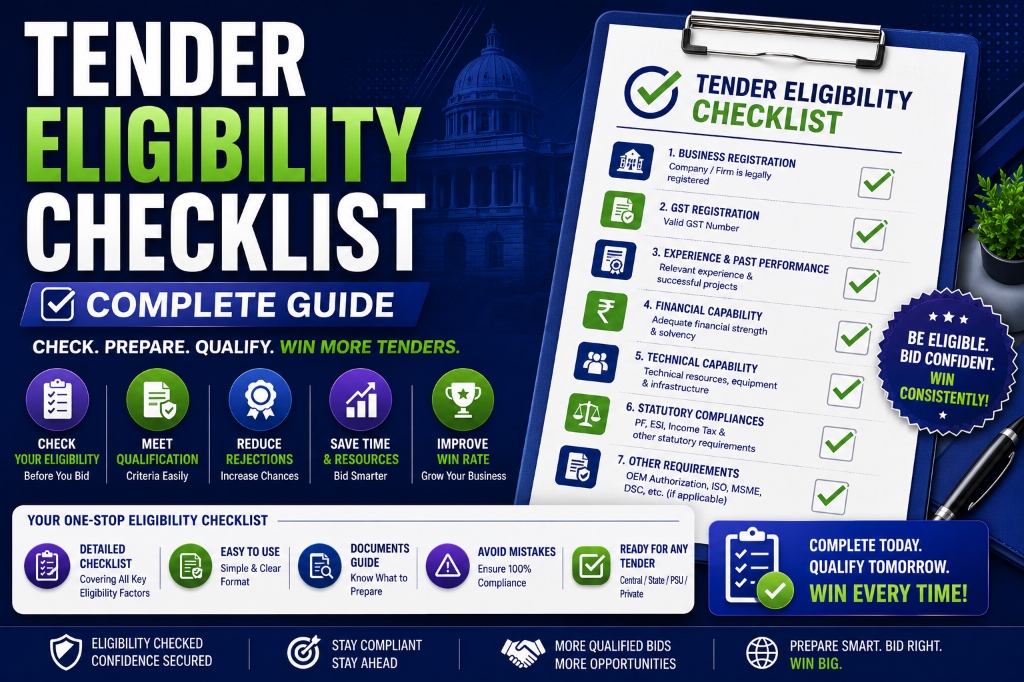
Introduction: The #1 Question Every Bidder Asks
Before a contractor calculates a single rupee of pricing, before an MSME drafts a technical proposal, before a startup uploads a single document — every bidder asks the same question: For the comprehensive end-to-end framework, consult our complete government tender guide India. To understand foundational rules, refer to our how to read a tender document. (See also: Tender Risk Assessment Matrix & Defense Guide).
"Am I even eligible for this tender?"
This is not a trivial question. It is the gatekeeper of the entire bidding process. Get it wrong, and you waste weeks of preparation, thousands of rupees in documentation costs, and potentially lakhs in forfeited EMD. Get it right, and you focus your energy only on tenders you can actually win.
The numbers are staggering:
| Statistic | Value |
|---|---|
| Bids rejected at technical stage | 20–30% of all submissions |
| Rejections due to eligibility issues | ~45% of technical rejections |
| Missing mandatory documents | 35% of all rejections |
| Eligibility criteria failures | 10% of all rejections |
| Average cost per bid preparation | ₹15,000–₹50,000 |
| EMD forfeited per rejection | ₹50,000–₹20,00,000 |
| MSMEs unaware of relaxations | Estimated 60%+ |
The most critical insight? The majority of eligibility-based rejections are preventable. They happen because bidders:
- Don't read the eligibility section before downloading the full tender
- Miss subtle requirements hidden in Annexures
- Don't know about MSME/startup relaxations they're entitled to
- Fail to maintain document validity (expired DSC, lapsed ISO, outdated Udyam)
- Submit bids on tenders where they score 3/10 on eligibility — then wonder why they lost
This guide is your complete eligibility framework. It covers every criterion Indian government tenders require, the MSME/startup relaxations most bidders miss, a 50-point self-assessment checklist, a bid/no-bid scoring matrix, and the exact document organization system that prevents rejection.
Key Insight: Eligibility is not about being the "best" bidder. It is about being a qualified bidder. A technically perfect bid from an ineligible firm is worth exactly zero. A compliant bid from a marginally qualified firm can win L1.
🚀 Want to check your eligibility against any tender in 45 seconds? Upload a tender PDF and get an instant eligibility score, missing document list, and compliance report. Check My Eligibility FREE →

Get the Bid Mastery Toolkit
From document download to token submission — every checklist, tracker, and milestone planner.
- ✓ 150-Point Pre-Submission Checklist (PDF)
- ✓ 50-Point Technical Bid Compliance Audit
- ✓ 30-Point Financial Bid Verification
- ✓ Bid Submission Timeline & Deadline Planner (Excel)
🔒 256-Bit Secure Razorpay Checkout · Lifetime Access · Instant Digital Delivery
The Three Pillars of Tender Eligibility: Financial, Technical & Legal
Every government tender in India evaluates bidders across three fundamental pillars. Understanding these pillars — and how they interact — is the foundation of smart bidding.
                    ┌─────────────────┐
                    │   TENDER        │
                    │   ELIGIBILITY   │
                    └────────┬────────┘
                             │
         ┌───────────────────┼───────────────────┐
         ▼                   ▼                   ▼
   ┌───────────┐      ┌───────────┐      ┌───────────┐
   │ FINANCIAL │      │ TECHNICAL │      │   LEGAL   │
   │  PILLAR   │      │  PILLAR   │      │  PILLAR   │
   │           │      │           │      │           │
   │• Turnover │      │• Experience│     │• GST/PAN  │
   │• Net Worth│      │• Personnel │     │• Udyam    │
   │• Solvency │      │• Equipment │     │• Certifications│
   │• Bank Cert│      │• Methodology│     │• Blacklist│
   └───────────┘      └───────────┘      └───────────┘
How Evaluators Use These Pillars:
| Stage | What Evaluators Check | Pass/Fail |
|---|---|---|
| Stage 1: Mandatory Compliance | All three pillars — must meet EVERY mandatory criterion | Pass/Fail (knockout) |
| Stage 2: Technical Scoring | Technical pillar — scored out of 100 | Scored (higher = better) |
| Stage 3: Financial Evaluation | Financial pillar — L1, L2, L3 determination | Ranked (lowest compliant wins) |
Critical Rule: You must pass Stage 1 (mandatory compliance) to reach Stage 2. No exceptions. No appeals. If you fail Stage 1, your financial bid is never opened.
Pillar 1: Financial Eligibility Criteria — Turnover, Net Worth & Solvency
Financial criteria exist to ensure the bidder has the financial capacity to execute the contract without defaulting mid-project. For government departments, a contractor running out of funds mid-construction is not just a commercial failure — it is a public accountability crisis.
1. Average Annual Turnover (AAT)
Definition: The average of your company's annual turnover over the last 3 (sometimes 5) audited financial years.
How It's Calculated:
| Year | Turnover (₹) |
|---|---|
| FY 2022-23 | ₹45,00,000 |
| FY 2023-24 | ₹62,00,000 |
| FY 2024-25 | ₹58,00,000 |
| Average Annual Turnover | ₹55,00,000 |
Typical Requirements:
| Tender Value | Typical AAT Requirement | MSME Relaxed Requirement |
|---|---|---|
| Up to ₹10 lakh | ₹5–10 lakh | ₹2.5–5 lakh |
| ₹10–50 lakh | ₹25–50 lakh | ₹12.5–25 lakh |
| ₹50 lakh – ₹1 crore | ₹50 lakh – ₹1 crore | ₹25–50 lakh |
| ₹1–5 crore | ₹1–5 crore | ₹50 lakh – ₹2.5 crore |
| ₹5–25 crore | ₹5–25 crore | ₹2.5–12.5 crore |
| ₹25–100 crore | ₹25–50 crore | ₹12.5–25 crore |
| Above ₹100 crore | ₹50–100+ crore | ₹25–50+ crore |
Formula Used by Tendering Authorities:
AAT = (Turnover Year 1 + Turnover Year 2 + Turnover Year 3) ÷ 3
Documents Required:
- Audited balance sheets and P&L statements for last 3 years
- CA certificate confirming AAT calculation
- GST returns (as supporting evidence)
Common Mistakes:
- Using unaudited financials (rejected automatically)
- Including non-operating income (rent, interest) in turnover
- Using consolidated turnover instead of standalone (for subsidiaries)
- Not updating FY 2024-25 data if tender issued in 2025-26
2. Net Worth
Definition: Total assets minus total liabilities as per latest audited balance sheet.
Typical Requirement: Positive net worth in the latest financial year. Some high-value tenders require net worth ≥ 25–50% of tender value.
Documents Required:
- Latest audited balance sheet
- CA certificate for net worth
How to Improve Net Worth:
- Retain earnings instead of distributing dividends
- Revalue fixed assets (with auditor approval)
- Convert unsecured loans to equity
- Reduce outstanding liabilities before year-end
3. Solvency Certificate
Definition: A bank certificate confirming your organization has sufficient credit facilities or liquid funds to execute the contract.
Typical Requirement: Solvency = 25–50% of tender value (varies by department).
Example:
- Tender value: ₹2 crore
- Solvency required: ₹50 lakh (25%)
- Your bank confirms credit facility of ₹60 lakh → ✅ Eligible
Documents Required:
- Solvency certificate from scheduled bank (not cooperative bank)
- Must be dated within 6 months of bid submission
- Must mention exact solvency amount
Pro Tip: Maintain a running solvency facility with your bank. Request renewal every 6 months so you always have a current certificate ready.
4. Banker's Certificate / Credit Facility
Some tenders require a banker's certificate confirming:
- Banking relationship for minimum 2–3 years
- No adverse remarks on account
- Overdraft / cash credit facility available
Financial Eligibility Summary Table
| Criterion | What It Proves | Typical Threshold | Documents | Validity |
|---|---|---|---|---|
| AAT (3 years) | Revenue capacity | 50–100% of tender value | Audited financials + CA cert | Current FY |
| Net Worth | Asset backing | Positive; 25–50% of tender | Audited balance sheet | Current FY |
| Solvency | Liquidity for execution | 25–50% of tender value | Bank solvency certificate | 6 months |
| Banker's Cert | Banking history | 2–3 years relationship | Banker's certificate | 3 months |
Instant Tender Eligibility & Risk Audit
Upload any 500-page NIT / BOQ PDF. Extract hidden disqualification traps, EMD waiver clauses, and complete eligibility criteria in under 45 seconds.
Pillar 2: Technical Eligibility Criteria — Experience, Personnel & Equipment
Technical criteria prove you can actually do the work — not just afford it. This is where most MSMEs struggle, and where most rejections happen.
1. Prior Experience — "Similar Works"
Definition: Completion of projects similar in nature, value, and complexity to the tendered work.
How "Similar" Is Defined:
| Tender Type | "Similar Work" Typically Means | Example |
|---|---|---|
| Road Construction | Road/bridge construction, not general civil | A building contract does NOT count |
| IT Software | Software development, not hardware supply | A networking project does NOT count |
| Electrical Works | Electrical installation, not plumbing | A civil contract does NOT count |
| AMC Services | Annual maintenance of similar equipment | One-time repair does NOT count |
| Supply Contract | Supply of same/similar goods | Different product category does NOT count |
Typical Experience Requirements:
| Tender Value | Single Project Requirement | Cumulative Requirement | Timeframe |
|---|---|---|---|
| Up to ₹10 lakh | 1 project of ₹2–5 lakh | 2 projects of ₹1 lakh each | Last 3 years |
| ₹10–50 lakh | 1 project of ₹5–25 lakh | 3 projects of ₹3 lakh each | Last 5 years |
| ₹50 lakh – ₹1 crore | 1 project of ₹25–50 lakh | 3 projects of ₹15 lakh each | Last 5 years |
| ₹1–5 crore | 1 project of ₹50 lakh – ₹2 crore | 3 projects of ₹30 lakh each | Last 7 years |
| ₹5–25 crore | 1 project of ₹2–10 crore | 3 projects of ₹1 crore each | Last 7 years |
| ₹25–100 crore | 1 project of ₹10–40 crore | 3 projects of ₹5 crore each | Last 10 years |
| Above ₹100 crore | 1 project of ₹40+ crore | 3 projects of ₹20 crore each | Last 10 years |
Documents Required:
- Work completion certificates on client letterhead
- Must mention: work description, contract value, completion date, client contact
- Work orders / supply orders
- Payment certificates / final bills
- Client contact details for verification
The "Past Performance" vs "Experience Criteria" Distinction:
The Supreme Court of India (May 2024) clarified that "Past Performance" and "Experience Criteria" are two different things:
| Criteria | What It Measures | Can Startups/MSMEs Be Exempt? |
|---|---|---|
| Experience Criteria | Years of experience, number of projects | Yes — MSMEs/startups exempt |
| Past Performance | Capability to manufacture/supply bid quantity | No — this is about capability, not experience |
Example from a real tender:
"Experience Criteria: Bidder must have 5 years of experience in manufacturing LED lights." → MSME exempt "Past Performance: Bidder must have supplied 50% of bid quantity in any one of last 3 years." → NOT exempt (proves manufacturing capacity)
2. Key Technical Personnel
Some tenders (especially construction, IT, and engineering) require specific personnel:
| Role | Typical Requirement | Documents |
|---|---|---|
| Project Manager | Graduate engineer, 10+ years experience | Degree certificate, experience certificates |
| Site Engineer | Diploma/graduate engineer, 5+ years | Degree, experience letters |
| Quality Engineer | Relevant degree + NDT certification | Degree, certifications |
| Safety Officer | NEBOSH / OSHA certification | Certificate, experience |
| IT Architect | B.Tech + 8+ years in relevant domain | Degree, experience, certifications |
Important: Personnel must be on the company's rolls (not consultants/contractors) unless specifically allowed. Some tenders require EPF/ESI proof for key personnel.
3. Plant, Machinery & Equipment
Construction and manufacturing tenders often require proof of owned/leased equipment:
| Equipment Type | Proof Required |
|---|---|
| Owned | Registration certificates, insurance papers, photographs |
| Leased | Lease agreement, lessor's ownership proof |
| Hired | Hire agreement, availability confirmation |
Tip: Maintain an equipment register with photographs, registration numbers, and insurance validity dates.
4. Technical Compliance Statement
A declaration that your product/service meets ALL technical specifications in the tender. This is typically a table format:
| S.No. | Tender Specification | Your Compliance | Deviation (if any) |
|---|---|---|---|
| 1 | LED: 150W, IP66, 5000K | 150W, IP66, 5000K | None |
| 2 | Pole: 8m GI, 3mm thick | 8m GI, 3mm thick | None |
| 3 | Warranty: 5 years | 5 years | None |
Rule: Any deviation must be explicitly stated. Hidden deviations = disqualification.
Pillar 3: Legal & Compliance Eligibility — Registrations, Certifications & Standing
Legal criteria ensure the bidder is a legitimate, compliant entity with no disqualifying history.
1. Mandatory Registrations
| Registration | Purpose | Validity | Renewal |
|---|---|---|---|
| GST | Tax compliance | Permanent (update changes) | Update details if changed |
| PAN | Income tax identity | Permanent | N/A |
| Udyam (MSME) | MSME identity for benefits | No fixed expiry | Update if details change |
| Company Incorporation | Legal entity proof | Permanent | Annual filings |
| DSC Class III | Digital signature for e-tendering | 1–2 years | Renew before expiry |
2. Sector-Specific Certifications
| Certification | Required For | Validity |
|---|---|---|
| ISO 9001:2015 | Quality management (most tenders) | 3 years (surveillance audits annually) |
| ISO 14001:2015 | Environmental management | 3 years |
| ISO 45001:2018 | Occupational health & safety | 3 years |
| BIS License | Product standards (electronics, construction materials) | As per product |
| FSSAI License | Food-related supplies | 1–5 years |
| NABL Accreditation | Testing laboratories | 2 years |
| BEE Certification | Energy efficiency (appliances) | As per product |
| CE/UL Certification | Imported equipment | As per product |
3. Legal Standing — Blacklist & Debarment Check
Mandatory Declaration: Every tender requires a self-declaration that the bidder:
- Has not been blacklisted by any government department
- Has not been debarred from government procurement
- Has no pending criminal cases against the company or directors
- Is not insolvent or under bankruptcy proceedings
How to Check Your Status:
| Portal | What to Check | URL |
|---|---|---|
| CPPP Banned List | Central government blacklisted firms | eprocure.gov.in |
| GeM Debarment | GeM-suspended sellers | gem.gov.in |
| State Portals | State-specific blacklists | Respective state e-procurement portals |
| MCA Portal | Company litigation status | mca.gov.in |
Consequence of False Declaration:
- Automatic disqualification
- Blacklisting for 1–3 years
- Criminal prosecution for fraud
- Forfeiture of EMD
4. Integrity Pact (For High-Value Tenders)
Tenders above ₹10 crore typically require an Integrity Pact — a binding agreement between the bidder and the government to prevent corruption.
Requirements:
- Signed by authorized signatory
- Witnessed by two independent witnesses
- Submitted in prescribed format (no modifications)
- Accompanied by EMD (if not MSME)
MSME & Startup Eligibility Relaxations: Your Competitive Edge
This is the most underutilized advantage in Indian government procurement. An estimated 60%+ of MSMEs are unaware of the relaxations they're entitled to.
MSME Relaxations Under Public Procurement Policy (2012)
| Criterion | Standard Requirement | MSME Relaxed Requirement | Savings/Impact |
|---|---|---|---|
| Turnover | 100% of tender value | 50% relaxation — 50% of tender value | Qualify for larger tenders |
| Experience | 5 similar works | Relaxed to 3 works (or exempt) | First-time bidders can compete |
| EMD | 1–3% of tender value | 100% exempt — Bid Security Declaration instead | Save ₹50K–₹20L per tender |
| Net Worth | As specified | Often relaxed or waived | Easier qualification |
| Solvency | As specified | Often relaxed or waived | Reduced bank documentation |
How to Claim MSME Relaxations
Register on Udyam Portal (free, 10 minutes)
- Visit udyamregistration.gov.in
- Enter Aadhaar + PAN + GSTIN
- Receive Udyam Registration Number (URN)
Upload Udyam Certificate in Every Bid
- Include as mandatory document
- Ensure Udyam details match your company name exactly
Fill MSME Declaration Form
- Available in every tender's annexures
- Declare your Udyam number and category (Micro/Small/Medium)
Claim EMD Exemption
- Submit Bid Security Declaration instead of EMD instrument
- Reference: GFR Rule 170
Startup Relaxations Under DPIIT Guidelines
| Criterion | Standard Requirement | Startup Relaxed Requirement |
|---|---|---|
| Turnover | As specified | Fully exempt for innovative projects up to ₹50 lakh |
| Experience | As specified | Fully exempt — no prior experience needed |
| EMD | 1–3% of tender value | Fully exempt |
| Prior Performance | May still apply | Check specific tender clause |
Who Qualifies as a "Startup":
- DPIIT-recognized startup (certificate from startupindia.gov.in)
- Incorporated as Private Limited, LLP, or Partnership
- Working towards innovation, development, or improvement of products/processes
- Less than 10 years old from date of incorporation
- Annual turnover < ₹100 crore in any preceding financial year
Comparison: Standard vs MSME vs Startup Eligibility
| Criterion | Standard Bidder | MSME Bidder | Startup Bidder |
|---|---|---|---|
| Turnover | 100% of tender value | 50% of tender value | Exempt (up to ₹50L) |
| Experience | 5 works | 3 works (or exempt) | Exempt |
| EMD | 1–3% of tender | Exempt (Bid Security Declaration) | Exempt |
| Price Preference | None | L1+15% matching | Case-by-case |
| Procurement Reservation | Open competition | 25% reserved quota | Emerging sector preference |
For complete details on MSME benefits, read our MSME Tender Benefits Complete Guide 2026.
Turn this 50-point checklist into an automated, audit-proof tender compliance sheet. Use our AI Compliance Matrix Builder to map every tender requirement with verifiable proof references automatically.
Generate Automated Compliance Matrix →The 50-Point Tender Eligibility Self-Assessment Checklist
Use this checklist for EVERY tender before committing resources. Score yourself honestly.
Section A: Financial Eligibility (10 Points)
- 1. I have audited financial statements for the last 3 financial years
- 2. My Average Annual Turnover meets the tender requirement (or 50% for MSMEs)
- 3. I have a CA certificate confirming my AAT calculation
- 4. My net worth is positive in the latest financial year
- 5. I have a net worth certificate from my CA (if required)
- 6. I have a solvency certificate from a scheduled bank (dated within 6 months)
- 7. The solvency amount meets the tender requirement (typically 25–50% of tender value)
- 8. I have a banker's certificate confirming banking relationship (if required)
- 9. My GST registration is active and matches my company name exactly
- 10. I have filed all GST returns up to the current date
Section B: Technical Eligibility (15 Points)
- 11. I have completed the required number of "similar works" in the specified timeframe
- 12. My largest completed project meets the minimum single-project value requirement
- 13. I have completion certificates for all claimed projects (on client letterhead)
- 14. Completion certificates mention: work description, contract value, completion date
- 15. I have work orders / supply orders for all claimed projects
- 16. I have payment/final bill certificates for all claimed projects
- 17. All claimed projects fall within the tender's specified timeframe (last 3/5/7/10 years)
- 18. I have the required key technical personnel on my rolls (not consultants)
- 19. I have degree certificates and experience letters for all key personnel
- 20. I have proof of required plant/machinery (ownership/lease/hire documents)
- 21. I can submit a technical compliance statement addressing every specification
- 22. My product/service matches ALL technical specifications (no deviations)
- 23. If deviations exist, they are explicitly stated with justification
- 24. I have required test reports from NABL-accredited labs (if applicable)
- 25. I have OEM authorization if bidding as a dealer/distributor
Section C: Legal & Compliance (15 Points)
- 26. My company PAN card is valid and matches company name
- 27. My Udyam/MSME registration is active (if claiming MSME benefits)
- 28. My company incorporation documents are valid (MOA/AOA/Partnership Deed)
- 29. My DSC Class III is valid for at least 30 days beyond the bid deadline
- 30. I have a Power of Attorney or Board Resolution for the authorized signatory
- 31. I have all required ISO/BIS/FSSAI/NABL certifications (valid and current)
- 32. My company is NOT blacklisted on CPPP, GeM, or any state portal
- 33. My company has no pending criminal cases
- 34. My company is not under insolvency/bankruptcy proceedings
- 35. I can submit an Integrity Pact (for tenders above ₹10 crore)
- 36. I have a cancelled cheque for bank account verification
- 37. My bank account details match the name on PAN/GST exactly
- 38. I have an EPF/ESI registration (if required for key personnel)
- 39. I have a Make in India declaration (if claiming local content preference)
- 40. I have an MSME declaration (if claiming MSME benefits)
Section D: Tender-Specific (10 Points)
- 41. I have read the ENTIRE Notice Inviting Tender (NIT)
- 42. I have checked all corrigenda issued after tender publication
- 43. I meet the tender's specific eligibility criteria (not just general ones)
- 44. My bid validity period covers the tender's requirement (90/120/180 days)
- 45. I can submit EMD in the required format (or claim MSME exemption)
- 46. I understand the procurement method (Direct Purchase/L1/Bidding/RA)
- 47. I meet the local content requirement (Make in India Order)
- 48. I am not debarred from bidding on this specific department's tenders
- 49. I have checked the "Past Performance" requirement separately from "Experience"
- 50. I have verified that JV/consortium rules allow my participation structure
Scoring:
- 45–50: Bid aggressively — you're fully qualified
- 35–44: Bid with caution — address missing items before submission
- 25–34: Consider bidding only if missing items can be quickly resolved
- Below 25: Do NOT bid — focus on building eligibility first
The Bid/No-Bid Scoring Matrix: Stop Wasting Money on Unwinnable Tenders
The 50-point checklist tells you IF you're eligible. The bid/no-bid matrix tells you IF you should bid.
The 6-Criteria Scoring Framework
| Criteria | Weight | Your Score (0–10) | Weighted Score |
|---|---|---|---|
| Eligibility Match | 25% | ___ | ___ |
| Past Experience Alignment | 20% | ___ | ___ |
| Competitive Pricing Feasibility | 20% | ___ | ___ |
| Resource Availability | 15% | ___ | ___ |
| Strategic Value | 10% | ___ | ___ |
| Timeline Feasibility | 10% | ___ | ___ |
| TOTAL | 100% | ___ |
How to Score Each Criterion
1. Eligibility Match (25%)
| Score | Meaning |
|---|---|
| 10 | Exceed all criteria comfortably |
| 8 | Meet all criteria with margin |
| 6 | Meet most criteria, borderline on 1–2 |
| 4 | Meet minimum criteria barely |
| 2 | Fail 1–2 minor criteria |
| 0 | Fail mandatory criteria |
2. Past Experience Alignment (20%)
| Score | Meaning |
|---|---|
| 10 | Completed 3+ similar projects larger than tender value |
| 8 | Completed 2 similar projects matching tender value |
| 6 | Completed 1 similar project, slightly below tender value |
| 4 | Completed similar projects but different sector |
| 2 | No direct experience but related experience |
| 0 | No relevant experience |
3. Competitive Pricing Feasibility (20%)
| Score | Meaning |
|---|---|
| 10 | Can quote L1 or L1+10% with healthy margin |
| 8 | Can quote L1+15% (MSME matching range) |
| 6 | Can quote at cost + 10% margin |
| 4 | Can quote at cost + 5% margin (thin) |
| 2 | Must quote below cost to be competitive |
| 0 | Cannot price competitively at all |
4. Resource Availability (15%)
| Score | Meaning |
|---|---|
| 10 | All resources (manpower, material, equipment) readily available |
| 8 | Most resources available, minor gaps |
| 6 | Key resources available, some need procurement |
| 4 | Significant resource gaps, need subcontracting |
| 2 | Major resource constraints |
| 0 | Cannot mobilize required resources |
5. Strategic Value (10%)
| Score | Meaning |
|---|---|
| 10 | Opens new department/sector/geography for future growth |
| 8 | Strengthens relationship with existing client |
| 6 | Builds credentials for larger tenders |
| 4 | Regular business, no strategic advantage |
| 2 | Low-value, high-effort tender |
| 0 | No strategic value, purely transactional |
6. Timeline Feasibility (10%)
| Score | Meaning |
|---|---|
| 10 | Comfortable timeline, can deliver early |
| 8 | Timeline is tight but achievable |
| 6 | Timeline is aggressive, needs overtime |
| 4 | Timeline is very tight, high risk of delay |
| 2 | Timeline is unrealistic |
| 0 | Cannot meet timeline under any circumstances |
Decision Matrix
| Weighted Total | Decision | Action |
|---|---|---|
| 8.0 – 10.0 | BID AGGRESSIVELY | Allocate best resources. Prioritize this tender. |
| 6.0 – 7.9 | BID SELECTIVELY | Prepare standard templates. Don't over-invest. |
| 4.0 – 5.9 | BID ONLY IF STRATEGIC | Bid only if strategic value is 8+ and you can close gaps. |
| Below 4.0 | DO NOT BID | Use time for better opportunities. Build eligibility first. |
Real Example: Bid/No-Bid in Action
Tender: Supply of 500 computers to a government college (₹25 lakh) Bidder: TechServe IT Solutions (Small Enterprise, 3 years old)
| Criteria | Weight | Score | Weighted |
|---|---|---|---|
| Eligibility Match | 25% | 8 (MSME, meets relaxed criteria) | 2.0 |
| Past Experience | 20% | 6 (1 similar AMC, no supply contract) | 1.2 |
| Pricing Feasibility | 20% | 7 (can quote L1+12%, match under MSME) | 1.4 |
| Resource Availability | 15% | 8 (has supplier relationships) | 1.2 |
| Strategic Value | 10% | 9 (first education sector client) | 0.9 |
| Timeline Feasibility | 10% | 8 (30-day delivery, achievable) | 0.8 |
| TOTAL | 100% | 7.5 |
Decision: BID SELECTIVELY. Score of 7.5 means prepare a solid bid but don't divert resources from higher-scoring opportunities. The strategic value of entering the education sector justifies the effort.
How to Read Eligibility Criteria in a Tender Document (NIT Section)
The Notice Inviting Tender (NIT) contains the eligibility criteria, but they're often scattered across multiple sections. Here's how to find and interpret them.
Where to Find Eligibility Criteria
| Section in Tender Document | What It Contains |
|---|---|
| Section I: Instructions to Bidders (ITB) | General eligibility, EMD, bid validity, format requirements |
| Section II: Conditions of Contract | Technical specifications, performance requirements |
| Section III: Schedule of Requirements | BOQ, quantities, delivery timelines |
| Section IV: Qualification Requirements | THE MAIN ELIGIBILITY SECTION — turnover, experience, certifications |
| Annexure A: Technical Bid Format | Document checklist for technical bid |
| Annexure B: Financial Bid Format | Pricing format, BOQ structure |
| Annexure C: Declaration Forms | MSME declaration, Integrity Pact, Make in India declaration |
The "Knockout Criteria" Checklist
These are pass/fail criteria. Fail any one, and you're disqualified.
| # | Knockout Criterion | Where to Check |
|---|---|---|
| 1 | Minimum turnover | Section IV, Clause X.X |
| 2 | Similar experience (number + value) | Section IV, Clause X.X |
| 3 | Valid GST registration | Section IV, Clause X.X |
| 4 | Valid PAN | Section IV, Clause X.X |
| 5 | Not blacklisted | Section IV, Clause X.X + Declaration Form |
| 6 | EMD submitted (or exemption claimed) | Section I, Clause X.X |
| 7 | Bid validity period | Section I, Clause X.X |
| 8 | DSC valid | Section I, Clause X.X |
| 9 | Power of Attorney / Board Resolution | Annexure A |
| 10 | Integrity Pact (if > ₹10 crore) | Annexure C |
The "Scored Criteria" Checklist
These criteria earn you points. Higher score = better ranking.
| # | Scored Criterion | Typical Weight |
|---|---|---|
| 1 | Technical proposal quality | 20–30% |
| 2 | Past performance (client feedback) | 10–15% |
| 3 | Key personnel qualifications | 10–15% |
| 4 | Methodology & approach | 10–20% |
| 5 | Quality certifications | 5–10% |
| 6 | Financial strength beyond minimum | 5–10% |
Important: You MUST pass all knockout criteria before scored criteria matter. A bidder with a perfect technical proposal but missing GST registration is disqualified before scoring begins.
Common Eligibility Traps & How to Avoid Them
Trap 1: The "Exact Match" Turnover Requirement
The Trap: Tender requires "Average Annual Turnover of ₹50 lakh for last 3 years." Your AAT is ₹48 lakh. You're disqualified.
The Fix:
- For MSMEs: Claim 50% relaxation (₹25 lakh requirement)
- For all: Check if the tender allows "or equivalent" language
- Build turnover through smaller contracts before bidding on larger ones
Trap 2: The "Similar Work" Definition
The Trap: You completed a ₹1 crore building construction project. The tender is for road construction. Your experience doesn't count.
The Fix:
- Read the EXACT definition of "similar work" in the tender
- Only count projects that match the definition word-for-word
- Build experience in your target sector deliberately
Trap 3: The "Past Performance" vs "Experience" Confusion
The Trap: You see "Experience Criteria: 5 years" and think you're exempt as MSME. But there's also "Past Performance: Must have supplied 50% of bid quantity." The second one is NOT exempt.
The Fix:
- Read BOTH criteria separately
- "Experience" = years/projects (MSME exempt)
- "Past Performance" = capability proof (NOT exempt)
- Supreme Court confirmed this distinction in May 2024
Trap 4: The Expired Certificate
The Trap: Your ISO 9001 certificate expired 2 months ago. You didn't notice. Bid rejected.
The Fix:
- Maintain a document expiry tracker
- Set alerts 90 days before expiry
- Renew proactively, not reactively
Trap 5: The "Cumulative Experience" Miscalculation
The Trap: Tender requires "3 similar works of ₹10 lakh each OR 1 work of ₹30 lakh." You have 3 works of ₹8 lakh each. Total ₹24 lakh — but each is below ₹10 lakh. Disqualified.
The Fix:
- Read the OR/AND logic carefully
- "3 works of ₹X each" means EACH work must be ≥ ₹X
- "Cumulative ₹Y" means total across all works ≥ ₹Y
Trap 6: The Missing Corrigendum
The Trap: You downloaded the tender on Day 1. A corrigendum on Day 5 changed the turnover requirement from ₹25 lakh to ₹50 lakh. You didn't check. Bid rejected.
The Fix:
- Check the tender portal DAILY after downloading
- Download ALL corrigenda
- Maintain a corrigendum log
Trap 7: The "Deemed Eligible" Assumption
The Trap: You assume that because you registered on GeM, you're eligible for all GeM tenders. GeM registration is just the entry gate — each tender has its OWN eligibility criteria.
The Fix:
- Read the NIT of EVERY tender individually
- Don't assume eligibility transfers across tenders
- Use the 50-point checklist for every single bid
Eligibility by Tender Type: Open, Limited, Two-Stage & e-RA
Different tender types have different eligibility implications.
| Tender Type | Eligibility Complexity | MSME Advantage | Key Eligibility Difference |
|---|---|---|---|
| Open Tender | High (many bidders, strict criteria) | High (EMD exempt, price preference) | Standard criteria apply |
| Limited Tender | Medium (fewer bidders, pre-qualified) | Medium | Must be on department's vendor list |
| Single Tender | Low (sole source) | Low | Only OEMs or emergency suppliers |
| Two-Stage | Very High (technical + financial filtering) | Medium | Stage 1: Qualification; Stage 2: Proposal |
| e-Reverse Auction | Low (price-only) | High (can match L1) | Must have catalogue on GeM |
Two-Stage Bidding Eligibility (Special Case)
Two-stage tenders have dual eligibility gates:
Stage 1 — Request for Qualification (RFQ):
- Basic eligibility: Turnover, experience, certifications
- Only qualified bidders proceed to Stage 2
- No financial bid at this stage
Stage 2 — Request for Proposal (RFP):
- Detailed technical proposal
- Financial bid
- Only shortlisted bidders from Stage 1 participate
Strategy: If you're borderline on eligibility, two-stage tenders give you a chance to prove capability through your Stage 1 submission.
Sector-Specific Eligibility Requirements
Different sectors have unique eligibility criteria beyond the standard three pillars.
Construction & Infrastructure (CPWD, NHAI, State PWD)
| Additional Requirement | Typical Threshold |
|---|---|
| CPWD Contractor Registration | Class-based (Class I, II, III, IV, V) |
| Key Personnel | Graduate engineer + site supervisor |
| Equipment | Hot mix plant, paver, roller (for road works) |
| Safety Certification | NEBOSH / site-specific safety plan |
| Environmental Clearance | For projects > certain thresholds |
Defence (MoD, DRDO, OFB)
| Additional Requirement | Typical Threshold |
|---|---|
| Security Clearance | For classified projects |
| DGS&D Registration | For many supply categories |
| Make in India Compliance | ≥50% local content |
| Indigenous Content Certificate | For certain categories |
Railways (IREPS)
| Additional Requirement | Typical Threshold |
|---|---|
| RDSO Approval | For critical safety items |
| IREPS Vendor Registration | Mandatory for bidding |
| Quality Assurance Plan | RDSO-approved QAP |
IT & Software
| Additional Requirement | Typical Threshold |
|---|---|
| CMMI / ISO 27001 | For large IT projects |
| Data Center Certification | Tier III / IV for hosting projects |
| GST Software Development | Specific to software tenders |
Food & Supplies (FSSAI)
| Additional Requirement | Typical Threshold |
|---|---|
| FSSAI License | Mandatory for all food items |
| Hygiene Rating | For certain categories |
| Shelf Life Compliance | Minimum 75% shelf life at delivery |
Case Study: How an MSME Used Relaxations to Win a ₹2.5 Crore Tender
Company: GreenTech Solar Solutions, Jaipur (Small Enterprise, solar panel installation) Challenge: First-time bidder for a large government tender with no prior experience at ₹2.5 crore scale Tender: Solar panel installation for 50 government schools (₹2.5 crore)
The Eligibility Challenge
| Criterion | Tender Requirement | GreenTech's Position | Without MSME Relaxation |
|---|---|---|---|
| Turnover (AAT) | ₹1.25 crore | ₹68 lakh | ❌ FAIL |
| Experience | 3 similar works of ₹50 lakh each | 2 works of ₹30 lakh each | ❌ FAIL |
| EMD | ₹50,000 (2%) | Had funds but tight | Would pay ₹50,000 |
| Net Worth | ₹50 lakh | ₹35 lakh | ❌ FAIL |
The MSME Relaxation Strategy
- Registered on Udyam (already done — 2 years prior)
- Claimed 50% turnover relaxation: ₹1.25 crore → ₹62.5 lakh required. Their ₹68 lakh AAT now ✅ PASSES.
- Claimed experience relaxation: 3 works of ₹50 lakh → relaxed to 3 works of ₹25 lakh. Their 2 works of ₹30 lakh each ✅ PASSES (2 out of 3 required).
- Claimed EMD exemption: Saved ₹50,000. Submitted Bid Security Declaration instead.
- Claimed net worth relaxation: ₹50 lakh → ₹25 lakh required. Their ₹35 lakh ✅ PASSES.
The Result
- Technically qualified — passed all mandatory criteria with MSME relaxations
- Quoted ₹2.38 crore (L1+5%)
- Won the contract (no other MSME bid, so no price matching needed)
- Used completion certificate to bid on 3 larger tenders in the next 18 months
- Revenue from government contracts: ₹0 → ₹4.2 crore in 2 years
Key Lesson: Without knowing about MSME relaxations, GreenTech would have disqualified themselves before even bidding. The relaxations turned an "unwinnable" tender into a ₹2.5 crore contract.
The Eligibility Document Vault: How to Organize Your Credentials
A disorganized document system is the #1 cause of eligibility-related rejections. Build a "Document Vault" that stays ready 24/7.
Folder Structure
📁 Tender Document Vault/
├── 📁 A. Company Registration/
│   ├── GST_Certificate.pdf
│   ├── PAN_Card.pdf
│   ├── Udyam_Registration.pdf
│   ├── Incorporation_Certificate.pdf
│   └── MOA_AOA.pdf
├── 📁 B. Financial Documents/
│   ├── FY_2022-23_Audited_Financials.pdf
│   ├── FY_2023-24_Audited_Financials.pdf
│   ├── FY_2024-25_Audited_Financials.pdf
│   ├── CA_AAT_Certificate.pdf
│   ├── Net_Worth_Certificate.pdf
│   ├── Solvency_Certificate.pdf
│   └── Bankers_Certificate.pdf
├── 📁 C. Experience Certificates/
│   ├── Project_1_Completion_Certificate.pdf
│   ├── Project_1_Work_Order.pdf
│   ├── Project_1_Final_Bill.pdf
│   ├── Project_2_Completion_Certificate.pdf
│   └── ...
├── 📁 D. Technical Certifications/
│   ├── ISO_9001_2015.pdf
│   ├── BIS_License.pdf
│   ├── Test_Reports_NABL.pdf
│   └── OEM_Authorization.pdf
├── 📁 E. Legal Documents/
│   ├── DSC_Class_III.pdf
│   ├── Power_of_Attorney.pdf
│   ├── Board_Resolution.pdf
│   └── Integrity_Pact_Template.pdf
├── 📁 F. Personnel Documents/
│   ├── PM_Degree_Certificate.pdf
│   ├── PM_Experience_Letters.pdf
│   ├── Site_Engineer_Degree.pdf
│   └── ...
├── 📁 G. Equipment Documents/
│   ├── Equipment_1_Registration.pdf
│   ├── Equipment_1_Insurance.pdf
│   ├── Equipment_2_Lease_Agreement.pdf
│   └── ...
└── 📄 Document_Expiry_Tracker.xlsx
Document Expiry Tracker Template
| Document | Issue Date | Expiry Date | Days Left | Renewal Action | Responsible |
|---|---|---|---|---|---|
| DSC Class III | 01/03/2025 | 01/03/2027 | 210 | Renew by 01/02/2027 | Admin |
| ISO 9001:2015 | 15/06/2024 | 14/06/2027 | 670 | Recertification audit by 15/05/2027 | QA Manager |
| Udyam Registration | 10/01/2023 | No expiry | — | Update if details change | Admin |
| Solvency Certificate | 01/04/2026 | 01/10/2026 | 55 | Request renewal by 01/09/2026 | Finance |
| BIS License | 20/08/2025 | 19/08/2026 | 376 | Renewal application by 20/07/2026 | Technical |
Rule: Set calendar alerts at 90 days, 60 days, and 30 days before expiry.
FAQs: Tender Eligibility in India
Q1: What are the main eligibility criteria for government tenders in India?
A: Three pillars: (1) Financial Capacity — turnover, net worth, solvency; (2) Technical Track Record — similar works, key personnel, equipment; (3) Legal Compliance — GST, PAN, Udyam, certifications, clean legal standing. You must meet ALL mandatory criteria in each pillar to pass technical evaluation.
Q2: Can MSMEs get relaxation in tender eligibility criteria?
A: Yes. MSMEs with valid Udyam registration get: up to 50% turnover relaxation, exemption from prior experience in many tenders, 100% EMD exemption, 15% price preference, and 25% procurement reservation. Read our MSME Tender Benefits Complete Guide for full details.
Q3: What documents are needed to prove tender eligibility?
A: Core documents: GST certificate, PAN card, Udyam certificate (for MSME benefits), audited financials (3 years), solvency certificate, experience certificates for similar works, company incorporation documents, DSC Class III, Power of Attorney, and integrity pact (for high-value). Sector-specific certs (ISO, BIS, FSSAI) may be required. Download our 50-Point Tender Checklist.
Q4: What is the bid/no-bid decision framework?
A: A structured scoring system across 6 criteria: Eligibility Match (25%), Experience Alignment (20%), Pricing Feasibility (20%), Resource Availability (15%), Strategic Value (10%), Timeline Feasibility (10%). Score 8–10 = bid aggressively; 6–7 = bid selectively; below 6 = do not bid. This prevents wasting ₹15,000–₹50,000 per unwinnable tender.
Q5: What percentage of tender bids are rejected due to eligibility issues?
A: Approximately 20–30% of all bids are rejected at the technical stage. Of these, ~45% are eligibility-related: missing documents (35% of all rejections), spec non-compliance (25%), and eligibility failures (10%). Most are preventable with proper preparation. Read our Why Tenders Get Rejected guide.
Q6: How is "similar work experience" defined in government tenders?
A: It varies by tender but typically requires: same/similar category of work, minimum contract value (often 40–50% of tender value for single project), completion within specified timeframe (last 5–10 years), and proof via completion certificates on client letterhead. Always read the EXACT definition in the tender document — a road contract does NOT count as building experience.
Q7: What is the minimum turnover required for government tenders?
A: Typically 50–100% of the tender value as Average Annual Turnover over last 3 years. For example, a ₹50 crore tender may require ₹25–50 crore AAT. MSMEs get 50% relaxation (₹12.5–25 crore). Startups are fully exempt for innovative projects up to ₹50 lakh. Use our EMD Calculator for related calculations.
Q8: What is EMD and who is exempt from it?
A: EMD (Earnest Money Deposit) is 1–3% of tender value as security. MSMEs with valid Udyam registration are fully exempt under GFR Rule 170. Startups recognized by DPIIT are also exempt. Instead, submit a Bid Security Declaration. This saves ₹50,000–₹20,00,000 per tender. Read our EMD Exemption Guide.
Q9: Can a startup with no prior experience bid on government tenders?
A: Yes. DPIIT-recognized startups are exempt from prior experience and turnover requirements for innovative projects up to ₹50 lakh. For larger tenders, startups can bid if they meet technical parameters. Some tenders require alternative proof like proof of concept or pilot project results. Check the specific tender's startup exemption clause.
Q10: What happens if I bid without meeting all eligibility criteria?
A: Automatic disqualification at technical evaluation. Your financial bid is never opened. You forfeit any EMD submitted (unless MSME-exempt). The ₹15,000–₹50,000 spent on bid preparation is wasted. There is no appeal for eligibility-based disqualification. This is why the bid/no-bid framework and 50-point checklist are critical.
Conclusion: Your 14-Day Eligibility Audit Plan
Eligibility is not a one-time check — it is a continuous state of readiness. Here's your plan to audit and strengthen your eligibility profile.
Week 1: Document Audit (Days 1–7)
| Day | Action | Time |
|---|---|---|
| 1 | Create your Document Vault folder structure | 30 min |
| 2 | Gather all current documents and file them | 2 hours |
| 3 | Check expiry dates on ALL documents | 1 hour |
| 4 | Create Document Expiry Tracker spreadsheet | 30 min |
| 5 | Set calendar alerts for renewals (90/60/30 days) | 30 min |
| 6 | Identify missing documents and gaps | 1 hour |
| 7 | Plan renewals: DSC, ISO, BIS, solvency, etc. | 1 hour |
Week 2: Eligibility Building (Days 8–14)
| Day | Action | Time |
|---|---|---|
| 8 | Register on Udyam (if not already) | 15 min |
| 9 | Apply for DSC Class III (if expired/missing) | 30 min |
| 10 | Request solvency certificate from bank | 30 min |
| 11 | Update GST details if any changes | 15 min |
| 12 | Review your target tender types and identify experience gaps | 2 hours |
| 13 | Bid on 2–3 smaller tenders to build experience credentials | Ongoing |
| 14 | Celebrate completing your eligibility audit | — |
The 3 Habits of Always-Eligible Bidders
Monthly Document Review: First Monday of every month, check your Document Expiry Tracker. Renew anything expiring in the next 90 days.
Pre-Bid Checklist Ritual: Before downloading ANY tender document, run the 50-point checklist. If you score below 35, don't download — find a better tender.
Experience Building Discipline: Every quarter, bid on at least one tender that builds your credentials for the NEXT tier of tenders. Today's ₹10 lakh contract is tomorrow's ₹1 crore qualification.
Related Guides
- Complete Government Tender Guide India 2026
- GeM Registration Complete Guide 2026
- GeM Buyer Registration Process Guide
- MSME Tender Benefits Complete Guide 2026
- EMD Exemption for MSME Tenders
- Price Preference L1+15% Guide
- 25% Procurement Reservation for MSME
- Why Tenders Get Rejected in India
- Technical Bid vs Financial Bid Complete Guide
- How to Write a Technical Bid
- Financial Bid Preparation Guide India
- GFR 2017 Tender Rules Explained
- Udyam Registration Complete Guide
Free Tools
- EMD Calculator
- Price Preference Calculator
- Win Probability Calculator
- Compliance Matrix Template
- 50-Point Tender Checklist
Last Updated: August 8, 2026
Written by: TenderFlow Pro Research Team
Reviewed by: Government Procurement Compliance Experts
Sources: GFR 2017 (as amended July 2024), Public Procurement Policy for MSEs (2012), DPIIT Start-up India Framework, Supreme Court Judgments on Public Procurement (2024), GeM Portal Guidelines, CPPP Procurement Manuals
Disclaimer: This guide is for informational purposes only. Eligibility criteria vary by tender, department, and sector. Always refer to the specific tender document and consult with legal/financial advisors for specific bidding decisions.
Ready to check your eligibility against any tender? Upload a tender PDF for FREE instant eligibility analysis →