Technical Bid Rejection Reasons & Solutions 2026: How to Pass Government Tender Technical Evaluation
Home → Blog → Technical Bid Rejection Guide For the comprehensive end-to-end framework, consult our step-by-step government tender bidding process.
Last Updated: July 11, 2026 · Reading Time: 28 minutes · Written by: TenderFlow Pro Research Teammenu_book Table of Contents
If your technical bid was rejected on non-NIT grounds, file an administrative appeal instantly with the protest letter generator under GFR 2017 Rule 171.
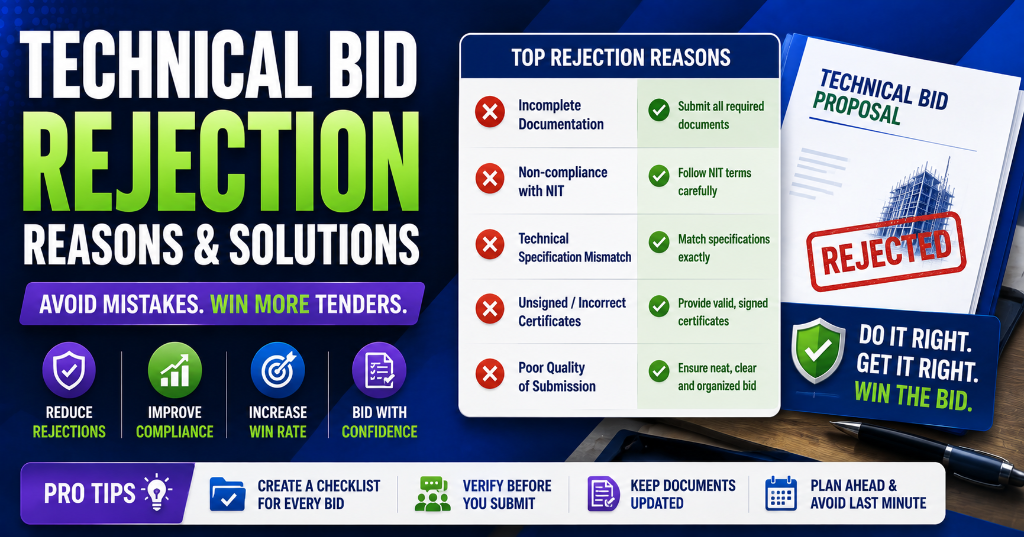
- Reason 1: Missing or Incomplete Mandatory Documents To understand foundational rules, refer to our BOQ analysis for government tenders.
- Reason 2: Technical Specification Mismatch
- Reason 3: Invalid or Expired Certifications
- Reason 4: Insufficient Experience or Turnover Proof
- Reason 5: Non-Compliance with Tender Conditions & Annexures
- Reason 6: Improper Bid Format or Unsigned Documents
- Reason 7: Failure to Meet Eligibility Criteria
- Reason 8: Missing OEM Authorization for Branded Products
- Reason 9: Incorrect Make in India / Local Content Declarations
- Reason 10: EMD Format or Amount Errors
- Reason 11: Mismatched Information Across Documents
- Reason 12: Late or Improper Bid Submission
- The Compliance Matrix: Your Secret Weapon Against Rejection
- Technical Bid Document Checklist: 25 Items You Cannot Miss
- How to Appeal a Technical Bid Rejection
- Technical Bid vs Financial Bid: Key Differences
- Real-World Case Studies: Technical Rejections Turned Into Wins
- How TenderFlow Pro's AI Prevents Technical Bid Rejection
- FAQs About Technical Bid Rejection
- Conclusion: Master Technical Bids, Win More Tenders
Introduction: Why 35% of Technical Bids Never Make It to Financial Opening
In government tendering, price doesn't matter if you never get to the price stage. Under the two-bid system mandated by GFR 2017 Rule 163, technical bids are evaluated first. Only technically qualified bidders proceed to financial bid opening. Industry data shows that approximately 30–35% of all technical bids are rejected — meaning one in three bidders is eliminated before their price is even considered.
The tragedy? Most of these rejections are completely avoidable. They stem from documentation errors, specification mismatches, expired certificates, and compliance oversights — not from lack of capability or competitive pricing.
This guide covers every technical bid rejection reason, the exact evaluation process, and step-by-step solutions to ensure your bid passes technical scrutiny and reaches the financial stage. For general non-technical rejections in India (such as financial or administrative), check our comprehensive guide on Why Tenders Get Rejected in India.
📋→✅Pass Technical Evaluation Every Time
Upload any tender and TenderFlow Pro's AI generates a compliance matrix, detects missing documents, and flags specification mismatches before submission. Never lose a tender to a technical error again.
Write Your Technical Bid Now →
---
Get the Rejection Recovery Toolkit
Prevent disqualifications with strict audit checklists + lawyer-grade appeal letters.
- ✓ 150-Point Pre-Submission Checklist (PDF)
- ✓ 50-Point Technical Bid Compliance Audit
- ✓ 30-Point Financial Bid Accuracy Verification
- ✓ 5 Post-Rejection Appeal Letter Formats (GFR 171)
🔒 256-Bit Secure Razorpay Checkout · Lifetime Access · Instant Digital Delivery
What Is a Technical Bid? Understanding the Two-Bid System
Under GFR 2017 Rule 163, government tenders for complex procurements use a two-bid system:
The Two Envelopes:
Outer Sealed Envelope (Bid Submission)
├── Sealed Envelope 1: TECHNICAL BID
│   ├── Bid Submission Form (signed)
│   ├── Technical Compliance Statement
│   ├── Product Brochures & Datasheets
│   ├── Quality Certifications (BIS, ISO, etc.)
│   ├── Experience Certificates
│   ├── OEM Authorization (if applicable)
│   ├── Make in India Declaration (Annexure XI)
│   ├── Border Country Declaration (Annexure XII)
│   ├── EMD / Bid Security Declaration
│   ├── Financial Statements
│   └── Compliance Matrix
└── Sealed Envelope 2: FINANCIAL BID
    ├── Price Schedule / BOQ
    ├── GST Calculations
    └── Total Bid Value
What the Technical Bid Contains:
| Section | Contents | Purpose |
|---|---|---|
| Bid Submission Form | Signed declaration accepting tender terms | Legal acceptance |
| Technical Compliance | Point-by-point response to specifications | Prove product meets requirements |
| Product Documentation | Brochures, datasheets, drawings | Technical evidence |
| Certifications | BIS, ISO, FSSAI, CE, etc. | Quality standard proof |
| Experience Proof | Completion certificates, work orders | Capability demonstration |
| OEM Authorization | Letter from brand owner | Reseller legitimacy |
| Compliance Declarations | Make in India, Border Country, Local Content | Regulatory compliance |
| EMD | Bank Guarantee, DD, or BSD | Bid security |
| Financial Proof | ITR, balance sheet, turnover | Financial capability |
| Compliance Matrix | Requirement-to-response mapping | Evaluator convenience |
When Is the Two-Bid System Used?
| Tender Type | Two-Bid Required? | Typical Value |
|---|---|---|
| Plant & Machinery | Yes | ₹25 lakh+ |
| IT Systems & Software | Yes | ₹25 lakh+ |
| Turnkey Projects | Yes | ₹50 lakh+ |
| Medical Equipment | Yes | ₹10 lakh+ |
| Simple Goods (stationery, etc.) | No | Up to ₹25 lakh |
| Services (consulting, etc.) | Sometimes | Varies |
Learn more about the two-bid system in our GFR 2017 rules guide.
---How Technical Bid Evaluation Works: The TEC Process
Understanding how evaluators think helps you prepare better bids.
The Tender Evaluation Committee (TEC):
| Role | Responsibility |
|---|---|
| Chairman | Senior officer, final decision authority |
| Technical Expert | Evaluates specifications, certifications |
| Finance Representative | Checks financial documents, turnover |
| Legal/Compliance Officer | Verifies declarations, compliance |
| User Department Representative | Validates technical requirements |
The Evaluation Process (Typical Timeline):
| Stage | Duration | Activity |
|---|---|---|
| Day 1: Bid Opening | 1 day | Technical bids opened in public; financial bids remain sealed |
| Days 2–7: Document Verification | 5–7 days | Check completeness, signatures, validity |
| Days 8–18: Technical Review | 10–12 days | Evaluate specifications, certifications, experience |
| Days 19–23: Committee Deliberation | 3–5 days | Discuss, score, prepare evaluation report |
| Days 24–28: Results Notification | 3–5 days | Notify technically qualified and rejected bidders |
| Day 29+: Financial Bid Opening | 1 day | Open financial bids of only qualified bidders |
Evaluation Criteria:
Bids are typically categorized as:
| Category | Meaning | Next Step |
|---|---|---|
| Technically Acceptable | Meets all requirements | Proceed to financial evaluation |
| Technically Acceptable with Deviation | Minor deviations noted | May proceed with conditional acceptance |
| Technically Non-Responsive | Fails one or more requirements | Rejected |
Instant Tender Eligibility & Risk Audit
Upload any 500-page NIT / BOQ PDF. Extract hidden disqualification traps, EMD waiver clauses, and complete eligibility criteria in under 45 seconds.
The 12 Most Common Technical Bid Rejection Reasons (With Solutions)
Reason 1: Missing or Incomplete Mandatory Documents
Frequency: ~28% of technical rejections Impact: Immediate disqualification Fix Difficulty: EasyWhat Goes Wrong:
The TEC evaluates bids against a mandatory document checklist. Missing even ONE document = rejection.
| Commonly Missing Document | Why It's Mandatory | Consequence |
|---|---|---|
| Bid Submission Form | Legal acceptance of tender terms | Bid not considered submitted |
| Technical Compliance Statement | Proof of specification adherence | Cannot verify technical match |
| GST Certificate | Tax compliance | Eligibility failure |
| PAN Card | Identity verification | Eligibility failure |
| Udyam/MSME Certificate | MSME benefit eligibility | Cannot claim benefits |
| Experience Certificates | Proof of capability | Eligibility failure |
| BIS/ISO Certifications | Quality standard compliance | Technical disqualification |
| OEM Authorization | Brand ownership/reseller rights | Disqualification for branded products |
| Make in India Declaration (Annexure XI) | Local content compliance | Mandatory for tenders >₹5L |
| Border Country Declaration (Annexure XII) | Security compliance | Mandatory for all tenders |
| Compliance Matrix | Requirement mapping | Evaluator cannot verify completeness |
Solution:
- Create a Master Document Template with these folders:
📁 Tender Documents Master
├── 📁 Registration
│   ├── GST_Certificate.pdf
│   ├── PAN_Card.pdf
│   ├── Udyam_Certificate.pdf
│   └── Incorporation_Certificate.pdf
├── 📁 Technical
│   ├── Product_Brochures/
│   ├── Technical_Datasheets/
│   └── Certifications/
│       ├── BIS_Certificate.pdf
│       ├── ISO_9001.pdf
│       └── FSSAI_License.pdf
├── 📁 Experience
│   ├── Completion_Certificates/
│   ├── Work_Orders/
│   └── Client_Testimonials/
├── 📁 Brand
│   └── OEM_Authorization_Letters/
├── 📁 Compliance
│   ├── Make_in_India_Declaration.pdf
│   ├── Border_Country_Declaration.pdf
│   └── Local_Content_Certificate.pdf
└── 📁 Financial
    ├── ITR_Last_3_Years/
    ├── Balance_Sheet/
    └── Turnover_Proof/
- Set Calendar Reminders 30 days before certificate expiry
- Verify Before Every Bid: Cross-check tender checklist against your master folder
[Infographic: Technical Bid Document Checklist]
Printable checklist with 25 mandatory items, expiry tracking, and verification columns.
---Reason 2: Technical Specification Mismatch
Frequency: ~22% of technical rejections Impact: Technical disqualification Fix Difficulty: MediumWhat Goes Wrong:
Your product/service does not exactly match the buyer's technical requirements. Evaluators use a pass/fail approach — there is no "close enough."
| Mismatch Type | Example | Evaluator Action |
|---|---|---|
| Wrong dimensions | Tender: 1200×600mm; You: 1000×500mm | ❌ Reject |
| Different model | Tender: "HP LaserJet Pro M404"; You: "HP LaserJet" (generic) | ❌ Reject |
| Lower capacity | Tender: 5 HP motor; You: 3 HP motor | ❌ Reject |
| Missing certification | Tender: ISI-certified; You: Non-certified | ❌ Reject |
| Different material | Tender: Stainless steel; You: Mild steel | ❌ Reject |
| Lower grade | Tender: Grade A; You: Grade B | ❌ Reject |
Solution:
- Create a Specification Comparison Table for every tender:
| Tender Requirement | Your Product | Match? | Evidence |
|---|---|---|---|
| Dimension: 1200×600mm | 1200×600mm | ✅ Yes | Datasheet p.3 |
| Motor: 5 HP, 3-phase | 5 HP, 3-phase | ✅ Yes | Spec sheet |
| Certification: BIS IS 1239 | BIS IS 1239 | ✅ Yes | BIS Certificate |
| Brand: HP LaserJet Pro M404 | HP LaserJet Pro M404dn | ⚠️ Close | Check if "dn" is acceptable |
- If Mismatch Exists:
- Minor deviation: Submit technical deviation statement with justification AND supporting evidence
- Major deviation: Do NOT bid — rejection is guaranteed
- Update Your Catalog: Ensure GeM/CPPP listings match your actual product specs exactly
Reason 3: Invalid or Expired Certifications
Frequency: ~15% of technical rejections Impact: Technical disqualification Fix Difficulty: EasyWhat Goes Wrong:
| Certification Issue | Why It Happens | Fix |
|---|---|---|
| Expired BIS license | Forgot to renew | Renew 60 days before expiry |
| Invalid ISO certificate | Issued by non-accredited body | Only use NABCB/IAF-accredited certifiers |
| Wrong certification scope | ISO 9001 for manufacturing, but you're a service provider | Get certification matching your business |
| FSSAI license expired | Food business, license lapsed | Renew immediately; don't bid until valid |
| CE marking missing | Export product without CE | Obtain CE or don't bid on tenders requiring it |
| Test report outdated | Report older than validity period | Get fresh test reports from NABL labs |
Common Certifications Required:
| Product/Service Category | Typical Certifications |
|---|---|
| Electrical Equipment | BIS, CE, IEC |
| Food Products | FSSAI, AGMARK, BIS |
| Construction Materials | BIS, ISO 9001, Test Reports |
| IT Products | BIS, STQC, ISO 27001 |
| Medical Devices | CDSCO, ISO 13485, CE |
| Textiles | BIS, ISO 9001, OEKO-TEX |
| Chemicals | BIS, ISO 14001, GMP |
Solution:
- Create a Certification Tracker:
| Certification | Issuing Body | Issue Date | Expiry Date | Renewal Due | Status |
|---|---|---|---|---|---|
| BIS IS 1239 | BIS | 01-01-2025 | 31-12-2026 | 01-11-2026 | ✅ Valid |
| ISO 9001 | TUV SUD | 15-03-2024 | 14-03-2027 | 15-01-2027 | ✅ Valid |
| FSSAI License | FSSAI | 10-06-2025 | 09-06-2026 | 10-04-2026 | ⚠️ Renew Soon |
- Verify Accreditation: Ensure certifying bodies are NABCB/IAF accredited
- Scope Match: Certification scope must cover the product/service you're bidding for
Reason 4: Insufficient Experience or Turnover Proof
Frequency: ~12% of technical rejections Impact: Eligibility failure Fix Difficulty: Medium (requires time)What Goes Wrong:
| Requirement | Common Mistake | Fix |
|---|---|---|
| Minimum 3 years experience | Only 2 years of documented work | Don't bid; build experience first |
| Similar project completion | Experience in different domain | Target tenders matching your actual experience |
| Minimum ₹50 lakh turnover | Turnover ₹45 lakh | Don't bid; target lower-value tenders |
| 3 similar completed projects | Only 2 completion certificates | Collect certificates from all past projects |
| Client reference letters | Generic letters without project details | Request specific letters mentioning project value and scope |
How to Build Experience Documentation:
- Collect Completion Certificates from every project:
- Project name and description
- Contract value
- Completion date
- Client signature and seal
- Performance rating (if available)
- Organize Work Orders:
- Purchase orders
- Contract agreements
- Delivery challans
- Payment receipts
- Request Client Testimonials:
- On client letterhead
- Mentioning specific project details
- Including performance feedback
- Start Small:
- Win small tenders first
- Build completion certificates
- Gradually target larger tenders
---Reason 5: Non-Compliance with Tender Conditions & Annexures
Frequency: ~10% of technical rejections Impact: Non-responsive bid Fix Difficulty: EasyWhat Goes Wrong:
Tenders include mandatory conditions and annexures. Ignoring them = rejection.
| Mandatory Condition | Where Found | Consequence of Non-Compliance |
|---|---|---|
| Make in India Declaration (Annexure XI) | Tender NIT, Annexures | Rejection for tenders >₹5L |
| Border Country Declaration (Annexure XII) | Tender NIT, Annexures | Rejection for ALL tenders |
| Local Content Certificate | Tender conditions | Loss of domestic preference |
| Environmental Compliance | Technical specifications | Disqualification |
| Safety Standards | Technical specifications | Disqualification |
| Warranty Terms | Conditions of Contract | Non-responsive |
| Delivery Timeline Acceptance | Schedule of Requirements | Non-responsive |
Solution:
- Read Every Annexure: Don't skip annexures assuming they're "standard"
- Use the Exact Format: Copy-paste the tender's declaration format; don't create your own
- Sign and Date Correctly:
- Date must be AFTER tender publication date
- Date must be BEFORE bid submission deadline
- Signed by authorized signatory
- Double-Check: Have a second person review all declarations before submission
Reason 6: Improper Bid Format or Unsigned Documents
Frequency: ~8% of technical rejections Impact: Non-responsive bid Fix Difficulty: Very EasyWhat Goes Wrong:
| Format Error | Example | Fix |
|---|---|---|
| Unsigned bid form | Bid submission form without signature | Always sign with authorized signatory |
| Wrong page numbering | Pages not numbered as per tender requirement | Follow tender format exactly |
| Missing index/table of contents | Documents submitted without index | Include index with page numbers |
| Wrong file format | Uploaded .docx instead of required PDF | Convert to PDF before upload |
| Illegible scans | Blurry or dark document scans | Use scanner (not phone camera) for documents |
| Wrong document sequence | Documents not in order specified | Follow tender's document sequence |
Solution:
- Follow the Tender's Format Instructions Exactly:
- Page size (A4)
- Font (usually Times New Roman, 12pt)
- Margins
- Page numbering format
- Document sequence
- Use a Document Review Checklist:
- All pages signed by authorized signatory
- Date on every document is valid (after tender publication, before deadline)
- Page numbers on every page
- Table of contents included
- PDF format (not Word/Excel)
- File size under portal limits
- File names descriptive (e.g., "01_Bid_Submission_Form.pdf")
- Documents in exact sequence specified
Reason 7: Failure to Meet Eligibility Criteria
Frequency: ~7% of technical rejections Impact: Eligibility failure Fix Difficulty: MediumWhat Goes Wrong:
| Eligibility Requirement | Your Status | Decision |
|---|---|---|
| Minimum turnover: ₹1 crore | Your turnover: ₹80 lakh | ❌ Don't bid |
| 3 years in business | Your experience: 2 years | ❌ Don't bid |
| OEM status required | You're a trader without authorization | ❌ Don't bid or get authorization |
| Specific geographic location | You're outside eligible zone | ❌ Don't bid |
| Blacklist clearance | Your name appears on debarment list | ❌ Don't bid |
Solution:
- Create an Eligibility Matrix before bidding:
| Criterion | Required | Your Status | Pass/Fail |
|---|---|---|---|
| Turnover | ₹1 Cr | ₹1.2 Cr | ✅ Pass |
| Experience | 3 years | 5 years | ✅ Pass |
| OEM Status | Required | Authorized reseller | ✅ Pass |
| Location | India only | Delhi | ✅ Pass |
| Blacklist | Clear | Clear | ✅ Pass |
- If ANY criterion fails → Don't bid
- Build eligibility over time: Target smaller tenders to build turnover and experience
Reason 8: Missing OEM Authorization for Branded Products
Frequency: ~5% of technical rejections Impact: Disqualification for branded goods Fix Difficulty: Easy (if planned)What Goes Wrong:
If you're bidding to supply branded products (HP, Samsung, LG, etc.) as a trader/distributor, you need OEM authorization from the brand owner. Without it:
| Scenario | Authorization Required? | Without It |
|---|---|---|
| OEM bidding for own brand | No (you are the OEM) | — |
| Authorized distributor | Yes — authorization letter | ❌ Disqualification |
| Unauthorized reseller | Cannot obtain | ❌ Don't bid |
| Grey market supplier | Cannot obtain | ❌ Disqualification + blacklisting risk |
What a Valid OEM Authorization Letter Contains:
- Brand owner company letterhead
- Your company name as authorized distributor
- Specific product categories authorized
- Authorization validity period
- Brand owner signature and seal
- Reference to tender number (if tender-specific)
Solution:
- Establish OEM Relationships: Contact brand owners for authorized dealership/distributorship
- Request Tender-Specific Letters: Ask OEM to mention the specific tender number
- Verify Validity: Ensure authorization covers the tender period
- Keep Copies: Maintain a folder of all OEM authorization letters
Reason 9: Incorrect Make in India / Local Content Declarations
Frequency: ~4% of technical rejections Impact: Disqualification for tenders >₹5L Fix Difficulty: EasyWhat Goes Wrong:
| Error | Why It Happens | Fix |
|---|---|---|
| Missing Annexure XI | Didn't read tender conditions | Always include for tenders >₹5L |
| Wrong percentage declared | Guessed local content % | Calculate accurately from BOM |
| Outdated format | Used old declaration template | Use format from current tender |
| Unsigned declaration | Forgot to sign | Always sign and date |
| False information | Declared 100% local but imports components | Be accurate; false = blacklisting |
Make in India Declaration (Annexure XI) Requirements:
For tenders with estimated value >₹5 lakh, bidders must submit:
- Local content percentage
- Break-up of local vs imported components
- Self-certification or third-party certificate (for high-value tenders)
Solution:
- Calculate Local Content Accurately:
| Component | Source | Cost (₹) | Local? |
|---|---|---|---|
| Raw Material A | Indian supplier | 50,000 | ✅ Yes |
| Component B | Imported | 30,000 | ❌ No |
| Labor | Indian | 20,000 | ✅ Yes |
| Total | 1,00,000 | 70% Local |
- Use Tender-Specific Format: Copy from tender document, don't use old templates
- Be Honest: False declarations lead to blacklisting
Reason 10: EMD Format or Amount Errors
Frequency: ~3% of technical rejections Impact: Non-responsive bid Fix Difficulty: EasyWhat Goes Wrong:
| EMD Error | Consequence |
|---|---|
| Wrong amount | Bid rejected as non-responsive |
| Expired validity | EMD no longer valid at evaluation |
| Wrong format | Used DD instead of required BG |
| Unsigned BG | Bank guarantee not properly executed |
| Non-scheduled bank | BG from unrecognized bank rejected |
| MSME didn't claim exemption | Paid EMD unnecessarily; or claimed exemption without valid Udyam |
Solution:
- Verify EMD Requirements from Tender NIT:
- Exact percentage (2-5%)
- Exact amount
- Required format (BG/DD/FDR)
- Validity period
- For MSMEs — Claim Exemption:
- Submit Bid Security Declaration (BSD) instead of EMD
- Ensure Udyam is valid and linked to GeM
- Double-Check Before Submission:
- BG amount matches calculation
- Validity covers required period
- Bank is scheduled commercial bank
- Properly signed and sealed
Learn more in our complete EMD guide.
---Reason 11: Mismatched Information Across Documents
Frequency: ~3% of technical rejections Impact: Credibility failure Fix Difficulty: EasyWhat Goes Wrong:
| Mismatch | Example | Evaluator Interpretation |
|---|---|---|
| Business name differs | GST: "ABC Traders"; PAN: "ABC Trading" | Suspicious, possible fraud |
| Address mismatch | GST: Delhi address; Udyam: Mumbai address | Inconsistency, verification needed |
| Turnover figures differ | ITR shows ₹80L; Bid claims ₹1Cr | False information |
| Signatory mismatch | DSC registered to Director; Bid signed by Manager | Unauthorized signature |
| Product description varies | Brochure says "Grade A"; Datasheet says "Grade B" | Unclear what you're offering |
Solution:
- Standardize All Registrations:
- Same business name on GST, PAN, Udyam, Bank Account
- Same registered address
- Same authorized signatory
- Cross-Check Before Submission:
- Business name: GST = PAN = Udyam = Bank = Bid
- Address: All documents match
- Signatory: DSC, bid form, and authorization letter match
- Update Discrepancies: If mismatches exist, update registrations before bidding
Reason 12: Late or Improper Bid Submission
Frequency: ~2% of technical rejections Impact: Automatic rejection Fix Difficulty: Very EasyWhat Goes Wrong:
- Submitted after deadline (even by seconds). For GeM-specific bid rejection reasons and fixes, check our dedicated GeM Bid Rejection Guide.
- Uploaded to wrong tender ID
- Submitted on wrong portal (CPPP instead of GeM, or vice versa)
- Technical bid and financial bid mixed up in wrong envelopes
- DSC not applied properly
Solution:
- Submit 24+ Hours Before Deadline
- Verify Tender ID before uploading
- Verify Portal (GeM vs CPPP vs State portal)
- Test DSC before actual submission
- Download Acknowledgement with timestamp
The Compliance Matrix: Your Secret Weapon Against Rejection
A Compliance Matrix (also called Responsiveness Matrix) is the single most effective tool for preventing technical bid rejection (see how to build one in our Technical Bid Writing Guide).
What Is a Compliance Matrix?
A table that maps every requirement in the tender to your response:
| S.No. | Tender Requirement (Clause) | Your Response | Document Reference | Page No. | Status |
|---|---|---|---|---|---|
| 1 | Bid Submission Form (Format A) | Submitted as Annexure 1 | Annexure 1 | 1 | ✅ Compliant |
| 2 | GST Registration (Mandatory) | GST No. 07ABCDE1234F1Z5 | GST Certificate | 5 | ✅ Compliant |
| 3 | Turnover ≥ ₹1 Cr (ITR proof) | Turnover ₹1.2 Cr (FY 2024-25) | ITR Acknowledgement | 12 | ✅ Compliant |
| 4 | BIS IS 1239 Certified | BIS License No. LM-12345 | BIS Certificate | 18 | ✅ Compliant |
| 5 | 3 Years Experience | 5 years (2020–2025) | Experience Certificates | 25-30 | ✅ Compliant |
| 6 | Make in India Declaration | Submitted as Annexure 2 | Annexure 2 | 35 | ✅ Compliant |
Why Evaluators Love Compliance Matrices:
- Saves them hours of searching through your bid
- Shows professionalism and attention to detail
- Reduces chance of missed requirements
- Makes their job easier = better impression
How to Create One:
- Copy ALL requirements from tender document into first column
- Map your response to each requirement
- Reference exact document and page number
- Mark status clearly (Compliant / Partial / Non-Compliant)
- Include as first document in your technical bid
[Infographic: Compliance Matrix Template]
Visual template showing how to structure a compliance matrix for maximum evaluator clarity.
---Technical Bid Document Checklist: 25 Items You Cannot Miss
Use this checklist before EVERY technical bid submission:
Mandatory Forms:
- Bid Submission Form (signed and dated)
- Technical Compliance Statement
- Price Schedule (in technical bid envelope — NO, this goes in financial bid)
- Compliance Matrix
Registration Documents:
- GST Registration Certificate (valid)
- PAN Card (matching GST name)
- Udyam/MSME Registration (valid, linked to GeM if applicable)
- Incorporation Certificate (for companies/LLPs)
Technical Documents:
- Product Brochures
- Technical Datasheets
- Drawings/Layouts (if required)
- Quality Certifications (BIS, ISO, FSSAI, etc. — valid)
- Test Reports (from NABL-accredited labs, within validity)
Experience & Capability:
- Experience Certificates (relevant, verifiable)
- Work Orders/Completion Certificates
- Client Reference Letters (on client letterhead)
- Financial Statements (ITR, Balance Sheet, Turnover Proof)
Brand & Authorization:
- OEM Authorization Letter (for branded products)
- Trademark Registration (if own brand)
- Distribution/Dealership Certificates
Compliance Declarations:
- Make in India Declaration (Annexure XI) — for tenders >₹5L
- Border Country Declaration (Annexure XII) — for all tenders
- Local Content Certificate (if required)
- Any other tender-specific declarations
Financial Security:
- EMD (BG/DD/FDR) or Bid Security Declaration (for MSMEs)
How to Appeal a Technical Bid Rejection
If you believe your technical bid was wrongly rejected, you have the right to appeal under GFR 2017 Rule 171.
Grounds for Appeal:
| Ground | Example | Success Probability |
|---|---|---|
| Evaluation not as per published criteria | TEC used unpublished criteria to reject | High |
| Discriminatory treatment | Your bid rejected for issue that was accepted in another bidder's bid | High |
| Incorrect interpretation of specs | TEC misread your specification as non-compliant | Medium |
| Failure to consider submitted documents | TEC missed a document you submitted | Medium |
| Our product is better (without documentary proof) | Subjective claim without evidence | Low |
Appeal Process:
- Check Tender Document for appeal timeline (usually 7–15 days from rejection notification)
- Draft Representation:
- Reference tender number and your bid number
- Specify exact grounds for appeal
- Attach supporting evidence
- Request reconsideration or re-evaluation
- Submit to Grievance Redressal Officer (contact details in tender document)
- Follow Up: If no response within 15–30 days, escalate to higher authority
Important:
- Appeals based on "we're better" without documentary proof rarely succeed
- Documentary evidence is everything — attach copies of what you submitted
- Be professional, not emotional, in your representation
Technical Bid vs Financial Bid: Key Differences
| Parameter | Technical Bid | Financial Bid |
|---|---|---|
| Contents | Documents, specs, certifications, experience | Pricing, BOQ, GST, total value |
| Opened When | First (Day 1 of bid opening) | Second (after technical evaluation) |
| Evaluated By | Tender Evaluation Committee (TEC) | Financial Evaluation Committee |
| Evaluation Criteria | Compliance, specifications, eligibility | Price competitiveness (L1 selection) |
| Rejection Rate | ~30-35% | ~8-10% |
| Common Errors | Missing docs, spec mismatch, expired certs | Pricing errors, GST issues, arithmetic |
| Preparation Time | 70% of total bid preparation | 30% of total bid preparation |
Real-World Case Studies: Technical Rejections Turned Into Wins
Case Study 1: Missing Compliance Matrix = Rejection
Business: IT services company in Bangalore Tender: Government department software development Rejection: "Bid does not contain compliance matrix as mandated in Clause 5.2" Analysis: The company submitted all documents but forgot to include the compliance matrix Fix: Created a standard compliance matrix template; now included in every bid Result: Next 5 bids — all technically qualified Lesson: Even one missing document = rejection. Use a checklist.Case Study 2: Specification Mismatch Misunderstood
Business: Electrical equipment manufacturer in Gujarat Tender: Supply of industrial cables Rejection: "Offered cable IS 694 does not match tender requirement IS 1554" Analysis: Company assumed "all ISI cables are the same" — wrong Fix: Created specification comparison table for every tender; stopped bidding on mismatched specs Result: Win rate improved from 15% to 40% Lesson: Never assume equivalence. Verify exact specification match.Case Study 3: Expired BIS License
Business: Construction material supplier in Maharashtra Tender: PWD cement supply Rejection: "BIS license expired on 31-03-2025; bid submitted on 15-04-2025" Analysis: BIS license expired 15 days before bid submission; company didn't track expiry Fix: Created certification tracker with 60-day advance renewal alerts Result: Zero certification-related rejections in subsequent 12 months Lesson: Track certificate expirations religiously.Case Study 4: Successful Appeal
Business: Medical equipment supplier in Delhi Tender: Hospital MRI machine Rejection: "Technical specifications not met — field strength 1.5T vs required 3T" Analysis: Company's brochure mentioned "upgradable to 3T" but TEC only saw "1.5T" Appeal: Submitted technical datasheet showing upgrade path and third-party certification for 3T capability Result: Appeal accepted; bid re-evaluated as technically acceptable Lesson: If rejected, analyze whether the rejection was based on incomplete review. Appeal with evidence. ---How TenderFlow Pro's AI Prevents Technical Bid Rejection
TenderFlow Pro is built to eliminate technical bid rejection before it happens:
1. Automatic Compliance Matrix Generation
Upload any tender PDF and our AI:
- Extracts ALL requirements from the tender document
- Maps them to your uploaded documents
- Generates a ready-to-submit compliance matrix
- Flags missing requirements
2. Document Completeness Scanner
Before submission, our system checks:
- Which documents are mandatory for this tender
- Whether your documents are valid and not expired
- Whether document formats match tender requirements
- Whether all mandatory annexures are included
3. Technical Specification Matcher
Our engine compares your product specs against tender requirements:
- Flags exact mismatches
- Identifies "equivalent" opportunities (with documentation guidance)
- Recommends whether to bid or skip
- Suggests catalog updates needed
4. Certification Validity Tracker
- Tracks all your certifications with expiry dates
- Sends alerts 60 days before expiry
- Identifies which certifications are needed for upcoming tenders
- Suggests renewal actions
5. Format Validator
- Checks document format compliance (PDF, page size, naming)
- Verifies signature requirements
- Validates page numbering and indexing
- Ensures documents are in correct sequence
6. Eligibility Auto-Check
- Compares your profile against tender eligibility criteria
- Flags turnover/experience shortfalls
- Checks blacklist status
- Recommends whether to bid or skip
FAQs About Technical Bid Rejection
Q1: What is a technical bid in government tenders?
A: A technical bid is the first part of a two-bid system used in government tenders for complex procurements. It contains all non-price information including technical specifications, compliance documents, certifications, experience proof, and eligibility documents. Under GFR 2017 Rule 163, technical bids are opened and evaluated first. Only technically qualified bidders proceed to the financial bid opening stage.Q2: Why do technical bids get rejected?
A: Technical bids get rejected for these main reasons: (1) Missing or incomplete mandatory documents; (2) Technical specification mismatches where the product doesn't meet buyer requirements; (3) Invalid or expired certifications (BIS, ISO, FSSAI); (4) Insufficient experience or turnover proof; (5) Non-compliance with tender conditions and annexures; (6) Improper bid format or unsigned documents; (7) Failure to meet eligibility criteria; (8) Missing OEM authorization for branded products; and (9) Incorrect Make in India or Local Content declarations.Q3: What documents are required in a technical bid?
A: A technical bid typically requires: (1) Bid submission form with authorized signature; (2) Technical compliance statement; (3) Product brochures and technical datasheets; (4) Quality certifications (BIS, ISO, FSSAI as applicable); (5) Experience certificates and past performance proof; (6) OEM authorization letter (for branded products); (7) Make in India / Local Content declaration (Annexure XI); (8) Border Country declaration (Annexure XII); (9) EMD or Bid Security Declaration; (10) Financial statements and turnover proof; (11) GST and PAN registration copies; (12) Udyam/MSME certificate; and (13) Any other documents specified in the tender NIT.Q4: How is a technical bid evaluated?
A: Technical bids are evaluated by a Tender Evaluation Committee (TEC) appointed by the buyer. The committee checks each bid against a pre-defined evaluation criteria matrix. They verify: document completeness, technical specification compliance, certification validity, experience relevance, eligibility criteria fulfillment, and compliance with all tender conditions. Bids are scored or rated as "technically acceptable" or "technically non-responsive." Only technically acceptable bids proceed to financial evaluation.Q5: Can a technically rejected bid be appealed?
A: Yes, under GFR 2017 Rule 171 (Grievance Redressal), bidders can file a representation against technical rejection. The appeal must be filed within the timeframe specified in the tender (usually 7-15 days from rejection notification). Grounds for appeal include: evaluation not as per published criteria, discriminatory treatment compared to other bidders, incorrect interpretation of specifications, or failure to consider submitted documents. However, appeals based on "our product is better" without documentary proof are unlikely to succeed.Q6: What is the difference between technical bid and financial bid?
A: In the two-bid system under GFR 2017 Rule 163, bids are submitted in two separate sealed envelopes: (1) Technical Bid contains all non-price information — documents, specifications, certifications, experience proof, and compliance statements. It is opened and evaluated first. (2) Financial Bid contains only pricing information — item-wise rates, GST, total bid value. It is opened only for technically qualified bidders. The purpose is to ensure price does not influence technical evaluation.Q7: How can I ensure my technical bid is not rejected?
A: To ensure your technical bid passes evaluation: (1) Create a compliance matrix mapping every tender requirement to your supporting document; (2) Verify all certifications are valid and not expired; (3) Match technical specifications exactly — never assume "equivalent" is acceptable unless explicitly stated; (4) Use the exact document formats prescribed in the tender; (5) Get all documents signed by authorized signatory; (6) Submit EMD in correct format and amount; (7) Include all mandatory annexures and declarations; (8) Organize documents in the sequence requested; (9) Have a second person review before submission; and (10) Use TenderFlow Pro's AI scanner to detect gaps before submission.Q8: What happens if technical specifications don't match exactly?
A: If your technical specifications don't match the tender requirements exactly, your bid will be marked "technically non-responsive" and rejected. Government evaluators do not accept "close enough" or "functionally equivalent" unless the tender explicitly allows "or equivalent" language. Even minor deviations — like a different model number from the same brand, slightly lower capacity, or missing certification — can result in disqualification. Always verify exact match before bidding.Q9: What is a compliance matrix for technical bids?
A: A compliance matrix (also called a responsiveness matrix) is a table that maps every requirement in the tender document to your bid response. It has columns for: (1) Tender Requirement/Clause, (2) Your Response/Document, (3) Page Number in Your Bid, and (4) Compliance Status (Compliant/Partial/Non-Compliant). This helps evaluators quickly verify that you've addressed every requirement. It also helps you identify gaps before submission. Many tenders require the compliance matrix as a mandatory document.Q10: How long does technical bid evaluation take?
A: Technical bid evaluation typically takes 2-4 weeks from the date of technical bid opening, depending on tender complexity and number of bids. The process involves: document verification (3-5 days), technical specification review (5-10 days), committee deliberation (3-5 days), and preparation of technical evaluation report (2-3 days). For complex tenders (machinery, IT systems, turnkey projects), evaluation may take 4-6 weeks. Bidders are usually notified of technical evaluation results within 7 days of completion. ---Conclusion: Master Technical Bids, Win More Tenders
Technical bid rejection is not a reflection of your capability — it's a reflection of your preparation process. The businesses that win consistently are not necessarily better; they are simply more systematic about documentation, compliance, and attention to detail.
The 12 rejection reasons in this guide account for over 95% of all technical disqualifications. Master them, and you will pass technical evaluation in 9 out of 10 bids.
Your action plan:- Today: Create a master document folder with all certifications, registrations, and experience proofs
- This week: Set up certificate expiry tracking with 60-day advance alerts
- Before every bid: Create a compliance matrix; verify exact specification match; check eligibility criteria
- Before submission: Have a second person review all documents; verify signatures and dates
- Ongoing: Use TenderFlow Pro's AI to generate compliance matrices, detect missing documents, and validate technical specifications before submission
Remember: Price doesn't matter if you never reach the price stage. Master the technical bid, and you've won half the battle.
🎯Never Lose a Tender to Technical Rejection
TenderFlow Pro's AI generates compliance matrices, detects missing documents, flags specification mismatches, and validates certification validity — all before you submit. Pass technical evaluation every time.