Single Tender Enquiry (STE) Rules Under GFR 2017: Complete 2025 Guide for MSMEs & Government Contractors
Single Tender Enquiry (STE) Rules Under GFR 2017: Complete 2025 Guide for MSMEs & Government Contractors
Unjustified conversion to single tender enquiry? Challenge proprietary monopolization using the AI protest letter tool under GFR 154 guidelines.
menu_book Table of Contents
The ₹47 Crore Wake-Up Call: Why STE Rules Matter
In March 2022, the Comptroller and Auditor General of India (CAG) flagged a ₹47.84 crore contract awarded by the National Film Archive of India (NFAI) for preventive conservation of film reels — a contract that should have been competitively bid but was instead riddled with procurement irregularities including flawed RFP design, hypothetical assumptions, and inadequate planning. While not a pure STE case, it exemplifies what happens when procurement rules are bent: cost overruns of ₹24.80 crore and time overruns of nearly three years. For the comprehensive end-to-end framework, consult our Indian government procurement guide. To understand foundational rules, refer to our MSME benefits in government tenders. (See also: Consortium Bidding Strategy for Government Tenders). (See also: Splitting of Tenders & GFR Rule 157 Defense Guide).
Now consider this: India's government procurement market exceeds ₹20 lakh crore annually. Within this ocean of contracts, Single Tender Enquiries (STEs) represent the most exception-ridden, audit-scrutinized, and legally vulnerable procurement method. A single misstep in STE justification can trigger CAG objections, CVC inquiries, court intervention, and criminal proceedings under the Prevention of Corruption Act.
Key Stat: CAG audit reports consistently identify single tender and nomination-based procurement as high-risk areas. In one 2024 audit of a central PSU, audit found that advance payments of ₹23.60 crore were released to contractors without bank guarantees — a direct violation of GFR safeguards that often accompanies rushed STE decisions.
Whether you're an OEM hoping to secure proprietary contracts, an MSME wanting to understand why you were excluded, or a procurement officer ensuring compliance, this guide is your definitive resource.
🎯 CTA: Before bidding on your next tender, verify whether it should have been an open tender instead of STE — an invalid STE can be challenged and set aside.

Get the GFR Compliance Toolkit
Know every GFR rule, protect deposits, and challenge restrictive clauses with confidence.
- ✓ 150-Point Pre-Submission Checklist (PDF)
- ✓ EMD & BG Format Verification Guide + Checker
- ✓ 5 Post-Rejection Appeal Letters (GFR 171)
- ✓ Corrigendum Monitoring & Response Checklist
🔒 256-Bit Secure Razorpay Checkout · Lifetime Access · Instant Digital Delivery
What Is Single Tender Enquiry (STE)? A Definition
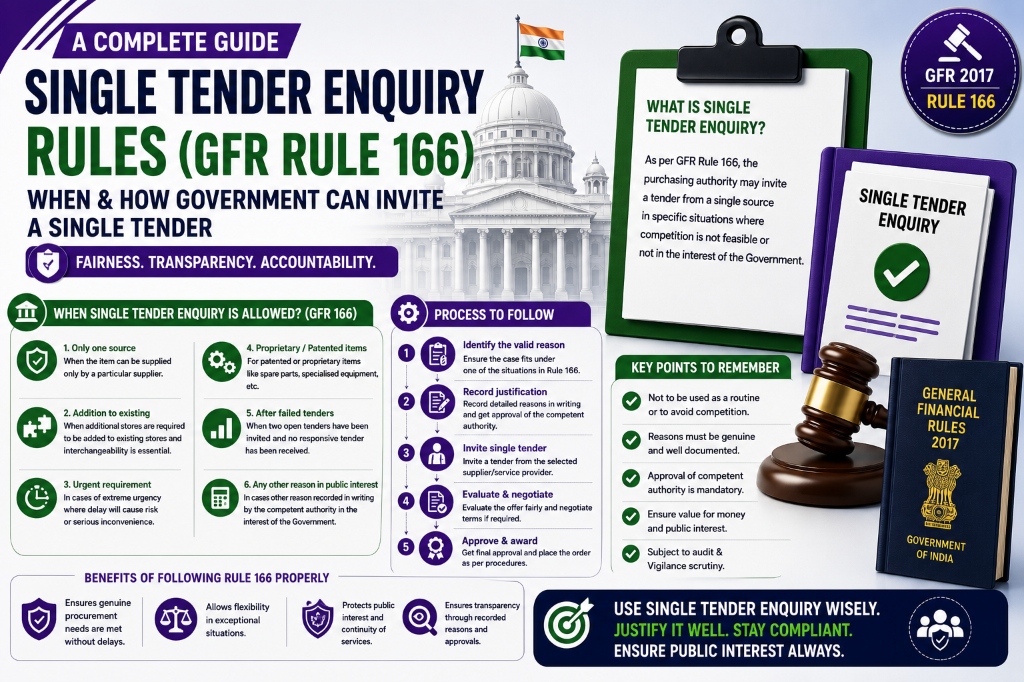
Single Tender Enquiry (STE) is the most restrictive procurement method permitted under the General Financial Rules, 2017. Under this method, the government procuring entity approaches only one supplier — eliminating competition entirely.
Because STE bypasses the foundational principles of transparency, competition, and fairness that underpin public procurement, it is permitted only in genuinely exceptional circumstances. It is not a shortcut. It is not a convenience tool. It is a last-resort mechanism with strict pre-conditions.
How STE Works: The Process Flow
┌─────────────────────────────────────────────────────────────────┐
│  STEP 1: NEED IDENTIFICATION                                     │
│  User department identifies requirement                          │
│  ↓                                                               │
│  STEP 2: STE JUSTIFICATION                                       │
│  Determine if requirement falls under Rule 166(i), (ii), or      │
│  (iii) — Proprietary / Emergency / Standardization               │
│  ↓                                                               │
│  STEP 3: PAC / EMERGENCY CERTIFICATE                             │
│  Obtain Proprietary Article Certificate (for i & iii) OR         │
│  Record written emergency justification (for ii)                 │
│  ↓                                                               │
│  STEP 4: COMPETENT AUTHORITY APPROVAL                            │
│  Secure approval from authority one level higher than normal     │
│  (STE requires higher-level approval)                            │
│  ↓                                                               │
│  STEP 5: PRICE REASONABLENESS CHECK                              │
│  Verify quoted price against market rates / last purchase rate   │
│  ↓                                                               │
│  STEP 6: NEGOTIATION & AWARD                                     │
│  Negotiate terms and place purchase order                        │
│  ↓                                                               │
│  STEP 7: DOCUMENTATION & AUDIT TRAIL                             │
│  Maintain complete file for audit scrutiny                       │
└─────────────────────────────────────────────────────────────────┘
Instant Tender Eligibility & Risk Audit
Upload any 500-page NIT / BOQ PDF. Extract hidden disqualification traps, EMD waiver clauses, and complete eligibility criteria in under 45 seconds.
Key Characteristics of STE
| Feature | STE Specification |
|---|---|
| Number of bidders approached | Exactly 1 |
| GFR Rule | Rule 166 |
| Value threshold | No fixed limit — situation-based |
| Public advertisement | No |
| Competition level | None |
| Approval requirement | Higher-level competent authority |
| Audit risk | Very High |
| PAC requirement | Mandatory for proprietary & standardization cases |
| EMD requirement | Usually waived or minimal |
| MSME price preference | Not applicable (no competition) |
GFR 2017 Rule 166: The Legal Foundation of STE
Rule 166 of GFR 2017 is the sole statutory basis for Single Tender Enquiry in central government procurement. Understanding its exact text is critical — both for procuring entities (to avoid audit objections) and for bidders (to challenge invalid STEs).
GFR 2017 Rule 166: Exact Text
Rule 166: Single Tender Enquiry
Procurement from a single source may be resorted to in the following circumstances:
(i) It is in the knowledge of the user department that only a particular firm is the manufacturer of the required goods.
(ii) In a case of emergency, the required goods are necessarily to be purchased from a particular source and the reason for such decision is to be recorded and approval of competent authority obtained.
(iii) For standardisation of machinery or spare parts to be compatible to the existing sets of equipment (on the advice of a competent technical expert and approved by the competent authority), the required item is to be purchased only from a selected firm.
Note: Proprietary Article Certificate in the following form is to be provided by the Ministry/Department before procuring the goods from a single source under the provision of sub Rule 166(i) and 166(iii) as applicable.
Critical Legal Interpretations of Rule 166
"May be resorted to" — The word "may" grants discretion, but this discretion must be exercised reasonably and non-arbitrarily. Arbitrary use of STE violates Article 14 of the Constitution.
"In the knowledge of the user department" — The department must have actual, documented knowledge that only one manufacturer exists. Mere assumption or convenience is insufficient.
"Emergency" — Must be a genuine, unforeseen urgency where delay would cause public harm. Routine urgency or poor planning does not qualify.
"Competent technical expert" — For standardization cases, the advice must come from a genuinely qualified expert, not a junior officer or the vendor themselves.
"Competent authority" — STE requires approval from an authority higher than the normal purchasing authority for that value.
The 3 Permitted Circumstances for STE (And Nothing Else)
GFR Rule 166 permits STE in exactly three circumstances. Any STE outside these three is illegal and challengeable.
Circumstance 1: Proprietary Item (Rule 166(i))
Definition: The required goods are manufactured by only one particular firm in the world. No substitute exists.
Examples:
- Specialized software with unique source code
- Patented medical equipment with no generic equivalent
- OEM spare parts protected by intellectual property
- Custom-built scientific instruments
Requirements:
- Proprietary Article Certificate (PAC) mandatory
- Certificate must state: "No other make or model is acceptable"
- Supporting documents from manufacturer required
- Finance wing concurrence required
- Competent authority approval required
Red Flags (CAG frequently objects to these):
- Claiming "proprietary" for items with readily available substitutes
- Obtaining PAC from dealer instead of manufacturer
- Failing to explore indigenization options
- Using "brand names" in specifications to create artificial proprietary status
Circumstance 2: Emergency (Rule 166(ii))
Definition: Goods are urgently needed from a specific source, and delay would cause demonstrable public harm.
Examples:
- Medical supplies during a pandemic outbreak
- Disaster relief equipment during floods/earthquakes
- Critical spare parts for power plants during grid failure
- Defense equipment during active military operations
Requirements:
- Written justification recorded before procurement
- Reason for choosing particular source documented
- Approval of competent authority obtained
- PAC NOT required (but emergency certificate is)
- Post-facto justification is invalid
Red Flags:
- "Emergency" created by poor planning (e.g., not ordering spares during routine maintenance)
- Approaching the same vendor repeatedly under "emergency" guise
- No contemporaneous documentation of the emergency
Circumstance 3: Standardization (Rule 166(iii))
Definition: Spare parts or components must be compatible with existing equipment, and only one source can ensure this compatibility.
Examples:
- Circuit boards for specific imported switching equipment
- Proprietary printer cartridges for leased printers
- Specialized lubricants for existing machinery
- Software licenses that must match existing enterprise systems
Requirements:
- Advice from competent technical expert (not vendor)
- Expert must certify compatibility requirements
- Competent authority approval
- PAC mandatory
- Efforts to indigenize must be documented
Red Flags:
- Technical "expert" is the vendor's representative
- No genuine compatibility issue — generic parts would work
- Using standardization to bypass competition for upgradable systems
The "Nothing Else" Rule
| Situation | Can STE Be Used? | Why Not? |
|---|---|---|
| Only 2–3 known suppliers | ❌ No | Use Limited Tender Enquiry |
| Supplier is "preferred" but not sole manufacturer | ❌ No | Violates Rule 149(ii) — fair competition |
| Urgency caused by department's own delay | ❌ No | Self-created emergency is invalid |
| Item available on GeM from multiple sellers | ❌ No | GeM mandates competitive bidding |
| Price is "better" from single source | ❌ No | Price advantage doesn't justify STE |
| Vendor has "better service" | ❌ No | Service quality is evaluation criteria, not STE ground |
| Repeat order from previous supplier | ❌ No | Must re-tender unless proprietary/standardization applies |
Proprietary Article Certificate (PAC): Format, Requirements & Common Mistakes
The Proprietary Article Certificate (PAC) is the most critical document in STE procurement. A defective PAC can invalidate the entire procurement and expose officers to audit objections and disciplinary action.
Standard PAC Format (As Per GFR 2017)
PROPRIETARY ARTICLE CERTIFICATE
(Under GFR-2017 Rule 166)

The indented goods are manufactured by M/s ___________________________

No other make or model is acceptable for the following reasons:
_____________________________________________________________________
_____________________________________________________________________
_____________________________________________________________________

Concurrence of finance wing to the proposal vide: ______________________

Approval of the competent authority vide: _____________________________

Place: ___________________
Date: ____________________

(Signature with date & designation of the Indenting Authority)

(Signature of the Head of the Department)
Additional Requirements (Institution-Specific)
Many organizations require additional documents alongside PAC:
| Document | Purpose | When Required |
|---|---|---|
| Manufacturer's Proprietary Certificate | OEM certifies item is their proprietary product | Always |
| Sole Authorized Distributor Certificate | If buying through dealer, not OEM directly | When OEM doesn't supply directly |
| Price Reasonableness Certificate | Supplier certifies price is lowest offered to any government buyer that year | Often required by PSUs |
| Technical Justification Note | Detailed technical reasons why no substitute exists | For high-value procurements |
| Indigenization Efforts Record | Documentation of attempts to find Indian alternatives | For imports above ₹50 lakh |
5 Common PAC Mistakes That Trigger CAG Objections
Vague Justification: Writing "no other make is acceptable" without explaining why is insufficient. CAG requires specific, technical reasons.
Dealer-Issued PAC: A dealer cannot issue a proprietary certificate. Only the manufacturer can certify that an item is their proprietary product.
Brand-Name Specifications: Writing tender specifications around a specific brand name (e.g., "Dell laptop or equivalent") and then claiming proprietary status is a classic CAG red flag.
No Finance Concurrence: PAC without finance wing concurrence is procedurally defective. The finance officer must independently verify the justification.
Post-Facto PAC: Creating the PAC after the purchase order is issued is invalid. PAC must precede procurement.
July 2024 GFR Amendments: New Thresholds That Changed Everything
On 10 July 2024, the Department of Expenditure, Ministry of Finance, issued a landmark Office Memorandum amending key thresholds in GFR 2017. These changes directly impact when STE can be used relative to other procurement methods.
Complete Threshold Comparison: Old vs New
| GFR Rule | Procurement Method | Old Threshold | New Threshold (July 2024) | Impact on STE |
|---|---|---|---|---|
| Rule 154 | Direct Purchase (without quotation) | Up to ₹25,000 | Up to ₹50,000 | More small purchases exempt from tendering |
| Rule 155 | Local Purchase Committee | ₹25,001 – ₹2,50,000 | ₹50,001 – ₹5,00,000 | Mid-value purchases now need LPC, not tender |
| Rule 162 | Limited Tender Enquiry (LTE) | Up to ₹25 lakh | Up to ₹50 lakh | STE justification harder for ₹25L–₹50L range |
| Rule 161 | Advertised Tender Enquiry (ATE) | ₹25 lakh and above | ₹50 lakh and above | More contracts must be openly advertised |
| Rule 173 | Purchase Committee independence | Above ₹25 lakh | Above ₹50 lakh | Higher-value procurements need stricter oversight |
What Changed for STE?
The July 2024 amendments indirectly tightened STE norms:
₹25L–₹50L Band Now Requires LTE, Not ATE: Previously, contracts above ₹25 lakh required open advertised tender. Now, contracts between ₹25 lakh and ₹50 lakh can use Limited Tender Enquiry — meaning departments can invite 3+ known suppliers instead of public advertising. This reduces the temptation to use STE in this band.
Higher LPC Limit Reduces STE Misuse: With LPC now covering up to ₹5 lakh (from ₹2.5 lakh), more small procurements can be handled through committee recommendations rather than questionable STE justifications.
Scientific Institutions Got Special Treatment (June 2025): In a subsequent amendment dated 05 June 2025, scientific institutions (DST, DBT, DAE, DRDO, ICAR, etc.) received doubled thresholds for research equipment:
| Rule | For Scientific Institutions (Research Only) |
|---|---|
| Rule 154 (Direct Purchase) | Up to ₹2,00,000 |
| Rule 155 (LPC) | ₹2,00,001 – ₹25,00,000 |
| Rule 162 (LTE) | Up to ₹1 crore |
| Rule 161 (ATE) | Above ₹1 crore |
⚠️ Critical: These scientific institution thresholds apply only to scientific equipment and consumables for research purposes. They do NOT apply to administrative procurement, construction, or non-research goods.
Open Tender vs Limited Tender vs Single Tender: Complete Comparison
Understanding the differences between procurement methods is essential for both bidders and procurement officers.
Side-by-Side Comparison Table
| Parameter | Open Tender (ATE) | Limited Tender (LTE) | Single Tender (STE) |
|---|---|---|---|
| GFR Rule | Rule 161 | Rule 162 | Rule 166 |
| Value threshold | ₹50 lakh and above | Up to ₹50 lakh | No fixed limit |
| Who can bid | Any eligible vendor | Pre-qualified/invited vendors (min. 3) | Only 1 specific vendor |
| Public advertisement | Yes — CPPP, GeM, newspapers | On CPPP/GeM + department website | No |
| Competition level | High | Medium | None |
| Bid timeline | Minimum 21 days (4 weeks for global) | Department decides | Negotiated directly |
| EMD required | Yes (unless MSME exempt) | Yes (unless MSME exempt) | Usually waived/minimal |
| PAC required | No | No | Yes (for i & iii) |
| Approval level | Standard competent authority | Standard competent authority | Higher authority |
| Audit risk if misused | Low | Medium | Very High |
| MSME price preference | ✅ 15% price matching | ✅ 15% price matching | ❌ Not applicable |
| MSME EMD exemption | ✅ Applicable | ✅ Applicable | ✅ Applicable (if charged) |
| 25% MSME reservation | ✅ Mandatory | ✅ Mandatory | ⚠️ Should be considered |
Decision Tree: Which Procurement Method to Use?
START: What is the estimated value?
│
├─ Up to ₹50,000 ──→ Direct Purchase (Rule 154)
│
├─ ₹50,001 to ₹5,00,000 ──→ Local Purchase Committee (Rule 155)
│
├─ ₹5,00,001 to ₹50,00,000 ──→ Limited Tender Enquiry (Rule 162)
│   └─ Exception: If urgent/public interest justifies,
│      seek competent authority approval for ATE/LTE deviation
│
├─ ₹50,00,001 and above ──→ Advertised Tender Enquiry (Rule 161)
│
└─ Is it a proprietary item / emergency / standardization?
    ├─ YES ──→ Single Tender Enquiry (Rule 166) + PAC/Emergency Certificate
    └─ NO ──→ Must use ATE/LTE as per value
Scientific Institutions: Special STE Thresholds (June 2025 Update)
A significant development in June 2025 changed the procurement landscape for India's research ecosystem.
Who Qualifies for Special Thresholds?
The following ministries/departments/organizations are covered under the 05 June 2025 amendment:
- Department of Science and Technology (DST)
- Department of Biotechnology (DBT)
- Department of Scientific & Industrial Research (DSIR)
- Department of Atomic Energy (DAE)
- Department of Space (DOS)
- Ministry of Earth Sciences (MoES)
- Defence Research and Development Organisation (DRDO)
- Indian Council of Agricultural Research (ICAR) and affiliated institutions
- Department of Health Research (DHR) / Indian Council of Medical Research (ICMR)
- Educational and Research Institutes conducting post-graduate/doctoral research
Special Thresholds for Scientific Equipment (Research Only)
| Procurement Method | Standard Limit | Scientific Institution Limit |
|---|---|---|
| Direct Purchase (Rule 154) | Up to ₹50,000 | Up to ₹2,00,000 |
| Local Purchase Committee (Rule 155) | ₹50,001 – ₹5,00,000 | ₹2,00,001 – ₹25,00,000 |
| Limited Tender Enquiry (Rule 162) | Up to ₹50 lakh | Up to ₹1 crore |
| Advertised Tender Enquiry (Rule 161) | ₹50 lakh and above | Above ₹1 crore |
| Global Tender Enquiry (Rule 161(iv)) | Above ₹200 crore (with approval) | Up to ₹200 crore (Director is Competent Authority) |
Implications for STE in Scientific Procurement
Higher LTE Limit = Less STE Temptation: With LTE now permitted up to ₹1 crore for scientific institutions, the justification for using STE in the ₹50 lakh–₹1 crore band has become much harder.
Director-Level GTE Authority: Scientific institution Directors can now approve Global Tender Enquiries up to ₹200 crore without seeking higher ministry approval — reducing the need for STE workarounds.
Research-Only Restriction: These enhanced thresholds apply strictly to "scientific equipment and consumables required only for research purpose." Administrative procurement (furniture, vehicles, stationery) follows standard thresholds.
Annual Reporting Required: Institutions must compile and share a list of such procurements with their Administrative Ministry at the end of every financial year.
CAG Audit Red Flags: How STE Is Misused (Real Cases)
The Comptroller and Auditor General of India (CAG) is the ultimate watchdog of public procurement. CAG audit reports consistently highlight STE misuse as a major vulnerability. Here are real patterns from recent audit findings:
Pattern 1: The "Single Tender in Disguise" — Nomination Without Justification
Case Reference: CAG Audit Report No. 12 of 2024 (Commercial)
Finding: ONGC invited bids from an OEM on single tender basis for revamp of three Turbine Generator units. The bid was invited for "complete revamp including material and services," but the OEM submitted separate bids for materials and services. ONGC accepted this variance without proper justification.
Audit Objection: The procurement deviated from tender conditions, and the single tender basis was not adequately justified. The materials remained non-functional for years, and warranty lapsed before installation.
Lesson: Even when dealing with an OEM, all tender conditions must be strictly followed. Variance without recorded justification = audit objection.
Pattern 2: Post-Facto Emergency Justification
Case Reference: Multiple CAG reports
Finding: Departments routinely classify procurements as "emergency" after identifying a preferred vendor. The emergency is not documented contemporaneously but is created to justify a pre-decided supplier.
Audit Objection: Post-facto justification violates GFR Rule 166(ii), which requires the reason for emergency to be recorded before procurement and approved by the competent authority.
Lesson: Emergency procurements must have dated, contemporaneous documentation showing the unforeseen event and why delay would cause harm.
Pattern 3: Artificial Proprietary Status Through Brand Names
Case Reference: CAG Audit Report No. 8 of 2024 (Union Government — Civil)
Finding: In the NFAI digitization project, pre-qualification criteria were designed in a way that limited competition. A CMMI Level 3 certificate requirement (not mandated by MeitY's model RFP) disqualified two bidders, creating a single-bid situation that led to tender scrapping and refloating.
Audit Objection: Inclusion of unnecessary pre-qualification criteria effectively limited competition and resulted in project delays.
Lesson: Specifications that artificially restrict competition to create a single-source situation are audit red flags. CAG examines whether the criteria were genuinely necessary or designed to favor a particular vendor.
Pattern 4: Advances Without Safeguards in STE
Case Reference: CAG Audit Report No. 8 of 2024
Finding: NFAI provided advance payments of ₹23.60 crore to contractors across six contracts without obtaining bank guarantees — a direct violation of CVC circulars and GFR provisions.
Audit Objection: Advances without financial safeguards expose the government to significant risk, especially in single-source contracts where competitive pressure is absent.
Lesson: In STE contracts, financial safeguards are even more critical because the government has no competitive benchmark to ensure vendor performance.
Pattern 5: Splitting Orders to Avoid Thresholds
Case Reference: CAG Audit Report No. 3 of 2024 (AB-SSCA)
Finding: A university awarded repair/renovation works to private contractors despite GFR Rule 133 requiring works above ₹30 lakh to be awarded to government/PSU agencies. The university claimed these were "administrative decisions."
Audit Objection: Awarding works to private contractors in contravention of GFR provisions without proper justification.
Lesson: Rule 157 of GFR 2017 explicitly prohibits splitting demands into small quantities to avoid higher authority sanctions. This applies equally to STE — you cannot split a ₹1 crore requirement into five ₹20 lakh STEs.
MSMEs & Single Tender Enquiry: Opportunities & Limitations
MSMEs often ask: "Can I participate in Single Tender Enquiries? Do MSME benefits apply?"
Can MSMEs Participate in STE?
Yes — but only in specific circumstances:
| Scenario | Can MSME Participate? | How? |
|---|---|---|
| MSME is the sole manufacturer of a proprietary item | ✅ Yes | Will be directly approached by procuring entity |
| MSME is an authorized dealer of a proprietary OEM | ✅ Yes | May be approached if OEM doesn't supply directly |
| MSME wants to challenge an invalid STE | ✅ Yes | File pre-bid objection or grievance |
| MSME wants price preference in STE | ❌ No | Price preference requires competition; STE has none |
| MSME wants EMD exemption in STE | ✅ Yes | If EMD is demanded, Udyam-registered MSEs are exempt |
| MSME wants 25% reservation benefit in STE | ⚠️ Partial | Procuring entity should consider MSMEs where feasible |
MSME Benefits in STE: What Applies vs What Doesn't
| MSME Benefit | Applicable in STE? | Explanation |
|---|---|---|
| EMD Exemption | ✅ Yes | If EMD is charged, MSEs can claim exemption |
| Price Preference (15%) | ❌ No | Requires competitive bidding; STE has none |
| 25% Procurement Reservation | ⚠️ Gray Area | Mandate applies to overall procurement, not individual tenders |
| Relaxed Eligibility | ✅ Yes | If STE criteria are met, MSME startups get relaxed norms |
| Timely Payment (45 days) | ✅ Yes | Applies to all government procurement including STE |
| Interest on Delayed Payment | ✅ Yes | MSME Samadhaan applicable |
Strategy for MSMEs: How to Win STE Contracts
Become the OEM: If you manufacture a unique product with no substitutes, register with government departments as a proprietary supplier. Maintain your Udyam registration and technical certifications.
Become an Authorized Dealer: If you cannot manufacture, obtain authorized dealership status for proprietary OEMs that supply to government.
Monitor Pre-Bid Meetings: Even in STE, departments sometimes hold pre-bid discussions. Attend to build relationships and understand requirements early.
Challenge Invalid STEs: If you know of a product with multiple suppliers being procured through STE, file a pre-bid objection. This creates a competitive opportunity.
Register on GeM: Many departments check GeM for alternative suppliers before approving STE. Being visible on GeM can prevent a proprietary classification.
How to Challenge an Invalid Single Tender Enquiry: 6-Step Framework
If you believe a Single Tender Enquiry is invalid — either because the item is not genuinely proprietary, the emergency is fabricated, or standardization is a pretext — you have multiple legal and administrative remedies.
Step 1: Pre-Bid Objection (Most Effective)
Timeline: Before the bid submission deadline Cost: Free Success Rate: High (if objection is technically sound)
How to File:
- Download the tender document from CPPP/GeM
- Identify the specific Rule 166 clause being invoked
- Gather evidence showing:
- Multiple manufacturers exist (for proprietary claims)
- No genuine emergency exists (for emergency claims)
- Generic parts are compatible (for standardization claims)
- Submit written objection to the Tender Inviting Authority before deadline
- Request that the tender be converted to LTE or ATE
Evidence to Gather:
- Manufacturer catalogs showing multiple brands
- GeM listings showing multiple sellers for the same item
- Technical datasheets showing compatibility of generic parts
- News reports or government data contradicting "emergency" claims
Step 2: CPPP Grievance Module
For e-procurement tenders, file a grievance on eprocure.gov.in:
- Navigate to Grievance/Suggestion Module
- Select category: Tender Condition
- Cite GFR Rule 166 and explain why the STE is invalid
- Attach documentary evidence
- Submit and track resolution
Step 3: CPGRAMS Portal
For central government departments:
- Visit pgportal.gov.in
- File grievance under relevant ministry
- Cite specific GFR violations
- Attach pre-bid objection copy and evidence
Step 4: Central Vigilance Commission (CVC)
If you suspect corruption or malafide intent:
- File complaint at cvc.gov.in
- Cite tender details and specific irregularities
- CAG audit precedents on similar STE misuse
- CVC can direct disciplinary action against erring officers
Step 5: Writ Petition (High Court)
If administrative remedies fail and public interest is affected:
- Ground: Violation of Article 14 (Right to Equality) — arbitrary STE denies equal opportunity to compete
- Ground: Violation of GFR 2017 — procurement without statutory authority
- Court: High Court with jurisdiction over the procuring entity
- Timeline: Urgent hearing possible; interim stay can be sought
- Cost: Moderate to High (legal fees)
Step 6: CAG Representation
For systemic misuse of STE in a department:
- Write to the CAG with documented evidence
- CAG can include the issue in their annual audit report
- Audit reports are tabled in Parliament and have significant political impact
- Past CAG reports on procurement irregularities have led to policy changes
Challenge Framework Summary
| Stage | Authority | Best For | Timeline | Cost |
|---|---|---|---|---|
| 1 | Tender Inviting Authority | Technical objections | Before deadline | Free |
| 2 | CPPP Grievance | E-procurement tenders | 30–45 days | Free |
| 3 | CPGRAMS | Central government | 30–60 days | Free |
| 4 | CVC | Corruption suspected | 60–90 days | Free |
| 5 | High Court | Fundamental rights violation | 3–12 months | Moderate-High |
| 6 | CAG | Systemic misuse | Annual audit cycle | Free |
Step-by-Step: Filing a Pre-Bid Objection Against STE
Template: Pre-Bid Objection Against Invalid Single Tender Enquiry
To,
The Tender Inviting Authority
[Name of Department / PSU]
[Address]

Date: [DD/MM/YYYY]

Subject: PRE-BID OBJECTION AGAINST SINGLE TENDER ENQUIRY
         Tender ID: [Number] | Estimated Value: ₹[Amount]

Respected Sir/Madam,

I/We, [Name of Firm], a [Micro/Small/Medium] Enterprise registered under
Udyam Registration No. [Number], wish to submit a pre-bid objection against
the above-referenced tender being issued as a Single Tender Enquiry (STE)
under GFR Rule 166.

I submit that the STE is invalid and contrary to GFR 2017 for the following
reasons:

1. **NON-PROPRIETARY STATUS:**
   The tender describes the requirement as proprietary. However, the following
   manufacturers supply identical/technically equivalent goods:
   - M/s [Name 1], [Address], [Website/Product link]
   - M/s [Name 2], [Address], [Website/Product link]
   - [List all known alternatives]

   These products meet the technical specifications and are available at
   competitive prices. Therefore, Rule 166(i) — "only a particular firm is
   the manufacturer" — does not apply.

2. **NO GENUINE EMERGENCY:**
   [If applicable] The tender claims emergency under Rule 166(ii). However:
   - The requirement was foreseeable and part of routine maintenance
   - [X] months/years have passed since the need was first identified
   - No contemporaneous emergency documentation is provided in the NIT
   - The "emergency" appears to have been created to justify a pre-selected
     vendor

3. **STANDARDIZATION NOT ESTABLISHED:**
   [If applicable] The tender claims standardization under Rule 166(iii).
   However:
   - No competent technical expert certificate is attached to the NIT
   - Generic spare parts from [Manufacturer] are technically compatible
     with existing equipment
   - The existing equipment is not so specialized as to require OEM-only parts

4. **VIOLATION OF RULE 149(ii):**
   GFR Rule 149(ii) mandates that procurement shall be made in a manner
   that competition is not restricted. By issuing an STE when multiple
   suppliers exist, the procuring entity is violating this fundamental
   principle.

5. **VIOLATION OF ARTICLE 14:**
   The arbitrary classification of this requirement as STE denies equal
   opportunity to compete to numerous eligible suppliers, violating the
   right to equality under Article 14 of the Constitution of India.

**PRAYER:**
In light of the above, I humbly pray that:
(a) The Single Tender Enquiry be set aside;
(b) The requirement be re-tendered as a Limited Tender Enquiry (LTE) or
    Advertised Tender Enquiry (ATE), as appropriate;
(c) All eligible suppliers, including MSMEs, be given fair opportunity to
    participate;
(d) I be informed of the decision before the bid submission deadline.

I am enclosing herewith:
1. Copy of the tender document (NIT)
2. Evidence of alternative manufacturers/suppliers
3. Technical datasheets showing compatibility
4. Copy of Udyam Registration Certificate
5. [Any other supporting documents]

Yours faithfully,

[Signature]
[Name]
[Designation]
[Firm Name]
[Address]
[Mobile] | [Email]
[Udyam Registration Number]
STE Compliance Checklist for Procuring Entities
If you're a procurement officer, use this checklist to ensure your STE withstands audit scrutiny:
Before Initiating STE
- Rule 166 Applicability: Does the requirement fall under (i) Proprietary, (ii) Emergency, or (iii) Standardization?
- Alternatives Explored: Have we verified that no other supplier can meet the requirement?
- GeM Check: Is the item available on GeM from multiple sellers? (If yes, STE is invalid)
- Value Check: Could this be procured through LPC (up to ₹5 lakh) or LTE (up to ₹50 lakh)?
- Splitting Check: Are we splitting a larger requirement to fit STE? (Rule 157 violation)
Documentation Requirements
- PAC Obtained: For proprietary/standardization cases, is PAC in prescribed format?
- Manufacturer Certificate: Has the OEM certified the item as proprietary?
- Finance Concurrence: Has the finance wing concurred in writing?
- Competent Authority Approval: Has approval been obtained from higher authority?
- Emergency Justification: For emergency cases, is the justification dated and specific?
- Technical Expert Advice: For standardization, is the expert genuinely independent?
Post-Award Compliance
- Price Reasonableness: Has price been verified against market rates / last purchase?
- Performance Security: Has PBG/SD been obtained from the supplier?
- Delivery Monitoring: Is delivery being tracked against contract terms?
- Audit Trail: Is the complete file maintained with all approvals and justifications?
Frequently Asked Questions (FAQs)
Q1. What is the difference between Single Tender Enquiry and Limited Tender Enquiry?
A: Single Tender Enquiry (STE) under GFR Rule 166 approaches only one supplier with no competition. Limited Tender Enquiry (LTE) under Rule 162 invites bids from multiple pre-qualified suppliers (minimum 3) but does not advertise publicly. STE is an exception; LTE is a standard method for procurements up to ₹50 lakh.
Q2. Is there any value limit for Single Tender Enquiry?
A: No. Unlike Open Tender (₹50 lakh+) and Limited Tender (up to ₹50 lakh), STE has no fixed value threshold. It is permitted based on situation (proprietary/emergency/standardization), not value. However, higher-value STEs attract greater scrutiny and require higher-level approvals.
Q3. What is a Proprietary Article Certificate (PAC)?
A: A PAC is a mandatory certificate under GFR Rule 166 for proprietary and standardization-based STEs. It must be issued by the procuring department (not the vendor) and must state: (i) the manufacturer, (ii) reasons why no other make is acceptable, (iii) finance concurrence, and (iv) competent authority approval.
Q4. Can a department use STE for software procurement?
A: Only if the software is genuinely proprietary with no substitute available. If open-source alternatives or competing commercial software exists, STE is invalid. CAG has repeatedly objected to "proprietary" claims for software where competing products with similar functionality exist.
Q5. How do the July 2024 GFR amendments affect STE?
A: The July 2024 amendments indirectly tightened STE norms by: (1) Raising the LTE threshold to ₹50 lakh, making STE harder to justify in the ₹25L–₹50L band, (2) Raising direct purchase limits to ₹50,000 and LPC to ₹5 lakh, reducing the need for STE in small procurements, and (3) Increasing oversight thresholds to ₹50 lakh.
Q6. Can I challenge a Single Tender Enquiry after the contract is awarded?
A: Very difficult. The most effective challenge is a pre-bid objection filed before the submission deadline. Post-award challenges face procedural hurdles (locus standi, delay, etc.). However, if corruption is involved, CVC complaints and writ petitions may still be viable.
Q7. Do MSME benefits apply in Single Tender Enquiries?
A: EMD exemption and timely payment rules apply. However, 15% price preference does not apply because STE involves no competition. The 25% MSME procurement reservation mandate applies at the macro level, but individual STEs may bypass it if genuine proprietary/emergency conditions exist.
Q8. What happens if a department misuses STE?
A: Consequences include: (1) CAG audit objections tabled in Parliament, (2) CVC disciplinary proceedings against officers, (3) Court intervention setting aside the contract, (4) Blacklisting of vendors involved in collusion, and (5) Criminal proceedings under the Prevention of Corruption Act if bribery is proven.
Q9. Is STE allowed for construction works?
A: GFR Rule 166 specifically applies to goods. For works (construction, civil engineering), the Manual for Procurement of Works, 2019 applies. Single-source procurement of works is permitted only in exceptional circumstances with detailed justification and higher authority approval.
Q10. Can scientific institutions use STE more freely?
A: Scientific institutions have higher thresholds for LTE (up to ₹1 crore) and ATE (above ₹1 crore) for research equipment, but this does not relax STE rules. Rule 166 still applies strictly. The June 2025 amendment only changes value thresholds for competitive methods, not STE justification requirements.
Conclusion & Action Plan
Single Tender Enquiry is the most powerful and most dangerous tool in government procurement. Used correctly, it ensures critical proprietary and emergency supplies reach the government without delay. Used incorrectly, it becomes a vehicle for corruption, cronyism, and massive public waste.
Key Takeaways
- Rule 166 Has Only 3 Doors: Proprietary, Emergency, Standardization. Anything else is invalid.
- PAC Is Non-Negotiable: For proprietary and standardization cases, a defective PAC can invalidate the entire procurement.
- July 2024 Changed the Game: Higher LTE thresholds (₹50 lakh) mean STE is harder to justify in mid-value procurements.
- Scientific Institutions Have Special Rules: Research equipment thresholds are doubled, but STE rules remain strict.
- CAG Is Watching: Recent audit reports show increasing scrutiny of nomination-based and single-source procurement.
- MSMEs Can Fight Back: Pre-bid objections, CPPP grievances, and writ petitions are viable tools to challenge invalid STEs.
Your 7-Day Action Plan
| Day | Action | Outcome |
|---|---|---|
| Day 1 | Review all active tenders in your sector for STE classification | Identify potential challenges |
| Day 2 | Download GFR 2017 (updated July 2024) and bookmark Rule 166 | Have legal text ready |
| Day 3 | Create a "STE Watchlist" of tenders in your product category | Never miss an opportunity |
| Day 4 | If you're an OEM, prepare your proprietary documentation | Ready for STE approaches |
| Day 5 | If you spot an invalid STE, draft a pre-bid objection using our template | Protect your market |
| Day 6 | Register on CPPP and GeM to increase visibility | Prevent proprietary classification |
| Day 7 | Share this guide with your industry association | Collective vigilance |
Related Articles (Topical Authority Cluster)
- EMD Forfeiture Rules & Appeal Process: Complete 2025 Guide
- Open Tender vs Limited Tender: Which One Should You Bid On?
- GFR 2017 Amendments (July 2024): What Changed for MSME Suppliers
- How to Register on GeM Portal: Step-by-Step Guide for MSMEs
- Udyam Registration Complete Guide: Benefits, Process & Documents
- How to Win Government Tenders: 15 Proven Strategies for MSMEs
- Understanding Performance Security in Government Contracts
- CAG Audit Findings on Government Procurement: What MSMEs Must Know
Disclaimer: This article is for informational purposes only and does not constitute legal advice. For specific legal matters related to Single Tender Enquiries, consult a qualified procurement lawyer. Laws and rules are subject to change; verify current provisions from official government sources.
About TenderFlow Pro: TenderFlow Pro is India's leading AI-powered tender intelligence platform for MSMEs. We help small businesses discover, analyze, and win government tenders with 10x efficiency. Start your free trial today.
Last Updated: 18 July 2025 | Reviewed by: TenderFlow Pro Legal Advisory Panel