EMD Forfeiture Rules & Appeal Process in Indian Government Tenders: A Complete 2025 Guide for MSMEs
EMD Forfeiture Rules & Appeal Process in Indian Government Tenders: A Complete 2025 Guide for MSMEs
Unfair EMD forfeiture? Don't let your security deposit be blocked unlawfully. You can generate a legally binding protest letter citing GFR Rule 170 and MSME exemption policies in 60 seconds.
menu_book Table of Contents
The ₹2 Crore Question: Why EMD Forfeiture Can Destroy Your Business
In September 2025, the Delhi High Court upheld the forfeiture of ₹2 crore in Earnest Money Deposit (EMD) from Himalaya Communications Pvt. Ltd. in a BSNL tender dispute — a stark reminder that EMD forfeiture is not a theoretical risk. It is a business-ending reality for MSMEs operating on thin margins. [Source: Delhi High Court, O.M.P. (COMM) 391/2023] For the comprehensive end-to-end framework, consult our Indian government procurement guide. To understand foundational rules, refer to our MSME benefits in government tenders. (See also: Tender Bid Withdrawal Rules & Penalties Guide).
Consider this: India's government procurement market is valued at over ₹20 lakh crore annually, with the 25% MSME procurement mandate creating massive opportunities for small businesses. Yet, thousands of MSMEs lose their EMD every year due to procedural misunderstandings, missed deadlines, or unjust forfeiture decisions they never appealed.
Key Stat: Government tenders in India typically require EMD ranging from 0.5% to 5% of the estimated contract value. On a ₹50 lakh tender, that's ₹25,000 to ₹2.5 lakh locked away — sometimes forever.
This guide is your complete defense manual against EMD forfeiture. Whether you're a first-time bidder or an experienced government contractor, you'll learn:
- The exact legal grounds for forfeiture under GFR 2017
- How to appeal an unjust forfeiture decision (with templates)
- MSME exemptions that can save you 100% of EMD costs
- Recent Supreme Court judgments that changed the forfeiture landscape
- A proven 6-step recovery framework
🎯 CTA: Before you bid on your next tender, check if your Udyam Registration qualifies for EMD exemption — it could save you lakhs.

Get the Rejection Recovery Toolkit
Prevent disqualifications with strict audit checklists + lawyer-grade appeal letters.
- ✓ 150-Point Pre-Submission Checklist (PDF)
- ✓ 50-Point Technical Bid Compliance Audit
- ✓ 30-Point Financial Bid Accuracy Verification
- ✓ 5 Post-Rejection Appeal Letter Formats (GFR 171)
🔒 256-Bit Secure Razorpay Checkout · Lifetime Access · Instant Digital Delivery
What Is EMD (Earnest Money Deposit) in Government Tenders?
Earnest Money Deposit (EMD), also called Bid Security, is a refundable financial guarantee that bidders submit to demonstrate their seriousness in participating in a government tender. It acts as a deterrent against frivolous bidding and protects the procuring entity from losses if a bidder withdraws or defaults.
How EMD Works: The Lifecycle
| Stage | Action | EMD Status |
|---|---|---|
| Pre-Bid | Bidder calculates and submits EMD with bid | Held by procuring entity |
| Evaluation | Technical & financial bids evaluated | EMD remains held |
| Award | Contract awarded to L1 bidder | Unsuccessful bidders' EMD queued for refund |
| Post-Award (Winner) | Winner submits Performance Security | EMD refunded or adjusted against security deposit |
| Post-Award (Others) | Tender finalized | EMD refunded within 30 days (standard) |
| Forfeiture Trigger | Breach of tender conditions | EMD forfeited to procuring entity |
Instant Tender Eligibility & Risk Audit
Upload any 500-page NIT / BOQ PDF. Extract hidden disqualification traps, EMD waiver clauses, and complete eligibility criteria in under 45 seconds.
EMD Amount Calculation
EMD = Estimated Tender Value × EMD Percentage

Example:
Tender Value = ₹10,00,000
EMD Percentage = 2%
EMD = ₹10,00,000 × 2/100 = ₹20,000
Standard EMD Percentages in India:
| Tender Category | EMD Range | Typical Value |
|---|---|---|
| Small procurement (< ₹5 lakh) | 0% | No EMD required |
| Standard tenders | 1% – 2% | Buyer-specific |
| High-value projects | 2% – 3% | Buyer-specific |
| Specialized/Complex contracts | Up to 5% | Buyer-specific |
| GeM tenders (> ₹5 lakh) | 1% (standard) | 0.5% – 5% allowed |
Accepted Forms of EMD
| Form | Description | Validity Requirement |
|---|---|---|
| Demand Draft (DD) | Bank draft in favor of procuring entity | Valid through tender validity + 30 days |
| Bank Guarantee (BG) | Irrevocable bank guarantee from scheduled bank | Valid through tender validity + 45-60 days |
| Fixed Deposit Receipt (FDR) | FDR pledged in favor of procuring entity | Valid through tender validity period |
| Insurance Surety Bond | Surety bond from IRDA-approved insurer | As per tender conditions |
| Online Payment | Net banking/RTGS on e-procurement portals | Auto-refunded to source account |
⚠️ Critical: No interest is payable on EMD deposits unless explicitly stated in the tender document. Always verify the exact form and validity requirements in the NIT (Notice Inviting Tender).
GFR 2017 EMD Rules: The Legal Foundation
The General Financial Rules, 2017 (GFR) govern all central government procurement in India. While GFR 2017 does not prescribe a single universal EMD rule, it establishes the framework through which individual ministries and departments formulate their EMD policies.
Key GFR 2017 Provisions Relevant to EMD
| GFR Provision | Relevance to EMD |
|---|---|
| Rule 144 | Procurement of goods — empowers departments to prescribe bid security |
| Rule 159 | Bid security requirements for works contracts |
| Rule 171 | Performance security post-award (EMD transitions to performance guarantee) |
| Rule 172 | Forfeiture of performance security for breach of contract |
| Rule 197 | E-procurement guidelines (applies to CPPP/GeM) |
GFR 2017 Core Principles on EMD
- Bid Security as Deterrent: EMD ensures only serious bidders participate and prevents bid withdrawal during the validity period.
- Refund Mandate: EMD must be refunded to unsuccessful bidders promptly after contract award.
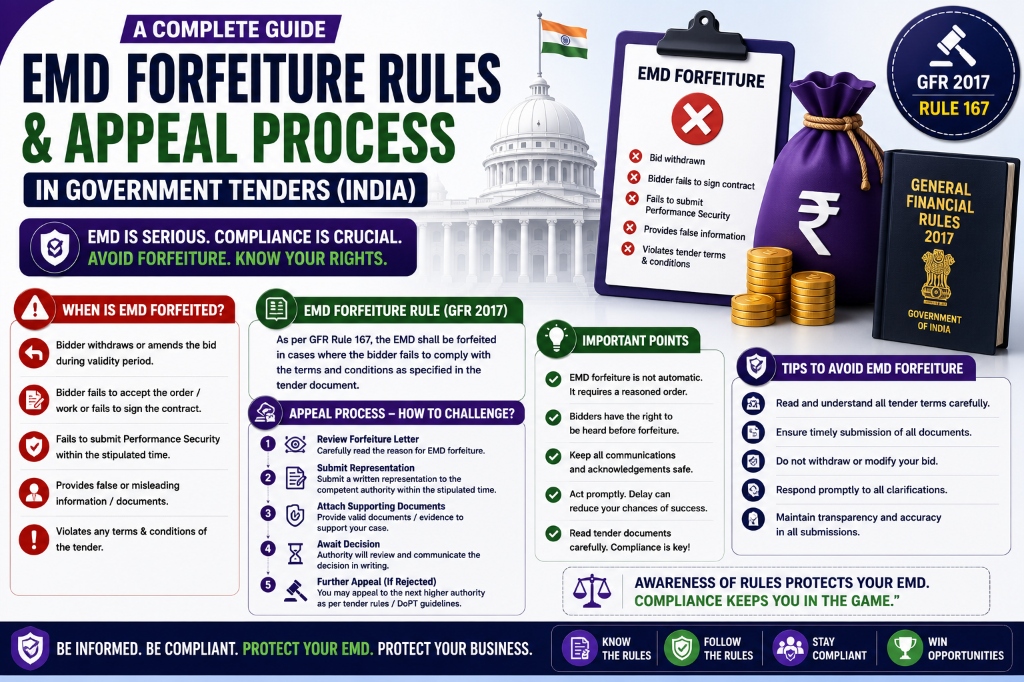
- Forfeiture on Breach: EMD can be forfeited if the bidder withdraws the bid, fails to accept the award, or breaches tender conditions.
- No Interest Liability: Unless specified, government is not liable to pay interest on delayed EMD refunds.
- Exemption for MSMEs: Micro and Small Enterprises are exempt from EMD under the Public Procurement Policy for MSEs.
State Government Alignment
Most state governments have adopted GFR 2017-aligned procurement rules with similar EMD provisions. However, state-specific variations exist:
- Some states cap EMD at 2% regardless of tender value
- Others exempt all MSMEs (including Medium) from EMD
- E-refund timelines may vary from 15 to 45 days
🔗 Internal Link: Learn how GFR 2017 July 2024 amendments changed procurement for MSMEs.
GeM Portal EMD Rules: Digital Procurement Specifics
The Government e-Marketplace (GeM) has transformed how EMD is handled in digital procurement. With over 6.3 crore MSMEs registered on Udyam and growing GeM adoption, understanding portal-specific EMD rules is critical.
GeM EMD Applicability Rules
| Scenario | EMD Required? | Notes |
|---|---|---|
| Tender value < ₹5 lakh | No | Automatic exemption |
| Tender value > ₹5 lakh | Yes | 1% standard (0.5%–5% range) |
| Udyam-registered MSE | No | Must upload valid Udyam certificate |
| DPIIT-recognized Startup | No | Must upload Startup Recognition Certificate |
| NSIC-registered unit | No | Single Point Registration Scheme |
| BIS License Holder | No | For tendered product category |
| Central/State PSU | No | Valid PSU registration required |
| KVIC/Coir Board/TRIFED | No | Entity registration certificate |
GeM EMD Payment Process
- Login to GeM portal with seller credentials
- Search the bid using bid number
- Download EMD Draft Document from the portal
- Select "No" for EMD exemption (if applicable, skip to upload exemption doc)
- Bank Processing: Bank creates BG/processes payment and auto-intimates GeM
- Upload EMD Receipt (PDF) with details:
- Issuing Bank Name, Branch, Manager
- Guarantee Number, Bid Number
- EMD Amount, Validity Date
- Submit application with OTP verification
GeM EMD Refund Timeline
| Bidder Type | Refund Trigger | Typical Timeline |
|---|---|---|
| Unsuccessful bidder | Tender finalization | 7–15 working days (auto-refund) |
| Successful bidder | Performance Security submission | 15–30 working days |
| Tender cancelled | Administrative cancellation | Full refund to all bidders |
GeM EMD Forfeiture Conditions
- Withdrawal of bid after submission
- Refusal to accept contract after winning
- Failure to start work on time
- Violation of tender terms
- Failure to submit performance security within stipulated time
- Submission of incorrect or false documents
⚠️ Warning: On GeM, exempted sellers cannot be asked to submit EMD even through ATC/STC clauses. Such conditions are null and void. Always challenge unlawful EMD demands.
7 Grounds for EMD Forfeiture in Government Tenders
Understanding the exact grounds for forfeiture is your first line of defense. Here are the 7 legally recognized grounds under GFR 2017, GeM guidelines, and standard tender conditions:
Ground 1: Bid Withdrawal During Validity Period
If you withdraw your bid after the submission deadline but before the tender is finalized, your EMD is liable for forfeiture. Some entities also impose debarment for 1 year.
| Withdrawal Timing | Consequence |
|---|---|
| Before submission deadline | EMD refunded, but cannot resubmit |
| After deadline, before price bid opening | EMD forfeited + debarment (min. 1 year) |
| After price bid opening | EMD forfeited + debarment (min. 1 year) |
Ground 2: Failure to Accept Award / Sign Contract
The L1 bidder must accept the Advance Purchase Order (APO) or Letter of Award (LOA) and sign the contract within the stipulated period (typically 14–30 days). Failure = forfeiture.
Ground 3: Non-Submission of Performance Security
After winning, you must submit the Performance Security (typically 5%–10% of contract value) within the specified timeframe. Missing this deadline triggers EMD forfeiture.
Ground 4: Submission of False Documents
If post-verification reveals that your technical bid, financial documents, or eligibility certificates are forged, incorrect, or misleading, EMD is forfeited summarily.
Ground 5: Bid Amendment or Impairment
Amending, impairing, or derogating from your bid in any respect during the validity period is a breach that warrants forfeiture under Clause 12.7 of standard GIB (General Instructions to Bidders).
Ground 6: Failure to Produce Samples
In technical tenders requiring sample evaluation, failure to produce samples at the prescribed time and place can result in EMD forfeiture.
Ground 7: Non-Compliance with Tender Terms
Any material breach of tender terms — such as failure to attend pre-bid meetings (if mandatory), non-compliance with technical specifications, or violation of integrity pact — can trigger forfeiture.
Grounds for EMD Forfeiture: Quick Reference Table
| Ground | Legal Basis | Severity |
|---|---|---|
| Bid withdrawal during validity | GFR 2017, Clause 12.7 GIB | High — automatic |
| Non-acceptance of APO/LOA | Clause 12.7(b) GIB | High — automatic |
| No performance security | GFR Rule 171, GIB | High — automatic |
| False documents | GFR, Integrity Pact | Critical — may attract blacklisting |
| Bid amendment/impairment | Clause 12.7(a) GIB | High |
| Sample non-production | Tender-specific clause | Medium-High |
| General non-compliance | Tender-specific terms | Variable |
EMD Forfeiture vs. EMD Refund: A Side-by-Side Comparison
| Parameter | EMD Refund | EMD Forfeiture |
|---|---|---|
| Trigger | Unsuccessful bid / Contract fulfillment / Tender cancellation | Breach of tender conditions |
| Timeline | 7–30 days after finalization | Immediate upon breach determination |
| Amount | 100% of EMD returned | 100% of EMD retained by buyer |
| Interest | Usually none (unless specified) | N/A |
| Process | Automatic (online) or manual request | Order issued by Tender Accepting Authority |
| Appealability | Only if delayed | Appealable through multi-level framework |
| MSME Impact | Working capital restored | Permanent loss + potential debarment |
| Documentation | Refund receipt / Bank credit | Forfeiture order with reasons |
MSME EMD Exemptions: Your Financial Shield
The Public Procurement Policy for Micro and Small Enterprises (PPP-MSE Order, 2012) is the single most powerful protection for small businesses in government tenders.
Who Qualifies for EMD Exemption?
| Category | Registration Required | EMD Exemption |
|---|---|---|
| Micro Enterprise | Valid Udyam Registration | ✅ 100% exempt |
| Small Enterprise | Valid Udyam Registration | ✅ 100% exempt |
| Medium Enterprise | Valid Udyam Registration | ❌ Not exempt |
| Startup | DPIIT Recognition Certificate | ✅ 100% exempt |
| NSIC-registered MSE | Single Point Registration | ✅ 100% exempt |
| KVIC/Coir Board/TRIFED | Entity registration | ✅ 100% exempt |
Financial Impact of EMD Exemption
Scenario: You want to bid on 5 tenders simultaneously, each worth ₹25 lakh.
| Without Exemption | With Udyam/NSIC Exemption |
|---|---|
| EMD @ 2% per tender = ₹50,000 × 5 = ₹2.5 lakh blocked | ₹0 blocked |
| Capital locked for 3–6 months | Full working capital available |
| Opportunity cost of blocked funds | Can bid on 10+ more tenders |
| Risk of forfeiture loss | Zero forfeiture risk on EMD |
How to Claim EMD Exemption
- Register on Udyam Registration portal (free, online, instant)
- Download your Udyam Registration Certificate
- Upload the certificate in the EMD exemption section while bidding
- Submit Bid Security Declaration (Appendix-10 format) instead of EMD
- Verify that the portal validates your Udyam number automatically
⚠️ Critical Mistake: Simply having Udyam registration is NOT enough. You must actively claim the exemption in your bid document. Many MSMEs lose this benefit by forgetting to upload the exemption certificate.
🔗 Internal Link: Complete Udyam Registration Guide for MSMEs (2025)
The EMD Appeal Process: 6-Step Recovery Framework
If your EMD has been forfeited — or is being threatened with forfeiture — follow this proven 6-step recovery framework used by successful bidders and procurement lawyers:
Step 1: Document Review & Legal Position Assessment
Before doing anything, gather:
- Complete tender document (NIT, GIB, GCC, all appendices)
- Your bid submission records
- EMD payment proof (DD/BG/Receipt)
- Forfeiture order/letter with reasons
- All correspondence with the procuring entity
Assess: Was the forfeiture legally justified? Check:
- Did you actually breach the specific clause cited?
- Was the forfeiture order issued by a competent authority?
- Were you given an opportunity to explain?
- Is the forfeiture amount disproportionate to the actual loss?
Step 2: Internal Appeal to Appellate Authority
Every procuring entity must designate an Appellate Authority (typically one rank higher than the Competent Authority for debarment). File a written appeal within the stipulated time (usually 30 days from forfeiture order).
Appeal Letter Must Include:
- Tender ID, reference number, bid details
- EMD amount and payment proof
- Grounds why forfeiture is unjustified
- Legal precedents supporting your position
- Prayer for refund with interest
Step 3: CPPP Grievance Module (for e-Procurement Tenders)
For tenders floated on CPPP (Central Public Procurement Portal):
- Visit eprocure.gov.in
- Navigate to Grievance/Suggestion Module
- Select category: GENERAL > Refund of EMD
- Enter tender details (ID, value, EMD amount, dates)
- Upload supporting documents (PDF only)
- Submit grievance with detailed complaint (up to 2000 characters)
CPPP Grievance Categories:
- Corruption
- Tender Condition disputes
- Declaration of Tender Results
- Release of Purchase Orders
- Refund of EMD ← Your category
- Contract Payments
- Limited/Single Tender objections
- Others
Step 4: CPGRAMS Portal (for Central Government Bodies)
For delays or unjust actions by central government departments:
- Visit pgportal.gov.in
- Register/Login with mobile number
- File grievance under relevant ministry/department
- Cite GFR 2017 provisions and tender clauses
- Attach all documentary evidence
- Track resolution timeline (typically 30–60 days)
Step 5: RTI Application (Information as Weapon)
File an RTI with the Public Information Officer (PIO) of the procuring entity:
Ask For:
- Date the EMD release was sanctioned or reasons for pending status
- File notings on your EMD refund/forfeiture
- Bank advice/cheque/RTGS reference of refund (if any)
- Office order on EMD release for that tender
- Copy of the forfeiture order with approval chain
Why RTI Works: The procuring entity must create a paper trail. This often forces action and provides evidence for higher appeals.
Step 6: Legal Remedies (Civil Court / Arbitration / Writ)
If all administrative remedies fail:
| Legal Route | When to Use | Timeline | Cost |
|---|---|---|---|
| Civil Suit | For recovery of EMD + interest | 2–5 years | Moderate |
| Arbitration | If tender has arbitration clause | 1–3 years | High |
| Writ Petition | If fundamental rights violated | 6–18 months | Moderate |
| MSME Samadhaan | If exempt MSME was charged EMD | 30–90 days | Free |
💡 Pro Tip: The Supreme Court in Kailash Nath Associates v. DDA (2015) established that proof of actual loss is required for EMD forfeiture under Section 74 of the Indian Contract Act. If the procuring entity cannot prove loss, you have a strong legal case.
Step-by-Step: How to File an EMD Forfeiture Appeal
Template: EMD Forfeiture Appeal Letter
To,
The Appellate Authority / Head of Office
[Name of Department / PSU]
[Address]

Date: [DD/MM/YYYY]

Subject: APPEAL AGAINST FORFEITURE OF EARNEST MONEY DEPOSIT
         Tender ID: [Number] | EMD Amount: ₹[Amount]

Respected Sir/Madam,

I/We, [Name of Firm], participated in the above-referenced tender and
deposited EMD of ₹[Amount] vide [DD/BG/Transaction Number] dated [Date].

I have received an order dated [Date] forfeiting my EMD on the ground
of [reason cited]. I respectfully submit that this forfeiture is
unjustified for the following reasons:

1. [Ground 1: e.g., "No concluded contract existed at the time of
   alleged breach as per Supreme Court precedent in South Eastern
   Coalfields v. S.Kumar's Associates"]

2. [Ground 2: e.g., "The procuring entity has failed to quantify
   actual loss suffered, violating Section 74 of the Indian Contract
   Act and the dictum in Kailash Nath Associates v. DDA"]

3. [Ground 3: e.g., "I am a Udyam-registered Micro Enterprise and
   was entitled to EMD exemption under PPP-MSE Order, 2012"]

4. [Ground 4: e.g., "The forfeiture order was issued without
   providing an opportunity of being heard, violating principles
   of natural justice"]

PRAYER:
In light of the above, I humbly pray that:
(a) The order of forfeiture dated [Date] be set aside;
(b) My EMD of ₹[Amount] be refunded with interest @ [Rate]% per
    annum from [Date] till realization;
(c) I be granted [any other relief].

I am enclosing herewith:
1. Copy of tender document
2. Copy of bid submission
3. Copy of EMD payment proof
4. Copy of forfeiture order
5. Copy of Udyam/NSIC registration (if applicable)
6. [Any other documents]

Yours faithfully,

[Signature]
[Name]
[Designation]
[Firm Name]
[Address]
[Mobile] | [Email]
[Udyam Registration Number, if applicable]
Escalation Matrix for EMD Recovery
| Stage | Authority | Action | Timeline |
|---|---|---|---|
| 1 | Tender Inviting Authority | Written demand for refund | Immediate |
| 2 | Appellate Authority | Formal appeal against forfeiture | Within 30 days of order |
| 3 | Head of Office / Nodal Grievance Officer | Review and direction | 15–30 days |
| 4 | CPPP Grievance Module | Online grievance for e-tenders | 30–45 days |
| 5 | CPGRAMS | Central government grievance | 30–60 days |
| 6 | RTI to PIO | Information on EMD status | 30 days (RTI mandate) |
| 7 | MSME Samadhaan | If exempt MSME was charged | 30–90 days |
| 8 | Civil Court / Arbitration | Legal recovery | 1–5 years |
Supreme Court & High Court Judgments on EMD Forfeiture (2024–2025)
Recent judicial pronouncements have significantly shaped the EMD forfeiture landscape. Here are the landmark judgments every bidder must know:
1. SBI v. C. Natarajan (Supreme Court, 2024)
Citation: (2024) 2 SCC 637 Key Holding: In SARFAESI auction contexts, the SARFAESI Act (being a special enactment with overriding effect under Sections 35 and 37) excludes the application of Sections 73 and 74 of the Indian Contract Act, 1872. Full forfeiture of EMD is permissible in statutory auctions.
Impact on Government Tenders: This judgment specifically applies to bank auctions under SARFAESI, not to government procurement tenders. For government tenders, the principles of Kailash Nath Associates still apply.
2. Central Bank of India v. Shanmugavelu (Supreme Court, 2024)
Citation: CIVIL APPEAL NO(S). 235-236 OF 2024 Key Holding: Forfeiture of entire EMD by a bank under SARFAESI Rule 9(5) does NOT amount to unjust enrichment. The Supreme Court set aside the High Court's order that had limited forfeiture to actual loss.
Critical Distinction: The Court emphasized that this principle applies to public auctions under special statutes, not to ordinary government tender contracts where Section 74 of the Contract Act may still regulate forfeiture.
3. Himalaya Communications v. BSNL (Delhi High Court, 2025)
Citation: O.M.P. (COMM) 391/2023, decided 26 September 2025 Key Holding: The Delhi High Court upheld the forfeiture of ₹2 crore EMD where the L1 bidder failed to accept APOs and furnish Performance Bank Guarantees within the stipulated and extended time.
Legal Principles Affirmed:
- APOs (Advance Purchase Orders) are Letters of Intent, not concluded contracts
- Contract formation requires: (a) acceptance of APO + (b) furnishing of PBG
- Forfeiture at the pre-contractual stage (before contract formation) does not infringe statutory rights under the Contract Act
- The procuring entity is entitled to forfeit EMD if the bidder's fault prevents contract formation
MSME Lesson: Even if you're L1, accept the APO immediately and negotiate extensions afterward. Delayed acceptance = forfeiture risk.
4. Dolphin Suppliers v. Union of India (Calcutta High Court, 2025)
Citation: Decided 27 March 2025 Key Holding: Reaffirmed that in e-auctions under special statutes (like SEBI auctions), the Indian Contract Act cannot be pressed into service to prevent forfeiture of EMD. The specific auction terms govern.
Judicial Summary Table
| Case | Court | Year | Key Principle | Applies To |
|---|---|---|---|---|
| SBI v. C. Natarajan | Supreme Court | 2024 | SARFAESI overrides Contract Act | Bank auctions only |
| Central Bank v. Shanmugavelu | Supreme Court | 2024 | Full forfeiture ≠ unjust enrichment | SARFAESI auctions |
| Himalaya Comm. v. BSNL | Delhi High Court | 2025 | Pre-contractual forfeiture valid | Government tenders |
| Dolphin Suppliers v. UOI | Calcutta HC | 2025 | Special statutes override Contract Act | E-auctions under special laws |
| Kailash Nath v. DDA | Supreme Court | 2015 | Proof of loss required under Sec. 74 | Ordinary contracts/tenders |
Bottom Line for Government Tenders: While recent Supreme Court judgments have strengthened forfeiture powers in bank auctions and special statutory proceedings, the Kailash Nath Associates principle — requiring proof of actual loss for forfeiture under Section 74 — remains relevant for ordinary government procurement tenders where the forfeiture clause may be construed as a penalty.
Case Studies: Real EMD Forfeiture Cases with Outcomes
Case Study 1: The ₹2 Crore BSNL Cable Tender Loss
Entity: Himalaya Communications Pvt. Ltd. Tender: BSNL procurement of Optical Fiber Cables (24F and 48F) EMD: ₹2 crore (Bank Guarantee) Issue: Declared L1 on 28.09.2016, issued APOs on 28.10.2016
What Went Wrong:
- Petitioner sent samples for testing; samples were rejected
- Requested multiple extensions to obtain TSEC (Technical Specification Evaluation Certificate)
- Failed to accept APOs and furnish PBGs even during extended time (till 12.12.2016)
- BSNL withdrew APOs on 09.01.2017 and forfeited EMD
Legal Battle:
- Filed writ petition (withdrawn due to arbitration clause)
- Arbitration proceedings — Arbitrator upheld forfeiture
- Section 34 petition in Delhi High Court — Dismissed on 26.09.2025
Outcome: ₹2 crore forfeited. Total loss including legal costs: ~₹2.5 crore
Key Lesson: Accept the APO first, then negotiate. The Court ruled that APOs were merely LOIs, and contract formation required acceptance + PBG. The petitioner's delay in accepting APOs — regardless of sample testing issues — was fatal.
Case Study 2: The MSME That Saved ₹1.5 Lakh Through Exemption
Entity: Micro Enterprise (Udyam Registered), Maharashtra Tender: State PWD road maintenance contract Estimated Value: ₹75 lakh Standard EMD: ₹1.5 lakh (2%)
What Went Right:
- Registered on Udyam portal before bidding
- Uploaded Udyam certificate in bid document
- Submitted Bid Security Declaration (Appendix-10) instead of EMD
- Bid was technically evaluated and accepted
Outcome: ₹1.5 lakh saved upfront. Bid was unsuccessful, but zero capital was blocked. The MSME used the saved capital to bid on 3 additional tenders in the same quarter.
ROI of Udyam Registration: ₹0 cost (free registration) → ₹1.5 lakh saved + opportunity to bid on more tenders.
Case Study 3: The Delayed Refund Recovered via RTI
Entity: Small Enterprise, Karnataka Tender: Central PSU tender for electrical equipment EMD: ₹50,000 (Online payment through CPPP) Status: Unsuccessful bidder
Problem: EMD not refunded even 90 days after tender finalization
Recovery Steps:
- Sent written demand to Accounts Officer (no response)
- Filed RTI seeking EMD release status and file notings
- RTI response revealed refund was "pending due to internal approval"
- Escalated to Head of Office with RTI response attached
- EMD refunded within 7 days of escalation
Outcome: ₹50,000 recovered + ₹2,400 interest (claimed for 90-day delay at 8% p.a.)
Key Lesson: RTI is a powerful tool. The paper trail forced the department to act. Always set a 30-day reminder post-award to track your EMD refund.
EMD Forfeiture Mistakes That Cost MSMEs Lakhs
Mistake 1: Not Claiming MSME Exemption
Impact: Paying EMD when you don't have to Frequency: ~40% of eligible MSMEs forget to claim exemption Cost: 1%–5% of every tender value bid Fix: Create a bidding checklist with "Upload Udyam Certificate" as mandatory step
Mistake 2: Missing APO Acceptance Deadline
Impact: Automatic forfeiture even if you're L1 Frequency: Common among first-time winners Cost: 100% of EMD + debarment risk Fix: Set calendar alerts for 7 days, 3 days, and 1 day before APO acceptance deadline
Mistake 3: Submitting EMD in Wrong Format
Impact: Bid rejected as "non-responsive" at opening stage Frequency: ~15% of rejected bids Cost: Lost tender opportunity + EMD return delay Fix: Verify exact EMD form (DD/BG/FDR) and beneficiary name in NIT
Mistake 4: Not Tracking Refund Timeline
Impact: EMD stuck for months without action Frequency: Very common Cost: Working capital crunch + opportunity cost Fix: Maintain a Tender Tracker sheet with EMD refund due dates
Mistake 5: Accepting Forfeiture Without Appeal
Impact: Permanent loss of EMD Frequency: ~60% of forfeited EMDs are never appealed Cost: 100% of EMD + precedent for future unjust forfeitures Fix: Always appeal if you believe forfeiture is unjustified. The appeal cost is usually lower than the EMD amount.
Mistake 6: Using Expired Udyam/NSIC Certificates
Impact: Exemption denied, bid rejected for insufficient EMD Frequency: Common after Udyam re-registration deadlines Cost: Lost bid + reputational damage Fix: Set annual reminders 30 days before Udyam certificate expiry
EMD Forfeiture Prevention Checklist
Use this checklist before submitting every government tender:
Pre-Bid Checklist
- Udyam/NSIC Status: Is my registration valid? Is the certificate uploaded?
- EMD Exemption: Am I eligible? Have I claimed it in the bid?
- EMD Calculation: Is the amount correct? (Tender Value × %)
- EMD Form: DD/BG/FDR — is it in the exact format required?
- Beneficiary Name: Does it match the NIT exactly?
- Validity Period: Is EMD valid for tender validity + 45/60 days?
- Bank Details: Are account details correct for refund?
- Tender Terms: Have I read the forfeiture clauses in GIB/Section 4?
Post-Award Checklist (If You Win)
- APO Received: Date of receipt noted
- Acceptance Deadline: Calendar alert set (typically 14 days)
- PBG Amount: Calculated (typically 5%–10% of contract value)
- PBG Deadline: Calendar alert set
- Contract Signing: Date and location confirmed
- Performance Security: Form and beneficiary verified
Post-Award Checklist (If You Lose)
- Refund Due Date: Calculated (30 days from award/bid validity expiry)
- Bank Account: Verified active and correctly linked on portal
- 30-Day Reminder: Set to check refund status
- Escalation Plan: Ready if refund is delayed
Frequently Asked Questions (FAQs)
Q1. What is EMD in government tenders?
A: EMD (Earnest Money Deposit) or Bid Security is a refundable deposit submitted by bidders to demonstrate seriousness in participating in a government tender. It typically ranges from 0.5% to 5% of the estimated tender value and is refunded to unsuccessful bidders after tender finalization.
Q2. What are the main reasons for EMD forfeiture?
A: The 7 primary grounds are: (1) Bid withdrawal during validity period, (2) Failure to accept APO/sign contract, (3) Non-submission of performance security, (4) Submission of false documents, (5) Bid amendment/impairment, (6) Failure to produce samples, and (7) General non-compliance with tender terms.
Q3. How can I appeal an EMD forfeiture decision?
A: Follow the 6-step framework: (1) Review documents and assess legal position, (2) File internal appeal with Appellate Authority, (3) Use CPPP Grievance Module for e-tenders, (4) File CPGRAMS complaint for central bodies, (5) File RTI for information and paper trail, (6) Approach civil court/arbitration/MSME Samadhaan as final remedy.
Q4. Are MSMEs exempt from EMD in all government tenders?
A: Micro and Small Enterprises (MSEs) with valid Udyam Registration are exempt from EMD in most central government tenders under the PPP-MSE Order, 2012. However, some specialized tenders (defense, high-security) may still require EMD. Medium Enterprises are not exempt. Always verify the specific tender's exemption clause.
Q5. What is the EMD refund timeline for unsuccessful bidders?
A: Under GFR 2017, EMD should be refunded within 30 days of contract award or bid validity expiry. On GeM, refunds are typically processed within 7–15 working days automatically. If delayed beyond 30 days, you should send a written demand and consider filing RTI.
Q6. Can the entire EMD be forfeited without proof of actual loss?
A: In ordinary government tenders (not SARFAESI auctions), the Supreme Court in Kailash Nath Associates v. DDA (2015) held that proof of actual loss is required under Section 74 of the Indian Contract Act. However, if the tender explicitly provides for forfeiture and you breach pre-contractual conditions (like not accepting an APO), the procuring entity can forfeit EMD. Recent 2024–2025 judgments on SARFAESI auctions do not automatically apply to government procurement.
Q7. What is the difference between EMD and Performance Security?
A: EMD is submitted during bidding to ensure serious participation. Performance Security (typically 5%–10%) is submitted after winning to ensure contract execution. EMD is refunded when Performance Security is submitted. Performance Security is refunded after project completion.
Q8. Can I use the same Bank Guarantee for multiple tenders?
A: No. Each tender requires a separate EMD instrument. One BG cannot cover multiple tenders. Each BG must specify the individual tender ID and be issued in favor of the specific procuring entity.
Q9. What should I do if my EMD refund is delayed beyond 30 days?
A: (1) Send a dated written demand to the Accounts Officer quoting GFR 2017 and tender clause, (2) Escalate to Head of Office, (3) File grievance on CPPP/CPGRAMS, (4) File RTI for file notings and status, (5) If you're an exempt MSME who was wrongly charged, file on MSME Samadhaan portal.
Q10. Is EMD required on GeM for tenders below ₹5 lakh?
A: No. GeM tenders with estimated value below ₹5 lakh do not require EMD. For tenders above ₹5 lakh, EMD is typically 1% of estimated value, but Udyam-registered MSEs and DPIIT-recognized startups are fully exempt.
Conclusion & Action Plan
EMD forfeiture is one of the most financially devastating risks in government procurement — but it is also entirely preventable with the right knowledge and processes.
Key Takeaways
- Know the Rules: GFR 2017, GeM guidelines, and your tender's specific GIB clauses govern EMD. Read them before bidding.
- Claim Your Exemption: If you're a Udyam-registered MSE or DPIIT startup, never pay EMD. Upload your exemption certificate.
- Accept APOs Immediately: The Himalaya Communications case (₹2 crore loss) proves that delayed APO acceptance is fatal.
- Appeal Unjust Forfeitures: 60% of forfeited EMDs are never appealed. Use the 6-step framework.
- Track Your Refunds: Set 30-day reminders. Use RTI as a weapon against delays.
Your 7-Day Action Plan
| Day | Action | Outcome |
|---|---|---|
| Day 1 | Verify Udyam registration validity | Ensure exemption eligibility |
| Day 2 | Create a Tender Tracker spreadsheet | Never miss a deadline again |
| Day 3 | Review your last 5 bids for EMD compliance | Identify past mistakes |
| Day 4 | Download Bid Security Declaration template | Ready for next exempt bid |
| Day 5 | Bookmark CPPP Grievance & CPGRAMS portals | Ready for escalation |
| Day 6 | Set calendar alerts for all pending tender deadlines | Prevent forfeiture |
| Day 7 | Share this guide with your bidding team | Organization-wide compliance |
Related Articles (Topical Authority Cluster)
- How to Register on GeM Portal: Step-by-Step Guide for MSMEs
- Udyam Registration Complete Guide: Benefits, Process & Documents
- GFR 2017 Amendments (July 2024): What Changed for MSME Suppliers
- How to Win Government Tenders: 15 Proven Strategies for MSMEs
- GeM vs CPPP vs State Portals: Complete Comparison for MSME Bidders
- Understanding Performance Security in Government Contracts
- MSME Samadhaan Portal: Recover Delayed Payments from Government Buyers
- Common Tender Bidding Mistakes MSMEs Make (And How to Avoid Them)
Disclaimer: This article is for informational purposes only and does not constitute legal advice. For specific legal matters related to EMD forfeiture, consult a qualified procurement lawyer. Laws and rules are subject to change; verify current provisions from official government sources.
About TenderFlow Pro: TenderFlow Pro is India's leading AI-powered tender intelligence platform for MSMEs. We help small businesses discover, analyze, and win government tenders with 10x efficiency. Start your free trial today.
Last Updated: 18 July 2025 | Reviewed by: TenderFlow Pro Legal Advisory Panel