Liquidated Damages in Government Tenders: Formula, GFR Rules & Supreme Court Precedents (2026)
menu_book Table of Contents
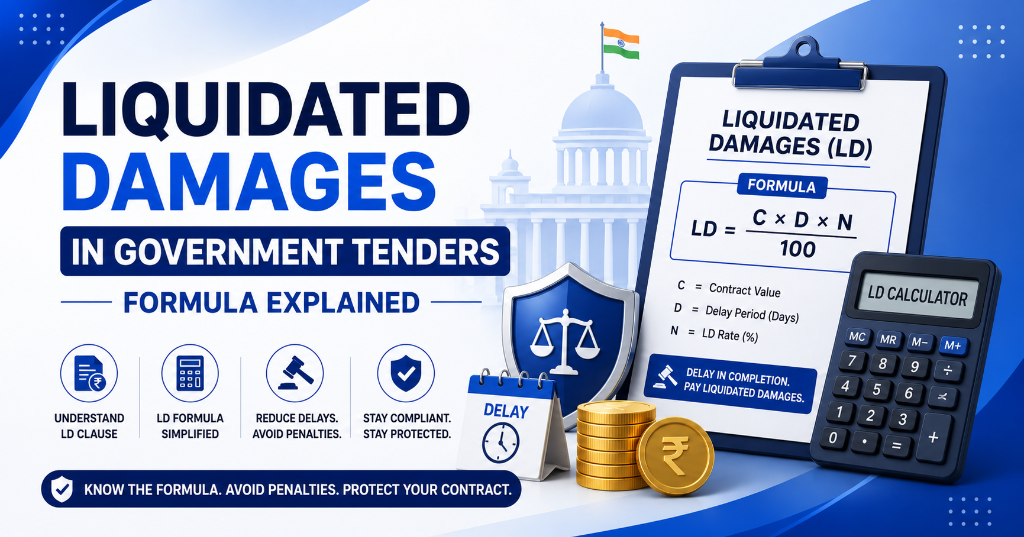
The Margin Killer: Why Liquidated Damages Destroy Contractor Profits
India's government procurement market processes ₹20–25 lakh crore annually. Contractors bid aggressively—8–15% margins on goods, 12–18% on works, 15–25% on consultancy. But a single delay can erase years of profitability in weeks. For the comprehensive end-to-end framework, consult our government tender guide for MSMEs. To understand foundational rules, refer to our GFR 2017 tender rules explained.
The brutal math: A ₹2 crore works contract with 12% planned margin (₹24 lakh profit) and 0.5% weekly LD rate loses ₹1 lakh per week of delay. At 10 weeks, ₹10 lakh is gone—42% of the entire profit. At 20 weeks, the ₹20 lakh LD exceeds the profit, and the contractor works at a loss.
And this is before cost overruns, material price escalation, financing costs, and retention money blocking.
Liquidated damages are not a theoretical risk. They are the single most common financial drain on government contractors who fail to plan for schedule risk, document delays properly, and invoke Extension of Time (EOT) protocols.
This guide is not about avoiding LD through perfect execution—no contractor achieves that. It is about understanding the formula, the law, the precedents, and the waiver mechanisms so you price risk correctly, document delays meticulously, and protect your margins when things go wrong.

Get the GFR Compliance Toolkit
Know every GFR rule, protect deposits, and challenge restrictive clauses with confidence.
- ✓ 150-Point Pre-Submission Checklist (PDF)
- ✓ EMD & BG Format Verification Guide + Checker
- ✓ 5 Post-Rejection Appeal Letters (GFR 171)
- ✓ Corrigendum Monitoring & Response Checklist
🔒 256-Bit Secure Razorpay Checkout · Lifetime Access · Instant Digital Delivery
What Are Liquidated Damages? Definition & Legal Framework
Liquidated Damages (LD) are pre-agreed sums stipulated in a contract as compensation payable by one party to the other in the event of a specific breach—most commonly, delay in performance.
In government procurement, LD clauses serve three functions:
| Function | How It Works |
|---|---|
| Compensatory | Pre-estimates the loss government suffers from delay (idle resources, extended project timelines, cost escalation) |
| Deterrent | Creates financial pressure on contractors to adhere to schedules |
| Administrative Efficiency | Eliminates need for lengthy litigation to prove actual loss for every delay |
Key Legal Sources
| Law/Rule | Relevance |
|---|---|
| Section 74, Indian Contract Act 1872 | Governs all LD clauses in India; supersedes common law distinctions |
| GFR 2017 | Mandates LD clauses in government contracts; specifies standard rates |
| CPWD/State PWD Manuals | Detailed LD application for works contracts |
| Contract-Specific Tender Documents | Defines exact rate, cap, trigger, and calculation method |
Section 74 of the Indian Contract Act 1872: The Complete Analysis
Section 74 is the constitutional scripture of liquidated damages in India. Unlike UK or US law, it does not distinguish between "liquidated damages" and "penalty."
The Complete Text
"When a contract has been broken, if a sum is named in the contract as the amount to be paid in case of such breach, or if the contract contains any other stipulation by way of penalty, the party complaining of the breach is entitled, whether or not actual damage or loss is proved to have been caused thereby, to receive from the party who has broken the contract reasonable compensation not exceeding the amount so named or, as the case may be, the penalty stipulated for."
What Section 74 Actually Means
| Interpretation | Practical Impact |
|---|---|
| No LD vs Penalty distinction | Courts treat both terms the same—award "reasonable compensation" not exceeding stipulated amount |
| "Whether or not actual damage is proved" | Where loss is difficult to quantify, no proof needed. Where quantifiable, proof is mandatory (per Kailash Nath 2015) |
| "Reasonable compensation" | Court can award LESS than stipulated amount if it finds the sum excessive or unconscionable |
| "Not exceeding the amount so named" | Contractor's maximum exposure is capped at the contractually stipulated sum |
The "Genuine Pre-Estimate" Test
The Supreme Court in ONGC v. Saw Pipes (2003) established the critical distinction:
| Clause Type | Burden of Proof | Court's Approach |
|---|---|---|
| Genuine Pre-Estimate of Loss | Burden shifts to breaching party to prove NO loss occurred | Award stipulated amount unless proven unreasonable |
| Penalty / Extravagant Sum | Burden on claiming party to prove actual loss | Award only reasonable compensation, likely less than stipulated |
Instant Tender Eligibility & Risk Audit
Upload any 500-page NIT / BOQ PDF. Extract hidden disqualification traps, EMD waiver clauses, and complete eligibility criteria in under 45 seconds.
GFR 2017 & Standard LD Rates by Contract Type
Under GFR 2017, every government contract must contain an LD clause. The standard rates have evolved through departmental practice and are now codified in procurement manuals.
Standard LD Rates (2026)
| Contract Type | Standard Rate | Per Unit | Typical Cap | Authority |
|---|---|---|---|---|
| Works (CPWD/State PWD) | 0.5% | Per week of delay | 5% of contract value | CPWD Manual |
| Works (Certain departments) | 1.0% | Per week of delay | 10% of contract value | Department-specific |
| Goods/Supply | 0.5% | Per week of delay | 5% of contract value | GFR 2017 |
| Goods (Critical/Time-sensitive) | 1.0% | Per week of delay | 10% of contract value | Tender-specific |
| Services (SLA-based) | Monthly % | Based on SLA breach metrics | 5-10% of annual value | Contract terms |
| Turnkey/EPC | 0.5-1.0% | Per week of commissioning delay | 10% of contract value | Tender-specific |
LD Calculation Methods
| Method | Formula | Best For |
|---|---|---|
| Weekly Rate | LD = Contract Value × Rate% × Weeks of Delay | Most common; works and supply contracts |
| Daily Rate | LD = Contract Value × (Rate%/7) × Days of Delay | High-value, time-critical projects |
| Milestone Rate | LD = Milestone Value × Rate% × Delay Weeks | Phased contracts with milestone deadlines |
| SLA-Based | LD = Monthly Fee × Deduction% per SLA breach | IT services, maintenance contracts |
The LD Formula: Step-by-Step Calculation with Examples
Formula 1: Standard Weekly LD (Most Common)
LD = Contract Value × LD Rate per Week × Number of Weeks of Delay

Where:
Contract Value = Total agreement value (₹)
LD Rate = 0.5% or 1.0% (as per tender)
Weeks of Delay = Full weeks beyond contractual deadline (partial weeks rounded up)
Formula 2: With Cap Verification
Calculated LD = Contract Value × LD Rate × Weeks
If Calculated LD > (Contract Value × Cap%), then LD = Contract Value × Cap%
Example 1: Standard Works Contract
| Parameter | Value |
|---|---|
| Contract Value | ₹2,00,00,000 |
| LD Rate | 0.5% per week |
| Cap | 10% of contract value |
| Contract Deadline | 31 March 2026 |
| Actual Completion | 15 June 2026 |
| Delay | 11 weeks |
Calculation:
LD = ₹2,00,00,000 × 0.005 × 11 = ₹11,00,000
Cap Check: 10% of ₹2 Cr = ₹20,00,000
Since ₹11 lakh < ₹20 lakh → LD = ₹11,00,000
Impact on Margin:
- Planned profit at 12%: ₹24,00,000
- LD deducted: ₹11,00,000
- Remaining profit: ₹13,00,000 (46% profit erosion)
Example 2: High-Value Infrastructure
| Parameter | Value |
|---|---|
| Contract Value | ₹50,00,00,000 |
| LD Rate | 0.5% per week |
| Cap | 5% of contract value |
| Delay | 20 weeks |
Calculation:
LD = ₹50 Cr × 0.005 × 20 = ₹5,00,00,000
Cap Check: 5% of ₹50 Cr = ₹2,50,00,000
Since ₹5 Cr > ₹2.5 Cr → LD capped at ₹2,50,00,000
Impact: At 10% planned margin (₹5 Cr profit), the capped LD of ₹2.5 Cr erodes 50% of profit. Beyond the cap, the government may terminate the contract.
Example 3: Daily Rate Contract
| Parameter | Value |
|---|---|
| Contract Value | ₹10,00,00,000 |
| LD Rate | 0.5% per week = 0.0714% per day |
| Delay | 45 days |
Calculation:
Daily Rate = 0.5% ÷ 7 = 0.0714%
LD = ₹10 Cr × 0.000714 × 45 = ₹32,13,000
Liquidated Damages vs Penalty: The Indian Legal Position
Unlike UK and US law, Indian law does not distinguish between liquidated damages and penalty. Section 74 treats both uniformly.
The English Common Law Position (For Context)
| Concept | Definition | Enforceability |
|---|---|---|
| Liquidated Damages | Genuine pre-estimate of loss at contract formation | Fully enforceable |
| Penalty | Sum stipulated to terrorize party into performance; extravagant vs. probable loss | Unenforceable; courts reduce to actual loss |
The Indian Position: Section 74 Uniform Treatment
"The Indian Legislature has sought to cut across the web of rules and presumptions [of English common law]." — Fateh Chand v. Balkishan Das (1964)
| Clause Label | Court's Treatment | Outcome |
|---|---|---|
| "Liquidated Damages" | Examines if genuine pre-estimate; if yes, enforceable | Award = stipulated sum (unless unconscionable) |
| "Penalty" | Same examination; substance over form | Award = reasonable compensation ≤ stipulated sum |
| No label provided | Court examines substance and circumstances | Same as above |
The "Extravagant and Unconscionable" Test
From Dunlop Pneumatic Tyre Co. v. New Garage and Motor Co. (1914) (cited by Indian courts):
"It will be held to be penalty if the sum stipulated for is extravagant and unconscionable in amount in comparison with the greatest loss that could conceivably be proved to have followed from the breach."
In Indian Practice: Courts rarely reduce LD in government contracts because:
- The rates (0.5-1% per week) are commercially reasonable
- The caps (5-10%) prevent unconscionability
- Government delay losses (project cost escalation, idle staff, extended supervision) are difficult to quantify
Supreme Court on LD: Fateh Chand (1964) to Kailash Nath (2015)
Fateh Chand v. Balkishan Das (1964) — AIR 1964 SC 980
The Foundation: The Supreme Court established that Section 74 eliminates the English common law distinction between penalty and liquidated damages.
"[Section 74] is clearly an attempt to eliminate the somewhat elaborate refinements made under the English common law in distinguishing between stipulations providing for payment of liquidated damages and penalty... The Indian Legislature has sought to cut across the web of rules and presumptions."
Key Holding: The court awards reasonable compensation not exceeding the stipulated amount, regardless of label.
Maula Bux v. Union of India (1970)
The Refinement: The Court clarified that while Section 74 dispenses with proof of actual loss in some cases, this does not apply universally.
"The expression 'whether or not actual damage or loss is proved to have been caused thereby' is intended to cover different classes of contracts... Where the Court is unable to assess compensation, the sum named by the parties if it be regarded as genuine estimate may be taken into consideration as the measure of reasonable compensation but not if the sum named is in the nature of penalty."
Key Holding: Where loss is quantifiable, the claimant must prove it. Where loss is difficult/impossible to prove, the stipulated sum (if genuine pre-estimate) can be awarded.
ONGC Ltd. v. Saw Pipes Ltd. (2003) — (2003) 5 SCC 705
The Revolution: The most significant LD ruling in Indian contract law.
Key Holdings:
- Terms of contract are paramount: Clear, unambiguous LD clauses are enforceable
- Burden shift: If LD is genuine pre-estimate, breaching party must prove NO loss
- Difficult-to-quantify loss: In complex contracts, exact loss proof is impossible; pre-estimate suffices
- Penalty vs genuine pre-estimate: Courts examine language and circumstances at contract formation, not breach
"In some contracts, it would be difficult for the Court to assess the compensation arising from breach... If the parties have pre-estimated such loss after clear understanding, it would be totally unjustified to arrive at the conclusion that the party who has committed breach is not liable to pay compensation."
Kailash Nath Associates v. DDA (2015) — (2015) 4 SCC 136
The Correction: The Supreme Court refined ONGC v. Saw Pipes, clarifying that proof of actual loss is not entirely dispensed with.
"The expression 'whether or not actual damage or loss is proved to have been caused thereby' means that where it is possible to prove actual damage or loss, such proof is not dispensed with. It is only in cases where damage or loss is difficult or impossible to prove that the liquidated amount named in the contract, if a genuine pre-estimate of damage or loss, can be awarded."
Key Holding: The possibility of proof determines whether actual loss evidence is required. Where quantifiable, proof is mandatory.
ONGC v. Saw Pipes (2003): The Landmark Ruling That Changed Everything
The Facts
ONGC awarded a contract to Saw Pipes Ltd. for supply of pipes. The contract contained an LD clause for delay in delivery. Saw Pipes delayed delivery, and ONGC invoked LD.
The Dispute
Saw Pipes argued that:
- ONGC had not proved actual loss due to the delay
- The LD clause was a penalty and unenforceable
- No evidence was led to establish the genuineness of the pre-estimate
The Supreme Court's 4-Point Framework
| Point | Holding |
|---|---|
| 1. Contract Terms First | "Terms of the contract are required to be taken into consideration before arriving at the conclusion whether the party claiming damages is entitled to the same" |
| 2. Clear Terms = Enforceable | "If the terms are clear and unambiguous stipulating the liquidated damages... unless it is held that such estimate is unreasonable or is by way of penalty, party who has committed the breach is required to pay such compensation" |
| 3. Section 74 + Section 73 | "Section 74 is to be read along with Section 73... the person aggrieved by the breach is not required to prove actual loss or damage suffered by him before he can claim a decree" |
| 4. Difficult-to-Quantify Loss | "In some contracts, it would be impossible for the Court to assess the compensation arising from breach... If the compensation contemplated is not by way of penalty or unreasonable, Court can award the same if it is genuine pre-estimate by the parties" |
The Outcome
- LD clause upheld
- ONGC awarded LD without proving exact loss
- Burden shifted to Saw Pipes to prove no loss occurred (which they failed to do)
Why This Matters for Government Contractors
The ONGC v. Saw Pipes ruling means that in most government contracts—where delay losses are genuinely difficult to quantify (project escalation, idle staff, extended supervision)—the government can enforce LD without proving exact loss. The contractor's only defense is to prove no loss occurred at all—a nearly impossible burden.
R.B. Enterprises v. Union of India (2023): When Arbitrators Cannot Award LD Without Proof
Court: Delhi High Court Citation: 2023 SCC OnLine Del 8321 Significance: Limits ONGC v. Saw Pipes; arbitrators must find loss occurred
The Facts
R.B. Enterprises challenged an arbitral award that granted LD to the Union of India. The arbitrator had awarded LD based solely on the contractual stipulation without any finding that actual loss or damage was suffered.
The Delhi High Court's Ruling
The Court set aside the arbitral award, holding:
"It is thus apparent that no finding has been rendered by the learned Arbitrator that the Respondent suffered loss or damage on account of breach, which is a sine qua non of a claim of liquidated damage... There is no finding by the Arbitrator that the Respondent suffered any loss/damage and none was established by leading evidence."
The Critical Distinction
| Situation | ONGC v. Saw Pipes Applies? | Proof Required? |
|---|---|---|
| Court adjudicating LD claim | Yes | Burden shifts to contractor to prove no loss |
| Arbitrator adjudicating LD claim | Limited | Arbitrator must still find loss occurred; cannot rely solely on contractual stipulation |
The Lesson for Contractors
Even after ONGC v. Saw Pipes, arbitrators cannot award LD as a mechanical exercise. They must:
- Find that breach occurred
- Find that loss/damage was suffered (or was likely to be suffered)
- Determine that the stipulated amount is reasonable compensation
This creates a viable challenge route for contractors facing LD awards in arbitration.
7 Conditions When LD Can Be Waived or Reduced
Condition 1: Force Majeure
| Event | Documentation Required | Timeline |
|---|---|---|
| Natural disaster (flood, earthquake, cyclone) | District administration certificate, meteorological reports | Within 7 days of event |
| Epidemic/pandemic | Health department notification, lockdown orders | Within 7 days of declaration |
| Government-ordered shutdown | Official gazette notification, department order | Within 48 hours of order |
Key Rule: Force Majeure does not operate automatically. The contractor must notify the Engineer-in-Charge in writing within the stipulated time (usually 7–14 days) and apply for Extension of Time.
Condition 2: Government-Caused Delay
| Delay Type | Evidence Required | LD Impact |
|---|---|---|
| Late site handover | Site handover minutes, correspondence | LD not applicable for delay period |
| Pending approvals (drawings, designs) | Submission receipts, reminder letters | LD not applicable for approval delay |
| Design changes after contract award | Change order records, revised drawings | LD not applicable for change implementation time |
| Delayed payment affecting work progress | Payment certificates, bank statements | LD may be waived; contractor may claim interest |
Condition 3: Approved Extension of Time (EOT)
The most common and effective LD defense. EOT grants a new deadline, and LD applies only from the extended date.
Condition 4: Concurrent Delay (Contractor + Government)
Where both parties contribute to delay, courts and arbitrators often apportion LD or reduce it proportionally.
Condition 5: Early Warning & Mitigation
Contractors who demonstrate proactive efforts to mitigate delay (alternative suppliers, overtime, parallel workflows) may receive LD reduction on compassionate grounds.
Condition 6: Disproportionate LD vs Actual Loss
If the contractor proves the LD amount is grossly disproportionate to actual loss (per Kailash Nath), the court may reduce it.
Condition 7: Compassionate Grounds
At the discretion of the competent authority in exceptional circumstances (contractor's key personnel death, factory fire with evidence).
Extension of Time (EOT): The Contractor's Shield Against LD
EOT is not a favor. It is a contractual right when delays are not the contractor's fault.
The EOT Application Process
| Step | Action | Timeline |
|---|---|---|
| 1. Identify Delay Event | Document the specific cause (government delay, force majeure, unforeseen site condition) | Within 7 days of delay start |
| 2. Issue Early Warning | Notify Engineer-in-Charge in writing of potential delay | Within 14 days of delay event |
| 3. Submit Detailed EOT Application | Include: event description, impact on critical path, delay duration calculation, supporting documents | Within 28 days of delay event |
| 4. Engineer Assessment | Engineer-in-Charge reviews delay against programme | 28–42 days from application |
| 5. EOT Grant/Rejection | Written order with revised completion date | 42–56 days from application |
| 6. LD Calculation from Extended Date | If EOT granted, LD applies only from new deadline | Ongoing |
Critical Path Method (CPM) for EOT
Modern contracts require CPM-based delay analysis:
| Delay Type | EOT Eligible? | LD Impact |
|---|---|---|
| Delay on critical path | Yes | LD not applicable for delay period |
| Delay on non-critical path (with float) | No | LD applies if overall completion not affected |
| Concurrent delays (contractor + government) | Partial | LD apportioned |
| Contractor's own delay | No | Full LD applies |
Pro Tip: Maintain a baseline programme (approved CPM schedule) and update it monthly. This is your primary evidence in EOT disputes.
LD by Contract Type: Works, Supply, Services & Turnkey
Works Contracts (CPWD/State PWD)
| Aspect | Details |
|---|---|
| Standard Rate | 0.5% per week |
| Cap | 5% of contract value |
| Trigger | Delay in completion of entire work or milestone |
| Deduction | From running bills |
| EOT | Available for government delays, force majeure, unforeseen conditions |
| Special Feature | Milestone-based LD for phased contracts |
Goods/Supply Contracts
| Aspect | Details |
|---|---|
| Standard Rate | 0.5% per week |
| Cap | 5–10% of contract value |
| Trigger | Delay in delivery beyond contractual delivery date |
| Deduction | From payment against delivery or final bill |
| Per-Consignment LD | Some contracts apply LD per delayed consignment, not aggregate |
| EOT | Limited; usually only for force majeure |
Services Contracts (SLA-Based)
| Aspect | Details |
|---|---|
| Standard Rate | Monthly deduction based on SLA breach |
| Cap | 5–10% of monthly/annual fee |
| Trigger | SLA breach (response time, uptime, resolution time) |
| Deduction | From monthly invoice |
| EOT | Not applicable; SLA is continuous obligation |
Turnkey/EPC Contracts
| Aspect | Details |
|---|---|
| Standard Rate | 0.5–1.0% per week |
| Cap | 10% of contract value |
| Trigger | Delay in commissioning/handover |
| Deduction | From milestone payments |
| EOT | Available; complex due to multiple interfaces |
The 6-Element LD Clause Checklist: What to Verify Before Bidding
Before submitting any bid, analyze the LD clause against these six elements:
| # | Element | What to Check | Risk Level |
|---|---|---|---|
| 1 | LD Rate | 0.5% or 1.0% per week? Daily or weekly? | High |
| 2 | Cap | 5% or 10% of contract value? | High |
| 3 | Trigger | Completion delay? Per milestone? Per consignment? | Critical |
| 4 | EOT Procedure | How to apply? What documentation? Approval timeline? | Critical |
| 5 | Force Majeure Definition | What events qualify? Notification deadline? | High |
| 6 | Deduction Mechanism | From running bills? Separate invoice? Interest on delayed LD? | Medium |
LD Risk Pricing Formula
Adjusted Bid Price = Base Cost + Overhead + Profit Margin + LD Risk Premium

Where:
LD Risk Premium = (Probability of Delay × Expected Delay Weeks × Weekly LD Amount) × Risk Factor

Example:
Contract Value: ₹5 Cr
LD Rate: 0.5%/week = ₹2.5 lakh/week
Probability of delay: 30%
Expected delay (if occurs): 6 weeks
Risk Factor: 1.5 (conservative)

LD Risk Premium = 0.30 × 6 × ₹2.5 lakh × 1.5 = ₹6.75 lakh
Strategic Insight: Contractors who price LD risk into bids win more sustainably. Those who ignore it face margin erosion that destroys profitability.
Case Study: How a ₹2 Crore Contract Lost ₹10 Lakh to 10 Weeks of Delay
Contractor: MetroBuild Infra Pvt. Ltd., Mumbai Contract: Road resurfacing for Municipal Corporation, ₹2 crore Planned Margin: 12% (₹24 lakh profit) LD Clause: 0.5% per week, cap 10%
The Delay Timeline
| Event | Date | Impact |
|---|---|---|
| Contract awarded | 01 June 2025 | 6-month duration |
| Monsoon arrives early | 15 July 2025 | Work stopped for 4 weeks |
| Contractor does NOT apply for EOT | — | Delay accumulates without protection |
| Material supplier delays delivery | 01 August 2025 | Additional 3 weeks |
| Contractor applies for EOT (late) | 20 August 2025 | Rejected—application beyond 28-day window |
| Work resumes | 10 September 2025 | 8 weeks behind |
| Final completion | 15 December 2025 | 10 weeks delay |
The LD Calculation
LD = ₹2,00,00,000 × 0.005 × 10 = ₹10,00,000
Cap Check: 10% of ₹2 Cr = ₹20,00,000
LD Applied: ₹10,00,000 (within cap)
The Financial Impact
| Item | Amount |
|---|---|
| Contract Value | ₹2,00,00,000 |
| Planned Profit (12%) | ₹24,00,000 |
| LD Deducted | ₹10,00,000 |
| Cost Overruns (material, labor) | ₹3,50,000 |
| Financing Cost (delayed payment) | ₹1,20,000 |
| Actual Profit | ₹9,30,000 |
| Profit Margin | 4.65% |
The contractor's 12% margin collapsed to 4.65%—a 61% profit erosion—because they failed to:
- Apply for EOT within 28 days of the monsoon delay
- Document government-caused delays properly
- Price LD risk into the original bid
Case Study: How Force Majeure Saved a Contractor ₹15 Lakh in LD
Contractor: Himalayan Hydro Projects, Dehradun Contract: Mini-hydel power project, ₹8 crore LD Clause: 0.5% per week, cap 5%
The Crisis
On 15 August 2025, a cloudburst and flash flood destroyed access roads to the project site, washing away temporary bridges and construction camps. Work was impossible for 6 weeks.
The Response
| Day | Action | Evidence |
|---|---|---|
| Day 1 (15 Aug) | Site engineer photographs damage; drone survey | Geo-tagged photos, drone footage |
| Day 2 (16 Aug) | Formal notification to Engineer-in-Charge | Registered letter + email |
| Day 3 (17 Aug) | District administration damage assessment requested | Application with photos |
| Day 7 (22 Aug) | EOT application submitted with CPM analysis | Baseline schedule, revised schedule, delay impact |
| Day 10 (25 Aug) | District administration issues damage certificate | Official letter |
| Day 14 (29 Aug) | Meteorological department report obtained | Rainfall data, cloudburst confirmation |
| Day 21 (05 Sep) | Engineer-in-Charge inspects site | Joint inspection report |
| Day 35 (19 Sep) | EOT granted for 6 weeks | Written order with revised completion date |
The Outcome
- LD that would have applied: ₹8 Cr × 0.005 × 6 = ₹24,00,000
- LD actually applied: ₹0 (EOT granted, new deadline established)
- Contractor's cost: ₹2 lakh (documentation, survey, application effort)
- Net saving: ₹22 lakh
Key Insight: The difference between ₹24 lakh LD and ₹0 LD was not the flood—it was documentation discipline within 48 hours and a properly structured EOT application with CPM evidence.
TenderFlow Pro: LD Risk Calculator & EOT Management
Manual LD tracking across dozens of active contracts is a margin management disaster. TenderFlow Pro provides:
📊 LD Risk Calculator Input contract value, LD rate, cap, planned duration, and risk factors. Get instant LD exposure analysis and recommended risk premium for bid pricing.
⏰ Delay Alert Engine Real-time monitoring of contract milestones against actual progress. Alerts at 75%, 90%, and 100% of planned duration—triggering EOT application workflows before it's too late.
📝 EOT Application Builder Auto-generates EOT applications with pre-filled contract details, delay event documentation templates, CPM analysis frameworks, and legal precedent citations.
⚖️ LD Challenge Assistant Analyzes LD deduction notices against contract terms, delay documentation, and Supreme Court precedents. Generates challenge letters with legal grounds and evidence organization.
📈 Force Majeure Documentation Kit Standardized templates for damage assessment, district administration coordination, meteorological reports, and notification letters—ensuring 48-hour compliance.
💰 Margin Impact Simulator Model different delay scenarios (2 weeks, 6 weeks, 12 weeks) against your bid margin. See exactly how LD, cost overruns, and financing costs affect profitability before you bid.
👉 Protect Your Margins with TenderFlow Pro
FAQs: Liquidated Damages Mastery
Q1. What is the liquidated damages formula in Indian government tenders? LD = Contract Value × LD Rate per Week × Number of Weeks of Delay. Capped at 5–10% of contract value. Example: ₹2 Cr contract, 0.5% per week, 10 weeks delay = ₹10 lakh LD.
Q2. What is the standard liquidated damages rate in government contracts? 0.5% of contract value per week of delay (CPWD standard). Some departments specify 1% per week. Cap is typically 5–10% of contract value.
Q3. What does Section 74 of the Indian Contract Act 1872 say about liquidated damages? Section 74 treats "liquidated damages" and "penalty" uniformly. The aggrieved party receives "reasonable compensation" not exceeding the stipulated amount. Where loss is difficult to prove, the stipulated sum (if genuine pre-estimate) can be awarded without proof.
Q4. Can the government forfeit liquidated damages without proving actual loss? Yes, if the LD clause is a genuine pre-estimate (per ONGC v. Saw Pipes 2003). The burden shifts to the contractor to prove no loss occurred. However, per Kailash Nath (2015), where loss is quantifiable, proof is mandatory.
Q5. How can liquidated damages be waived in government contracts? Four conditions: (1) Force Majeure with prompt notification, (2) Government-caused delays with documentation, (3) Approved Extension of Time, (4) Compassionate grounds at competent authority's discretion.
Q6. What is the difference between liquidated damages and penalty under Indian law? Indian law does NOT distinguish between them. Section 74 treats both uniformly. Courts examine whether the sum is a "genuine pre-estimate of loss" or "extravagant and unconscionable."
Q7. What is the ONGC v. Saw Pipes ruling on liquidated damages? The Supreme Court held that if the LD clause is a genuine pre-estimate, the burden of proving no loss shifts to the breaching party. Where loss is difficult to quantify, the stipulated amount can be awarded without proof of actual damage.
Q8. Can I claim both liquidated damages and actual damages for the same breach? No. Once LD is awarded for a specific breach, no separate claim for loss of profits or consequential damages lies for that same breach.
Q9. How is liquidated damages deducted from contractor payments? LD is deducted from running bills or final bills via debit note. The contractor can challenge through departmental representation, arbitration, or court intervention if LD is arbitrary or disproportionate.
Q10. What should I check in the LD clause before bidding? Verify six elements: (1) LD Rate, (2) Cap, (3) Trigger (completion/milestone/consignment), (4) EOT Procedure, (5) Force Majeure Definition, (6) Deduction Mechanism. Price LD risk into your bid margin.
Your 30-Day LD Risk Management Action Plan
Week 1: Contract Audit & LD Exposure Mapping
- List all active contracts with LD clauses
- Document LD rate, cap, trigger, and EOT procedure for each
- Calculate maximum LD exposure per contract
- Identify contracts where current progress puts you at LD risk
- Review EOT application history; identify missed deadlines
Week 2: Documentation Discipline
- Create delay event notification template (48-hour response)
- Establish CPM baseline for all ongoing works contracts
- Set up monthly progress update system with photographic evidence
- Build correspondence file for all government-caused delays
- Train site engineers on EOT application triggers and timelines
Week 3: Force Majeure & Risk Protocols
- Create force majeure response kit (templates, contact lists, evidence protocols)
- Establish relationship with district administration for damage certification
- Set up weather monitoring alerts for project locations
- Build supplier delay notification system with contractual remedies
- Review insurance coverage for delay-related losses
Week 4: Bid Pricing Integration
- Calculate LD risk premium for upcoming tenders
- Build margin impact simulator for different delay scenarios
- Review competitor LD clauses in your tender category
- Establish EOT application workflow with legal review
- Document lessons learned from past LD experiences
Conclusion
Liquidated damages are not a penalty for failure. They are a pre-agreed price for delay—and that price is negotiable at the bidding stage, manageable during execution, and challengeable after deduction.
The contractors who master LD are not those who never delay. They are those who:
- Price LD risk into every bid using the risk premium formula
- Document delays meticulously within 48-hour windows
- Apply for EOT aggressively before deadlines close
- Challenge arbitrary LD deductions with evidence and precedent
- Build force majeure protocols before disasters strike
The difference between a contractor who survives government procurement and one who thrives is not execution perfection. It is LD risk management discipline.
Ready to automate your LD risk management? Get TenderFlow Pro and access the LD Risk Calculator, EOT Application Builder, and Force Majeure Documentation Kit that protects margins across your entire contract portfolio.
Related Articles:
- Performance Security Under GFR Rule 171
- How to Write a Technical Bid for Government Tenders
- Financial Bid Preparation Guide for India
- Tender Technical Disqualification Reasons India
- GeM vs CPPP: Which Portal Should You Use?
- GeM Product Listing Approval Guide
- GeM Portal Caution Money Rules & Refund
- GeM Vendor Assessment Complete Guide
Meta Tags: