Tender Technical Disqualification Reasons in India (2026): 15 Fatal Mistakes & How to Avoid Them
menu_book Table of Contents
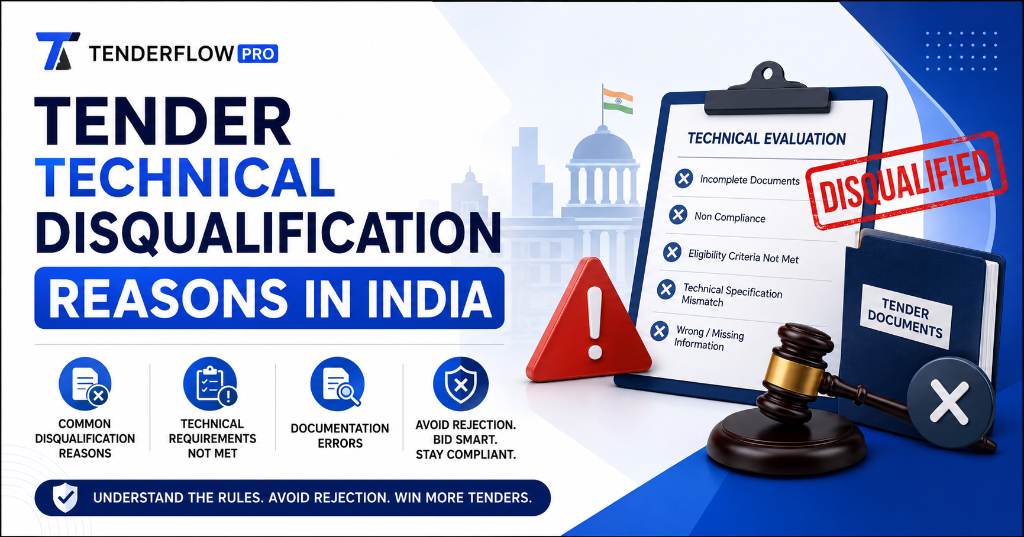
The 68% Reality: Why Most Bids Die Before Evaluation Begins
India's government procurement market is worth ₹20–25 lakh crore annually. In a single week of June 2026, over 64,000 tenders worth ₹1.85 lakh crore were published across central ministries, state portals, and GeM. Yet the brutal truth is this: For the comprehensive end-to-end framework, consult our step-by-step government tender bidding process. To understand foundational rules, refer to our tender rejection complete guide.
68% of tender rejections in FY 2025–26 were not due to weak capabilities or high prices. They were due to document-level non-compliance.
A 2025 Ministry of MSME study confirmed what experienced contractors have known for years: government tender systems are compliance-first, capability-second. Your bid may be technically superior, your price may be competitive, your team may be world-class—but if your Power of Attorney has a date mismatch, if your GST certificate expired last week, or if you uploaded the wrong version of your Udyam certificate, you are disqualified before a single evaluator reads your methodology.
This is not a bug in the system. It is the system.
Government procurement operates under GFR 2017, which mandates strict two-envelope evaluation, mandatory document verification, and zero tolerance for procedural deviations. The evaluators are not looking for reasons to qualify you. They are looking for reasons to disqualify you—because their primary accountability is to the Comptroller and Auditor General (CAG), not to your business growth.
The stakes: A single disqualification costs not just the current tender. It costs:
- Man-hours invested in bid preparation (typically 40–120 hours per tender)
- EMD blocking and working capital freeze
- Opportunity cost of missing the tender cycle
- Reputational damage if disqualification is public
- Potential blacklisting for repeated violations

Get the Rejection Recovery Toolkit
Prevent disqualifications with strict audit checklists + lawyer-grade appeal letters.
- ✓ 150-Point Pre-Submission Checklist (PDF)
- ✓ 50-Point Technical Bid Compliance Audit
- ✓ 30-Point Financial Bid Accuracy Verification
- ✓ 5 Post-Rejection Appeal Letter Formats (GFR 171)
🔒 256-Bit Secure Razorpay Checkout · Lifetime Access · Instant Digital Delivery
GFR 2017 Framework: The Legal Backbone of Technical Evaluation
Understanding disqualification requires understanding the rules that govern it. The General Financial Rules, 2017 (GFR 2017) are the constitutional scripture of Indian public procurement. Three rules are particularly critical for technical bid survival:
Rule 173(iv): Transparency & Disclosure
"Suitable provision should be kept in the bidding document to enable the bidder to question the bidding conditions, bidding process and/or rejection of its bid. The reasons for rejecting a tender or non-issuing a tender document to a prospective bidder must be disclosed where enquiries are made by the bidder."
What This Means for You: You have a legal right to know why your bid was rejected. If a procuring entity disqualifies you without providing documented reasons, they violate GFR 2017. This is the foundation of judicial challenges to unfair disqualification.
Rule 188: Late Bids
"Late bids i.e. bids received after the specified date and time of receipt should not be considered."
What This Means for You: There is no grace period. Government portals lock at the exact deadline. Submit 48 hours early. Always.
Rule 189: Evaluation Committee & Recording Reasons
"Technical bids should be analysed and evaluated by a Consultancy Evaluation Committee (CEC) constituted by the Ministry or Department. The CEC shall record in detail the reasons for acceptance or rejection of the technical proposals analysed and evaluated by it."
What This Means for You: Every disqualification must have documented justification. The evaluation committee cannot simply mark you "not evaluated" or give a cumulative score without breaking down where you lost marks. This rule was central to the E-Trav Tech case (discussed below), where the Delhi High Court directed authorities to provide criterion-wise score breakdowns.
Government buyers have strict statutory timelines to respond to pre-bid and technical rejection representations. If your bid was disqualified for minor or non-material deviations, generate a formal legal protest letter immediately using the AI Protest Letter Generator.
Generate Official Protest Letter →The 15 Fatal Technical Disqualification Reasons (Ranked by Frequency)
| Rank | Disqualification Reason | Frequency | Preventability | Severity |
|---|---|---|---|---|
| 1 | Missing mandatory documents | Very High | 100% Preventable | Fatal |
| 2 | Expired certificates/registrations | Very High | 100% Preventable | Fatal |
| 3 | Power of Attorney date mismatches | High | 100% Preventable | Fatal |
| 4 | Pricing leaked into technical bid | High | 100% Preventable | Fatal |
| 5 | Wrong financial years for turnover | High | 100% Preventable | Fatal |
| 6 | Experience certs not from client | Medium-High | 100% Preventable | Fatal |
| 7 | Technical spec non-compliance | Medium-High | 95% Preventable | Fatal |
| 8 | Missing BIS/FSSAI/ISO certs | Medium | 100% Preventable | Fatal |
| 9 | Late submission | Medium | 100% Preventable | Fatal |
| 10 | Ignoring corrigenda | Medium | 100% Preventable | Fatal |
| 11 | Documents in wrong cover | Medium | 100% Preventable | Fatal |
| 12 | Generic copy-paste methodology | Medium | 90% Preventable | Score Loss |
| 13 | Abnormally low bid scrutiny | Low-Medium | 80% Preventable | Conditional |
| 14 | Missing/wrong EMD | Low-Medium | 100% Preventable | Fatal |
| 15 | Bid validity too short | Low | 100% Preventable | Fatal |
Instant Tender Eligibility & Risk Audit
Upload any 500-page NIT / BOQ PDF. Extract hidden disqualification traps, EMD waiver clauses, and complete eligibility criteria in under 45 seconds.
Reason #1: Missing Mandatory Documents (The #1 Killer)
Impact: Immediate disqualification at document-checking stage Frequency: Accounts for ~35% of all technical bid rejections Preventability: 100%
The Documents Most Commonly Missing
| Document | Why It Gets Missed | Prevention |
|---|---|---|
| Power of Attorney for authorized signatory | Assumed board resolution is sufficient | Create POA template; notarize 7 days before every major bid |
| Audited financial statements (exact years specified) | Submitted most recent 3 years instead of years tender requires | Read TQC carefully; create year-specific document sets |
| Experience certificates from previous clients | Self-certified work completion used instead of client-issued certificate | Maintain client-signed completion certificates for every project |
| Udyam/MSME registration (portal-downloaded PDF) | Scanned copy uploaded instead of official portal download | Download fresh from udyam.gov.in for every bid |
| GST registration certificate | Expired or uploaded without latest amendment | Set calendar reminder 30 days before GST expiry |
| EMD payment proof | Paid but proof not uploaded in correct cover | Create EMD proof checklist; verify upload location |
| Integrity Pact (for high-value tenders) | Not signed by both bidder and witness | Pre-sign Integrity Pact templates |
| Affidavit of non-blacklisting | Not notarized or not on stamp paper | Maintain notarized affidavit valid for 6 months |
Real Case: A Pune-based MSME lost a ₹12 crore Ministry of Road Transport tender because they submitted a scanned Udyam certificate instead of the portal-downloaded PDF. The system flagged it as "unverified" and auto-disqualified the bid. The company had the certificate. They just uploaded the wrong version.
Reason #2: Expired Certificates & Registrations
Impact: Non-compliance on mandatory eligibility criteria Frequency: ~18% of rejections Preventability: 100%
The Certificate Expiry Trap
Government evaluators do not accept "renewal in progress" or "applied for extension." A certificate expired by even one day on the bid submission date renders you non-compliant.
| Certificate | Typical Validity | Renewal Lead Time | Tracking Method |
|---|---|---|---|
| Class 3 DSC | 1–3 years | 30 days before expiry | Calendar + email alerts |
| GST Registration | Until cancelled/amended | N/A (but filing must be current) | Monthly filing check |
| Udyam Registration | Lifetime (but updates needed) | N/A | Annual profile review |
| ISO 9001 | 3 years + surveillance audits | 60 days before expiry | Certification body alerts |
| BIS/ISI License | 1–2 years | 45 days before expiry | BIS portal monitoring |
| FSSAI License | 1–5 years | 30 days before expiry | FSSAI FoSCoS alerts |
| PAN | Lifetime | N/A | N/A |
| Bank Solvency Certificate | 6–12 months | 15 days before expiry | Bank relationship manager |
Pro Tip: Create a Certificate Expiry Dashboard in Excel or your CRM. Color-code: Green (valid >90 days), Yellow (valid 30–90 days), Red (valid <30 days or expired). Review weekly.
Reason #3: Power of Attorney Date Mismatches
Impact: Disqualification for lack of proper authorization Frequency: ~12% of rejections Preventability: 100%
This is the most legally complex and devastating disqualification reason. The Supreme Court's October 2024 judgment in Banshidhar Construction Pvt. Ltd. vs Bharat Coking Coal Limited (discussed in detail below) established the absolute standard:
A person submitting a bid must have valid Power of Attorney at least on the date of signing the bid documents.
The Fatal Sequence from Banshidhar Construction
| Document | Date | Problem |
|---|---|---|
| Board Resolution authorizing Director | 07.11.2023 | Valid |
| Power of Attorney notarized | 14.11.2023 | Valid |
| Bid documents executed/signed | 13.11.2023 | FATAL — executant had no authority on this date |
| Bid uploaded | 29.11.2023 | Within deadline |
| Technical bid rejected | 06.05.2024 | POA not valid on date of signing |
The Supreme Court upheld the disqualification, ruling that the technical bid committee was justified in rejecting the bid because the executant lacked authority on the date of document execution.
Prevention Protocol:
- Never execute bid documents before POA is notarized
- Never notarize POA on the same day as bid execution (buffer for administrative delays)
- Always verify that POA date ≤ bid document signing date
- Always ensure POA specifically authorizes the person to sign bid documents for the specific tender
Reason #4: Including Pricing in the Technical Bid
Impact: Immediate disqualification under two-envelope system Frequency: ~8% of rejections Preventability: 100%
This is the most embarrassing disqualification because it is the most avoidable. Under GFR 2017's two-envelope system:
- Envelope 1 (Technical): Capability, compliance, methodology, experience
- Envelope 2 (Financial): Pricing, BOQ, commercial terms
Any financial data in Envelope 1 = automatic disqualification.
What Counts as "Pricing Information"
| Prohibited in Technical Bid | Allowed in Technical Bid |
|---|---|
| Unit rates, per-item prices | Reference to "competitive pricing" (without numbers) |
| Total tender value | Statement that "financial bid is enclosed separately" |
| Cost breakdowns | Manpower cost (only if tender specifically asks) |
| GST calculations | General cost-saving methodology (without figures) |
| Budget estimates | Risk mitigation approach (without cost data) |
Prevention: Before uploading, run Ctrl+F on your technical bid PDF for: "₹", "Rs.", "rupees", "cost", "price", "rate", "total", "amount", "budget." If any appear, verify they are not pricing data.
Reason #5: Wrong Financial Years for Turnover Proof
Impact: Turnover criterion not met; disqualification Frequency: ~7% of rejections Preventability: 100%
Tender documents specify exact financial years for audited statements. Common trap: tender asks for FY 2022–23, 2023–24, and 2024–25, but bidder submits 2021–22, 2022–23, and 2023–24 because those show higher turnover.
The Rule: Submit exactly the years specified. Not "approximately." Not "the most favorable." Not "the most recent." The years in the tender document are mandatory.
Example from a Live Tender:
"The bidder shall submit audited annual reports for the last three financial years as chosen by the Bidder, comprising of the audited balance sheets and profit and loss accounts."
Critical Interpretation: "As chosen by the Bidder" does not mean you can pick any three years. It means you choose which three consecutive years to present—but they must be the last three from the tender's reference date.
Reason #6: Experience Certificates Not from Actual Client
Impact: Experience criterion rejected; disqualification Frequency: ~6% of rejections Preventability: 100%
Self-certified work completion letters, internal project reports, or photographs without client sign-off do not count as experience proof. Evaluators require certificates issued and signed by the actual client (the government department, PSU, or private entity that awarded the contract).
What Makes an Experience Certificate Valid
| Element | Requirement | Common Failure |
|---|---|---|
| Issuing Authority | Client organization letterhead | Self-certified by contractor |
| Contract Value | Explicitly stated in figures and words | Vague reference to "approximate value" |
| Contract Duration | Start date and completion date | Only completion date mentioned |
| Scope Description | Specific work matching tender requirements | Generic "civil works" without detail |
| Client Signature | Authorized signatory with designation | Unsigned or signed by junior officer |
| Date of Issue | Within reasonable period post-completion | Dated years after completion |
Pro Tip: For every completed project, request the completion certificate within 30 days of handover. Delayed requests often get buried in client bureaucracy or forgotten when key personnel transfer.
Reason #7: Technical Specification Non-Compliance
Impact: Technical score below qualifying threshold (typically 70%) Frequency: ~5% of rejections Preventability: 95%
This is where capability actually matters—but not in the way most bidders think. Technical specification non-compliance is not about being "good enough." It is about exact matching.
Real Case: Smart Street Lighting Tender
| Tender Requirement | Bidder Submission | Result |
|---|---|---|
| LED fixtures: 50,000-hour lifespan | 40,000-hour LEDs submitted | Disqualified — automatic non-compliance |
| IP67 rating | IP65 rating submitted | Disqualified — below minimum spec |
| BIS certification mandatory | Test report from non-NABL lab | Disqualified — wrong certification type |
The bidder's LEDs were reliable, cost-effective, and used successfully in 15 private projects. But they were not what the tender asked for. Government procurement is specification-driven, not outcome-driven.
Prevention: Build a Technical Compliance Matrix (detailed below) that maps every tender specification to your product/service proof. Flag any gap before bid preparation begins.
Reason #8: Missing Sector-Specific Certifications (BIS, FSSAI, ISO)
Impact: Mandatory criterion failure; disqualification Frequency: ~4% of rejections Preventability: 100%
GeM and CPPP have tightened enforcement of quality standards. In 2026, listing products in mandatory-certification categories without valid certificates results in listing removal and potential account suspension.
| Product/Service Category | Mandatory Certification | Issuing Authority |
|---|---|---|
| Electrical goods | BIS/ISI mark | Bureau of Indian Standards |
| Food products | FSSAI license | Food Safety and Standards Authority |
| Safety equipment | BIS or NABL test report | BIS / NABL-accredited labs |
| Construction materials (TMT, cement) | BIS certification | BIS |
| Medical devices | CDSCO / NABL | Central Drugs Standard Control Organization |
| IT products (select categories) | BIS registration | BIS |
| Pesticides | CIBRC registration | Central Insecticides Board |
| Quality management systems | ISO 9001:2015 | Accredited certification bodies |
Critical Rule: Certifications must be valid on the bid submission date. A BIS license expiring in 15 days is treated as expired if the evaluation extends beyond that date.
Reason #9: Late Submission (Even by One Minute)
Impact: Automatic rejection; bid not considered Frequency: ~3% of rejections Preventability: 100%
GFR 2017 Rule 188 is absolute: "Late bids...should not be considered."
Unlike private procurement where a friendly email might grant a 10-minute extension, government portals lock precisely at the deadline. The system timestamp is the only authority.
| Portal | Deadline Behavior | Common Failure |
|---|---|---|
| CPPP (eprocure.gov.in) | Server timestamp; no grace | Portal congestion in final hour |
| GeM (gem.gov.in) | System clock; instant lock | Bid not "frozen" before deadline |
| State Portals | Varies; generally strict | DSC authentication timeout |
Prevention Protocol:
- Submit 48 hours before deadline
- "Freeze" bid on CPPP 24 hours before (you can still unfreeze and edit)
- Test DSC login 3 days before to ensure token validity
- Never rely on mobile hotspots for submission—use stable broadband
Reason #10: Ignoring Corrigenda & Amendments
Impact: Bid prepared on superseded requirements; disqualification Frequency: ~3% of rejections Preventability: 100%
Corrigenda are amendments issued after tender publication. They can change:
- Technical specifications
- Eligibility criteria
- EMD amounts
- Submission deadlines
- BOQ quantities
- Evaluation methodology
Real Case: Processor Speed Change
A CPPP tender for IT hardware originally required Intel i7 processors. A corrigendum issued 10 days before the deadline changed this to Intel i9. Bidders who prepared bids based on the original document submitted i7 specifications and were disqualified for technical non-compliance—despite having i9 inventory available.
Prevention:
- Check for corrigenda daily during the bid preparation period
- Subscribe to portal alerts for your watched categories
- Download and parse every corrigendum immediately
- Update your compliance matrix to reflect changes
Reason #11: Documents in Wrong Cover/Envelope
Impact: Documents appear in wrong evaluation stage; disqualification or premature price exposure Frequency: ~2% of rejections Preventability: 100%
In two-envelope tenders, uploading technical documents in the financial bid section (or vice versa) creates two problems:
- Technical documents in financial section: Price is exposed before technical qualification, violating GFR 2017
- Financial documents in technical section: Immediate disqualification for including pricing in technical bid
Prevention: Create a Document-to-Cover Mapping before uploading:
| Document | Technical Cover (Envelope 1) | Financial Cover (Envelope 2) |
|---|---|---|
| Company registration | ✅ | ❌ |
| Audited financials | ✅ | ❌ |
| Experience certificates | ✅ | ❌ |
| Technical compliance matrix | ✅ | ❌ |
| Project methodology | ✅ | ❌ |
| BOQ with rates | ❌ | ✅ |
| Price schedule | ❌ | ✅ |
| EMD proof | ✅ (usually) | ❌ (sometimes) |
Always verify the specific tender's cover structure. Some tenders require EMD in Cover 1, others in Cover 2.
Reason #12: Generic Copy-Paste Methodologies
Impact: Low technical score; failure to meet 70% qualifying threshold Frequency: ~2% of rejections (but much higher score impact) Preventability: 90%
This is the most common reason for scoring below the qualifying threshold (typically 70%) rather than outright disqualification. Evaluators spot template content instantly.
What Evaluators Penalize
| Generic Content | What Evaluators Want |
|---|---|
| "We have 15 years of experience in civil works" | "We completed 3 road projects totaling ₹18.7 Cr in Jharkhand, including 2-lane NH widening with 12-month defect liability" |
| "Our team includes qualified engineers" | "Project Manager: Mr. R. Sharma, BE (Civil), IIT Roorkee, 14 years, led ₹5.2 Cr bridge project for PWD Bihar" |
| "We use modern equipment" | "Owned equipment: 2x Hyundai R210 excavators (2022), 1x Ajax Fiori concrete pump, total fleet value ₹1.4 Cr" |
| "We follow quality standards" | "ISO 9001:2015 certified since 2019; internal QA protocol with 47 checkpoints per construction stage" |
The Rule: Every methodology section must reference the specific project location, scope, constraints, and tender requirements. A bid for a Rajasthan desert road should address sand stabilization, extreme heat concrete curing, and dust control—not generic "road construction methodology."
Reason #13: Unrealistically Low Bids (Abnormally Low Bid Scrutiny)
Impact: Bid rejected for risking contract failure; potential blacklisting Frequency: ~1–2% of rejections Preventability: 80%
Under GFR 2017, procuring entities may reject bids that are "abnormally low"—priced so low that they create risk of non-performance, quality compromise, or contractor abandonment.
Triggers for Abnormally Low Bid Scrutiny
| Indicator | Threshold | Response Required |
|---|---|---|
| Bid price <70% of estimated cost | High scrutiny | Detailed cost breakdown demanded |
| Bid price <50% of next lowest bid | Extreme scrutiny | Justification with material, labor, overhead proof |
| Bid price <30% of estimated cost | Likely rejection | Exceptional justification with evidence |
| No prior experience in category | Additional scrutiny | Technical capacity demonstration required |
Prevention: Price at sustainable levels. If you must be aggressive to win L1, ensure you can defend every cost component with:
- Material quotations from suppliers
- Labor rate sheets
- Equipment hiring/ownership costs
- Overhead allocation methodology
- Contingency and profit margin justification
Reason #14: Missing EMD or Wrong EMD Format
Impact: Non-responsive bid; disqualification at document-checking stage Frequency: ~1–2% of rejections Preventability: 100%
EMD (Earnest Money Deposit) rules vary by tender:
- Amount: Typically 2–3% of estimated tender value
- Form: Demand Draft, Bank Guarantee, or e-BG via NeSL
- Validity: Must cover the entire bid validity period plus 30 days
- Exemptions: MSMEs and startups may be exempt on qualifying tenders
Common EMD Errors
| Error | Consequence |
|---|---|
| EMD amount ₹2 lakh instead of ₹2.5 lakh | Disqualification for insufficient security |
| Bank guarantee from non-scheduled bank | Disqualification (must be from scheduled commercial bank) |
| EMD validity expires before bid validity | Disqualification |
| EMD uploaded in wrong cover | Disqualification or bid treated as non-responsive |
| Claimed MSME exemption but Udyam not uploaded | Disqualification |
Reason #15: Bid Validity Shorter Than Required
Impact: Bid becomes invalid if evaluation extends beyond validity period Frequency: ~1% of rejections Preventability: 100%
Standard bid validity is 90–180 days from the bid opening date. If your bid validity is 90 days but evaluation takes 120 days, your bid becomes invalid and is not considered for award.
Prevention: Always quote the maximum validity period allowed by the tender. If the tender specifies "90 days minimum, 180 days maximum," quote 180 days. There is no downside to longer validity.
Case Study: Banshidhar Construction vs BCCL — How a Date Mismatch Cost ₹700 Crore
Case: Banshidhar Construction Pvt. Ltd. vs Bharat Coking Coal Limited (BCCL) Court: Supreme Court of India Date: October 4, 2024 Tender Value: ~₹700 crore (coal mine redevelopment, 25-year concession)
The Dispute
Banshidhar Construction submitted a bid for reopening and operating the Amalgamated East Bhuggatdih Simlabahal Coal Mine. Their technical bid was rejected on May 6, 2024, on the ground that it did not comply with Clause 10 of the NIT—specifically, the Power of Attorney for signing the bid.
The Fatal Timeline
| Event | Date | Significance |
|---|---|---|
| Board Resolution authorizing Director Lalti Devi | 07.11.2023 | Valid authorization to execute POA |
| Power of Attorney notarized | 14.11.2023 | Valid POA, but... |
| Bid documents executed/signed | 13.11.2023 | FATAL: Executant had no authority on this date |
| Bid uploaded on CPPP | 29.11.2023 | Within deadline |
| Technical bid opened | 04.12.2023 | Normal process |
| Technical bid rejected | 06.05.2024 | "Did not comply with Clause 10 of NIT" |
The Legal Arguments
Banshidhar's Case (argued by Senior Advocate Ravi Shankar Prasad):
- Bid documents were uploaded on 29.11.2023, within the stipulated time
- All mandatory requirements of Clause 10 were complied with
- The rejection was arbitrary and discriminatory because Respondent No. 8 (the successful bidder) had also failed to submit audited annual reports on time but was allowed to submit them later
BCCL's Defense (argued by Solicitor General Tushar Mehta):
- The Power of Attorney was dated 07.11.2023 but notarized on 14.11.2023
- The mandatory bid documents were executed on 13.11.2023
- At that time, the executant had no authority to execute the bid documents
- A person submitting a bid must have valid Power of Attorney at least on the date of signing
- The scope of judicial review in infrastructure contracts is very limited
The Supreme Court's Ruling
The Supreme Court upheld the disqualification, ruling that:
"A person submitting a bid was required to have a valid Power of Attorney in his favour at least on the date on which he was signing and executing the bid documents."
The Court distinguished this case from Respondent No. 8's situation (where clarifications were sought on audited reports) by noting that BCCL could seek shortfall documents from bidders but could not permit them to replace bid documents. The Power of Attorney issue was fundamental to authorization, not a curable deficiency.
The Lesson
A one-day date mismatch between POA notarization and bid document execution cost a company a ₹700 crore contract. No amount of technical capability, competitive pricing, or legal argument could overcome this procedural fatal flaw.
Case Study: E-Trav Tech vs Union of India — The Right to Know Why You Failed
Case: E-Trav Tech Limited vs Union of India & Ors. Court: Delhi High Court Date: March 10, 2026 Tender: Outsourcing of Consular/Passport/Visa (CPV) services at Indian Embassies
The Dispute
E-Trav Tech and several other bidders were disqualified at the technical bid stage for CPV service tenders at Indian Embassies in London, Riyadh, Kuwait, Abu Dhabi, and Canberra. They were informed that they failed to achieve the minimum qualifying score of 70%—but were given no reasons, no score breakdown, and no criterion-wise evaluation.
The Legal Framework
The petitioners relied on two critical provisions:
Clause B(II) of Chapter XV of the RFPs: "The bidding companies that do not qualify in the technical bid stage shall be informed of the reasons for their disqualification by email."
GFR 2017 Rule 173(iv): "The reasons for rejecting a tender...must be disclosed where enquiries are made by the bidder."
The Court's Analysis
The Delhi High Court emphasized:
"Recording of reasons acts as a safeguard against arbitrariness in actions of the State. It ensures that the decision taken by an authority is not arbitrary or actuated by extraneous reasons."
The Court cited its own earlier judgment in Amit Brothers vs Chief Engineer (2012), where it had directed all government departments to disclose reasons for rejection to avoid unnecessary litigation.
The Outcome
While the Court acknowledged the petitioners' right to reasons, it declined to order immediate disclosure because:
- Financial bids had not yet been opened in most tenders
- Disclosure at this stage could disrupt the tender process
- The petitioners had not alleged mala fide or arbitrariness in the evaluation itself
However, the Court made it clear that post-award, the petitioners would be entitled to full disclosure of criterion-wise marks and evaluation rationale.
The Lesson
You have a legal right to know why your bid was rejected. If a procuring entity gives you only a cumulative score ("you scored 65%, qualifying is 70%") without breaking down where you lost marks, they violate GFR 2017 and contractual RFP terms. This is grounds for judicial review—though courts will balance your commercial interest against public interest in completing the tender process.
The Compliance Matrix: Your Bulletproof Shield Against Disqualification
The compliance matrix is not optional. It is the single most effective tool for preventing disqualification. Here's the enhanced version specifically designed to catch the 15 fatal reasons:
The Anti-Disqualification Compliance Matrix
| S.No. | Tender Clause | Requirement | Your Response | Document Proof | Expiry Check | Status |
|---|---|---|---|---|---|---|
| 1 | Section 3.1 | Company registered for 5+ years | Incorporation: 15.03.2018 | ROC Certificate | N/A | ✅ Compliant |
| 2 | Section 4.2 | Turnover ₹5 Cr avg over 3 years | ₹6.2 Cr, ₹5.8 Cr, ₹7.1 Cr | CA Turnover Cert | N/A | ✅ Compliant |
| 3 | Section 5.1 | 3 similar completed projects | 4 projects completed | Completion Certs | N/A | ✅ Compliant |
| 4 | Section 6.3 | BE (Civil) Project Manager | Mr. R. Sharma, BE Civil, IIT Roorkee | CV + Degree | N/A | ✅ Compliant |
| 5 | Section 7.1 | Valid Power of Attorney | POA dated 10.07.2026, notarized 10.07.2026 | Notarized POA | 10.07.2027 | ✅ Compliant |
| 6 | Section 7.2 | Class 3 DSC valid | DSC valid until 15.12.2026 | DSC Certificate | 15.12.2026 | ⚠️ Renew by Nov |
| 7 | Section 8.1 | GST registration active | GSTIN: 07ABCDE1234F1Z5 | GST Certificate | Lifetime | ✅ Compliant |
| 8 | Section 8.2 | Udyam registration | Udyam: UDYAM-XX-XX-0000000 | Udyam Certificate | Lifetime | ✅ Compliant |
| 9 | Section 9.1 | BIS certification for electrical goods | ISI Mark: CM/L-1234567 | BIS License | 30.09.2026 | ⚠️ Renew by Aug |
| 10 | Section 10.1 | EMD ₹2.5 lakh | DD No. 123456, SBI | EMD Receipt | N/A | ✅ Compliant |
| 11 | Section 11.1 | Bid validity 180 days | 180 days from opening | Declaration | N/A | ✅ Compliant |
| 12 | Section 12.1 | No pricing in technical bid | Verified: zero financial data | Self-check | N/A | ✅ Compliant |
| 13 | Section 13.1 | Corrigenda checked | 2 corrigenda downloaded | Corrigenda PDFs | N/A | ✅ Compliant |
| 14 | Section 14.1 | Documents in correct cover | Mapped to Cover 1/2 | Upload checklist | N/A | ✅ Compliant |
| 15 | Section 15.1 | Methodology customized | Rajasthan-specific desert road plan | Methodology doc | N/A | ✅ Compliant |
TenderFlow Pro: AI-Powered Disqualification Prevention
Manual compliance checking across hundreds of tender documents is humanly impossible for lean MSME teams. TenderFlow Pro eliminates disqualification risk through:
🔍 Document Completeness Scanner Upload your tender PDF and document set. Our AI cross-checks every mandatory requirement against your files, flagging missing, expired, or mismatched documents before submission.
⚠️ Certificate Expiry Monitor Track all your certificates (DSC, GST, Udyam, ISO, BIS, FSSAI) in one dashboard. Get alerts 30, 60, and 90 days before expiry. Never lose a tender to an expired certificate again.
📅 POA Date Validator Our system checks Power of Attorney dates against bid document execution dates, preventing the exact fatal error that cost Banshidhar Construction ₹700 crore.
📝 Corrigenda Alert Engine Real-time monitoring of CPPP, GeM, and 500+ state portals. Instant notifications when a corrigendum is issued for any tender in your watchlist.
🎯 Technical Score Predictor Before submission, our engine analyzes your bid against the tender's published evaluation criteria and predicts your likely technical score. If you're below 75%, you get actionable improvement suggestions.
📊 Compliance Matrix Auto-Generator Upload any tender document. Our AI extracts every requirement, maps it to your document repository, and generates a complete compliance matrix in under 5 minutes.
👉 Start Your Free TenderFlow Pro Trial — Build your first anti-disqualification compliance matrix today.
FAQs: Technical Bid Disqualification Mastery
Q1. What is the most common reason for technical bid disqualification in India? Missing or incomplete mandatory documents. A 2025 Ministry of MSME study found 68% of rejections in FY 2025–26 were due to document-level non-compliance—not pricing or technical weakness.
Q2. Can a technical bid be rejected for including pricing information? Yes. Any price, cost estimate, or financial figure in the technical bid results in immediate disqualification under GFR 2017's two-envelope system. Technical and financial bids must remain completely separate.
Q3. What does GFR 2017 Rule 189 say about technical bid evaluation? Rule 189 mandates that technical bids be evaluated by a Consultancy Evaluation Committee (CEC) which must record detailed reasons for acceptance or rejection. Every disqualification must have documented justification.
Q4. Can a bidder challenge technical bid disqualification in court? Yes, but judicial review is limited. Courts interfere only if disqualification is arbitrary, mala fide, discriminatory, or violates natural justice. The Supreme Court in Banshidhar Construction vs BCCL (2024) confirmed narrow scope of review.
Q5. What happens if my Power of Attorney date doesn't match my bid document dates? This is fatal. In Banshidhar Construction vs BCCL, the Supreme Court upheld disqualification because the POA was notarized on 14.11.2023 but bid documents were signed on 13.11.2023—when the executant had no authority.
Q6. Are late bids ever accepted in Indian government tenders? No. GFR 2017 Rule 188 explicitly rejects late bids. Government portals lock at the exact deadline with zero grace period.
Q7. What is an "abnormally low bid" and can it lead to disqualification? Yes. Under GFR 2017, bids priced so low they risk contract failure may be rejected after scrutiny. The bidder must provide detailed cost justification; failure to do so results in rejection.
Q8. Can missing a corrigendum lead to technical bid disqualification? Yes. Corrigenda can change specifications, eligibility, EMD amounts, or deadlines. Bidders who miss updates may submit non-compliant bids. A real case involved a processor speed change from i7 to i9 that disqualified unaware bidders.
Q9. What documents are most commonly missing in technical bids? Power of Attorney, audited financials for exact years specified, client-issued experience certificates, portal-downloaded Udyam PDF, valid BIS/FSSAI certifications, and EMD proof in correct format.
Q10. How can I prevent technical bid disqualification? Four layers: (1) Document Discipline—master library with expiry tracking, (2) Compliance Matrix—map every requirement before writing, (3) Corrigenda Monitoring—daily checks during bid period, (4) Pre-Submission Audit—second-person review 48 hours before deadline.
Your 30-Day Anti-Disqualification Action Plan
Week 1: Document Audit & Certificate Health
- List every certificate and registration your business holds
- Check expiry dates for: DSC, GST, Udyam, ISO, BIS, FSSAI, bank solvency
- Create calendar alerts 30, 60, and 90 days before each expiry
- Download fresh portal-verified copies of Udyam and GST certificates
- Verify your Class 3 DSC is registered on all portals you use
Week 2: Template & Process Standardization
- Create standardized Power of Attorney template with buffer dates
- Build document-to-cover mapping template for two-envelope tenders
- Develop experience certificate request template for client signatures
- Create "No Pricing in Technical Bid" verification checklist
- Set up corrigenda monitoring for your top 5 tender categories
Week 3: Compliance Matrix Mastery
- Select one live tender and build full compliance matrix
- Practice extracting every requirement from NIT and tender document
- Map each requirement to specific document page numbers
- Identify any gaps in your document repository
- Test the matrix with a colleague as evaluator
Week 4: Live Application & Review
- Submit first bid using the full anti-disqualification protocol
- Submit 48 hours before deadline
- Conduct post-submission review: what worked, what didn't
- Document lessons learned for template refinement
- Set up automated tender alerts for your business categories
Conclusion
Technical bid disqualification is not a mystery. It is not bad luck. It is not corruption (usually). It is systematic non-compliance with documented rules—and it is 100% preventable.
The 15 reasons in this guide are not theoretical. They are extracted from:
- A 2025 Ministry of MSME study showing 68% document-level failure
- Supreme Court judgments upholding disqualifications for date mismatches
- Delhi High Court rulings on the right to reasons for rejection
- Thousands of real bidder experiences on CPPP, GeM, and state portals
The bidders who win consistently are not necessarily the biggest or the cheapest. They are the ones who treat compliance as a engineering discipline, not an afterthought. They build systems, not hope.
Your next step: Implement the 30-day action plan above. And when you're ready to eliminate human error from the equation, TenderFlow Pro automates the compliance intelligence that separates winning bidders from the 68% who never make it past the first gate.
Related Articles:
- How to Write a Technical Bid for Government Tenders
- Financial Bid Preparation Guide for India
- GeM vs CPPP: Which Portal Should You Use?
- GeM Product Listing Approval Guide
- GeM Portal Caution Money Rules & Refund
Meta Tags: