Splitting of Tenders Under GFR Rule 157: The Complete Guide to Detecting, Challenging & Preventing Piecemeal Procurement
Last Updated: July 18, 2026 | Reading Time: 20 minutes | Author: TenderFlow Pro Procurement Intelligence Team For the comprehensive end-to-end framework, consult our complete government tender guide India. (See also: How to Challenge Restrictive Tender Clauses Guide).
Quick Answer: GFR 2017 Rule 157 prohibits dividing a single demand for goods into smaller quantities to make piecemeal purchases, either to avoid obtaining sanction from higher authority or to bypass competitive bidding (open tender, L1 buying, or reverse auction on GeM). CAG detects splitting through four patterns: temporal clustering, supplier concentration, specification similarity, and missing internal documentation. For MSMEs, split tenders are particularly damaging because they fragment large contracts into small lots that large players ignore — but the combined value often exceeds thresholds where MSME price preference and reservation would apply. In 2024, tender splitting remained one of the top 3 procurement irregularities flagged by CAG across Central and State governments.
menu_book Table of Contents
What Is GFR Rule 157? The Exact Text & Meaning
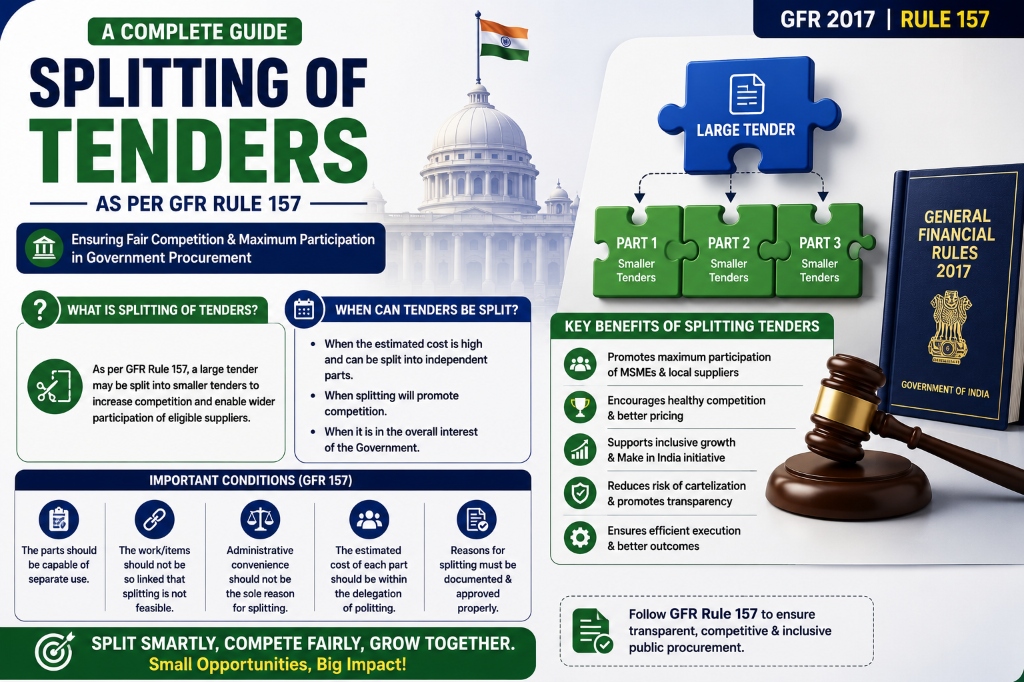
Rule 157 of the General Financial Rules (GFR) 2017 is one of the shortest rules in the procurement chapter — but it carries enormous weight. It is the statutory bulwark against one of the oldest and most persistent procurement frauds: breaking up a large requirement into small pieces to avoid scrutiny. To understand foundational rules, refer to our GFR 2017 tender rules explained.
The Exact Rule Text
"A demand for goods should not be divided into small quantities to make piecemeal purchases to avoid the necessity of obtaining the sanction of higher authority required with reference to the estimated value of the total demand." — GFR 2017, Rule 157
The GeM-Specific Extension
The GeM procurement manual adds a critical extension to Rule 157:
"A demand for goods shall not be divided into small quantities to make piecemeal purchases to avoid procurement through L-1 Buying / bidding / reverse auction on GeM or the necessity of obtaining the sanction of higher authorities required with reference to the estimated value of the total demand." — GeM Procurement Manual, Rule 149(viii)
Key Insight: Rule 157 applies not just to avoiding "higher authority sanction" but also to avoiding competitive procurement methods — open tender, L1 buying, bidding, and reverse auction on GeM.
The Two Prohibitions in Rule 157
| Prohibition | What It Means | Example |
|---|---|---|
| Avoiding Higher Authority Sanction | Splitting so a lower-level officer can approve, instead of a higher competent authority | A ₹60 lakh requirement split into 3 × ₹20 lakh purchases to avoid Director-level approval |
| Avoiding Competitive Procurement | Splitting to stay below thresholds that trigger open tender, L1 buying, or RA | A ₹60 lakh requirement split into 3 × ₹20 lakh LTEs to avoid open tender (₹50 lakh threshold) |
Why Rule 157 Exists
The rule exists because piecemeal purchases:
- Destroy competition — small purchases attract fewer bidders and less price discovery.
- Increase costs — aggregated piecemeal purchases often cost 15–30% more than a single competitive tender.
- Enable favoritism — small, repetitive purchases to the same supplier create entrenched monopolies.
- Erode accountability — fragmented records make audit trails harder to follow.
- Undermine MSME policy — large contracts that should be reserved for MSEs get fragmented into small direct purchases that bypass reservation rules.

Get the GFR Compliance Toolkit
Know every GFR rule, protect deposits, and challenge restrictive clauses with confidence.
- ✓ 150-Point Pre-Submission Checklist (PDF)
- ✓ EMD & BG Format Verification Guide + Checker
- ✓ 5 Post-Rejection Appeal Letters (GFR 171)
- ✓ Corrigendum Monitoring & Response Checklist
🔒 256-Bit Secure Razorpay Checkout · Lifetime Access · Instant Digital Delivery
Tender Splitting vs. Legitimate Packaging: The Critical Difference
Not all division of procurement is illegal. GFR 2017 explicitly allows "packaging" when justified. The difference between splitting (illegal) and packaging (legitimate) is one of the most contested areas in procurement audits.
What Is Legitimate Packaging?
The Manual for Procurement of Goods 2024 (MPG 2024) states:
*"The procuring authority shall normally neither package nor divide its procurement or take any other action so as to limit competition among bidders or to avoid the necessity of obtaining the sanction of higher authority required with reference to the estimated value of the total demand. Provided that in the interest of efficiency, economy, timely completion or supply, wider competition or access to MSEs, a procuring authority may, for reasons to be recorded in writing, divide its procurement into appropriate packages, or club requirements of other users for procurement."*
The 5 Tests for Legitimate Packaging
| Test | Legitimate Packaging | Illegal Splitting |
|---|---|---|
| 1. Recorded Justification | Written reasons recorded before procurement initiation | No documented rationale; post-hoc justification after audit |
| 2. Independent Needs | Each package represents a genuinely independent operational need | All parts are components of one unified requirement |
| 3. Different Locations | Packages are for different sites/offices with independent delivery timelines | Same location; simultaneous delivery |
| 4. Different Timelines | Each package has a distinct, non-overlapping delivery schedule | All packages needed at the same time |
| 5. Technical Separation | Each package is technically self-contained and independently usable | Packages are interdependent components of a single system |
Examples: Packaging vs. Splitting
| Scenario | Packaging (✅ Legal) | Splitting (❌ Illegal) |
|---|---|---|
| Office Furniture | 5 different regional offices each need 20 chairs independently | One office needs 100 chairs; split into 5 × 20 to avoid open tender |
| IT Equipment | Laptops for Delhi office now; printers for Mumbai office next quarter | 50 laptops + 50 printers for same office split into 2 purchases to stay below threshold |
| Construction | Phase 1 (foundation) and Phase 2 (superstructure) with 6-month gap | Foundation + superstructure + finishing split into 3 simultaneous contracts to avoid open tender |
| Annual Maintenance | AMC for Building A (Jan-Dec) and Building B (Jul-Jun) with different cycles | AMC for 10 buildings split into 10 separate orders placed simultaneously |
The Golden Rule: If the split reduces competition or avoids a higher approval threshold, it is illegal. If the split increases competition or improves operational efficiency, it may be legitimate.
The 4 CAG Audit Patterns That Detect Splitting
The Comptroller and Auditor General of India (CAG) and the Central Vigilance Commission (CVC) have developed sophisticated methods to detect tender splitting. Understanding these patterns helps both buyers avoid violations and bidders identify non-compliant tenders to challenge.
Pattern 1: Temporal Clustering
What CAG looks for: Multiple purchase orders or limited tender awards for related goods/services issued within a short period, each staying just below the open tender threshold.
Red Flags:
- 3+ purchase orders for the same/similar items within 30 days.
- All orders placed at month-end or quarter-end (budget exhaustion timing).
- All orders just below a threshold (e.g., ₹49.5 lakh when open tender threshold is ₹50 lakh).
Example:
| PO Number | Date | Item | Value | Supplier |
|---|---|---|---|---|
| PO-001 | 15.03.2026 | 50 HP Motors | ₹48,00,000 | M/s. Bharat Electricals |
| PO-002 | 22.03.2026 | 50 HP Motors | ₹48,00,000 | M/s. Bharat Electricals |
| PO-003 | 28.03.2026 | 50 HP Motors | ₹48,00,000 | M/s. Bharat Electricals |
Total: ₹1.44 crore for the same item to the same supplier in 13 days — but each PO is below the ₹50 lakh open tender threshold.
Pattern 2: Supplier Concentration
What CAG looks for: The same supplier repeatedly wins the fragmented pieces, especially when the combined value would have triggered open competition.
Red Flags:
- Same supplier wins 3+ consecutive "small" tenders for the same item category.
- No other supplier ever wins in that category.
- The supplier's combined annual awards from one department exceed the open tender threshold many times over.
Pattern 3: Specification Similarity
What CAG looks for: Split procurements include specifications that are clearly building blocks of a coherent larger requirement.
Red Flags:
- PO-1: 100 laptops; PO-2: 100 docking stations; PO-3: 100 monitors — all for the same office.
- PO-1: Civil works for Block A; PO-2: Civil works for Block B — but Blocks A and B are part of the same building.
- Specifications reference each other across POs (e.g., "compatible with items supplied under PO-001").
Pattern 4: Missing Internal Documentation
What CAG looks for: Internal files that discuss a "big requirement" that later got divided, with no documented rationale for why the split made operational sense.
Red Flags:
- Indent note mentions "total requirement of 500 units" but approval is sought for "100 units."
- File notings reference a "consolidated estimate" but procurement is done in fragments.
- No procurement plan or annual aggregation exercise exists.
The CAG Audit Trail
When CAG identifies splitting, the typical audit finding reads:
"The department split a requirement of ₹X crore into several smaller procurements of ₹Y lakh each to avoid open competitive tendering, resulting in loss of competition and potential excess expenditure. The department did not record any justification for the split. This is a violation of GFR 2017 Rule 157."
Consequences:
- Recovery of excess expenditure from the approving officer.
- Disciplinary action under CCS (CCA) Rules.
- Referral to CVC for vigilance investigation.
- Public exposure in CAG Report tabled in Parliament.
Instant Tender Eligibility & Risk Audit
Upload any 500-page NIT / BOQ PDF. Extract hidden disqualification traps, EMD waiver clauses, and complete eligibility criteria in under 45 seconds.
How Splitting Hurts MSMEs: The Hidden Cost
Tender splitting is not just a procedural violation — it is a direct attack on MSME competitiveness in government procurement.
The 5 Ways Splitting Harms MSMEs
| Harm | Explanation | Financial Impact |
|---|---|---|
| 1. Bypasses 25% Reservation | Large contracts reserved for MSEs get split into small direct purchases that don't count toward the 25% target | MSEs lose access to high-value contracts |
| 2. Eliminates Price Preference | L1+15% price band and 25% quantity reservation apply only to competitive tenders above certain thresholds | MSEs lose statutory price protection |
| 3. Favors Large Suppliers | Small, repetitive purchases to the same supplier create a "captive market" that new MSEs cannot penetrate | MSEs are locked out of recurring revenue |
| 4. Increases Transaction Costs | Bidding on 10 small tenders costs more than bidding on 1 large tender (documentation, EMD, site visits) | MSEs spend disproportionately on compliance |
| 5. Fragments Delivery Schedules | Split deliveries create coordination nightmares for small manufacturers with limited logistics capacity | MSEs struggle to meet fragmented timelines |
The Data Gap
While CAG does not publish consolidated statistics on splitting specifically, procurement data reveals the scale:
- GeM processed 72+ lakh orders in FY 2024–25, but a significant portion were small direct purchases (below ₹50,000) and L1 purchases (₹50,000–₹10 lakh).
- The average order value on GeM is approximately ₹75,000 — suggesting massive fragmentation.
- 44.72% of order value goes to MSEs, but this is concentrated in small-value transactions. Large-value MSE participation remains limited.
The MSME Opportunity: If you identify a department that consistently splits large requirements, file a grievance. The combined contract value may trigger the 25% MSE reservation — and you may be entitled to a portion of it.
GeM & Rule 157: Why Splitting Is Impossible on the Platform
GeM has built-in safeguards that make tender splitting significantly harder than in offline procurement. However, buyers have found workarounds.
GeM Safeguards Against Splitting
Buyer Purchase History Tracking: GeM maintains a complete audit trail of every buyer's purchases. The system flags buyers who place multiple small orders for the same item category within a short period.
Annual Procurement Plan (APP): Rule 149(vi) mandates that ministries publish their Annual Procurement Plan on GeM within 30 days of budget approval. This plan aggregates requirements and makes splitting visible.
Business Analytics (BA) Tools: GeM provides buyers with analytics on last purchase price, market trends, and supplier concentration. Auditors use these tools to identify abnormal purchasing patterns.
CPPP Integration: All GeM tenders above ₹50,000 are published on CPPP (eprocure.gov.in), creating a public record that CAG can cross-reference.
How Buyers Still Try to Split on GeM
| Workaround | How It Works | Why It Fails |
|---|---|---|
| Multiple Direct Purchases | Splitting into 10 × ₹49,999 direct purchases | GeM flags buyers exceeding ₹30 lakh annual small purchase limit per HoD |
| Different Product Categories | Listing the same item under different GeM categories | Golden Parameters and AI matching detect identical specifications |
| Different Consignees | Creating separate orders for the same office with different delivery addresses | Consignee master data reveals the same ultimate beneficiary |
| Staggered Timing | Placing orders 31 days apart to avoid temporal clustering | Annual aggregation still reveals the pattern |
The CGDA Report on GeM
The Controller General of Defence Accounts (CGDA) Committee Report on GeM explicitly noted:
"A demand for goods shall not be divided into small quantities to make piecemeal purchases to avoid procurement through L-1 Buying/bidding/reverse auction on GeM or the necessity of obtaining the sanction of higher authorities."
This underscores that GeM is not exempt from Rule 157 — the rule applies with equal force to digital procurement.
The 7 Most Common Splitting Scenarios in Government Procurement
Scenario 1: The "Just Below Threshold" Split
The Tactic: A ₹60 lakh requirement is split into 2 × ₹30 lakh LTEs to avoid the ₹50 lakh open tender threshold.
Why It's Illegal: The total demand is ₹60 lakh. Open tender is mandatory. Splitting into LTEs violates Rule 157 and Rule 162.
Detection: Temporal clustering + specification similarity.
Scenario 2: The "Annual AMC Fragmentation"
The Tactic: A ₹25 lakh annual maintenance contract for 50 computers is split into 10 × ₹2.5 lakh quarterly AMCs.
Why It's Illegal: The annual requirement is ₹25 lakh. The correct method is a single annual tender or rate contract.
Detection: Same supplier, same items, recurring quarterly pattern.
Scenario 3: The "Multi-Location Mirage"
The Tactic: A department with 5 offices splits a ₹1 crore furniture requirement into 5 × ₹20 lakh orders, claiming each office has independent needs.
Why It's Illegal: Unless each office independently identified its need and has distinct delivery timelines, this is splitting masquerading as decentralization.
Detection: All orders placed simultaneously; identical specifications; no independent indent notes.
Scenario 4: The "Phase-wise Construction Dodge"
The Tactic: A building construction project worth ₹5 crore is split into "civil works," "electrical works," and "plumbing works" — each just below the open tender threshold.
Why It's Illegal: These are interdependent components of a single project. The correct method is a composite contract or EPC tender.
Detection: Specifications reference each other; same site; same completion date.
Scenario 5: The "Emergency Excuse"
The Tactic: A department claims 5 separate "emergencies" in 2 months, each requiring urgent procurement just below the competitive threshold.
Why It's Illegal: Self-created emergencies (poor planning) do not justify Rule 166(ii) emergency procurement. CAG consistently rejects this defense.
Detection: Pattern of recurring "emergencies"; no contingency planning; same items each time.
Scenario 6: The "Rate Contract Ruse"
The Tactic: A department issues 20 small purchase orders against a rate contract throughout the year, each below the threshold — but the aggregate exceeds the threshold for fresh tendering.
Why It's Illegal: Rate contracts are for "standing offers" without committed quantities. If the aggregate demand is known at the outset, a fresh tender should be floated.
Detection: Total annual value against rate contract exceeds open tender threshold; no fresh tender floated.
Scenario 7: The "GeM Category Shuffle"
The Tactic: A buyer lists 100 laptops under "Computers," 100 under "IT Equipment," and 100 under "Office Automation" to create 3 separate small purchases.
Why It's Illegal: Same item, same need, same delivery — just different category codes. GeM's AI and Golden Parameters detect this.
Detection: Identical specifications across categories; same consignee; same delivery date.
Thresholds Post-July 2024: Where Splitting Becomes Tempting
The July 2024 amendment to GFR 2017 changed procurement thresholds, creating new temptation zones for splitting.
Updated Thresholds (Post-July 2024)
| Procurement Method | Threshold | Splitting Temptation |
|---|---|---|
| Direct Purchase (GeM) | Up to ₹50,000 | Split ₹5 lakh into 10 × ₹49,999 |
| L1 Purchase (GeM) | ₹50,000 – ₹10 lakh | Split ₹30 lakh into 3 × ₹9.9 lakh |
| Bidding/RA (GeM) | Above ₹10 lakh | Split ₹60 lakh into 2 × ₹29 lakh |
| LTE (Offline) | Up to ₹50 lakh | Split ₹70 lakh into 2 × ₹34 lakh |
| Open Tender (Offline) | ₹50 lakh & above | Split ₹1 crore into 3 × ₹33 lakh |
The "Danger Zone" for MSMEs
| Combined Requirement | Split Into | Method Used | MSME Impact |
|---|---|---|---|
| ₹15 lakh | 15 × ₹99,999 | Direct Purchase | No 25% reservation; no price preference |
| ₹30 lakh | 3 × ₹9.9 lakh | L1 Purchase | No competitive bidding; limited price discovery |
| ₹70 lakh | 2 × ₹34 lakh | LTE | No open tender; no MSME reservation triggered |
| ₹1.5 crore | 3 × ₹49 lakh | LTE | No open tender; no GeM-CPPP publication |
Key Insight: The most dangerous splitting occurs in the ₹10 lakh–₹1 crore range, where buyers fragment requirements to avoid open tendering or GeM bidding — precisely the range where MSMEs have the strongest competitive advantage.
Legal Consequences for Buyers: CAG, CVC & Disciplinary Action
For the Approving Officer
| Violation | Consequence |
|---|---|
| Rule 157 violation (minor) | CAG observation; written explanation sought |
| Rule 157 violation (significant) | Recovery of excess expenditure from the officer |
| Rule 157 violation + favoritism | Disciplinary action under CCS (CCA) Rules; suspension |
| Rule 157 violation + corruption | CVC inquiry; criminal prosecution under Prevention of Corruption Act |
For the Department
- CAG Audit Paragraph: Public exposure in CAG Report tabled in Parliament/State Legislature.
- PAC Scrutiny: Public Accounts Committee summons officers for explanation.
- Financial Penalty: Recovery of excess payment from the supplier (if proven).
- Re-tendering: Cancellation of split contracts and fresh tendering at higher cost.
- Reputational Damage: Department flagged as "high-risk" in future audits.
For the Supplier
- Contract Cancellation: If the split tender is quashed, all associated contracts may be cancelled.
- Blacklisting: If the supplier colluded in the splitting, they may be debarred under GFR 151/175.
- Recovery: Payments already made may be recovered.
- Future Exclusion: Supplier may be excluded from future tenders of the department.
How Bidders Can Detect a Split Tender Before Bidding
Smart bidders don't just bid — they investigate. Here's how to detect splitting before you waste time and money on a compromised tender.
The Splitting Detection Matrix
| Indicator | What to Check | How to Verify | Risk Level |
|---|---|---|---|
| Temporal Clustering | Has the same buyer issued similar tenders in the last 30–60 days? | Search CPPP/GeM by buyer name + date range | 🔴 High |
| Threshold Proximity | Is the tender value just below a major threshold (₹50 lakh, ₹10 lakh, ₹50,000)? | Compare tender value against GFR thresholds | 🔴 High |
| Specification Similarity | Do specifications reference other tenders or form part of a larger system? | Read technical specs carefully; look for cross-references | 🟡 Medium |
| Supplier Concentration | Does the same supplier always win this buyer's tenders in this category? | Check CPPP award history | 🟡 Medium |
| Missing Aggregation | Is there no annual procurement plan or consolidated estimate? | Check buyer's website for APP; file RTI if needed | 🟡 Medium |
| Emergency Claims | Is this the 3rd+ "emergency" tender from this buyer in 6 months? | Track buyer's emergency tenders | 🔴 High |
| Identical Items | Are the items identical to those in another active tender from the same buyer? | Cross-reference active tenders | 🔴 High |
Tools for Detection
- CPPP Search: Use eprocure.gov.in to search by buyer name + date range.
- GeM Buyer Analytics: Check the buyer's past purchase history on GeM.
- TenderFlow Pro Intelligence: Our platform flags suspicious splitting patterns automatically.
- RTI Application: File RTI to obtain the buyer's Annual Procurement Plan and internal indent notes.
When to Walk Away
If your pre-bid investigation reveals 3 or more red flags from the detection matrix, consider:
- Filing a pre-bid grievance instead of bidding.
- Requesting clarification from the buyer before bid submission.
- Challenging the tender if the violation is clear and material.
How to Challenge a Split Tender: Grievance & Legal Remedies
If you detect splitting, you have multiple avenues to challenge the tender — before or after award.
Pre-Bid Challenge (Before Submission Deadline)
Step 1: File Pre-Bid Grievance on GeM/CPPP
- Log into GeM or CPPP grievance module.
- Submit detailed complaint with evidence (other tender IDs, dates, values, specifications).
- Request that the buyer consolidate the requirement and re-tender as a single open tender.
Step 2: File RTI
- Ask for: Annual Procurement Plan, internal indent notes, consolidated requirement estimate.
- Use RTI response as evidence in your grievance.
Step 3: Approach the Buyer Directly
- Write to the Head of Department with evidence.
- Request pre-bid meeting clarification.
- Copy the CVO (Chief Vigilance Officer) of the department.
Step 4: CVC Complaint
- If the buyer ignores your grievance, file a complaint with the Central Vigilance Commission.
- CVC can direct the department to investigate and respond.
Post-Award Challenge (After Contract Award)
Step 1: GeM/CPPP Post-Award Grievance
- Challenge the award on grounds of Rule 157 violation.
- Request cancellation of the split contracts and fresh open tendering.
Step 2: Writ Petition (High Court)
- Under Article 226 of the Constitution.
- Grounds: Violation of GFR 157, lack of transparency, denial of equal opportunity.
- Relief: Quashing of split contracts; mandamus for fresh tendering.
Step 3: CAG Reference
- If the contract is already awarded, bring it to CAG's attention through the audit process.
- CAG audits are ongoing and can flag the issue in the next audit cycle.
What Evidence You Need
| Evidence Type | How to Obtain | Strength |
|---|---|---|
| Other tender IDs | CPPP/GeM search | Strong |
| Award details | CPPP award publication | Strong |
| Internal indent notes | RTI | Very Strong |
| Annual Procurement Plan | Buyer website / RTI | Strong |
| Supplier concentration data | CPPP history analysis | Medium |
| Specification cross-references | Tender document reading | Medium |
Buyer Compliance Self-Audit: 15-Point Checklist
For procurement officers, this checklist prevents Rule 157 violations before they happen.
Before Initiating Procurement
- 1. Consolidate Requirements: Have I aggregated all similar requirements for the financial year?
- 2. Check Annual Plan: Does the Annual Procurement Plan reflect the total requirement?
- 3. Determine Total Value: What is the estimated value of the TOTAL demand (not just this piece)?
- 4. Identify Threshold: Which procurement method applies to the TOTAL value?
- 5. Record Justification: If splitting, have I recorded written reasons for efficiency/economy/MSE access?
During Procurement Planning
- 6. Independent Needs Test: Does each package represent a genuinely independent operational need?
- 7. Location Test: Are packages for different locations with independent delivery timelines?
- 8. Technical Separation Test: Is each package technically self-contained?
- 9. Timeline Test: Do packages have distinct, non-overlapping delivery schedules?
- 10. Competition Test: Does the split INCREASE competition (not reduce it)?
Post-Procurement Verification
- 11. Audit Trail: Can I justify every split purchase to an auditor with documented reasons?
- 12. Aggregation Check: If all split purchases were combined, would they exceed the threshold?
- 13. Supplier Diversity: Did the split result in awards to multiple suppliers, or just one?
- 14. Cost Comparison: Is the total cost of split purchases competitive vs. a single tender?
- 15. CAG Defense: Can I defend this procurement before the Public Accounts Committee?
If you answer "No" to any of questions 1–10, STOP. Do not split. Consolidate and use the correct procurement method.
State-Level Variations: West Bengal, Karnataka & Other States
While GFR 2017 applies to Central Government, states have their own rules that often mirror or strengthen the splitting prohibition.
West Bengal
The West Bengal Finance Department issued Memo No. 284-F(Y) dated 16.01.2020, reinforcing:
"Under no circumstances splitting of works, Projects/ Schemes/ procurements, be done for avoiding the provisions of e-tender and/or for avoiding the Financial powers of the sanctioning authority as per delegation of financial power."
Key Provision: In all split procurements, no payment should be released before Finance Department examination.
Karnataka
The Karnataka Transparency in Public Procurements Act, 1999 defines "procurement entity" broadly and prohibits fragmentation to avoid competitive bidding.
Other States
| State | Key Provision |
|---|---|
| Maharashtra | Maharashtra Public Procurement Act prohibits splitting to avoid e-tendering |
| Tamil Nadu | TNT Act mandates consolidation of annual requirements |
| Gujarat | Gujarat Transparency in Public Procurement Act covers splitting |
| Punjab | Punjab Infrastructure Development Act addresses concession splitting |
Important: State PSUs and local bodies receiving Central funding must comply with both state rules and GFR 2017.
Case Study: How a ₹3.2 Cr Requirement Was Split Into 8 Direct Purchases
Department: A Central Ministry (name withheld) Item: Supply and installation of CCTV surveillance systems across 8 regional offices Total Requirement: 320 cameras + NVRs + monitors + cabling Actual Requirement Value: ₹3.2 crore (₹10 lakh per office)
What Happened
Instead of floating a single open tender for ₹3.2 crore, the ministry's regional offices placed 8 separate direct purchase orders on GeM, each valued at ₹39.99 lakh — just below the ₹40 lakh threshold that would have required bidding/RA on GeM.
| Office | Cameras | NVRs | Monitors | Cabling | Total Value | Method |
|---|---|---|---|---|---|---|
| Delhi | 40 | 5 | 10 | 1 lot | ₹39.99L | Direct Purchase |
| Mumbai | 40 | 5 | 10 | 1 lot | ₹39.99L | Direct Purchase |
| Chennai | 40 | 5 | 10 | 1 lot | ₹39.99L | Direct Purchase |
| Kolkata | 40 | 5 | 10 | 1 lot | ₹39.99L | Direct Purchase |
| Hyderabad | 40 | 5 | 10 | 1 lot | ₹39.99L | Direct Purchase |
| Bangalore | 40 | 5 | 10 | 1 lot | ₹39.99L | Direct Purchase |
| Ahmedabad | 40 | 5 | 10 | 1 lot | ₹39.99L | Direct Purchase |
| Pune | 40 | 5 | 10 | 1 lot | ₹39.99L | Direct Purchase |
| TOTAL | 320 | 40 | 80 | 8 lots | ₹3.19 Cr | Should be Open Tender |
The Red Flags
- Temporal Clustering: All 8 orders placed within 15 days.
- Specification Similarity: Identical specifications across all offices.
- Supplier Concentration: Same supplier (M/s. SecureVision Pvt. Ltd.) won all 8 orders.
- Threshold Proximity: Every order was ₹39.99 lakh — just below the ₹40 lakh threshold.
- No Justification: No recorded reason for splitting; no Annual Procurement Plan reference.
The Challenge
An MSME bidder (M/s. Bharat Surveillance Solutions, Udyam-registered) who had been tracking CCTV tenders noticed the pattern. They:
- Filed a GeM grievance citing Rule 157 violation.
- Submitted an RTI for the ministry's Annual Procurement Plan and internal indent notes.
- Wrote to the CVO of the ministry with evidence.
- Approached CVC when the ministry failed to respond.
The Outcome
- CVC directed the ministry to investigate and respond within 30 days.
- Ministry admitted that the requirement was a single consolidated demand of ₹3.2 crore.
- All 8 orders were cancelled (supplier had already delivered 3 offices; goods were returned).
- Fresh open tender floated for ₹3.2 crore on CPPP + GeM.
- M/s. Bharat Surveillance Solutions bid and won the contract at ₹2.85 crore — 11% below the split purchase price.
- Approving officer faced disciplinary inquiry under CCS (CCA) Rules.
Key Takeaways
- Splitting costs the government more. The split purchases totaled ₹3.19 crore. The open tender resulted in ₹2.85 crore — a ₹34 lakh saving (10.7%).
- MSMEs can challenge splitting. Bharat Surveillance was a small MSME that used grievance mechanisms to level the playing field.
- Evidence is everything. The RTI response (APP + indent notes) was the smoking gun that proved the violation.
- CVC intervention works. When departments ignore grievances, CVC escalation forces action.
Frequently Asked Questions (FAQ)
Q1. What exactly does GFR Rule 157 prohibit?
A: Rule 157 prohibits dividing a single demand for goods into smaller quantities to make piecemeal purchases for two purposes: (a) to avoid obtaining sanction from a higher authority that would be required for the total demand value, and (b) to avoid competitive procurement methods (open tender, L1 buying, bidding, or reverse auction on GeM).
Q2. Is all division of procurement illegal under Rule 157?
A: No. GFR 2017 and MPG 2024 explicitly allow legitimate packaging when justified by efficiency, economy, timely completion, wider competition, or MSE access — provided the reasons are recorded in writing before procurement initiation. The key test is whether the division reduces competition or avoids higher authority.
Q3. How does CAG detect tender splitting?
A: CAG uses four primary patterns: (1) Temporal Clustering — multiple similar orders within a short period; (2) Supplier Concentration — the same supplier repeatedly wins fragmented pieces; (3) Specification Similarity — split items are building blocks of a larger system; (4) Missing Documentation — no recorded justification for the split in internal files.
Q4. Can a buyer split a tender to help MSMEs participate?
A: Only if the split genuinely improves MSE access. For example, dividing a large construction project into smaller civil works packages that MSE contractors can realistically execute may be justified. However, splitting a goods procurement into tiny direct purchases to "help" MSEs is not legitimate — it bypasses the 25% reservation framework and competitive price discovery.
Q5. What should I do if I suspect a tender has been split?
A: (1) Search CPPP/GeM for other tenders from the same buyer in the same category; (2) File a pre-bid grievance on GeM/CPPP with evidence; (3) File RTI for the Annual Procurement Plan and internal indent notes; (4) If ignored, escalate to CVC or file a writ petition under Article 226.
Q6. Does Rule 157 apply to GeM purchases?
A: Yes. The GeM procurement manual explicitly extends Rule 157 to GeM, prohibiting piecemeal purchases to avoid L1 buying, bidding, or reverse auction on the platform. GeM's analytics and audit trails make splitting easier to detect than in offline procurement.
Q7. What are the consequences for a buyer who splits tenders?
A: Consequences range from CAG audit observations and recovery of excess expenditure to disciplinary action under CCS (CCA) Rules, CVC vigilance inquiries, and in severe cases, criminal prosecution under the Prevention of Corruption Act. The approving officer is personally liable.
Q8. Can a supplier be punished for participating in a split tender?
A: If the supplier colluded in the splitting (e.g., suggested the split to the buyer, provided false invoices for smaller lots), they can be debarred under GFR 151/175 and blacklisted. However, if the supplier was an innocent participant, they typically face contract cancellation without personal penalty — though they may lose payments already made.
Q9. What is the "Annual Procurement Plan" and how does it prevent splitting?
A: Under GFR Rule 173 and GeM Rule 149(vi), every ministry must publish an Annual Procurement Plan (APP) within 30 days of budget approval. The APP consolidates all requirements for the year, making it impossible to hide fragmented demands. Auditors cross-reference actual purchases against the APP to detect splitting.
Q10. Are there any software tools to detect tender splitting automatically?
A: Yes. TenderFlow Pro's AI-powered platform automatically flags suspicious patterns: temporal clustering, threshold proximity, supplier concentration, and specification similarity across multiple tenders from the same buyer. Government auditors also use CPPP analytics and GeM Business Intelligence tools.
Conclusion & Action Plan
Tender splitting is the silent killer of competitive government procurement. It doesn't make headlines like bribery or bid-rigging, but it costs the exchequer thousands of crores annually by eliminating the price-discovery mechanism that competitive tendering provides. For MSMEs, it is an invisible wall that keeps them out of contracts they are legally entitled to win.
Rule 157 is not a mere formality — it is a structural safeguard that ensures public money is spent through transparent, competitive processes. The CAG's four detection patterns (temporal clustering, supplier concentration, specification similarity, and missing documentation) have made splitting increasingly risky for buyers. And with GeM's AI-powered analytics, the era of "creative fragmentation" is coming to an end.
For bidders, the message is clear: don't just bid — investigate. The 15 minutes you spend checking a buyer's past tenders could save you weeks of wasted bid preparation and reveal a challengeable violation that opens the door to a contract you otherwise couldn't win.
For buyers, the compliance self-audit is non-negotiable. In an era of CAG special audits, CVC real-time monitoring, and GeM AI flagging, the only safe procurement is consolidated, transparent, and documented procurement.
Your 14-Day Action Plan
| Day | Action |
|---|---|
| Day 1 | Audit your last 12 months of tenders. Identify any that were part of a potential split pattern. |
| Day 2 | Search CPPP for 3 target buyers. Check their last 6 months of tenders for clustering patterns. |
| Day 3 | Download and review the Annual Procurement Plan of your top 2 target buyers. |
| Day 4 | Create a "Splitting Alert" system on TenderFlow Pro for your product categories. |
| Day 5 | Draft a template pre-bid grievance letter for Rule 157 challenges. |
| Day 6 | File RTI for a buyer's APP and indent notes (practice run). |
| Day 7 | Review your own procurement (if you're a buyer). Complete the 15-point compliance checklist. |
| Day 8–14 | Monitor 5 active tenders. Apply the Splitting Detection Matrix to each. Challenge if 3+ red flags appear. |
Related Articles
- GeM Portal Reverse Auction Strategy: Complete Winning Guide
- Make in India Preference Policy: Complete DPIIT PPP-MII Guide
- Limited Tender Enquiry (LTE): Rules, Eligibility & Supplier Registration
- Proprietary Article Certificate (PAC): GFR 166 Complete Guide
- Debarment & Blacklisting in Government Tenders: GFR 2017 Rules
- NSIC Single Point Registration: Complete Benefits Guide
Disclaimer: This article is for informational purposes only and does not constitute legal advice. Procurement rules are subject to amendment. Always verify current GFR 2017 provisions and departmental guidelines before initiating or challenging procurement. TenderFlow Pro is not affiliated with CAG, CVC, or any government department.
© 2026 TenderFlow Pro. All rights reserved.