NSIC Single Point Registration (SPRS): The Complete Benefits Guide for MSME Government Tenders (2026)
Last Updated: July 18, 2026 | Reading Time: 18 minutes | Author: TenderFlow Pro Procurement Intelligence Team For the comprehensive end-to-end framework, consult our government tender guide for MSMEs. (See also: Udyam Re-Registration & Mandatory Update Guide).
Quick Answer: The NSIC Single Point Registration Scheme (SPRS) is a government procurement gateway for Micro & Small Enterprises (MSEs) that provides EMD exemption, free tender document access, L1+15% price preference, and eligibility for 25% Central Government procurement reservation. With over 1.5 lakh MSEs registered and 358 items reserved for exclusive purchase from the small-scale sector, SPRS is the most underutilized competitive advantage for MSMEs in Indian government tenders. Registration requires Udyam Registration, takes 30–45 days, costs ₹3,000–₹1,00,000 (capped), and is valid for 2 years.
menu_book Table of Contents
What Is NSIC Single Point Registration (SPRS)?
The Single Point Registration Scheme (SPRS) is a flagship procurement facilitation program operated by the National Small Industries Corporation (NSIC) — a Mini Ratna PSU under the Ministry of Micro, Small and Medium Enterprises (MSME), Government of India. Established in 1955 and launched in its current form in 1976, SPRS registers Micro and Small Enterprises (MSEs) for participation in Government Purchases across all Central Ministries, Departments, PSUs, and autonomous bodies. To understand foundational rules, refer to our MSME benefits in government tenders.
Definition Box: NSIC Single Point Registration Scheme (SPRS) — A government procurement registration system under which Micro and Small Enterprises (MSEs) are technically and commercially verified by NSIC, issued a registration certificate with a monetary limit, and granted statutory benefits under the Public Procurement Policy for MSEs Order 2012, including EMD exemption, free tender access, and price preference in government tenders.
Why SPRS Matters in 2026
- GeM processed 72+ lakh orders worth ₹5.43 lakh crore in FY 2024–25, with MSEs capturing 44.72% of order value.
- 25% of all Central Government procurement is statutorily reserved for MSEs.
- 358 items are reserved for exclusive purchase from the small-scale sector.
- 4% of MSE procurement is earmarked for SC/ST-owned units; 3% for women-owned units.
- Despite these massive opportunities, less than 2 lakh MSEs are registered under SPRS — out of 6+ crore MSMEs in India.
Source: NSIC Official Portal, Ministry of MSME Annual Report 2024–25.

Get the MSME Advantage Toolkit
Claim every statutory exemption, track document renewals, and enforce price preferences.
- ✓ 150-Point Pre-Submission Checklist (PDF)
- ✓ Document Expiry & Renewal Tracker (Excel)
- ✓ GST / PAN / TAN Cross-Verification Guide
- ✓ MSME EMD Exemption Claim Kit (4 Letters)
🔒 256-Bit Secure Razorpay Checkout · Lifetime Access · Instant Digital Delivery
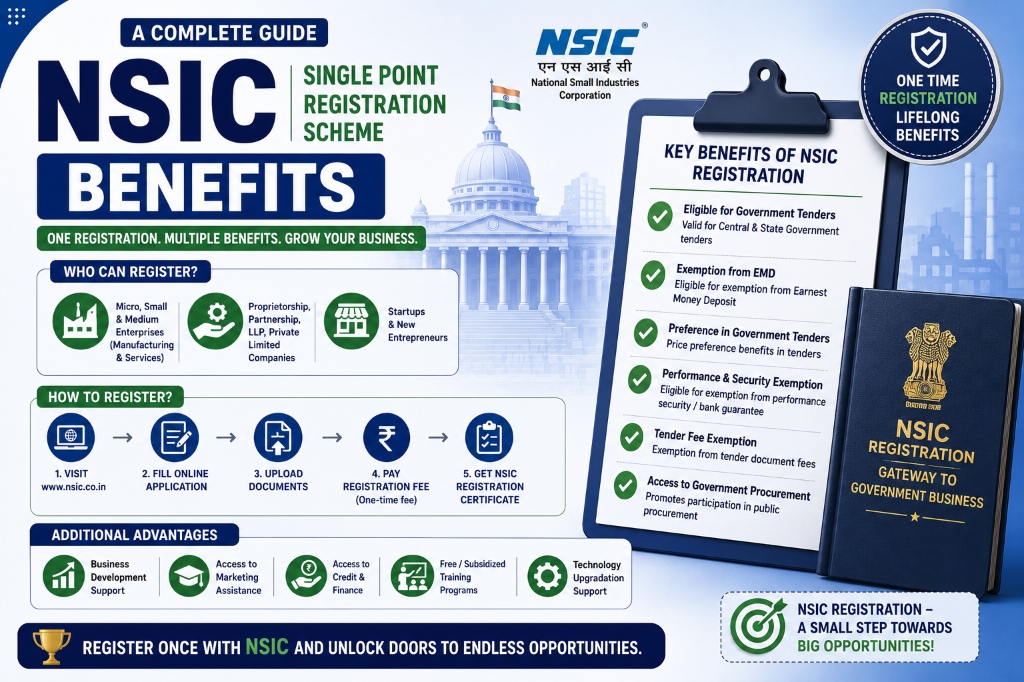
The 7 Core Benefits of NSIC SPRS Registration
NSIC SPRS registration unlocks seven statutory benefits that directly impact your ability to win government contracts.
Benefit 1: Exemption from Earnest Money Deposit (EMD)
What it means: NSIC-registered MSEs are exempt from paying EMD (typically 2–5% of tender value) in government tenders.
Financial Impact:
- On a ₹50 lakh tender, EMD = ₹1–2.5 lakh saved per bid.
- On a ₹5 crore tender, EMD = ₹10–25 lakh saved per bid.
- For active bidders placing 20+ bids annually, this unlocks ₹50 lakh–₹1 crore in working capital.
Critical Note: EMD exemption applies only to MSEs registered under SPRS and Udyam. Traders are NOT eligible for EMD exemption under SPRS.
Benefit 2: Free Issue of Tender Documents
What it means: NSIC-registered units receive tender sets and bidding documents free of cost from Central Government departments and PSUs.
Financial Impact:
- Tender document fees range from ₹500 to ₹5,000 per tender.
- For 50 tenders annually, savings = ₹25,000–₹2.5 lakh.
- More importantly, zero cost removes the psychological barrier to bidding on exploratory tenders.
Benefit 3: L1 + 15% Price Preference
What it means: In any tender where the L1 (lowest) bidder is a non-MSE, NSIC-registered MSEs quoting within L1 + 15% can match the L1 price and secure up to 25% of the order quantity.
How It Works:
| Scenario | L1 Bidder | Your Quote | Eligible? | Outcome |
|---|---|---|---|---|
| Tender A | Non-MSE: ₹10,00,000 | ₹11,20,000 (12% above) | ✅ Yes | Match L1, win up to 25% |
| Tender B | Non-MSE: ₹10,00,000 | ₹11,60,000 (16% above) | ❌ No | Not eligible |
| Tender C | MSE: ₹10,00,000 | ₹11,20,000 (12% above) | ❌ No | L1 is MSE, no preference |
Strategic Value: This is the single most powerful benefit. You can win contracts without being the cheapest bidder.
Benefit 4: 25% Procurement Reservation
What it means: Every Central Ministry, Department, and PSU must set an annual goal of procuring at least 25% of their total annual purchases from MSEs.
Breakdown:
- 25% — Total MSE reservation
- 4% — Specifically earmarked for SC/ST-owned MSEs
- 3% — Specifically earmarked for women-owned MSEs
Reality Check: While the 25% mandate exists, many departments struggle to meet it due to insufficient registered MSEs. This creates a supply gap that registered MSEs can exploit.
Benefit 5: Access to 358 Reserved Items
What it means: The Government of India has identified 358 products for exclusive purchase from the small-scale sector. Only MSEs (including NSIC-registered ones) can supply these items.
Examples of Reserved Items:
- Ball bearings and industrial bearings
- Steel furniture and filing cabinets
- Sanitary fittings and plumbing fixtures
- Electrical switches, sockets, and MCBs
- Laboratory glassware and porcelain
- Hand tools and cutting tools
- Rubber hoses and conveyor belts
- Paper products and stationery items
Full List: Available at nsic.co.in under the "List of 358 Reserved Items" download.
Benefit 6: Consortia & Tender Marketing Support
What it means: NSIC facilitates consortia formation where multiple MSEs can jointly bid for large tenders that none could handle individually.
How It Works:
- MSE A has manufacturing capability but no delivery network.
- MSE B has logistics but limited production.
- NSIC helps them form a consortium to bid jointly.
- The combined capacity meets the tender requirement.
Additional Support:
- NSIC organizes Buyer-Seller Meets and Exhibitions.
- Registered units get priority in Vendor Development Programs.
- Access to International Trade Fairs and Export Promotion support.
Benefit 7: Raw Material Assistance & Credit Facilitation
What it means: Beyond procurement benefits, NSIC offers:
- Raw Material Assistance Scheme — Financing for purchase of indigenous and imported raw materials.
- Bank Credit Facilitation — Tie-ups with SBI and other banks for easier MSME loans.
- Performance & Credit Rating — NSIC facilitates credit rating to improve loan eligibility.
The 358 Reserved Items: Exclusive Purchase from MSEs
The Government of India maintains a list of 358 items reserved for exclusive purchase from the small-scale sector. This is one of the most powerful but least understood benefits of SPRS registration.
What "Exclusive Purchase" Means
For these 358 items, Central Government departments and PSUs must procure from MSEs. If sufficient MSE capacity does not exist, they may seek relaxation — but the default position is MSE-only procurement.
Top Categories in the 358-Item List
| Category | Examples | Tender Value Range |
|---|---|---|
| Industrial Bearings | Ball bearings, roller bearings, thrust bearings | ₹5L – ₹2 Cr |
| Steel Furniture | Office almirahs, filing cabinets, racks | ₹2L – ₹50L |
| Sanitary Fittings | Taps, valves, flushing cisterns | ₹3L – ₹30L |
| Electrical Accessories | Switches, sockets, MCBs, distribution boards | ₹5L – ₹1 Cr |
| Hand Tools | Spanners, pliers, screwdrivers, hammers | ₹1L – ₹20L |
| Laboratory Glassware | Beakers, flasks, test tubes, burettes | ₹2L – ₹15L |
| Rubber Products | Hoses, belts, gaskets, seals | ₹5L – ₹40L |
| Paper Products | Envelopes, files, registers, carbon paper | ₹1L – ₹10L |
| Agricultural Tools | Sickles, spades, garden tools | ₹50K – ₹5L |
| Chemical Products | Adhesives, cleaning agents, polishes | ₹2L – ₹25L |
How to Use the 358-Item List
- Download the list from NSIC's website.
- Identify items that match your manufacturing capability.
- Focus your tender tracking on these items — competition is restricted to MSEs.
- Register under SPRS for the specific items you manufacture.
- Bid aggressively — with non-MSE competitors excluded, your win rate increases dramatically.
Instant Tender Eligibility & Risk Audit
Upload any 500-page NIT / BOQ PDF. Extract hidden disqualification traps, EMD waiver clauses, and complete eligibility criteria in under 45 seconds.
Eligibility Criteria: Who Can Register?
Not every business can register under SPRS. The eligibility criteria are strict and designed to ensure only genuine MSEs benefit.
Mandatory Eligibility Requirements
| Requirement | Details | Document Proof |
|---|---|---|
| Udyam Registration | Must be registered as Micro or Small Enterprise under Udyam | Udyam Registration Certificate (URC) |
| Business Type | Manufacturing OR Services only | GST registration, factory license |
| Traders Excluded | Trading businesses are NOT eligible | — |
| Drugs/Medicines Excluded | Pharma manufacturing not eligible | — |
| Operational Status | Must have commenced commercial production | Sales invoices, production records |
| 1-Year Existence | Must have completed 1 year of operation (for full registration) | Audited balance sheets |
| Government Sale | Must have completed at least one sale to a government department or PSU | Supply order copy, delivery challan |
Provisional Registration Exception
MSEs that have commenced commercial production but not completed one year can apply for Provisional Registration with a monetary limit of ₹5 lakh and validity of 1 year.
Who CANNOT Register Under SPRS?
- ❌ Traders and resellers
- ❌ Medium Enterprises (only Micro and Small)
- ❌ Drug and medicine manufacturers
- ❌ Businesses without Udyam Registration
- ❌ Businesses without audited financial statements (for full registration)
- ❌ Businesses that have not supplied to any government entity
Provisional Registration for Startups (Under 1 Year)
New MSEs often face a chicken-and-egg problem: they need government orders to build credibility, but they need credibility to win government orders. Provisional Registration solves this.
Provisional Registration Details
| Parameter | Full Registration | Provisional Registration |
|---|---|---|
| Eligibility | 1+ year of operation | <1 year but commenced production |
| Monetary Limit | Based on turnover (typically ₹10L–₹5Cr) | Fixed at ₹5 lakh |
| Validity | 2 years | 1 year |
| EMD Exemption | ✅ Yes | ✅ Yes |
| Free Tender Access | ✅ Yes | ✅ Yes |
| Price Preference | ✅ Yes | ✅ Yes |
| 358 Reserved Items | ✅ Yes | ✅ Yes |
| Renewal | Every 2 years | Convert to full after 1 year |
Provisional Registration Strategy for Startups
- Start bidding immediately on tenders up to ₹5 lakh.
- Build a government supply track record during the provisional period.
- Complete 1 year of operation and apply for full registration.
- Use the 1-year track record to justify a higher monetary limit.
NSIC Registration Process: Step-by-Step (2026)
The SPRS registration process is now fully online through www.nsicspronline.com. Here's the exact process:
Step 1: Obtain Udyam Registration
Before applying for SPRS, you must have a valid Udyam Registration Number (URN).
- Visit udyamregistration.gov.in
- Register using Aadhaar and PAN.
- Receive Udyam Registration Certificate.
Step 2: Gather Documents
| Document | Purpose | Format |
|---|---|---|
| Udyam Registration Certificate | Prove MSE status | |
| PAN Card | Identity verification | |
| GST Registration | Tax compliance | |
| Audited Balance Sheets (last 3 years) | Turnover verification | |
| IT Returns (last 3 years) | Financial credibility | |
| Banker's Report | Banking relationship | Original letter |
| Ownership Proof of Premises | Business location | Sale deed / Rent agreement |
| Plant & Machinery Details | Production capacity | List with values |
| Sales & Purchase Bills | Operational proof | Scanned copies |
| Performance Statement from Buyers | Quality track record | Buyer certificates |
| ISO Certificate (if available) | Quality standard |
Step 3: Online Application (7-Step Form)
- Visit www.nsicspronline.com
- Login using URN, PAN, and Udyam-registered mobile number.
- Complete the 7-step form (each step can be saved and resumed):
- Step 1: Basic business details
- Step 2: Udyam and PAN verification
- Step 3: Financial details (turnover, plant & machinery)
- Step 4: Product/Service details (items for registration)
- Step 5: Document upload
- Step 6: Inspection agency selection
- Step 7: Fee payment
- Save and review each step before proceeding.
Step 4: Fee Payment
Use the NSIC Fee Calculator to determine exact fee based on turnover.
- Pay online through the portal.
- Save payment receipt.
Step 5: Technical Inspection
- NSIC forwards your application to an empanelled inspecting agency (18 agencies are empaneled).
- The agency conducts a physical inspection of your factory/premises.
- Inspection covers: production capacity, quality control, infrastructure, financial health.
- Inspection fee is separate from registration fee and paid directly to the agency.
Step 6: Certificate Issuance
- After receiving the inspection report, NSIC reviews and decides.
- If approved, the SPRS Registration Certificate is issued online.
- Physical copy is sent by post.
- Timeline: 30–45 days from application to certificate.
Step 7: Post-Registration Actions
- Download certificate from portal.
- Update GeM profile with NSIC registration number.
- Start bidding on tenders within your monetary limit.
Monetary Limit Calculation: How NSIC Fixes Your Tender Cap
Your monetary limit determines the maximum value of tenders you can bid on under SPRS. Understanding how NSIC calculates this is critical for strategic planning.
The Formula
NSIC fixes the monetary limit based on your net sales turnover during the last 3 years, as reflected in audited balance sheets.
Scenario 1: No Decrease in Plant & Machinery
Monetary Limit = 50% of Highest Turnover in Last 3 Years
Example:
- Year 1 turnover: ₹80 lakh
- Year 2 turnover: ₹1.2 crore
- Year 3 turnover: ₹95 lakh
- Highest turnover: ₹1.2 crore
- Monetary Limit = ₹60 lakh
You can bid on tenders up to ₹60 lakh.
Scenario 2: Decrease in Plant & Machinery > 10%
If your plant & machinery value has decreased by more than 10%, the formula changes based on profitability:
| Profitability Status | Monetary Limit Formula |
|---|---|
| Profit all 3 years | 50% of last year's net sales turnover |
| Loss in 1 of 3 years | 40% of average net sales turnover |
| Loss in 2 of 3 years | 30% of average net sales turnover |
| Loss all 3 years | 20% of average net sales turnover |
Example (Loss in 1 of 3 years):
- Year 1: ₹80 lakh (profit)
- Year 2: ₹1.2 crore (profit)
- Year 3: ₹95 lakh (loss)
- Average turnover: ₹98.33 lakh
- Monetary Limit = 40% of ₹98.33 lakh = ₹39.33 lakh
Monetary Limit Strategy
| Your Situation | Strategy |
|---|---|
| Limit too low for target tenders | Bid on smaller tenders first. Build track record. Apply for limit enhancement after 6 months. |
| Limit adequate | Focus on tenders at 60–80% of your limit for optimal win rate. |
| New MSE (<1 year) | Apply for Provisional Registration (₹5 lakh limit). Convert to full after 1 year. |
| Multiple factories | Register all factories under one branch. NSIC considers consolidated turnover. |
Amendment for Monetary Limit Enhancement
You can apply for an amendment to increase your monetary limit if:
- Your turnover has increased significantly.
- You have invested in new plant & machinery.
- You have completed high-value government contracts successfully.
Fee: 50% of fresh registration fee.
Registration Fee Structure: Micro vs. Small, SC/ST & NE Concessions
NSIC registration fees are based on your enterprise category (Micro or Small) and turnover. The structure is designed to be affordable for genuine MSEs.
Fresh Registration Fee
| Turnover Range | Micro Enterprise Fee | Small Enterprise Fee |
|---|---|---|
| Up to ₹100 lakh | ₹3,000 | ₹5,000 |
| Above ₹100 lakh | ₹3,000 + ₹1,500 per additional ₹100 lakh | ₹5,000 + ₹2,000 per additional ₹100 lakh |
| Maximum Cap | ₹1,00,000 | ₹1,00,000 |
Examples:
| Enterprise | Turnover | Category | Fee Calculation | Total Fee |
|---|---|---|---|---|
| M/s. A | ₹45 lakh | Micro | ₹3,000 | ₹3,000 |
| M/s. B | ₹1.5 crore | Micro | ₹3,000 + ₹1,500 | ₹4,500 |
| M/s. C | ₹3 crore | Small | ₹5,000 + ₹4,000 | ₹9,000 |
| M/s. D | ₹10 crore | Small | ₹5,000 + ₹18,000 (capped at ₹1 lakh) | ₹1,00,000 |
Special Concessions
| Category | Concession | Details |
|---|---|---|
| SC/ST Owned MSEs | ₹100 + GST only | Nominal fee for all SC/ST applicants (2021–22 to 2025–26) |
| North Eastern Region MSEs | 20% fee concession | 20% discount on registration fee (inspection fee remains same) |
| Women-Owned MSEs | Standard fee | No additional discount, but eligible for 3% procurement reservation |
Renewal Fee
- 50% of fresh registration fee (based on current turnover).
- Same calculation methodology as fresh registration.
Inspection Fee
- Paid directly to the empanelled inspecting agency (not to NSIC).
- Varies by agency and location.
- Typically ₹5,000–₹25,000 depending on factory size and distance.
Total Cost Estimate
| Scenario | Registration Fee | Inspection Fee | Total Cost |
|---|---|---|---|
| Micro, ₹50L turnover, General | ₹3,000 | ₹8,000 | ₹11,000 |
| Small, ₹2Cr turnover, General | ₹7,000 | ₹12,000 | ₹19,000 |
| Micro, SC/ST, Any turnover | ₹100 + GST | ₹8,000 | ₹8,100 |
| Small, ₹5Cr turnover, General | ₹13,000 | ₹15,000 | ₹28,000 |
NSIC vs. Udyam vs. GeM: The Three-Pillar MSME Registration System
Indian MSMEs often confuse NSIC, Udyam, and GeM registrations. They are three distinct but complementary systems.
| Parameter | Udyam Registration | NSIC SPRS | GeM Seller Registration |
|---|---|---|---|
| Purpose | MSME identity & classification | Government procurement eligibility | E-commerce platform for government buying |
| Authority | Ministry of MSME | NSIC (Mini Ratna PSU) | GeM SPV |
| Mandatory For | All MSMEs | MSEs bidding on Central Govt tenders | All sellers on GeM |
| Benefits | EMD exemption, loans, subsidies | EMD exemption + free tenders + price preference + 358 items | Access to GeM marketplace |
| Fee | Free | ₹3,000–₹1,00,000 | Free |
| Validity | Lifetime (no renewal) | 2 years | Active until deactivated |
| Inspection | None | Physical factory inspection | Document verification |
| Monetary Limit | None | Based on turnover | None |
| Traders Allowed | Yes | No | Yes |
| Medium Enterprises | Yes | No | Yes |
| Procurement Reservation | 25% MSE | 25% MSE + 358 items | 25% MSE (via Udyam) |
The Relationship Between the Three
UDYAM (Foundation)
    ↓
NSIC SPRS (Procurement Gateway)
    ↓
GeM (Execution Platform)
Udyam is the foundation — it classifies you as Micro, Small, or Medium. NSIC SPRS is the procurement gateway — it certifies you as eligible for government tender benefits. GeM is the execution platform — it's where you actually list products and bid.
For maximum advantage: Register under all three. Udyam gives you identity. NSIC gives you tender benefits. GeM gives you the marketplace.
How to Use NSIC Registration to Win Government Tenders
Registration alone doesn't win tenders. Here's how to strategically leverage your SPRS status.
Strategy 1: Target the 358 Reserved Items
- Focus your manufacturing/marketing on items from the 358 reserved list.
- These items have restricted competition (MSEs only).
- Your NSIC registration is your entry ticket.
Strategy 2: Exploit the L1 + 15% Price Band
- Don't always bid to be L1.
- Quote at L1 + 10–12% in tenders where non-MSEs are likely to participate.
- Wait for the Price Match Accept notification.
- Match L1 and win 25% quantity — at a profitable price.
Strategy 3: Bid on Tenders Within Your Monetary Limit
- Use your monetary limit as a filter.
- Don't waste time on tenders above your cap.
- Build a track record on smaller tenders, then apply for limit enhancement.
Strategy 4: Leverage Consortia for Large Tenders
- Partner with complementary MSEs through NSIC's consortia scheme.
- Combine manufacturing + logistics + installation capabilities.
- Bid on tenders 3–5x your individual capacity.
Strategy 5: Highlight NSIC Status in Every Bid
- Mention your NSIC registration number prominently in technical bids.
- Attach a copy of your NSIC certificate.
- Reference the Public Procurement Policy for MSEs Order 2012.
- Remind buyers of their 25% procurement obligation.
Strategy 6: Track Department-Specific Procurement Goals
- Every department publishes its annual procurement plan.
- Identify departments that consistently under-perform on their 25% MSE target.
- Target these departments — they are more likely to favor MSE bids to meet their quota.
Renewal, Amendment & Post-Registration Compliance
Renewal Process
| Parameter | Details |
|---|---|
| Validity | 2 years from date of issue |
| Renewal Window | 3 months before expiry |
| Fee | 50% of fresh registration fee |
| Process | Online through nsicspronline.com |
| Documents | Updated audited balance sheets, turnover proof, performance statements |
| Inspection | May be required if significant changes |
Critical: Renew before expiry. Lapsed registration means loss of all benefits until renewal is processed.
Amendment Types
| Amendment Type | When Needed | Fee |
|---|---|---|
| Name Change | Company rebranding, merger | 50% of fresh fee |
| Address Change | Office/factory relocation | 50% of fresh fee |
| Partner/Director Change | Ownership restructuring | 50% of fresh fee |
| Monetary Limit Enhancement | Turnover growth | 50% of fresh fee |
| Additional Items | New product lines | 50% of fresh fee |
| Category Change | SC/ST status update | 50% of fresh fee |
Pro Tip: If renewal and amendment are applied together, only renewal fee is charged.
Post-Registration Compliance
- Annual Financial Reporting: Submit audited P&L, balance sheet, and IT returns annually.
- Performance Reporting: Update supply performance records.
- Udyam Renewal: Ensure Udyam registration remains active (though Udyam is lifetime, updates are needed for changes).
- GeM Profile Update: Add NSIC registration number to your GeM seller profile.
Common Mistakes That Delay or Reject NSIC Applications
❌ Mistake 1: Applying Without Udyam Registration
The Error: Submitting SPRS application before obtaining Udyam Registration.
The Consequence: Automatic rejection. Udyam is a mandatory prerequisite.
The Fix: Register on Udyam first. Wait for URN. Then apply for SPRS.
❌ Mistake 2: Mismatch Between Udyam and NSIC Details
The Error: PAN, name, or address differs between Udyam and NSIC applications.
The Consequence: Verification failure. Application returned for correction.
The Fix: Copy-paste exact details from Udyam certificate into NSIC form.
❌ Mistake 3: Incomplete Document Upload
The Error: Missing audited balance sheets, IT returns, or banker's report.
The Consequence: Application held in pending status indefinitely.
The Fix: Use the NSIC checklist. Upload every document in the prescribed format.
❌ Mistake 4: Selecting Wrong Inspection Agency
The Error: Choosing an inspection agency far from your factory or without domain expertise.
The Consequence: Delayed inspection, higher travel charges, unfavorable report.
The Fix: Select an agency from the empanelled list that is nearest to your location and has experience in your product category.
❌ Mistake 5: Not Renewing on Time
The Error: Letting registration lapse by missing the renewal window.
The Consequence: Loss of EMD exemption, free tender access, and price preference until renewal is processed (30–45 days).
The Fix: Set calendar reminders at 6 months, 3 months, and 1 month before expiry.
❌ Mistake 6: Traders Trying to Register
The Error: Trading firms applying for SPRS, thinking it will help them bid on GeM.
The Consequence: Rejection. NSIC does not register traders.
The Fix: If you're a trader, focus on GeM seller registration instead. NSIC is for manufacturers and service providers only.
❌ Mistake 7: Ignoring the Monetary Limit
The Error: Bidding on tenders above your monetary limit.
The Consequence: Bid rejected at technical stage. Wasted preparation effort.
The Fix: Check your NSIC certificate monetary limit before bidding. Apply for enhancement if needed.
Case Study: How a Kanpur Manufacturer Won ₹2.8 Cr Using SPRS
Company: Bharat Industrial Tools Pvt. Ltd., Kanpur (Udyam-registered Small Enterprise) Sector: Hand Tools and Cutting Tools (Category in 358 reserved items list) Challenge: Competing with large traders and unregistered manufacturers in open tenders.
The Problem
Bharat Industrial Tools had been manufacturing hand tools for 8 years but had never won a government contract. Their challenges:
- Couldn't afford EMD on large tenders (₹5–10 lakh per bid).
- Tender document costs were prohibitive (₹2,000–₹5,000 per tender).
- Lost bids to non-MSE competitors who quoted lower prices.
- No awareness of the 358 reserved items list.
The Transformation
Month 1: NSIC Registration
- Applied for SPRS registration online.
- Selected hand tools and cutting tools as registered items.
- Underwent technical inspection by an empanelled agency.
- Received certificate with ₹45 lakh monetary limit.
- Total cost: ₹9,500 (fee + inspection).
Month 2: Strategic Bidding
- Focused exclusively on 358 reserved item tenders for hand tools.
- Bid on 12 tenders in 3 months.
- Used EMD exemption to bid on 8 tenders simultaneously without blocking capital.
Month 3: First Win
- Won first tender: Supply of spanners and wrenches to a Central PSU — ₹8.5 lakh.
- Delivered on time with zero quality complaints.
- Used the performance certificate to apply for monetary limit enhancement.
Month 4–6: Scale Up
- Won 4 more tenders totaling ₹42 lakh.
- Applied for and received monetary limit enhancement to ₹80 lakh.
- Started bidding on larger tenders.
Month 7–12: Major Wins
- Won a ₹1.2 crore tender for supply of cutting tools to Defence PSU.
- Won a ₹95 lakh tender for hand tool kits to Railways.
- Won a ₹65 lakh tender for maintenance tools to a Central Ministry.
Results (Year 1 Post-Registration)
| Metric | Before NSIC | After NSIC |
|---|---|---|
| Government Contracts Won | 0 | 9 |
| Total Contract Value | ₹0 | ₹2.8 Crore |
| EMD Saved | ₹0 | ₹18.5 Lakh |
| Tender Document Costs Saved | ₹0 | ₹42,000 |
| Average Win Rate | 0% | 31% (9/29 bids) |
| Team Size | 12 | 18 |
Key Lessons
- The 358 reserved items list is a goldmine. Bharat Industrial Tools focused on a category where non-MSEs were excluded. Their competition dropped by 70%.
- EMD exemption is a game-changer. They could bid on 8 tenders simultaneously without worrying about blocked capital.
- Start small, build credibility, then scale. Their first win was ₹8.5 lakh. Their largest was ₹1.2 crore. The journey took 7 months.
- Monetary limit enhancement is achievable. With a strong track record, they doubled their limit in 6 months.
"Before NSIC, we were invisible to government buyers. After NSIC, we became their preferred supplier for hand tools. The ₹9,500 registration fee returned ₹2.8 crore in revenue. That's a 29,000% ROI." — Mr. Rajesh Kumar, Director, Bharat Industrial Tools Pvt. Ltd.
Frequently Asked Questions (FAQ)
Q1. Is NSIC registration the same as Udyam registration?
A: No. Udyam Registration is the government's MSME classification system (free, lifetime validity). NSIC SPRS is a procurement-specific registration that certifies you for government tender benefits (paid, 2-year validity). You need Udyam FIRST, then NSIC. They are complementary, not interchangeable.
Q2. Can traders register under NSIC SPRS?
A: No. NSIC does not register traders, resellers, or distributors. Only manufacturing and service enterprises are eligible. If you are a trader, focus on GeM seller registration and Udyam registration instead.
Q3. What is the validity of NSIC SPRS registration?
A: The registration certificate is valid for 2 years from the date of issue. It must be renewed every 2 years with updated financial documents. Provisional registration is valid for 1 year.
Q4. How is the monetary limit calculated for NSIC registration?
A: For enterprises with no decrease in plant & machinery: 50% of the highest turnover in the last 3 years. If plant & machinery has decreased by >10%, the limit is reduced to 40%, 30%, or 20% of average turnover depending on profitability over the last 3 years.
Q5. What are the 358 reserved items under NSIC SPRS?
A: The Government of India has identified 358 products for exclusive purchase from the small-scale sector. These include ball bearings, steel furniture, sanitary fittings, electrical accessories, hand tools, laboratory glassware, rubber products, and paper products. The full list is available for download on the NSIC website.
Q6. Can I apply for NSIC registration if my MSE is less than 1 year old?
A: Yes. MSEs that have commenced commercial production but not completed one year can apply for Provisional Registration with a fixed monetary limit of ₹5 lakh and validity of 1 year. After completing one year, you can convert to full registration.
Q7. What is the fee for SC/ST-owned MSEs under SPRS?
A: SC/ST-owned MSEs pay a nominal fee of ₹100 + GST only for SPRS registration, renewal, and amendments (valid from 2021–22 to 2025–26). This is a significant concession from the standard fee of ₹3,000–₹1,00,000.
Q8. How long does NSIC registration take?
A: The typical timeline is 30–45 days from application to certificate issuance. This includes: application review (1–2 weeks), technical inspection scheduling (1–2 weeks), inspection execution (3–5 days), report review (1 week), and certificate issuance (3–5 days).
Q9. Can I bid on GeM tenders with NSIC registration?
A: NSIC registration and GeM are separate systems. However, you should add your NSIC registration number to your GeM seller profile. On GeM, your Udyam registration (not NSIC) is what triggers MSE benefits like EMD exemption and price preference. NSIC is primarily for offline/CPPP tenders and department-specific procurement.
Q10. What happens if I don't renew my NSIC registration on time?
A: If your registration lapses, you lose all SPRS benefits immediately: EMD exemption, free tender access, price preference, and eligibility for 358 reserved items. You must renew (or reapply if lapsed for a long time) to regain benefits. Set reminders 3 months before expiry.
Conclusion & 21-Day NSIC Registration Action Plan
The NSIC Single Point Registration Scheme is the most underutilized weapon in the MSME government procurement arsenal. With 6+ crore MSMEs in India and fewer than 2 lakh registered under SPRS, the competitive gap is staggering. The 358 reserved items alone represent a ₹10,000+ crore annual market where non-MSEs are excluded.
For manufacturers and service providers, SPRS is not optional — it's the gateway to sustainable government revenue. The ₹3,000–₹28,000 registration cost is negligible compared to the EMD savings, free tender access, and price preference benefits that compound over years.
For startups under 1 year, Provisional Registration removes the "experience barrier" and lets you start building a government track record immediately.
21-Day NSIC Registration Action Plan
| Week | Action |
|---|---|
| Week 1 (Days 1–3) | Verify Udyam registration is active. Gather all documents (audited balance sheets, IT returns, banker's report, performance statements). |
| Week 1 (Days 4–7) | Visit nsicspronline.com. Complete the 7-step online application. Upload all documents. Pay registration fee. |
| Week 2 (Days 8–10) | Select empanelled inspection agency nearest to your location. Schedule inspection. Prepare factory for technical inspection. |
| Week 2 (Days 11–14) | Undergo technical inspection. Address any deficiencies raised by the inspecting agency. |
| Week 3 (Days 15–18) | Track application status on NSIC portal. Respond to any queries from NSIC. |
| Week 3 (Days 19–21) | Receive certificate. Download and print. Update GeM profile. Start bidding on tenders within your monetary limit. |
The Long Game
- Month 3: Win your first small tender (₹2–10 lakh).
- Month 6: Build a track record of 3+ successful deliveries.
- Month 9: Apply for monetary limit enhancement.
- Month 12: Win your first ₹50 lakh+ tender.
- Year 2: Renew registration. Target ₹1 crore+ in annual government revenue.
"NSIC registration is not a formality. It is a competitive moat. The 358 reserved items, the EMD exemption, the L1+15% price band — these are not bureaucratic niceties. They are the rules of a game that 98% of MSMEs don't even know exists. Register. Play. Win."
Related Articles
- GeM Portal Reverse Auction Strategy: Complete Winning Guide
- Make in India Preference Policy: Complete DPIIT PPP-MII Guide
- Limited Tender Enquiry (LTE): Rules, Eligibility & Supplier Registration
- Proprietary Article Certificate (PAC): GFR 166 Complete Guide
- Debarment & Blacklisting in Government Tenders: GFR 2017 Rules
Disclaimer: This article is for informational purposes only. NSIC rules, fees, and procedures are subject to change. Always verify current guidelines on nsic.co.in or nsicspronline.com before applying. TenderFlow Pro is not affiliated with NSIC or the Ministry of MSME.
© 2026 TenderFlow Pro. All rights reserved.