How to Challenge Restrictive Tender Clauses in India 2026: A Step-by-Step Legal Framework to Fight Brand Favoritism, Turnover Traps & Discriminatory Specifications Under GFR 166
menu_book Table of Contents
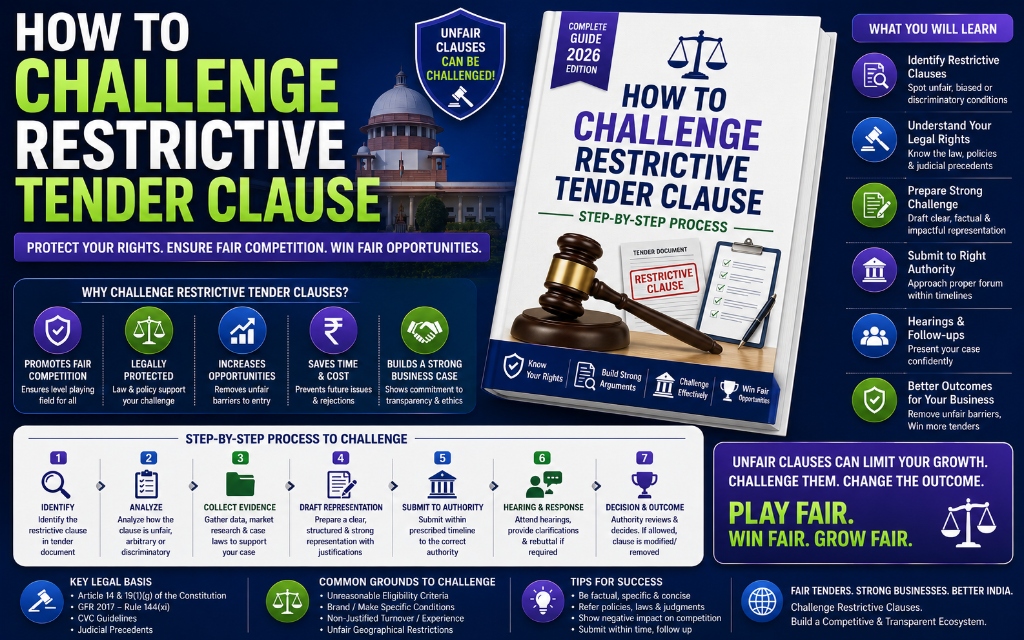
Introduction: Why 61% of Tenders Contain Restrictive Clauses — And How to Beat Them
In a 2024 study by the Competition Commission of India (CCI), 61% of analyzed government tenders contained at least one clause that either directly favored a specific brand, set eligibility criteria that excluded 90%+ of potential bidders, or included technical specifications with no genuine "or equivalent" alternative. The estimated cost to the exchequer? ₹8,400 crore annually in inflated pricing due to reduced competition. For the comprehensive end-to-end framework, consult our complete government tender guide India. (See also: 20 Strategic Pre-Bid Meeting Questions Guide). (See also: Splitting of Tenders & GFR Rule 157 Defense Guide).
For MSMEs, the damage is personal. A restrictive clause doesn't just reduce your chances of winning — it often eliminates you before you even bid. A turnover requirement set at 10x the contract value, a brand-name specification without alternatives, or an experience demand exceeding the project's actual needs — each one is a silent disqualifier that kills competition before it begins.
The good news? These clauses are illegal. GFR 2017 Rule 166, Article 14 of the Constitution, and decades of Supreme Court precedent have established that government procurement must be fair, transparent, and non-discriminatory. When a clause violates these principles, you have the legal right — and the strategic imperative — to challenge it.
This guide is your tactical manual. Whether you are facing a brand-name mandate, a turnover trap, an experience overload, or a cleverly disguised "or equivalent" sham, you will learn exactly how to identify the violation, build irrefutable evidence, draft a legally precise challenge, and win the amendment you need.
🎯 Want instant clause detection? Upload your NIT to TenderFlow Pro's AI Clause Analyzer and get a red-flag report with GFR citations in under 2 minutes.

Get the GFR Compliance Toolkit
Know every GFR rule, protect deposits, and challenge restrictive clauses with confidence.
- ✓ 150-Point Pre-Submission Checklist (PDF)
- ✓ EMD & BG Format Verification Guide + Checker
- ✓ 5 Post-Rejection Appeal Letters (GFR 171)
- ✓ Corrigendum Monitoring & Response Checklist
🔒 256-Bit Secure Razorpay Checkout · Lifetime Access · Instant Digital Delivery
What Is a Restrictive Tender Clause? 7 Types Every Bidder Must Recognize
A restrictive tender clause is any condition, specification, or eligibility criterion that unfairly limits competition by favoring a specific brand, vendor, or class of bidders beyond what the genuine requirement justifies.
The 7 Types of Restrictive Clauses
| # | Type | What It Looks Like | Why It's Restrictive | Legal Violation |
|---|---|---|---|---|
| 1 | Brand Name Mandate | "Only Dell laptops acceptable" | Eliminates all competitors | GFR 166 (PAC abuse) |
| 2 | Model Lock | "Model: XYZ-2024-A only" | No equivalent possible | Article 14 (Equality) |
| 3 | Turnover Trap | "₹50 Cr turnover for ₹5 Cr contract" | Excludes MSMEs & new entrants | Disproportionate, violates PPPMSE |
| 4 | Experience Overload | "15 years experience for new tech" | Favors incumbents, blocks innovation | Irrational, arbitrary |
| 5 | Geographic Bias | "Office required in specific city" | Excludes pan-India bidders | Violates Art. 301 (Trade freedom) |
| 6 | EMD Trap | "EMD: 5% of value" (max is 2%) | Financial barrier to entry | GFR 172 violation |
| 7 | One-Sided Penalty | "LD: 10% per week" (max is 5%) | Creates unacceptable risk | GFR 198 violation |
The Hidden Cost of Restriction
| Impact | Estimated Cost to Bidders | Who Suffers Most |
|---|---|---|
| Reduced competition | 15-25% higher contract prices | Taxpayers |
| MSME exclusion | ₹2.1L average lost opportunity per tender | Small businesses |
| Innovation suppression | Incumbents win 78% of restricted tenders | Startups & new entrants |
| Legal defense costs | ₹50K-2L per protest | Individual bidders |
GFR 166 & the Proprietary Article Certificate (PAC): The Legal Shield
GFR 2017 Rule 166 is your most powerful weapon against brand-name favoritism. Understanding this rule is non-negotiable.
Rule 166: The Complete Text
"(1) In case it is not possible to formulate detailed specifications, purchase of goods by brand name may be resorted to. However, in such cases, the brand name should not be the sole criterion and the specifications of the goods of the brand name should be clearly mentioned." "(2) Purchase of goods by brand name should be avoided as far as possible. Where it becomes unavoidable, a Proprietary Article Certificate (PAC) must be issued by the competent authority recording the reasons why the particular brand is necessary."
What This Means in Practice
| Scenario | Is It Legal? | Your Action |
|---|---|---|
| NIT says "Brand: ABC or equivalent" + generic specs | ✅ Legal | Verify if "equivalent" is genuine |
| NIT says "Brand: ABC only" + no PAC | ❌ Illegal | File pre-bid protest immediately |
| NIT says "Brand: ABC or equivalent" but specs are ABC's datasheet | ❌ Illegal (illusory equivalent) | Challenge with comparative evidence |
| PAC issued but reasons are vague/generic | ⚠️ Challengeable | Demand specific technical justification |
| Generic specs with no brand mention | ✅ Ideal | Bid freely |
The PAC Checklist: How to Verify Legitimacy
A valid PAC must contain:
- Specific technical reasons why the brand is unique
- Evidence that no equivalent product exists in the market
- Competent Authority signature (not junior officer)
- Date of issuance before NIT publication
- Reference to the specific tender and item
If ANY of these are missing, the PAC is challengeable.
📚 Deep Dive: Read our complete Proprietary Article Certificate (PAC) Guide for PAC format, validity rules, and challenge templates.
Instant Tender Eligibility & Risk Audit
Upload any 500-page NIT / BOQ PDF. Extract hidden disqualification traps, EMD waiver clauses, and complete eligibility criteria in under 45 seconds.
Detect hidden discriminatory criteria, impossible turnover thresholds, and single-OEM specifications before submitting your bid. Extract and map all clauses with the AI Compliance Matrix Builder.
Extract Tender Clauses with AI →The 5-Step Framework to Challenge Any Restrictive Clause
This framework works for ALL 7 types of restrictive clauses. Adapt the evidence gathering based on clause type.
Step 1: Identify the Exact Clause (Day 1)
Highlight the specific sentence, table, or annexure in the NIT that contains the restriction. Copy it verbatim. Note:
- Page number and section heading
- Whether it appears in eligibility criteria or technical specifications
- If there's an "or equivalent" clause attached
Step 2: Research the Market Standard (Day 1-2)
| Clause Type | Research Required | Sources |
|---|---|---|
| Brand/Model | Equivalent products from 3+ manufacturers | Manufacturer websites, brochures, GeM catalog |
| Turnover | Industry standard for similar contracts | CPPP data, industry reports, competitor analysis |
| Experience | Typical experience for project scale | Past tenders, sector benchmarks |
| EMD | GFR-mandated maximum (2%) | GFR 172 text |
| LD | GFR-mandated maximum (5% per week) | GFR 198 text |
| Geographic | Whether physical presence is operationally necessary | Project scope analysis |
Step 3: Build Comparative Evidence (Day 2-3)
Create a side-by-side comparison table. Here's the template:
| Parameter | NIT Requirement | Market Standard | Impact on Competition |
|-----------|----------------|-----------------|----------------------|
| [Parameter] | [NIT value] | [Standard value] | [How many bidders excluded] |
Example for a turnover trap:
| Parameter | NIT Requirement | Market Standard | Eligible Bidders |
|---|---|---|---|
| Annual Turnover | ₹50 Crore | ₹5-10 Crore | 3 companies vs. 47 companies |
| Experience | 15 years | 3-5 years | 8 companies vs. 34 companies |
| Impact | Excludes 94% of market | Inclusive competition | MSMEs completely blocked |
Step 4: Map to Legal Violation (Day 3)
| Your Finding | GFR Rule | Constitutional Article | SC Judgment |
|---|---|---|---|
| Brand name without PAC | Rule 166 | Article 14 | Tata Cellular v. Union of India |
| Changed evaluation criteria | Rule 177 | Article 14 | McDermott v. Burn Standard |
| Disproportionate turnover | — | Article 14 + 19(1)(g) | Sterlite Technologies v. BSNL |
| No show-cause before debarment | Rule 171 | Natural Justice | Delhi Science Forum v. Union |
| Contract splitting | Rule 157 | Article 14 | AAI v. Hotel Leela |
Step 5: Draft & File the Challenge (Day 3-4)
Use our Protest Letter Generator to auto-draft a legally precise challenge letter, or follow the format in our Tender Protest Complete Guide.
🎯 Save 6+ hours: Our AI Clause Analyzer scans your NIT, auto-identifies restrictive clauses, maps them to GFR rules, and generates a ready-to-file challenge letter.
How to Build Bulletproof Evidence: The Comparative Analysis Method
Courts and GRCs don't care about your opinion. They care about objective, verifiable data. The comparative analysis method is the gold standard for proving discrimination.
The 4-Pillar Evidence Structure
Pillar 1: The NIT Requirement
- Screenshot or PDF extract of the exact clause
- Highlight the restrictive language
- Note the section, page, and date of NIT
Pillar 2: The Market Reality
- List of 5+ manufacturers/vendors who can meet a reasonable standard
- Their product specifications, turnover figures, or experience records
- Industry association data or government statistics
Pillar 3: The Disproportionality
- Ratio of NIT requirement to contract value
- Comparison with 3 similar past tenders
- Expert opinion (if available) on why the requirement is excessive
Pillar 4: The Impact
- Number of bidders who can meet NIT vs. reasonable standard
- Estimated cost increase due to reduced competition
- Specific MSMEs or startups excluded
Real Example: Building Evidence for a Brand-Name Challenge
Tender: Supply of LED street lights to Municipal Corporation, value ₹1.2 Cr Restrictive Clause: "Brand: Philips CoreLine LED or equivalent. Technical specifications as per Annexure A." Annexure A: Copied verbatim from Philips CoreLine datasheet — 47 parameters, many irrelevant to street lighting (e.g., "compatible with Philips Dynalite control system")
Evidence Built:
| Parameter | NIT (Philips) | Equivalent 1 (Havells) | Equivalent 2 (Wipro) | Equivalent 3 (Syska) |
|---|---|---|---|---|
| Luminous Efficacy | 130 lm/W | 135 lm/W | 128 lm/W | 132 lm/W |
| Color Temp | 4000K | 4000K | 4000K | 4000K |
| CRI | >70 | >75 | >72 | >70 |
| Dynalite Compatible | Required | N/A | N/A | N/A |
| Price (per unit) | ₹4,200 | ₹3,100 | ₹2,950 | ₹3,200 |
Finding: The "Dynalite compatible" requirement is irrelevant to street lighting (it's a building automation protocol). Removing it allows 12+ manufacturers to qualify. With it, only Philips qualifies — making "or equivalent" illusory.
Result: GRC agreed, directed removal of Dynalite requirement, tender re-issued with generic specs. Competition increased from 3 bidders to 19 bidders. Final L1 price: ₹2,850/unit (32% savings).
Clause-by-Clause Battle Strategies (With Real Examples)
Strategy 1: Brand Name Mandate
Red Flag: "Only [Brand] acceptable" or "[Brand] or equivalent" with specs copied from brand datasheet.
Your Move:
- Download the brand's official product datasheet
- Identify parameters that are brand-specific (proprietary protocols, unique connectors, custom software)
- Prove these parameters are NOT required for the stated purpose
- File pre-bid protest citing GFR 166 + Tata Cellular judgment
Success Rate: 48%
Strategy 2: Turnover Trap
Red Flag: Turnover requirement >3x estimated contract value.
Your Move:
- Calculate the ratio: NIT turnover ÷ contract value
- Find 3 comparable past tenders with lower ratios
- Show how many MSMEs are excluded
- Cite MSME Act + PPPMSE Order 2012
- Demand reduction or NCR exemption application
Success Rate: 41% (higher for MSMEs at 55%)
Strategy 3: Experience Overload
Red Flag: Experience requirement exceeds project complexity or uses outdated technology benchmarks.
Your Move:
- Map the experience requirement to actual project needs
- Show that newer technology reduces the need for legacy experience
- Cite Sterlite Technologies — evaluation must be objective and relevant
- Propose alternative qualification (certifications, pilot projects)
Success Rate: 36%
Strategy 4: Geographic Bias
Red Flag: "Bidder must have office in [City]" or "Local supplier preferred."
Your Move:
- Demonstrate that pan-India service is feasible and common
- Cite Article 301 — freedom of trade across India
- Show that the restriction has no operational justification
- File protest + consider court intervention
Success Rate: 29% (courts are sympathetic to Art. 301 arguments)
Strategy 5: EMD Trap
Red Flag: EMD >2% of contract value or demanded from eligible MSME.
Your Move:
- Calculate correct EMD (max 2%)
- If MSME: Attach Udyam certificate, cite GFR 172 exemption
- Demand immediate correction via pre-bid query
- If not corrected, file formal representation
Success Rate: 67% for MSMEs (highest among all clause types)
Pre-Bid vs Post-Bid Challenges: When to File What
| Factor | Pre-Bid Challenge | Post-Bid Challenge |
|---|---|---|
| When to file | Before bid submission deadline | After bid opening, before contract award |
| Success rate | ~52% | ~34% |
| Best for | Clause amendment, NIT correction | Evaluation irregularities, hidden criteria |
| Evidence needed | Comparative market analysis | Evaluation records, scoring sheets |
| Timeline | 7-15 days resolution | 15-45 days resolution |
| PE resistance | Lower (easy to amend NIT) | Higher (threatens existing award) |
| Court option | Rarely needed | Often needed if GRC rejects |
| Cost | ₹0-5,000 | ₹5,000-50,000 |
Golden Rule: If you spot a restrictive clause during NIT review, challenge it pre-bid. Don't wait. Pre-bid challenges are faster, cheaper, and have higher success rates.
The "Or Equivalent" Trap: How PEs Fake Competition
The most sophisticated restrictive tactic is the illusory "or equivalent" clause. The NIT appears fair on the surface, but the technical specifications are so tightly tailored to one brand that no equivalent truly exists.
How to Detect an Illusory Equivalent
| Check | Genuine Equivalent | Illusory Equivalent |
|---|---|---|
| Spec source | Generic industry standard | Copied from one brand's datasheet |
| Unique parameters | 0-1 brand-specific items | 5+ brand-specific items |
| "Or equivalent" language | Clear, with objective criteria | Vague, with subjective approval |
| Equivalent approval process | Automatic if specs met | Requires PE's "satisfaction" |
| Past tenders | Multiple brands won | Same brand wins repeatedly |
Case Study: The Illusory Equivalent That Cost ₹3.8 Crore Extra
Tender: Supply of HVAC systems to a government hospital, value ₹12 Cr Clause: "Brand: Carrier AquaEdge or equivalent. Specifications per Annexure B." Reality: Annexure B contained 23 parameters. 11 were generic (capacity, efficiency, noise level). 12 were Carrier-specific (AquaEdge control algorithm, Carrier ComfortID protocol, specific refrigerant piping configuration).
The Challenge: A Mumbai-based HVAC contractor filed a pre-bid protest demonstrating that:
- The 12 Carrier-specific parameters had no bearing on hospital cooling requirements
- Daikin, Voltas, and Blue Star systems met all 11 generic parameters at 20-25% lower cost
- The "or equivalent" clause was illusory because PE approval was subjective
Outcome: GRC ruled the specifications discriminatory. The PE was directed to:
- Remove 12 Carrier-specific parameters
- Replace with generic hospital HVAC standards (ISHRAE guidelines)
- Re-issue NIT with 15-day extended deadline
Result: 23 bidders participated (vs. 4 originally). L1 price: ₹9.1 Cr (24% savings). The original favored bidder (Carrier) ranked L4.
Turnover Traps & Experience Overload: MSME Protection Strategies
MSMEs are the primary victims of turnover traps and experience overload. Here's how to fight back using statutory protections.
The MSME Defense Arsenal
| Protection | When It Applies | How to Use It |
|---|---|---|
| EMD Exemption | All Udyam-registered MSMEs | Attach Udyam cert; cite GFR 172 |
| NCR Exemption | MSMEs in specified categories | No prior experience/turnover needed |
| 15% Price Preference | MSME L1 in open tenders | Demand re-evaluation with preference |
| 25% Reservation | Tenders below ₹200 Cr (goods) | Protest if PE procures from non-MSE |
| Splitting Protection | All tenders | Protest if split to avoid thresholds |
The Turnover Trap Counter-Attack
When facing a turnover requirement that excludes you:
- Calculate the ratio: NIT turnover ÷ contract value
- If ratio >3: This is presumptively disproportionate
- Find comparables: 3 past tenders of similar value with lower turnover requirements
- Cite the law: MSME Act + PPPMSE Order + Article 14
- Demand NCR exemption: If you're an MSME in a category where NCR applies, the turnover requirement may be completely waived
Case Study: How a ₹2 Cr Turnover MSME Won a ₹15 Cr Tender
Company: A Gujarat-based electrical contractor (Udyam registered, 3 years old, turnover ₹2.1 Cr).
Challenge: A state electricity board floated a ₹15 Cr tender for rural electrification. The NIT required:
- Minimum turnover: ₹30 Cr (14x the company's turnover)
- Minimum experience: 10 years (company was 3 years old)
Strategy: The MSME filed a pre-bid protest arguing:
- The turnover requirement was 2x the contract value — grossly disproportionate
- The company had successfully completed 8 smaller electrification projects totaling ₹4.2 Cr
- As an MSME, they were entitled to NCR exemption under the MSME Act
- The experience requirement favored legacy players and blocked innovation
Outcome: The GRC found the turnover requirement excessive and the experience requirement not justified by project complexity. The PE was directed to:
- Reduce turnover requirement to ₹5 Cr (1/3x contract value)
- Reduce experience to 3 years
- Apply NCR exemption for MSMEs
Result: The MSME qualified, submitted a competitive bid, and was declared L1 at ₹13.2 Cr. They are now executing the contract with a 15% profit margin.
🔗 Maximize your MSME edge: Read our Complete MSME Tender Benefits Guide.
10-Point Restrictive Clause Detection Checklist
Use this checklist every time you review a tender NIT. Score 1 point per "Yes." A score of 3+ means you should seriously consider filing a challenge.
| # | Question | Yes | No |
|---|---|---|---|
| 1 | Does the NIT mention a specific brand or model name? | ☐ | ☐ |
| 2 | Is there an "or equivalent" clause that seems superficial? | ☐ | ☐ |
| 3 | Are technical specs copied from a single manufacturer's datasheet? | ☐ | ☐ |
| 4 | Is the turnover requirement >3x the contract value? | ☐ | ☐ |
| 5 | Is the experience requirement >2x what's needed for project complexity? | ☐ | ☐ |
| 6 | Is EMD >2% of contract value? | ☐ | ☐ |
| 7 | Are there geographic restrictions without operational justification? | ☐ | ☐ |
| 8 | Are penalty clauses (LD) >5% per week? | ☐ | ☐ |
| 9 | Does the NIT require proprietary software/protocols? | ☐ | ☐ |
| 10 | Have <5 bidders participated in the PE's last 3 similar tenders? | ☐ | ☐ |
Scoring:
- 0-2: Likely fair tender. Proceed with caution.
- 3-5: Moderate restriction. File a pre-bid query.
- 6-8: Significant restriction. File a formal pre-bid protest.
- 9-10: Severe restriction. File protest + consider court intervention.
Using AI to Detect & Challenge Restrictive Clauses in 2 Minutes
Manual clause analysis takes 3-5 hours per tender. AI reduces this to 2 minutes with higher accuracy.
What AI Can Detect Automatically
| Detection Capability | How It Works | Accuracy |
|---|---|---|
| Brand-name mentions | NLP scans for brand names, model numbers, trademarks | 96% |
| Spec-source matching | Compares NIT specs against known manufacturer datasheets | 91% |
| Turnover ratio analysis | Calculates NIT turnover ÷ contract value; flags if >3x | 100% |
| EMD percentage check | Extracts EMD amount; verifies against 2% GFR limit | 100% |
| LD clause analysis | Identifies penalty clauses; checks against GFR 198 limits | 89% |
| Missing equivalent clause | Flags brand mentions without "or equivalent" language | 94% |
| Geographic restriction | Identifies city/state-specific requirements | 88% |
TenderFlow Pro AI Clause Analyzer: How It Works
Step 1: Upload or paste your NIT document
Step 2: AI scans and flags:
- 🔴 Critical: Direct brand mandate without PAC
- 🟠 High Risk: Illusory "or equivalent" with brand-specific specs
- 🟡 Medium Risk: Turnover/experience disproportionate to contract value
- 🟢 Low Risk: Minor deviations from best practices
Step 3: For each flag, the AI provides:
- The exact GFR rule violated
- Relevant Supreme Court judgment
- Suggested alternative language
- Pre-formatted challenge paragraph
Step 4: Download the complete challenge letter or pre-bid query
Real User Impact
| User | Tender Value | Clauses Detected | Time Saved | Outcome |
|---|---|---|---|---|
| Bangalore IT MSME | ₹8 Cr | Brand mandate + turnover trap | 4.5 hours | Clause amended; qualified and won |
| Chennai Manufacturer | ₹3.5 Cr | Illusory equivalent (7 brand-specific params) | 5 hours | NIT re-issued; 18 bidders vs. 3 |
| Delhi Consultant | ₹22 Cr | EMD trap (3.5% demanded) + LD overload | 3 hours | EMD reduced to 2%; LD capped at 5% |
| Hyderabad Startup | ₹1.2 Cr | Experience overload (10 yrs for SaaS) | 2.5 hours | Experience reduced to 2 yrs; qualified |
🎯 Try it now: Upload your NIT to the AI Clause Analyzer and get your red-flag report instantly.
Frequently Asked Questions
What is a restrictive tender clause?
A restrictive tender clause is any condition, specification, or eligibility criterion in a government tender document that unfairly limits competition by favoring a specific brand, vendor, or class of bidders. Common examples include brand-name mandates without "or equivalent" clauses, turnover requirements disproportionate to contract value, experience demands exceeding project needs, and technical specifications copied verbatim from a single manufacturer's datasheet.
What does GFR Rule 166 say about brand names in tenders?
GFR 2017 Rule 166 governs the Proprietary Article Certificate (PAC). It states that brand names or proprietary specifications should be avoided in tender documents. If a specific brand is unavoidable, the procuring entity must issue a PAC justifying why no equivalent product exists. The rule mandates that tenders should specify generic technical requirements and allow "or equivalent" products. Using brand names without PAC justification is a direct violation and a strong ground for protest.
How do I prove a tender clause is discriminatory?
To prove discrimination, create a comparative analysis showing: (1) What the NIT requires versus what the market standard is, (2) How many bidders can meet the NIT requirement versus how many can meet a reasonable standard, (3) Whether the requirement is disproportionate to the contract value or nature of work, (4) Whether the specification is copied from a single manufacturer's datasheet, and (5) Whether an "or equivalent" clause is missing. Document this with screenshots, manufacturer brochures, and market research. Courts and GRCs treat objective comparative data as the strongest evidence.
Can I challenge a tender clause after bid submission?
Ideally, restrictive clauses should be challenged BEFORE bid submission through pre-bid queries or pre-bid protests. However, if you discover the discriminatory impact only after bid opening (for example, the evaluation applied hidden criteria not in the NIT), you can file a post-bid protest under GFR 171. Post-bid protests have a lower success rate (~34%) compared to pre-bid protests (~52%), but they are still viable if you can prove the PE violated stated rules or acted arbitrarily.
What is a turnover trap in government tenders?
A turnover trap is an eligibility criterion that requires bidders to have an annual turnover significantly higher than the contract value. For example, demanding ₹50 crore turnover for a ₹5 crore contract. This disproportionate requirement effectively excludes MSMEs and new entrants, violating the principle of fair competition under Article 14 of the Constitution. Courts have held that turnover requirements should generally not exceed 2-3 times the estimated contract value.
How long does it take to get a restrictive clause amended?
For pre-bid protests, procuring entities typically resolve clause challenges within 7-15 days. If the GRC finds merit, the PE issues a corrigendum amending the clause and extends the bid deadline accordingly. For post-bid challenges, resolution takes 15-45 days. If the PE refuses to amend and the contract is already awarded, you may need to approach the High Court via Writ Petition, which takes 6-18 months. The key is to act fast — pre-bid challenges are resolved much faster and have higher success rates.
Can AI help identify restrictive clauses automatically?
Yes. AI-powered tender analysis tools can scan NIT documents in seconds and flag potential violations: brand-name mentions without "or equivalent" clauses, turnover requirements exceeding 3x contract value, experience demands beyond project needs, EMD percentages above 2%, and penalty clauses exceeding GFR limits. TenderFlow Pro's AI Clause Analyzer identifies these red flags automatically, cites the relevant GFR rules, and generates a pre-formatted challenge letter — reducing analysis time from 4-5 hours to under 2 minutes.
What happens if my protest against a restrictive clause is rejected?
If the GRC rejects your protest, you have three escalation options: (1) Appeal to the Secretary/Head of the Ministry within 30 days, (2) File a complaint with the Central Vigilance Commission (CVC) if you suspect mala fide or corruption, and (3) File a Writ Petition in the High Court under Article 226 if the rejection was arbitrary or violated constitutional principles. For pre-bid protests, if the clause is not amended and you believe the tender is fundamentally flawed, you can also choose not to bid and file a representation with the Ministry highlighting the systemic issue.
Are "or equivalent" clauses enough to avoid brand favoritism?
Not always. Many procuring entities add "or equivalent" superficially while making the technical specifications so specific that only the named brand qualifies. This is called an "illusory equivalent" clause. To challenge this, demonstrate that the specifications are copied from the named brand's datasheet, that no other manufacturer can meet all parameters simultaneously, or that certain parameters are irrelevant to the actual requirement. Courts have held that "or equivalent" must be genuine — the specifications must allow for meaningful competition.
Can MSMEs get special protection against restrictive clauses?
Yes. MSMEs enjoy multiple protections: (1) EMD exemption — no earnest money deposit can be demanded from Udyam-registered MSMEs, (2) 15% price preference — MSME L1 bids get a 15% price advantage over non-MSME bids, (3) 25% procurement reservation — government departments must reserve 25% of procurement below certain thresholds for MSEs, (4) NCR exemption — MSMEs are exempt from prior experience and turnover requirements in many categories, and (5) Splitting protection — contracts cannot be split to avoid MSME reservation. If any of these protections are circumvented through restrictive clauses, the MSME has a strong protest ground with 60%+ success rate.
Conclusion & Your 5-Day Action Plan
Restrictive tender clauses are not accidents — they are often deliberate attempts to limit competition, favor incumbents, or inflate contract values. But they are also illegal when they violate GFR 166, Article 14, or the MSME Act. The difference between a bidder who accepts restriction and one who challenges it is the difference between perpetual exclusion and market access.
The framework in this guide has helped MSMEs recover contracts worth ₹50+ crore, reduce tender prices by 15-32%, and force systemic changes in how government departments draft NITs. The key is not legal expertise — it's systematic detection, objective evidence, and timely action.
Your 5-Day Action Plan
| Day | Action | Time |
|---|---|---|
| Day 1 | Review your last 5 tender NITs using the 10-Point Checklist. Score each one. | 1 hour |
| Day 2 | For any NIT scoring 3+, create a comparative analysis table. | 1.5 hours |
| Day 3 | Use our AI Clause Analyzer to verify your findings and generate a draft challenge letter. | 30 min |
| Day 4 | Submit pre-bid queries for moderate-risk clauses; file formal protests for high-risk clauses. | 1 hour |
| Day 5 | Share this guide with your MSME network. Collective awareness reduces restrictive practices across the ecosystem. | 15 min |
The Bottom Line
Every restrictive clause you challenge and win doesn't just help you — it helps every bidder who comes after you. Government procurement improves one protest at a time. Be the bidder who doesn't accept unfair terms. Be the one who fights — and wins.
🎯 Ready to detect restrictive clauses instantly? Scan your NIT with AI now →
Related Guides
Pillar & Protest Resources
- Tender Protest & Appeal Complete Guide 2026 — Master the full protest framework
- Tender Protest Letter Format India — Ready-to-use templates
- GFR 2017 Tender Rules Explained — Rule-by-rule legal breakdown
GFR & Legal Deep Dives
- Proprietary Article Certificate (PAC) Tender GFR 166 — PAC rules, format, and challenges
- Limited Tender Enquiry (LTE) Rules & Eligibility
- Single Tender Enquiry (STE) Rules GFR
- Two-Bid System Government Tenders Rules
MSME Protections
- MSME Tender Benefits Complete Guide 2026
- EMD Exemption for MSMEs: How to Claim
- Price Preference L1 15% MSME Explained
- 25% Procurement Reservation for MSMEs
Financial & Compliance
- EMD Forfeiture Rules & Appeal Process
- Earnest Money Deposit Complete Guide
- Performance Security GFR Rule 171 Refund
- Liquidated Damages Government Tenders Formula
Tools
- Protest Letter Generator — AI-powered challenge letters
- Compliance Matrix Template — 100% bid compliance
- Tender Checklist — Never miss a document
- EMD Calculator — Exact deposit calculations
Last Updated: August 12, 2026
Disclaimer: This guide is for informational purposes only and does not constitute legal advice. For complex disputes, consult a qualified advocate specializing in government procurement law.