Two-Bid System in Government Tenders: The Complete GFR Rule 163 & 164 Guide + GeM Two-Packet Winning Strategy
Last Updated: July 18, 2026 | Reading Time: 22 minutes | Author: TenderFlow Pro Procurement Intelligence Team For the comprehensive end-to-end framework, consult our ultimate guide to Indian government tenders.
Quick Answer: The Two-Bid System under GFR 2017 Rule 163 requires bidders to submit technical and financial bids in separate, sealed envelopes simultaneously. Technical bids are opened first and evaluated by a competent committee. Only technically qualified bidders' financial bids are opened at the second stage. This is distinct from Two-Stage Bidding (Rule 164), where technical bids are submitted first WITHOUT prices, evaluated, and then financial bids are invited from qualified bidders. On GeM, this translates to Single Packet (all-in-one) vs. Two-Packet (technical first, financial second) bids. For complex procurements above ₹50 lakh, the Two-Bid System is the default method. MSMEs benefit disproportionately because technical qualification filters out price-only competitors, and the L1+15% price preference applies only after technical qualification.
menu_book Table of Contents
What Is the Two-Bid System?
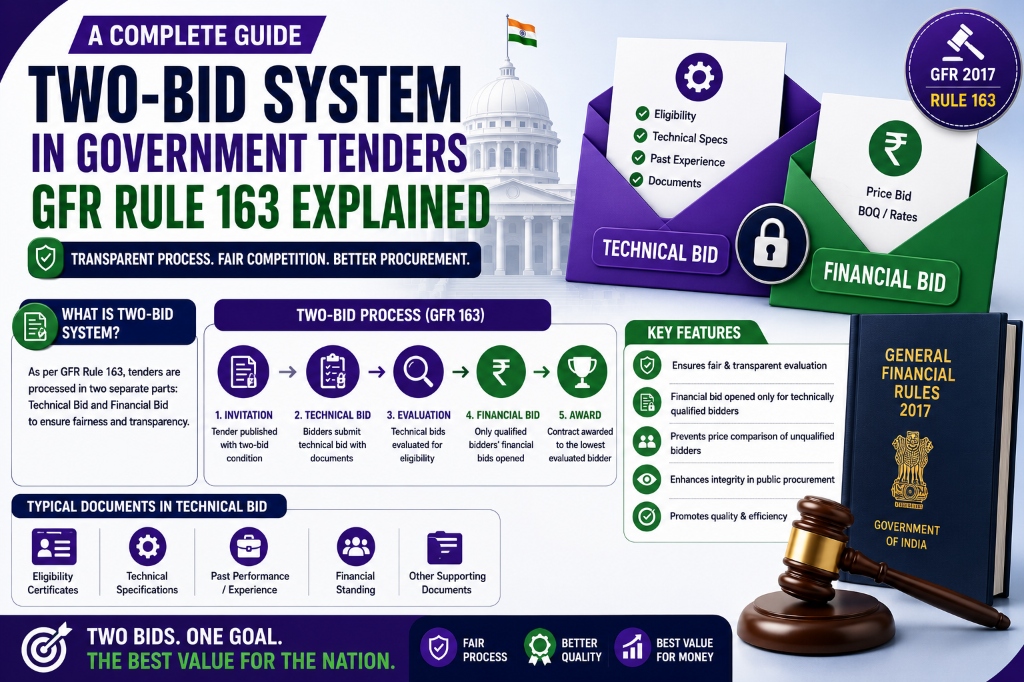
The Two-Bid System is a procurement evaluation method where bidders submit their offers in two separate parts — a Technical Bid and a Financial Bid — contained in separate sealed envelopes. The technical bid is evaluated first. Only bidders whose technical bids meet all requirements have their financial bids opened at a second stage. This ensures that price is never the sole criterion; technical competence is a prerequisite. To understand foundational rules, refer to our GFR 2017 tender rules explained.
Definition Box: Two-Bid System (GFR 2017 Rule 163) — A procurement method for high-value, complex, or technical goods where bids are submitted in two parts simultaneously: (i) a Technical Bid containing all technical details, compliance statements, and commercial terms, and (ii) a Financial Bid indicating item-wise prices. Technical bids are opened and evaluated first. Financial bids of only technically acceptable offers are opened at a second stage after notification.
Definition Box: Two-Stage Bidding (GFR 2017 Rule 164) — A distinct procurement method where bids are invited in two sequential stages: Stage 1 invites technical proposals without prices, which are evaluated and may be discussed with bidders. Stage 2 invites revised technical bids with financial prices from qualified bidders. Used when specifications cannot be finalized without bidder input.
Why the Two-Bid System Exists
- Prevents Price-Only Competition: In complex procurements (servers, medical equipment, defence systems), the cheapest non-compliant product is worse than an expensive compliant one.
- Ensures Technical Due Diligence: Buyers evaluate capability, quality, and compliance before considering cost.
- Reduces Bid Manipulation: Bidders cannot "buy" contracts by quoting unsustainably low prices for non-compliant products.
- Protects MSMEs: Small manufacturers with superior technical products but higher prices get a fair chance against cheap imports.

Get the GFR Compliance Toolkit
Know every GFR rule, protect deposits, and challenge restrictive clauses with confidence.
- ✓ 150-Point Pre-Submission Checklist (PDF)
- ✓ EMD & BG Format Verification Guide + Checker
- ✓ 5 Post-Rejection Appeal Letters (GFR 171)
- ✓ Corrigendum Monitoring & Response Checklist
🔒 256-Bit Secure Razorpay Checkout · Lifetime Access · Instant Digital Delivery
GFR Rule 163: Two-Bid System (Simultaneous Submission)
Rule 163 of GFR 2017 governs the Two-Bid System for procurement of high-value plant, machinery, and complex technical goods.
The Rule Text
"For purchasing high value plant, machinery etc. of a complex and technical nature, bids may be obtained in two parts as under: (i) Technical bid consisting of all technical details along with commercial terms and conditions; and (ii) Financial bid indicating item-wise price for the items mentioned in the technical bid. The technical bid and the financial bid should be sealed by the bidder in separate covers duly super-scribed and both these sealed covers are to be put in a bigger cover which should also be sealed and duly super-scribed. The technical bids are to be opened by the purchasing Ministry or Department at the first instance and evaluated by a competent committee or authority. At the second stage financial bids of only these technically acceptable offers should be opened after intimating them the date and time of opening the financial bid for further evaluation and ranking before awarding the contract."
Key Provisions of Rule 163
| Provision | Requirement | Consequence of Non-Compliance |
|---|---|---|
| Bid Structure | Two separate sealed envelopes (Technical + Financial) inside a master envelope | Bid rejected if not properly segregated |
| Envelope Labeling | Each envelope must be "duly super-scribed" with contents | Unlabeled envelopes may be rejected |
| Technical Opening | Technical bids opened first by the purchasing department | Financial bids remain sealed |
| Evaluation Committee | Competent committee evaluates technical bids | No individual can unilaterally disqualify |
| Financial Opening | Only technically acceptable bidders' financial bids opened | Disqualified bidders' financial bids returned unopened |
| Notification | Date and time of financial opening intimated to qualified bidders | Qualified bidders must be present or represented |
| No Price in Technical Bid | Any price indication in technical bid = disqualification | Automatic rejection |
The "No Price in Technical Bid" Rule
This is the most common disqualification in Two-Bid tenders. Any indication of price in the technical bid — even accidentally — leads to automatic rejection.
What counts as "price indication":
- Item-wise rates in technical brochures
- Total cost calculations in compliance matrices
- References to "our competitive price" or "lowest price guarantee"
- Cost-per-unit in technical specifications
- AMC charges mentioned in technical bid (should be in financial bid)
Prevention: Create a "price scrub" checklist. Before sealing the technical bid envelope, search for all currency symbols (₹, $, Rs., INR) and remove them.
GFR Rule 164: Two-Stage Bidding (Sequential Submission)
Rule 164 is often confused with Rule 163 but is fundamentally different. It is used when the buyer cannot finalize specifications without bidder input.
When Rule 164 Is Used
A ministry/department may use Two-Stage Bidding if:
| Condition | Example |
|---|---|
| (a) Cannot formulate detailed specifications without bidder input | Custom software development where requirements evolve |
| (b) Subject to rapid technological advances or market fluctuations | AI/ML procurement, cutting-edge medical devices |
| (c) Research, experiment, study, or development | R&D contracts, pilot projects |
| (d) Detailed survey/investigation required | Infrastructure projects with unknown ground conditions |
The Two-Stage Process
Stage 1: Technical Proposal (No Price)
- Bidders submit technical proposals without any price.
- Proposals evaluated by a committee.
- Committee may hold discussions with bidders (equal opportunity to all).
- Committee may revise specifications based on bidder inputs.
- Fundamental nature of procurement cannot be changed.
Stage 2: Final Bid with Price
- Only bidders whose Stage 1 bids were not rejected are invited.
- Revised terms and conditions issued.
- Bidders submit final bids with prices.
- Bidders may withdraw without penalty if they cannot meet revised specs.
- Financial evaluation and L1 determination follow.
Key Difference from Rule 163
| Aspect | Rule 163 (Two-Bid) | Rule 164 (Two-Stage) |
|---|---|---|
| Submission | Simultaneous (both envelopes together) | Sequential (technical first, financial later) |
| Price in First Stage | No (but financial bid is submitted, just sealed) | Yes — no price submitted at all in Stage 1 |
| Specification Finality | Fixed specifications | Specifications may evolve based on Stage 1 inputs |
| Bidder Discussions | Not typically allowed | Explicitly allowed and encouraged |
| Withdrawal Right | No (except under corrigendum) | Yes — bidders can withdraw after Stage 1 without penalty |
| Bid Security | EMD/PBG submitted with bid | EMD may be required at Stage 2 only |
| Use Case | Complex but specifiable goods | Complex, evolving, or R&D-type procurements |
Instant Tender Eligibility & Risk Audit
Upload any 500-page NIT / BOQ PDF. Extract hidden disqualification traps, EMD waiver clauses, and complete eligibility criteria in under 45 seconds.
Rule 163 vs. Rule 164: The Critical Difference
Understanding which rule applies is essential for correct bid preparation.
Quick Reference Table
| Parameter | Two-Bid System (Rule 163) | Two-Stage Bidding (Rule 164) |
|---|---|---|
| GFR Rule | Rule 163 | Rule 164 |
| Nature | Simultaneous two-part submission | Sequential two-stage process |
| First Stage Contains | Technical bid + commercial terms (no price) | Technical proposal only (no price, no commercial terms) |
| Second Stage Contains | Financial bid (opened only for qualified) | Final bid with price (invited from qualified) |
| Specifications | Fixed and final | May be revised after Stage 1 |
| Discussions | Generally not allowed | Explicitly allowed |
| Withdrawal | Not permitted without penalty | Permitted after Stage 1 without penalty |
| Typical Value | High-value complex goods | Very high-value, R&D, or undefined-scope projects |
| EMD | Submitted with bid | May be deferred to Stage 2 |
| Committee Role | Evaluate and qualify/disqualify | Evaluate, discuss, and revise specs |
| Examples | Medical equipment, servers, machinery | Software development, research projects, EPC contracts |
The Confusion Trap
Many bidders and even some buyers use "Two-Bid" and "Two-Stage" interchangeably. This is dangerous:
- If you prepare a Rule 163 bid for a Rule 164 tender, you may submit prices prematurely and be disqualified.
- If you prepare a Rule 164 bid for a Rule 163 tender, you may not submit your financial bid at all.
Always check the tender document's "Method of Procurement" section. It will explicitly state whether Rule 163 or Rule 164 applies.
GeM Implementation: Single Packet vs. Two-Packet Bids
GeM digitizes the Two-Bid System through "Two-Packet Bids." Understanding GeM's implementation is critical because most high-value government procurement now happens on GeM.
GeM Single Packet Bid
How it works:
- All documents (technical + financial) are submitted in one digital packet.
- The buyer evaluates both technical and financial aspects simultaneously.
- All bidders appear in the comparative statement, but some may be technically unsuitable.
- Reverse Auction (RA) is NOT available in Single Packet bids.
- Schedule-wise evaluation is NOT available — total value is used by default.
Best for: Simple procurements with straightforward technical requirements.
Limitations:
- No RA means less price competition.
- No tender committee can be constituted — evaluation is done by the buyer only.
- Forced RA may be prompted for multiple L1 cases.
GeM Two-Packet Bid
How it works:
- Packet 1 (Technical): Contains all technical documents, compliance statements, certifications, and commercial terms.
- Packet 2 (Financial): Contains the price bid (BOQ, rates, total).
- Both packets are submitted simultaneously but evaluated sequentially.
- A Technical Evaluator (new role introduced by GeM) or Tender Committee evaluates Packet 1.
- Only technically qualified bidders' Packet 2 is opened.
Best for: Complex procurements where technical compliance is critical before price evaluation.
Key Features:
- Technical Evaluator Role: GeM introduced a dedicated "Technical Evaluator" user role for buyers to enable tender committee evaluation.
- Bid to RA Available: After technical qualification, the top 50% (or minimum 3) enter Reverse Auction.
- Schedule-wise Evaluation: Available for multi-item tenders.
- Tender Committee: Can be constituted for evaluation.
GeM Two-Packet Process Flow
Step 1: Bid Creation (Buyer)
- Buyer selects "Two-Packet Bid" at bid creation.
- Defines technical specifications, eligibility criteria, and evaluation parameters.
- Sets bid submission deadline.
Step 2: Bid Submission (Seller)
- Seller uploads Packet 1 (Technical) and Packet 2 (Financial) separately.
- Both packets must be submitted before the deadline.
- Packet 2 is encrypted and cannot be viewed by anyone until technical evaluation is complete.
Step 3: Technical Bid Opening
- Buyer/Tender Committee opens Packet 1.
- Evaluates technical compliance against specifications.
- Marks each bidder as "Technically Suitable" or "Technically Unsuitable."
- EMD of technically unsuitable bidders is returned within 15 days.
Step 4: Financial Bid Opening
- Only technically suitable bidders are notified of the financial bid opening date/time.
- Packet 2 (Financial) is decrypted and opened.
- Comparative statement generated showing only qualified bidders.
- L1 (lowest) bidder identified.
Step 5: Post-Opening (if applicable)
- MSME price preference applied if L1 is non-MSE.
- Reverse Auction initiated if buyer opted for "Bid to RA."
- Contract awarded to L1 (or matched MSMEs).
When Is the Two-Bid System Mandatory?
By Value Threshold
| Procurement Value | Method | Two-Bid Applicability |
|---|---|---|
| Up to ₹50,000 | Direct Purchase (GeM) | Not applicable |
| ₹50,000 – ₹10 lakh | L1 Purchase (GeM) | Not applicable |
| ₹10 lakh – ₹50 lakh | Bidding/RA (GeM) or LTE (offline) | Buyer discretion |
| ₹50 lakh & above | Open Tender (offline) | Mandatory for complex goods |
| Above ₹10 lakh (GeM) | Bidding/RA (GeM) | Buyer discretion; common for complex items |
By Nature of Procurement
The Two-Bid System is mandatory or strongly recommended for:
| Category | Examples | Why Two-Bid? |
|---|---|---|
| Medical Equipment | MRI machines, ventilators, dialysis units | Patient safety; technical specs critical |
| IT Infrastructure | Servers, data centers, networking equipment | Compatibility and performance specs vary |
| Defence Equipment | Weapons, vehicles, communication systems | National security; strict technical standards |
| Laboratory Equipment | Spectrometers, microscopes, HPLC systems | Precision and calibration requirements |
| Industrial Machinery | CNC machines, presses, generators | Complex installation and after-sales service |
| Software Development | Custom applications, ERP systems | Functional requirements need validation |
| Construction (Complex) | Bridges, tunnels, high-rise buildings | Engineering specs and material quality |
Buyer Discretion
Even below ₹50 lakh, buyers may opt for Two-Bid if:
- Technical complexity warrants separate evaluation.
- Previous single-bid procurements resulted in non-compliant supplies.
- The item is critical to operations (e.g., hospital equipment, safety systems).
How to Prepare a Winning Technical Bid
The technical bid is your gateway to the financial stage. If you fail here, your price never gets seen. Here's how to build a bulletproof technical bid.
The Technical Bid Compliance Matrix
Create a table that maps every tender requirement to your compliance evidence:
| S.No | Tender Requirement | Your Compliance | Evidence Document | Page No. |
|---|---|---|---|---|
| 1 | ISO 9001:2015 Certification | ✅ Compliant | ISO Certificate | Annexure-A, Pg 1 |
| 2 | Minimum 5 Years Experience | ✅ Compliant | Experience Certificates | Annexure-B, Pg 1-5 |
| 3 | Turnover ≥ ₹10 Cr | ✅ Compliant | Audited Balance Sheet | Annexure-C, Pg 1 |
| 4 | OEM Authorization | ✅ Compliant | OEM Letter | Annexure-D, Pg 1 |
| 5 | Technical Specifications (Item 1) | ✅ Compliant | Technical Brochure | Annexure-E, Pg 1-3 |
| 6 | Delivery Timeline: 60 Days | ✅ Compliant | Delivery Schedule | Annexure-F, Pg 1 |
| 7 | Warranty: 2 Years | ✅ Compliant | Warranty Terms | Annexure-G, Pg 1 |
| 8 | After-Sales Service Network | ✅ Compliant | Service Center List | Annexure-H, Pg 1 |
Essential Technical Bid Documents
| Document | Purpose | Common Mistakes |
|---|---|---|
| Cover Letter | Introduction, bid validity, earnestness | Generic letter not addressing specific tender |
| Compliance Statement | Point-by-point response to specifications | "Complied" without evidence; "Will comply" instead of "Complied" |
| Technical Brochures | Product specifications, datasheets | Outdated brochures; specs not matching tender |
| OEM Authorization | Proof of dealership/distributorship | Expired authorization; wrong product scope |
| Experience Certificates | Past supply proof | Certificates not on buyer's letterhead; missing order value |
| Financial Documents | Turnover, net worth, banking | Unaudited statements; missing CA certification |
| Quality Certifications | ISO, BIS, CE, industry-specific | Expired certificates; wrong standard version |
| Test Reports | Third-party testing evidence | Reports from non-NABL labs; wrong test parameters |
| Service Network Details | After-sales capability | Vague addresses; no contact numbers |
| Manpower Details | Installation/training team | Insufficient team size; unqualified personnel |
The "Complied" vs. "Will Comply" Trap
| Response | Meaning | Risk |
|---|---|---|
| "Complied" | You already meet the requirement | Low risk if evidence is attached |
| "Will comply" | You promise to comply later | High risk — evaluators may reject as non-compliant |
| "Partially complied" | You meet some but not all aspects | Medium risk — may be accepted if minor deviation |
| "Not complied" | You don't meet the requirement | Automatic disqualification unless deviation is permissible |
Golden Rule: Never write "Will comply" unless the tender explicitly allows it. Always write "Complied" and attach evidence.
Technical Bid Scrub Checklist (Before Submission)
- No price figures anywhere in the technical bid.
- No currency symbols (₹, $, Rs., INR).
- No references to "our competitive pricing" or "lowest cost."
- All pages numbered and signed.
- Index/table of contents included.
- Every "Complied" has corresponding evidence.
- Certificates are current (not expired).
- OEM authorization covers the exact tender period.
- Experience certificates mention the specific items supplied.
- Test reports are from NABL/accredited labs.
- Format matches tender requirements (PDF, bound, etc.).
How to Prepare a Winning Financial Bid
The financial bid is opened only for technically qualified bidders. Your goal: be the lowest among the qualified.
Financial Bid Structure
| Component | Contents | Common Format |
|---|---|---|
| Price Schedule/BOQ | Item-wise rates, quantities, totals | Excel template (protected) |
| Total Bid Price | Grand total (inclusive/exclusive of GST) | As per tender instructions |
| Validity Period | How long the price remains valid | Typically 90–180 days |
| Price Break-up | Cost components (optional but helpful) | Material, labor, overhead, profit |
| Schedule of Rates | For works contracts | As per CPWD/departmental schedule |
Pricing Strategy for Two-Bid Tenders
Strategy 1: The "Qualified L1" Approach
- Ensure technical bid is flawless (100% compliance).
- Price aggressively but sustainably.
- Remember: you're only competing against other technically qualified bidders — not the entire field.
Strategy 2: The "MSME Band" Approach
- If you're an MSME, you don't need to be L1.
- Quote within L1+15% (if L1 is non-MSE).
- Focus on technical excellence to ensure qualification.
- Let the price preference do the rest.
Strategy 3: The "Technical Premium" Approach
- If your product has genuine technical superiority, price slightly higher.
- In Two-Bid tenders, technical evaluation is rigorous. A marginally better product may justify a 5–10% price premium to the buyer.
- This works best when the tender has "quality-cum-cost based" evaluation (QCBS) rather than pure L1.
GST: Inclusive vs. Exclusive
| Tender Instruction | What to Quote | Example |
|---|---|---|
| "Rates inclusive of all taxes" | Quote total including GST | ₹10,00,000 (incl. 18% GST) |
| "Rates exclusive of GST" | Quote base price; GST added separately | ₹8,47,458 + 18% GST = ₹10,00,000 |
| "GST extra as applicable" | Quote base price; GST will be added | ₹8,47,458 + GST @ applicable rate |
Critical: Read the tender instructions carefully. Quoting inclusive when exclusive is required (or vice versa) can lead to disqualification or financial loss.
The Technical Evaluation Process: What Happens Behind Closed Doors
Understanding how technical evaluation works helps you prepare better and challenge unfair disqualifications.
The Evaluation Committee
| Role | Responsibility |
|---|---|
| Convener/Chairman | Heads the committee; signs the evaluation report |
| Technical Expert | Evaluates technical specifications, test reports, compliance |
| Finance Member | Checks financial eligibility, turnover, EMD validity |
| User Department Representative | Ensures technical compliance meets operational needs |
| Procurement Officer | Ensures procedural compliance |
The Evaluation Steps
Step 1: Eligibility Check
- Are all mandatory documents present?
- Are EMD, DSC, and registration valid?
- Is the bidder blacklisted/debarred?
- Non-compliant at this stage = outright rejection.
Step 2: Technical Compliance Check
- Point-by-point comparison of tender specs vs. bidder's technical bid.
- Minor deviations may be acceptable if explicitly allowed in the tender.
- Major deviations = rejection.
Step 3: Experience & Capability Assessment
- Past performance evaluated.
- Manufacturing/installation capability verified.
- Service network assessed.
Step 4: Quality Assessment
- Certifications verified (ISO, BIS, etc.).
- Test reports scrutinized.
- Sample evaluation (if required by tender).
Step 5: Scoring (if applicable)
- Some tenders use a scoring system (e.g., 70% technical + 30% financial).
- Technical score determined first.
- Only bidders above a threshold score proceed to financial evaluation.
Step 6: Preparation of Evaluation Report
- Committee prepares a detailed report.
- Each bidder's status (Suitable/Unsuitable) recorded with reasons.
- Report signed by all committee members.
Your Rights as a Bidder
- Right to be present at technical bid opening (if offline).
- Right to representation if you believe evaluation was unfair.
- Right to know the evaluation criteria in advance (must be in tender document).
- Right to challenge if the committee exceeded its mandate or changed criteria post-bid.
Financial Bid Opening: L1 Determination & MSME Price Preference
The Financial Opening Process
- Notification: All technically qualified bidders are informed of the date, time, and venue of financial bid opening.
- Opening: Financial bids of only qualified bidders are opened in the presence of bidders or their representatives.
- Comparative Statement: A tabular statement is prepared showing bidder names and their total quoted prices.
- L1 Identification: The lowest responsive bidder is identified as L1.
- Reasonableness Check: The buyer checks if L1 price is reasonable (not abnormally low).
MSME Price Preference in Two-Bid Tenders
The Two-Bid System amplifies MSME advantages because:
- Technical qualification filters out low-quality cheap bidders. MSMEs with genuine technical capability qualify while price-only competitors are eliminated.
- Price preference applies only among qualified bidders. If L1 is a non-MSE and you're an MSE within L1+15%, you can match and win.
- 25% quantity reservation applies to the total tender value, not fragmented pieces.
Example:
| Bidder | Technical Status | Financial Quote | MSME? | Outcome |
|---|---|---|---|---|
| M/s. GlobalTech | ✅ Qualified | ₹8.5 Cr | No | L1 |
| M/s. BharatMfg | ✅ Qualified | ₹9.6 Cr (12.9% above L1) | Yes | Within 15% band → Can match L1 |
| M/s. CheapImport | ❌ Disqualified | Not opened | No | Eliminated at technical stage |
| M/s. PrecisionEng | ✅ Qualified | ₹9.8 Cr | Yes | Within 15% band → Can match L1 |
Result: M/s. BharatMfg and M/s. PrecisionEng (both MSMEs) can match L1 at ₹8.5 Cr and win up to 25% quantity each. The cheap import was eliminated at technical stage — protecting the MSMEs from unfair price competition.
Common Two-Bid Mistakes That Disqualify Bidders
❌ Mistake 1: Price in Technical Bid
The Error: Including a price list, cost breakdown, or even a reference to "our competitive price" in the technical bid.
The Consequence: Automatic disqualification. No appeal.
The Fix: Run a "price scrub" — search for all currency symbols and price-related words in the technical bid before submission.
❌ Mistake 2: Missing Mandatory Documents
The Error: Assuming the committee will evaluate based on "best effort" if a document is missing.
The Consequence: Disqualification for non-compliance with mandatory requirements.
The Fix: Use the compliance matrix. Check every mandatory document against the tender's "List of Documents Required."
❌ Mistake 3: Expired Certificates
The Error: Submitting an ISO certificate that expired 2 months ago.
The Consequence: Disqualification if the certificate was mandatory.
The Fix: Maintain a "certificate calendar" with 60-day advance renewal reminders.
❌ Mistake 4: Wrong BOQ Type
The Error: Filling an Item Rate BOQ as if it's Item Wise (leaving some items blank).
The Consequence: BOQ validation error; bid rejected.
The Fix: Confirm the BOQ type before filling. See our BOQ Error Fix Guide.
❌ Mistake 5: Not Attending Technical Opening
The Error: Skipping the technical bid opening, assuming you'll be informed of results later.
The Consequence: You miss the opportunity to object to irregularities in real-time.
The Fix: Always attend bid openings (physically or virtually) or send an authorized representative with a notarized power of attorney.
❌ Mistake 6: Generic Technical Bid
The Error: Using the same technical bid for every tender without customizing for specific requirements.
The Consequence: Low technical scores or disqualification for non-specific compliance.
The Fix: Customize every technical bid. Address the specific tender's technical specifications, not generic product descriptions.
❌ Mistake 7: Underestimating Delivery Timeline
The Error: Promising 30-day delivery knowing it takes 45 days.
The Consequence: If you win, you face liquidated damages. If the committee checks your past delivery performance, you may be disqualified.
The Fix: Add 20% buffer to your realistic delivery timeline.
MSME Advantages in the Two-Bid System
The Two-Bid System is arguably the most MSME-friendly procurement method. Here's why:
Advantage 1: Technical Merit Over Price
In single-bid (open) tenders, the cheapest bidder often wins — even with inferior products. In Two-Bid tenders, cheap but non-compliant bidders are eliminated at the technical stage. MSMEs with superior technical products but slightly higher prices get a fair chance.
Advantage 2: EMD Exemption
MSMEs are exempt from Earnest Money Deposit (EMD) in most tenders. In the Two-Bid System, this is particularly valuable because:
- You can bid on more Two-Bid tenders simultaneously (each requiring 2–5% EMD for non-MSMEs).
- If disqualified at technical stage, you lose nothing (non-MSMEs lose EMD only if they withdraw, but the blocked capital is still a cost).
Advantage 3: Price Preference After Technical Qualification
The 15% price preference for MSMEs applies only after technical qualification. In a single-bid tender, a non-MSE might quote so low that even with 15% preference, the MSME cannot match. In a Two-Bid tender, the non-MSE must first pass technical evaluation — and many low-price bidders fail here.
Advantage 4: 25% Quantity Reservation
For tenders where the 25% MSE reservation applies, the Two-Bid System ensures that the reserved quantity goes to technically capable MSEs — not just the cheapest MSE who might deliver substandard goods.
Advantage 5: Startup & DPIIT Benefits
DPIIT-recognized startups enjoy:
- Relaxed eligibility criteria (turnover, experience).
- Exemption from prior turnover and experience in some categories.
- Self-certification of compliance (reducing documentation burden).
In the Two-Bid System, these benefits help startups qualify technically even without extensive track records.
Two-Bid vs. Single-Bid: Complete Comparison
| Parameter | Single-Bid System | Two-Bid System (Rule 163) | Two-Stage Bidding (Rule 164) |
|---|---|---|---|
| GFR Rule | Rule 161 (Open Tender) | Rule 163 | Rule 164 |
| Submission | One envelope/packet | Two envelopes/packets simultaneously | Two stages sequentially |
| Price Visibility | All prices visible at opening | Price hidden until technical qualification | No price in Stage 1 |
| Technical Evaluation | Concurrent with price | Before price evaluation | Before price invitation |
| Committee Required | Optional | Mandatory | Mandatory |
| Bidder Discussions | Not allowed | Not typically allowed | Explicitly allowed |
| Withdrawal | Penalty applies | Penalty applies | Allowed after Stage 1 without penalty |
| EMD | Submitted with bid | Submitted with bid | May be deferred to Stage 2 |
| Best For | Standard goods, simple specs | Complex technical goods | R&D, evolving specs, undefined scope |
| Value Range | Any (typically ₹50L+) | High-value complex goods | Very high-value, innovative projects |
| MSME Advantage | Moderate | High | High |
| GeM Equivalent | Single Packet | Two Packet | Custom Bid (rare) |
| Time to Award | 4–6 weeks | 6–8 weeks | 8–12 weeks |
| Audit Risk | Low | Medium | Medium |
Case Study: How a Hyderabad MSME Won a ₹6.5 Cr Tender via Two-Bid System
Company: Vintech Medical Systems Pvt. Ltd., Hyderabad (Udyam-registered Small Enterprise, DPIIT-recognized startup) Sector: Medical Diagnostic Equipment Tender: Supply, installation, and commissioning of 25 dialysis machines for a Central Government hospital Value: ₹6.5 Crore Method: Two-Bid System (Rule 163) via CPPP
The Challenge
The tender attracted 14 bidders, including 3 large multinational corporations (MNCs) with decades of experience. Vintech was a 4-year-old startup with limited government supply history. Their product was technically superior (made-in-India, AI-powered monitoring) but priced 8% higher than the cheapest MNC quote.
The Strategy
Phase 1: Technical Bid Dominance
Vintech's team spent 3 weeks on the technical bid — 2 weeks more than they typically spent. Their approach:
- Compliance Matrix: 47-line matrix mapping every tender requirement to evidence.
- Technical Superiority: Detailed documentation of their AI-powered patient monitoring system (not offered by any competitor).
- Make in India: Class-I Local Supplier certification under PPP-MII Order (62% local content).
- Startup Benefits: DPIIT recognition certificate; self-certification of compliance where permitted.
- Service Network: 12 service centers across India (more than any MNC).
- Test Reports: NABL-accredited lab reports for all critical parameters.
- OEM Status: They were the OEM (not a reseller), which the tender preferred.
Phase 2: Surviving Technical Evaluation
- 14 bidders submitted.
- Technical opening revealed 2 bids with price indications in technical envelopes — instant disqualification.
- 1 bid missing mandatory ISO 13485 certificate — disqualified.
- 2 bids from blacklisted suppliers — disqualified.
- 1 bid with expired OEM authorization — disqualified.
- 8 bidders remained technically qualified — including all 3 MNCs and Vintech.
Phase 3: Financial Bid Opening
| Bidder | Technical Status | Financial Quote | Notes |
|---|---|---|---|
| M/s. MedGlobal (MNC) | ✅ Qualified | ₹6.02 Cr | L1 |
| M/s. EuroHealth (MNC) | ✅ Qualified | ₹6.18 Cr | L2 |
| M/s. Vintech Medical | ✅ Qualified | ₹6.50 Cr | L3, 8% above L1 |
| M/s. AsiaCare (MNC) | ✅ Qualified | ₹6.55 Cr | L4 |
| 4 other bidders | ✅ Qualified | ₹6.60–₹7.10 Cr | L5–L8 |
Phase 4: MSME Price Preference Activation
- L1 (M/s. MedGlobal) was a non-MSE.
- Vintech was an MSE within L1+15% (8% < 15%).
- Vintech received a Price Match Accept notification.
- They matched L1 at ₹6.02 Cr.
- Under the 25% quantity reservation for MSEs, Vintech was awarded 100% of the contract (the hospital needed all 25 machines from one supplier for standardization).
The Result
- Contract Value: ₹6.02 Cr (matched L1)
- Vintech's Margin: 14% (they had priced at ₹6.50 Cr with 20% margin; at ₹6.02 Cr, margin was 14% — still healthy).
- Follow-on Contracts: 3 AMC contracts worth ₹1.8 Cr over 5 years.
- Hospital Outcome: Got AI-powered dialysis machines at L1 price.
Key Lessons
- Technical bid is 70% of the battle. Vintech spent 3 weeks on technical bid preparation. The 5 disqualified competitors lost at this stage — not at price.
- Two-Bid System protects quality. The 2 cheapest bidders were disqualified for technical non-compliance. The hospital got better equipment at a fair price.
- MSME price preference is a superpower. Vintech didn't need to be L1. They needed to be qualified and within 15%.
- Make in India + MSME + Startup = triple advantage. Each certification added credibility and opened preference doors.
"We were the smallest company in the room. But we were the only one that read every line of the technical specifications. The Two-Bid System doesn't care about your size — it cares about your compliance." — Dr. Priya Reddy, CEO, Vintech Medical Systems Pvt. Ltd.
Frequently Asked Questions (FAQ)
Q1. What is the difference between Two-Bid and Two-Stage bidding?
A: In Two-Bid (Rule 163), technical and financial bids are submitted simultaneously in separate envelopes. Technical bids are opened first; financial bids of only qualified bidders are opened later. In Two-Stage (Rule 164), technical proposals are submitted first without any price. After evaluation and possible discussions, qualified bidders are invited to submit final bids with prices in Stage 2. Two-Stage is used when specifications cannot be finalized without bidder input.
Q2. Can I submit a single envelope if the tender asks for Two-Bid?
A: No. If the tender specifies Two-Bid, you must submit two separate sealed envelopes (Technical and Financial) inside a master envelope. Submitting a single envelope will result in rejection. On GeM, you must upload Packet 1 and Packet 2 separately.
Q3. What happens if I accidentally include a price in my technical bid?
A: Automatic disqualification. There is no exception for "accidental" inclusion. Before sealing your technical bid, run a search for all currency symbols (₹, $, Rs., INR) and remove them. This is the #1 reason for disqualification in Two-Bid tenders.
Q4. How long does the Two-Bid process take?
A: Typically 6–8 weeks from bid submission to contract award. This includes: technical bid opening (1 week), technical evaluation (2–3 weeks), notification to qualified bidders (1 week), financial bid opening (1 week), and post-opening formalities (1–2 weeks). Two-Stage bidding takes longer (8–12 weeks) due to the additional Stage 1 evaluation and discussion period.
Q5. Is the Two-Bid System mandatory on GeM?
A: No. On GeM, the buyer chooses between Single Packet and Two-Packet bids. Two-Packet is recommended for complex procurements but not mandatory. However, for high-value, technically complex items, most buyers opt for Two-Packet to ensure compliance before price evaluation.
Q6. Can a bidder challenge technical disqualification?
A: Yes. If you believe your technical bid was wrongly disqualified, you can: (1) File a representation with the Head of Department within the time limit specified in the tender. (2) File a grievance on GeM/CPPP. (3) Approach CVC if malafide is suspected. (4) File a writ petition under Article 226 if procedural violations are proven. However, you cannot challenge the committee's technical judgment unless it was arbitrary, biased, or exceeded its mandate.
Q7. Do MSME benefits apply in Two-Bid tenders?
A: Yes. In fact, Two-Bid tenders are more favorable to MSMEs than single-bid tenders because: (1) Technical qualification eliminates cheap non-compliant competitors. (2) The 15% price preference and 25% quantity reservation apply after technical qualification. (3) EMD exemption reduces bidding costs.
Q8. What is a "Technical Evaluator" on GeM?
A: GeM introduced a "Technical Evaluator" user role to enable buyers to assign technical bid evaluation to committee members. The Technical Evaluator can view Packet 1, mark bidders as suitable/unsuitable, and recommend qualification. This role is separate from the buyer's main account and ensures independent technical evaluation.
Q9. Can I withdraw my bid after technical qualification?
A: In Rule 163 (Two-Bid), withdrawal after technical qualification but before financial opening typically results in EMD forfeiture. In Rule 164 (Two-Stage), withdrawal after Stage 1 is explicitly permitted without penalty if you cannot meet revised specifications. Always check the tender's specific terms.
Q10. What should I do if my financial bid is not opened?
A: If your financial bid was not opened, it means you were technically disqualified. You should: (1) Request a copy of the technical evaluation report to understand why. (2) If the reason is unclear or unfair, file a representation. (3) Use the feedback to improve your next technical bid. (4) Your EMD will be returned within 15 days (for GeM) or as per tender terms (for offline).
Conclusion & 21-Day Action Plan
The Two-Bid System is the great equalizer of Indian government procurement. It doesn't matter if you're a ₹100 crore conglomerate or a ₹1 crore MSME — what matters is whether your technical bid meets every specification, every certification requirement, and every compliance criterion. The MNCs that lost to Vintech Medical Systems didn't lose because of price. They lost because they treated the technical bid as a formality.
For MSMEs, the Two-Bid System is not a hurdle — it's a competitive moat. Your technical depth, your certifications, your local service network, and your compliance discipline are assets that cheap competitors cannot replicate. The 15% price preference and 25% quantity reservation are powerful tools, but they only work if you first survive the technical stage.
The data is clear: in Two-Bid tenders, 30–40% of bidders are disqualified at the technical stage. Most of these disqualifications are preventable — expired certificates, missing documents, price in the technical bid, or generic compliance statements. The bidders who invest time in their technical bid reap disproportionate rewards.
21-Day Two-Bid Mastery Plan
| Week | Action |
|---|---|
| Week 1 (Days 1–3) | Audit your last 5 technical bids. Identify every "Will comply" and replace with "Complied" + evidence. |
| Week 1 (Days 4–7) | Create a master compliance matrix template. Populate it with your standard certifications and documents. |
| Week 2 (Days 8–10) | Identify 3 active Two-Bid tenders in your category. Download tender documents and BOQ templates. |
| Week 2 (Days 11–14) | Prepare technical bids for all 3. Run the "price scrub" checklist. Get a second opinion from a colleague. |
| Week 3 (Days 15–17) | Submit technical bids. Attend technical bid opening (physically or virtually). |
| Week 3 (Days 18–21) | If qualified, prepare financial bids. If disqualified, request evaluation report and improve for next time. |
The Golden Rules of Two-Bid Success
- Technical bid is 70% of the battle. Spend 70% of your preparation time on it.
- No price in technical bid. Ever. Not even a hint.
- "Complied" needs evidence. Every claim must have a document.
- Certificates must be current. A 1-day expired certificate can disqualify you.
- Attend the opening. Irregularities happen. You need to see them.
"In the Two-Bid System, your price is irrelevant until your technical bid is flawless. The MNCs have bigger budgets. You have sharper compliance. Make compliance your weapon."
Related Articles
- BOQ Excel Validation Error: Complete Fix Guide
- GeM Portal Reverse Auction Strategy: Complete Winning Guide
- Make in India Preference Policy: Complete DPIIT PPP-MII Guide
- Limited Tender Enquiry (LTE): Rules, Eligibility & Supplier Registration
- Proprietary Article Certificate (PAC): GFR 166 Complete Guide
- Debarment & Blacklisting in Government Tenders: GFR 2017 Rules
- NSIC Single Point Registration: Complete Benefits Guide
- Splitting of Tenders Under GFR Rule 157: Detection & Challenge Guide
Disclaimer: This article is for informational purposes only and does not constitute legal advice. Procurement rules are subject to amendment. Always verify current GFR 2017 provisions and tender-specific terms before bidding. TenderFlow Pro is not affiliated with GeM, CPPP, or any government department.
© 2026 TenderFlow Pro. All rights reserved.