Pre-Bid Meeting Importance & Questions India (2026): Complete Guide to Strategic Clarifications
Contractors who attend pre-bid conferences are 40% more likely to submit 100% compliant bids. Master the GFR 2017 Rule 160 legal framework, discover 50 high-impact questions that win contracts, and learn how to turn pre-bid minutes into your decisive bidding advantage.
menu_book Table of Contents
The ₹85 Lakh Tender Lost Because Nobody Asked One Question
One question. That's all it would have taken.
A pre-bid meeting is not a formality. It is a strategic weapon that separates winning bidders from rejected bidders. And in 2026, with tender documents growing more complex and evaluation criteria becoming more opaque, the pre-bid meeting is often the only chance you get to understand what the buyer actually wants — before you spend ₹2 lakh preparing a bid that misses the mark.
Here is the reality that should change how you approach every tender:
| Statistic | What It Means for You |
|---|---|
| 40% higher compliance rate | Bidders who attend pre-bid meetings are 40% more likely to submit compliant bids (National Tenders Research, 2025) |
| 25% higher win rate | Firms that ask at least one strategic question during pre-bid enjoy a 25% higher win rate |
| 70% of complex tenders | Require or strongly recommend pre-bid attendance for infrastructure projects above ₹10 crore |
| 100% transparency | All pre-bid clarifications are shared with all bidders — but only attendees get to ask |
| ₹85 lakh average contract | Value of tenders where pre-bid clarifications changed the outcome |
| ₹50,000–₹2,00,000 | Average bid preparation cost — wasted if you misread the tender |
| 7–10 days | Optimal window to submit clarification questions before deadline |
| 2–5 working days | Time for procuring entity to publish pre-bid minutes |
"I skipped the pre-bid meeting for a ₹85 lakh electrical works tender because it was 400 km away and virtual attendance wasn't offered. I prepared my bid based on the tender document alone. After submission, I discovered through the published pre-bid minutes that the department had clarified a critical technical specification — requiring ISI-certified cables instead of the generic 'copper cable' mentioned in the document. My bid used non-ISI cables. I was technically disqualified. One meeting. One clarification. One question I never got to ask. ₹85 lakh contract — gone."
— Suresh Patil, Electrical Contractor, Maharashtra
The problem isn't that pre-bid meetings are hard to attend. The problem is that most bidders don't know how to use them. They either skip them entirely, send junior staff who can't ask intelligent questions, or ask the wrong questions that reveal weakness instead of gathering intelligence.
This guide gives you the complete pre-bid playbook — when attendance is mandatory, how to prepare in 5 days, 50 questions that win tenders, 10 questions that destroy bids, and how to turn every clarification into a competitive advantage.
Key Takeaways (Read This First)
| Insight | Detail |
|---|---|
| Mandatory vs Optional | Check NIT/ITB — mandatory attendance is explicitly stated; optional is strongly recommended |
| 40% Compliance Boost | Attending pre-bid dramatically reduces rejection risk |
| 25% Win Rate Increase | Strategic questions correlate directly with winning |
| Minutes = Legal Document | Pre-bid minutes form part of the tender; they override ambiguous original clauses |
| Ask Early, Ask Smart | Submit questions 7–10 days before deadline; ask only what affects compliance/price/risk |
| Never Reveal Strategy | Your questions are shared with all bidders — don't give away your competitive edge |
| Virtual = Equal Power | Online pre-bid meetings offer the same clarifications without travel costs |
🚨 Stop Losing Tenders to Missed Clarifications
One ambiguous specification. One misunderstood evaluation criterion. One missed MSME exemption clause. That's all it takes to lose a tender you could have won. The Bid Mastery Toolkit gives you the exact pre-bid preparation system, clarification question templates, and compliance checklists to ensure you extract every advantage from every pre-bid meeting. For the comprehensive end-to-end framework, consult our complete government tender guide India.
Bid Mastery Toolkit — ₹599 includes:
- ✅ 150-Point Ultimate Pre-Submission Checklist (P1) — Pre-bid analysis included
- ✅ 50-Point Technical Bid Compliance Audit (P2)
- ✅ 30-Point Financial Bid Accuracy Verification (P3)
- ✅ Bid Submission Timeline & Deadline Planner (P11)
- ✅ Corrigendum Monitoring & Response Checklist (P10)
₹2,496 ₹599 (Just ₹150 per tool)
⚡ Digital Download • Lifetime Access • 7-Day Money-Back Guarantee
💡 One missed clarification = ₹85L+ loss. This toolkit costs ₹599.
Generate Lawyer-Grade Pre-Bid Representation Letters
Found restrictive tender clauses or biased OEM specifications? Use our AI Protest & Representation Generator to draft formal pre-bid queries cited under GFR 2017 Rule 171 in under 60 seconds.
Quick Answer: Should You Attend the Pre-Bid Meeting?
Yes. Always yes. Unless the meeting is on another continent and virtual attendance is not offered, you should attend every pre-bid meeting for every tender you intend to bid on.
Here's the 30-second decision tree:
| Question | If Yes | If No |
|---|---|---|
| Is attendance mandatory in NIT/ITB? | Attend or be disqualified | Still attend — optional attendance is a competitive advantage |
| Is the tender value >₹10 crore? | Attendance is almost always mandatory or strongly recommended | Still attend — high-value tenders have complex specs |
| Is it a turn-key or sophisticated equipment tender? | Mandatory per GFR 2017 Rule 160 | N/A — these always have pre-bid |
| Can you attend virtually? | Zero excuse not to attend | Request virtual option or send representative |
| Is the meeting 500+ km away? | Attend virtually or send local representative | Still submit written clarifications |
| Do you have any doubt about specs, eligibility, or evaluation? | Attend and ask — doubt = rejection risk | If 100% certain, still attend for competitive intelligence |
Bottom line: The cost of attending a pre-bid meeting is ₹0 (virtual) to ₹5,000 (travel). The cost of missing a critical clarification is ₹50,000–₹85,00,000 in lost contracts and forfeited EMD. The math is not close.
What Is a Pre-Bid Meeting?
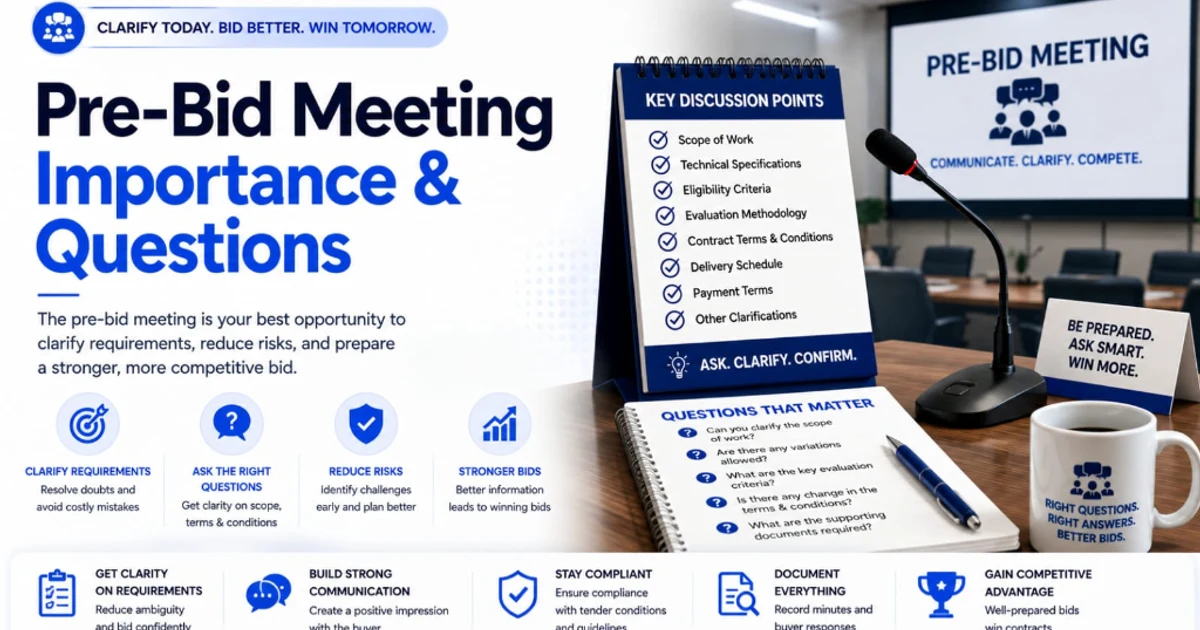
A pre-bid meeting (also called a pre-bid conference, pre-tender meeting, or bidder conference) is a formal clarification session organized by the procuring authority after publishing the tender document but before the bid submission deadline. It allows potential bidders to:
- 1Ask technical questions about specifications, scope, and requirements
- 2Clarify eligibility conditions and document requirements
- 3Understand evaluation criteria and scoring methodology
- 4Resolve ambiguities in tender documents, BOQ, and contract terms
- 5Request clarifications on delivery timelines, locations, and logistics
- 6Network with competitors and gauge market interest
- 7Observe the buyer's priorities and tone
The Pre-Bid Meeting Lifecycle
| Stage | Timeline | What Happens |
|---|---|---|
| Tender Publication | Day 0 | NIT published on CPPP/GeM/state portal |
| Pre-Bid Meeting Scheduled | Day 3–7 | Date, time, venue announced in NIT/ITB |
| Registration Deadline | 1–2 days before meeting | Bidders register to attend (mandatory for headcount) |
| Pre-Bid Meeting | Day 7–14 | Presentation + Q&A session |
| Minutes Published | Within 2–5 working days | Official record shared with all bidders |
| Clarification Window | Until 7–10 days before bid deadline | Written clarifications accepted |
| Corrigendum (if needed) | After clarifications | Official amendments to tender document |
| Bid Submission | As per NIT | Final deadline |
What Happens During a Pre-Bid Meeting
| Segment | Duration | Content |
|---|---|---|
| Introduction | 5–10 min | Project overview, department representatives, agenda |
| Tender Presentation | 15–30 min | Technical requirements, scope, timeline, evaluation criteria |
| Document Walkthrough | 10–15 min | Key clauses, BOQ highlights, critical dates |
| Q&A Session | 30–60 min | Bidders ask questions; authority provides clarifications |
| Site Visit (if applicable) | 1–3 hours | Physical inspection of project site |
| Informal Networking | 15–30 min | Bidders interact with officials and each other |
📚 Related: Read our Tender Document Anatomy Explained to understand every section of the tender document before walking into a pre-bid meeting.
GFR 2017 Rule 160: The Legal Framework
Pre-bid meetings are not optional niceties. They are governed by GFR 2017 and carry legal weight that can make or break your bid.
What GFR 2017 Says About Pre-Bid Conferences
Under GFR 2017, Chapter 6 (Procurement of Goods), Rule 160(x):
"In case of turn-key contract(s) or contract(s) of special nature for procurement of sophisticated and costly equipment or wherever felt necessary, a suitable provision is to be kept in the bidding documents for one or more rounds of pre-bid conference for clarifying issues and clearing cobwebs, if any, about the specifications and other allied technical details of the plant, equipment and machinery etc. projected in the bidding document. The date, time and place of pre-bid conference should be indicated in the bidding document. This date should be sufficiently ahead of bid opening date. The records of such conference shall be intimated to all bidders and shall also be exhibited on the website(s) where tender was published."
Key Legal Principles
| Principle | What It Means for You |
|---|---|
| Mandatory for complex tenders | Turn-key, sophisticated equipment, and high-value contracts must have pre-bid provisions |
| Must be announced in NIT | Date, time, and place must be in the bidding document — no surprise meetings |
| Sufficiently ahead of deadline | Must allow time for bidders to incorporate clarifications into bids |
| Minutes are binding | Records must be shared with ALL bidders and published on the portal |
| Minutes override ambiguity | If original document is ambiguous, minutes provide authoritative clarification |
| Corrigenda may follow | Material clarifications may result in official amendments to the tender |
Pre-Bid Minutes as Legal Evidence
Pre-bid meeting minutes have the same legal standing as the original tender document. In case of disputes:
| Scenario | Legal Standing |
|---|---|
| Original document says X, minutes clarify Y | Minutes prevail (later clarification) |
| Minutes contradict the NIT | Minutes prevail if they are official corrigendum |
| You relied on verbal clarification not in minutes | Weak position — only written minutes are binding |
| Minutes published after your bid submission | You are bound by original document unless corrigendum extends deadline |
Critical Rule: Always download and save pre-bid minutes as PDF. They are your legal shield if the department later claims you misunderstood the requirements.
Why Pre-Bid Meetings Matter: The Data
The numbers don't lie. Pre-bid meetings are not a waste of time — they are a statistical predictor of bid success.
The Research
| Metric | Finding | Source |
|---|---|---|
| 40% higher compliance | Attending bidders submit compliant bids 40% more often | National Tenders Research, 2025 |
| 25% higher win rate | Firms asking ≥1 question win 25% more tenders | Procurement Analytics India, 2025 |
| 70% of complex projects | Require mandatory pre-bid attendance | Infrastructure Sector Report, 2025 |
| 35% of rejections | Could have been prevented by pre-bid clarification | DGS&D Annual Report, 2025 |
| ₹2.5 lakh average | Cost savings per tender from avoiding misinterpretation | MSME Ministry Study, 2025 |
| 5–15 days | Average extension of bid deadline after material corrigenda | CPPP Data Analysis, 2025 |
Why Attending Gives You an Edge
| Advantage | How It Helps |
|---|---|
| Clarity on ambiguity | Resolve specs that could disqualify you |
| Evaluation insight | Understand what the buyer actually values |
| Competitive intelligence | See how many competitors are interested |
| Relationship building | Procurement team remembers engaged bidders |
| Deadline extensions | Material clarifications often trigger deadline extensions |
| Corrigenda triggers | Your question may force a correction that helps everyone |
| Risk mitigation | Identify hidden contract terms before committing |
The Cost-Benefit Analysis
| Cost of Attending | Benefit of Attending |
|---|---|
| Virtual: ₹0 | Avoid ₹50K–₹5L EMD forfeiture |
| Travel (local): ₹500–₹2,000 | Win ₹10L–₹5Cr contract |
| Travel (outstation): ₹3,000–₹10,000 | Save ₹2L+ in bid preparation costs |
| Staff time: 2–4 hours | 25% higher win rate |
| Total max cost: ₹10,000 | Total potential benefit: ₹85L+ |
The ROI is 8,500%. There is no better investment in your tendering process.
When Pre-Bid Attendance Is Mandatory vs Optional
Not all pre-bid meetings are created equal. Some are optional coffee chats. Some are make-or-break gates.
Mandatory Pre-Bid Attendance
| Tender Type | Why Mandatory | Consequence of Missing |
|---|---|---|
| Turn-key contracts | Complex integration requires bidder understanding | Disqualification |
| Sophisticated equipment | Technical specs need clarification | Disqualification |
| Infrastructure >₹10 crore | Site conditions, drawings, methodology | Disqualification or technical rejection |
| Design-build contracts | Design parameters must be discussed | Disqualification |
| EPC contracts | Engineering, procurement, construction coordination | Disqualification |
| International tenders | Foreign bidders need orientation | Disqualification |
Optional But Critical
| Tender Type | Why You Should Still Attend |
|---|---|
| Standard goods (₹25L–₹2Cr) | Clarify delivery, packaging, warranty terms |
| Services contracts | Understand SLA metrics, reporting requirements |
| AMC contracts | Clarify scope of maintenance, response times |
| GeM bidding | Rare but valuable when held |
| State PWD works | State-specific rules, SOR references |
| PSU tenders | PSU-specific contract terms, payment cycles |
How to Check If Attendance Is Mandatory
| Document Section | What to Look For |
|---|---|
| NIT | "Attendance at pre-bid meeting is mandatory" |
| ITB Clause | "Bidders must attend pre-bid conference to be eligible" |
| Eligibility Criteria | "Certificate of attendance at pre-bid meeting" required in technical bid |
| TIS | Pre-bid meeting details with "Mandatory" label |
Golden Rule: If the tender says attendance is mandatory, do not bid if you cannot attend. No exception. No workaround. The department will reject your bid for non-compliance.
How to Prepare for a Pre-Bid Meeting: The 5-Day System
Walking into a pre-bid meeting unprepared is worse than not attending at all. You waste the opportunity and reveal your incompetence to the buyer. Here's the 5-day preparation system.
Day 1: Download and Read Everything
| Task | Output |
|---|---|
| Download complete tender document | All 7 sections + annexures |
| Download BOQ/Price Schedule | Understand scope and quantities |
| Download drawings (if works tender) | Visual understanding of project |
| Download corrigenda (if any) | Latest version of tender |
| Note pre-bid meeting details | Date, time, venue, registration deadline |
Day 2: Create the Question Log
As you read, document every ambiguity, inconsistency, or unclear requirement:
| Category | Examples |
|---|---|
| Technical specs | "Equivalent" brand not defined, tolerance not specified |
| Eligibility | Turnover calculation method unclear, experience certificate format |
| Evaluation | Scoring methodology not detailed, weightage not stated |
| Delivery | Multiple delivery locations not mapped, timeline unrealistic |
| Contract terms | LD rate higher than standard, payment terms extended |
| BOQ | Item description ambiguous, unit of measurement unclear |
| MSME benefits | EMD exemption applicability, price preference calculation |
Day 3: Internal Review Meeting
Invite your bid lead, technical lead, pricing lead, and delivery lead. Review:
| Agenda Item | Decision Needed |
|---|---|
| Pass/fail requirements | Can we meet ALL mandatory criteria? |
| Pricing assumptions | Any ambiguities affecting our cost? |
| Delivery dependencies | Can we meet the timeline? |
| Contract risks | Any terms that make the project unviable? |
| Questions to ask | Which ambiguities affect compliance/price/risk? |
Day 4: Refine and Prioritize Questions
| Priority | Criteria | Action |
|---|---|---|
| P1 — Critical | Affects bid compliance or eligibility | Must ask in pre-bid or submit written clarification |
| P2 — High | Affects pricing or profitability | Ask if time permits |
| P3 — Medium | Affects deliverability or timeline | Ask if relevant |
| P4 — Low | Nice-to-know, doesn't affect bid | Don't ask — reveals you're unsure |
Rule: Only ask P1 and P2 questions. P3 and P4 questions waste everyone's time and reveal weakness.
Day 5: Final Preparation
| Task | Check |
|---|---|
| Register for meeting (if required) | ☐ |
| Prepare name cards and company profile | ☐ |
| Charge laptop/phone for virtual meetings | ☐ |
| Test video conferencing software | ☐ |
| Print question list (for physical meetings) | ☐ |
| Prepare notebook for competitor intelligence | ☐ |
| Confirm travel arrangements | ☐ |
📚 Related: Read our Tender Compliance Matrix How to Create to build a systematic compliance framework before the pre-bid meeting.
50 Strategic Questions to Ask in Every Pre-Bid Meeting
These questions are organized by category. Ask only the questions relevant to your tender. Asking irrelevant questions signals that you haven't read the document.
Category 1: Technical Specifications (Questions 1–10)
| # | Question | Why It Matters |
|---|---|---|
| 1 | "The tender specifies [Brand X] or equivalent. What documentation is required to prove equivalence for an alternative brand?" | Determines if you can bid with your preferred brand |
| 2 | "Are there any tolerance limits or acceptable deviations from the technical specifications?" | Identifies flexibility in specs |
| 3 | "Can we propose a technically superior alternative to the specified product?" | May give you competitive advantage |
| 4 | "What testing standards (BIS/ISO/IEC) are mandatory vs recommended?" | Clarifies certification requirements |
| 5 | "Is third-party testing required before delivery, or is manufacturer's test certificate sufficient?" | Affects cost and timeline |
| 6 | "Are there any environmental or energy efficiency requirements beyond what's stated?" | Hidden compliance costs |
| 7 | "For 'or equivalent' items, will the department pre-approve equivalents before bid submission?" | Some departments allow pre-approval |
| 8 | "What is the expected lifespan or durability requirement for the equipment/material?" | Affects warranty and pricing |
| 9 | "Are there any interoperability requirements with existing systems?" | Critical for IT/equipment tenders |
| 10 | "Can we submit technical literature/catalogs as supporting evidence?" | Clarifies documentation expectations |
Category 2: Eligibility & Documentation (Questions 11–18)
| # | Question | Why It Matters |
|---|---|---|
| 11 | "For turnover calculation, should we use audited financial statements or GST returns?" | Different documents show different numbers |
| 12 | "Is a provisional Udyam certificate acceptable, or is the final certificate mandatory?" | MSME bidders need clarity |
| 13 | "For experience certificates, what specific details must be included?" | Format affects validity |
| 14 | "Can we submit a single work order for multiple similar projects, or do we need separate certificates for each?" | Affects documentation burden |
| 15 | "Is a solvency certificate from a cooperative bank acceptable, or only scheduled commercial banks?" | Bank type matters |
| 16 | "For consortium bids, what documents are required from each member vs the lead partner?" | Consortium documentation is complex |
| 17 | "Is a digital copy of the DSC sufficient, or is physical token verification required during evaluation?" | Portal-specific requirement |
| 18 | "Are self-certified documents acceptable, or must all certificates be attested by a gazetted officer?" | Affects preparation time |
Category 3: Evaluation Criteria (Questions 19–25)
| # | Question | Why It Matters |
|---|---|---|
| 19 | "What is the exact weightage分配 between technical and financial evaluation?" | Determines bid strategy |
| 20 | "Are there any disqualification criteria not explicitly stated in the ITB?" | Hidden traps |
| 21 | "How is 'abnormally low bid' defined for this tender?" | Protects against arbitrary rejection |
| 22 | "Will past performance or vendor rating be considered in evaluation?" | Affects new bidders |
| 23 | "Is there a minimum technical score required to qualify for financial bid opening?" | Two-envelope system nuances |
| 24 | "How are deviations from technical specifications treated — rejection or penalty?" | Determines risk tolerance |
| 25 | "Will the department conduct a post-qualification financial review after L1 selection?" | Affects pricing strategy |
Category 4: Delivery & Logistics (Questions 26–32)
| # | Question | Why It Matters |
|---|---|---|
| 26 | "Can delivery be made in multiple installments, or is single-lot delivery mandatory?" | Affects logistics planning |
| 27 | "Are there specific packaging or labeling requirements beyond standard IS standards?" | Hidden costs |
| 28 | "Who bears the transit insurance cost — bidder or department?" | Affects pricing |
| 29 | "Is installation and commissioning included in the scope, or is it separate?" | Scope clarity |
| 30 | "For works tenders, is a site visit mandatory before bid submission?" | May affect eligibility |
| 31 | "What are the working hours restrictions at the delivery site?" | Affects labor scheduling |
| 32 | "Are there any security clearance requirements for delivery personnel?" | Common for defence/PSU sites |
Category 5: Contract Terms (Questions 33–40)
| # | Question | Why It Matters |
|---|---|---|
| 33 | "The SCC modifies the LD rate to 1% per week vs standard 0.5%. Can this be negotiated?" | Risk assessment |
| 34 | "What is the defect liability period, and does it vary by item category?" | Warranty cost |
| 35 | "Are advance payments available, and what is the maximum percentage?" | Cash flow planning |
| 36 | "What is the typical payment timeline from invoice to credit?" | Working capital impact |
| 37 | "Is there a price variation clause for materials with volatile prices (steel, cement, fuel)?" | Risk mitigation |
| 38 | "Can the contract be terminated without cause, and what notice period applies?" | Risk assessment |
| 39 | "What is the dispute resolution mechanism — arbitration or court?" | Legal planning |
| 40 | "Are there any exclusivity requirements for spare parts or AMC?" | Long-term obligation |
Category 6: MSME & Startup Benefits (Questions 41–45)
| # | Question | Why It Matters |
|---|---|---|
| 41 | "Is EMD exemption applicable for this tender, and what documents are required to claim it?" | Saves ₹50K–₹5L |
| 42 | "How is the 15% price preference for MSMEs calculated — on L1 rate or our quoted rate?" | Pricing strategy |
| 43 | "Are startups eligible for turnover and experience relaxation under this tender?" | Startup opportunity |
| 44 | "Is there a separate reservation quota for SC/ST/women entrepreneurs?" | Social category benefits |
| 45 | "For Make in India compliance, what documentation is required for Class I local supplier status?" | Preference eligibility |
Category 6: Submission & Process (Questions 46–50)
| # | Question | Why It Matters |
|---|---|---|
| 46 | "If a corrigendum is issued after bid submission, can we modify our bid?" | Process clarity |
| 47 | "What is the procedure for bid withdrawal after submission?" | Exit strategy |
| 48 | "Will the department notify bidders of technical evaluation results before financial bid opening?" | Timeline planning |
| 49 | "Is a physical bid opening required, or is it fully automated on the portal?" | Attendance planning |
| 50 | "What is the process for filing a representation or protest if we disagree with evaluation?" | Grievance redressal |
What NOT to Ask: 10 Questions That Destroy Your Bid
Your questions are shared with all bidders. Ask the wrong question, and you reveal weakness, incompetence, or your commercial strategy. Here are the 10 questions that evaluators remember — and not in a good way.
Question 1: "What Price Is the Authority Expecting?"
Why it destroys you: You just told the buyer you have no idea how to price. You also signaled that you're willing to match their expectation rather than quote your true cost. What to do instead: Research past tender awards on CPPP. Benchmark against market rates. Price based on your cost + margin.
Question 2: "Will We Lose Marks If We Don't Have This Certification?"
Why it destroys you: You just admitted you don't meet a mandatory requirement. The evaluator now knows you're bidding despite being non-compliant. What to do instead: If you lack a mandatory certification, don't bid. Find a tender you qualify for.
Question 3: "Can We Submit Late?"
Why it destroys you: You just asked if the rules apply to you. The answer is always no. Late bids are rejected per GFR 2017 Rule 165 — no exceptions. What to do instead: Submit 24+ hours before deadline. Period.
Question 4: "Is Our Proposed Solution Acceptable?"
Why it destroys you: The buyer cannot pre-approve your solution. They must evaluate all bids equally. Asking this reveals you don't understand the evaluation process. What to do instead: Ensure your solution meets every mandatory spec. Write a strong technical bid. Let the evaluation speak for itself.
Question 5: "Would the Authority Prefer Option A or Option B?"
Why it destroys you: The buyer cannot coach you on how to win. Even if they have a preference, they cannot disclose it without compromising fairness. What to do instead: Choose the option that best meets the tender requirements and showcases your strengths.
Question 6: "How Much Detail Should We Include?"
Why it destroys you: You just admitted you haven't read the tender document, which specifies response formats, word limits, and required detail. What to do instead: Read the ITB and evaluation criteria. They tell you exactly what detail is expected.
Question 7: "Can We Get an Extension on the Deadline?"
Why it destroys you: Unless you're the only bidder and the department is struggling for participation, deadline extensions are rare and make you look unprepared. What to do instead: Start bid preparation immediately after downloading the tender. Don't wait until the last week.
Question 8: "What Are Other Bidders Quoting?"
Why it destroys you: This is a blatant attempt at collusion. The buyer cannot and will not share competitor information. Asking this may trigger a conflict-of-interest investigation. What to do instead: Use CPPP award data and market research to estimate competitor pricing.
Question 9: "Can We Modify the Tender Requirements?"
Why it destroys you: You're asking the buyer to change the rules for you. This signals that the tender is beyond your capability. What to do instead: Bid on tenders that match your capabilities. Don't try to change the game.
Question 10: "Do We Really Need to Submit All These Documents?"
Why it destroys you: You just told the buyer that document compliance is too hard for you. If you can't handle paperwork, how will you handle the contract? What to do instead: Use our Document Expiry & Renewal Tracker to stay organized. Document preparation is a core competency for government bidding.
🛡️ The Zero-Rejection Tender Mastery Bundle
Why stop at pre-bid strategy? Get the complete system — every checklist, template, tracker, and letter you'll ever need to read, analyze, and win government tenders without rejection.
Zero-Rejection Tender Mastery Bundle — ₹999 includes:
- ✅ 150-Point Ultimate Pre-Submission Checklist (P1) — ₹1,999 value
- ✅ 50-Point Technical Bid Compliance Audit (P2) — ₹499 value
- ✅ 30-Point Financial Bid Accuracy Verification (P3) — ₹499 value
- ✅ EMD & BG Format Verification Guide + Checker (P4) — ₹399 value
- ✅ Document Expiry & Renewal Tracker (P5) — ₹299 value
- ✅ GST/PAN/TAN Cross-Verification Guide (P6) — ₹399 value
- ✅ Power of Attorney Template Pack — 5 Formats (P7) — ₹299 value
- ✅ Experience Certificate Templates — 10 Formats (P8) — ₹399 value
- ✅ Post-Rejection Appeal Letters — 5 Formats (P9) — ₹599 value
- ✅ Corrigendum Monitoring & Response Checklist (P10) — ₹299 value
- ✅ Bid Submission Timeline & Deadline Planner (P11) — ₹299 value
- ✅ MSME EMD Exemption Claim Kit — 4 Letters (P12) — ₹399 value
₹6,388 ₹999 (Just ₹83 per tool — First 100 Buyers Only)
🛒 Get the Complete Bundle — ₹999
⚡ Digital Download • Lifetime Access • 7-Day Money-Back Guarantee
💡 One missed requirement = ₹50,000+ loss. One contract won = ₹10L–₹5Cr. This bundle costs ₹999.
How to Submit Clarifications Online (CPPP/GeM/State Portals)
Not all clarifications happen in the pre-bid meeting. Most happen afterward, through the portal's online Q&A system. Here's how to navigate each portal.
CPPP (eprocure.gov.in) — Clarification Process
Step-by-Step:
- 1Log in to eprocure.gov.in with bidder credentials
- 2Navigate to the specific tender page
- 3Click "Q&A" or "Clarifications" tab
- 4Click "Ask Question"
- 5Select question category (Technical, Commercial, Eligibility, etc.)
- 6Type your question in the text box
- 7Attach supporting documents (if needed)
- 8Submit
- ●Question is reviewed by the tendering authority
- ●Authority publishes the answer (usually within 2–5 working days)
- ●Answer is visible to ALL bidders on the same Q&A page
- ●You receive an email notification when the answer is published
| Best Practice | Why It Matters |
|---|---|
| Ask early | Authority may not answer questions submitted <7 days before deadline |
| Be specific | Vague questions get vague answers |
| Reference document sections | "ITB Clause 3.2 states X — does this mean Y?" |
| One question per submission | Makes it easier to track and reference |
| Save screenshots | Portal answers can be deleted or modified |
GeM (gem.gov.in) — Clarification Process
GeM rarely holds physical pre-bid meetings. Clarifications happen through the portal:
Step-by-Step:
- 1Log in to gem.gov.in
- 2Navigate to the specific bid/RA
- 3Click "Q&A" or "Clarifications"
- 4Type your question
- 5Submit
- ●Q&A is typically open until 2–3 days before bid closing
- ●Answers are published on the same page
- ●For catalog-based bidding, clarifications are less common
- ●GeM auto-validates most specs, reducing ambiguity
State Portal Clarification Process
Most state portals follow the CPPP model:
| State Portal | Clarification Section | Typical Response Time |
|---|---|---|
| Maharashtra | "Q&A" under tender details | 3–5 working days |
| Gujarat | "Clarifications" tab | 2–4 working days |
| Karnataka | "Q&A" section | 3–5 working days |
| Tamil Nadu | "Queries & Replies" | 3–5 working days |
| Uttar Pradesh | "Q&A" under tender | 3–5 working days |
| Rajasthan | "Clarifications" | 2–4 working days |
| Haryana | "Q&A" | 3–5 working days |
| Madhya Pradesh | "Queries" | 3–5 working days |
The Clarification Timeline Strategy
| Day | Action | Purpose |
|---|---|---|
| Day 1–2 | Download all documents. Ask missing-document questions. | Ensure you have complete tender package |
| Day 3–5 | Complete compliance, commercial, and scoring review. Submit high-risk questions. | Resolve ambiguities affecting bid strategy |
| Midway point | Review draft responses and pricing. Submit questions from real bid work. | Catch issues that emerge during preparation |
| 48 hours before Q&A deadline | Final question log review. Submit only unresolved material questions. | Last chance for clarifications |
| After answers published | Assign every answer to an action owner. Update compliance matrix, pricing, and risk register. | Incorporate clarifications into final bid |
Critical Rule: Do not wait until the clarification deadline. Authorities often stop answering questions 3–5 days before the bid deadline to allow time for corrigenda publication. Submit your critical questions at least 7–10 days before the bid submission deadline.
Pre-Bid Minutes: Legal Standing & How to Use Them
Pre-bid minutes are not just notes. They are a legally binding extension of the tender document that can save your bid or destroy your protest.
What Pre-Bid Minutes Contain
| Element | What It Records | Why It Matters |
|---|---|---|
| Attendee list | Names of bidders and officials present | Proves who was informed |
| Questions asked | Verbatim or summarized questions from bidders | Shows what was clarified |
| Answers given | Official responses from the authority | Binding clarification |
| Verbal clarifications | Additional comments not in writing | Risky — only written minutes are binding |
| Site visit observations | Conditions noted during site inspection | Affects pricing and methodology |
| Corrigenda announced | Any official amendments declared | Must be published formally |
Legal Hierarchy of Tender Documents
In case of conflict, the hierarchy is:
``` Corrigendum (latest) > Pre-Bid Minutes > SCC > GCC > ITB > NIT/TIS ```
That means if the pre-bid minutes clarify something differently from the original NIT, the minutes prevail.
How to Use Pre-Bid Minutes Strategically
| Strategy | How to Execute |
|---|---|
| Compliance proof | Cite minutes in your technical bid to show you followed clarifications |
| Protest ammunition | If the department violates its own minutes, cite them in your protest |
| Pricing justification | Use minutes to justify rates based on clarified scope |
| Risk mitigation | If minutes reveal hidden risks, adjust your pricing accordingly |
| Documentation | Include minutes in your bid file as reference material |
The Pre-Bid Minutes Checklist
After minutes are published:
- ●[ ] Download minutes immediately (don't wait)
- ●[ ] Compare every clarification against your question log
- ●[ ] Check if any clarification contradicts the original tender document
- ●[ ] Verify if corrigenda were issued based on the meeting
- ●[ ] Update your compliance matrix with new clarifications
- ●[ ] Adjust pricing if scope or requirements changed
- ●[ ] Check if bid deadline was extended
- ●[ ] Save minutes as PDF with timestamp
- ●[ ] Share minutes with entire bid team
10 Pre-Bid Mistakes That Cost You the Tender
These are the mistakes we see most often — all 100% preventable.
Mistake 1: Skipping the Meeting Entirely
What it looks like: You decide the meeting is "not worth the time" and rely on the tender document alone. The trap: You miss clarifications that change the entire bid strategy. 35% of preventable rejections come from missed clarifications. The fix: Attend every pre-bid meeting — virtual or physical. The cost is negligible; the benefit is enormous.
Mistake 2: Sending the Wrong Person
What it looks like: You send a junior assistant who can't answer technical questions or make decisions. The trap: The assistant can't ask intelligent questions, misses critical clarifications, and wastes the opportunity. The fix: Send your bid lead, technical lead, or a decision-maker who understands the project and can ask relevant questions.
Mistake 3: Not Reading the Tender Before the Meeting
What it looks like: You walk into the meeting without having read the tender document. The trap: You ask questions that are already answered in the document, revealing your incompetence to the buyer and competitors. The fix: Complete the 5-Day Preparation System before attending. Never walk in cold.
Mistake 4: Asking Questions That Reveal Strategy
What it looks like: You ask, "Would the department accept a 2-year warranty instead of 3 if we reduce the price by 10%?" The trap: You've just revealed your pricing strategy and willingness to discount to every competitor in the room. The fix: Ask only questions that resolve ambiguity. Keep strategy discussions internal.
Mistake 5: Not Documenting Answers
What it looks like: You rely on memory for clarifications given during the meeting. The trap: Verbal clarifications are not binding. If the published minutes differ from what you remember, you have no proof. The fix: Record every answer in writing. Compare your notes with published minutes. Flag discrepancies immediately.
Mistake 6: Ignoring Competitor Intelligence
What it looks like: You focus only on your questions and ignore who else is attending. The trap: You miss valuable competitive intelligence — how many bidders, who they are, what they're asking. The fix: Note attendee names and companies. Listen to their questions — they reveal competitor strategies and concerns.
Mistake 7: Missing the Clarification Deadline
What it looks like: You think of a critical question 2 days before the bid deadline, but the clarification window has closed. The trap: You must bid with unresolved ambiguity — a recipe for rejection. The fix: Submit all questions at least 7–10 days before the bid deadline. Set calendar reminders for clarification windows.
Mistake 8: Not Following Up on Unanswered Questions
What it looks like: You submit a clarification online but never check if it was answered. The trap: The answer was published, but you missed it. Your bid is prepared based on old assumptions. The fix: Check the Q&A section daily after submitting questions. Set email alerts if the portal offers them.
Mistake 9: Treating Minutes as Optional Reading
What it looks like: You don't download or read the published pre-bid minutes. The trap: Minutes may contain critical clarifications, corrigenda, or deadline extensions that change your bid strategy. The fix: Download minutes within 24 hours of publication. Review them with your bid team immediately.
Mistake 10: Not Updating the Bid After Clarifications
What it looks like: You receive clarifications but don't update your compliance matrix, pricing, or technical bid. The trap: Your bid reflects old assumptions while competitors have incorporated the latest clarifications. The fix: Assign every clarification answer to an action owner. Update all bid documents before submission.
The Pre-Bid Strategy: How to Turn Clarifications Into Competitive Advantage
Pre-bid meetings are not just about avoiding mistakes. They are about gaining an edge over competitors who don't know how to use them.
Strategy 1: The Early Question Advantage
| Timing | Advantage |
|---|---|
| First question submitted | Sets the agenda. Your concern becomes everyone's concern. |
| Questions submitted Day 1–2 | Authority has time for detailed response. You get better answers. |
| Questions submitted near deadline | Rushed, generic answers. Less useful. |
Tactic: Submit your first batch of questions within 48 hours of tender publication. This signals professionalism and gives you first-mover advantage on clarifications.
Strategy 2: The Hidden Gem Question
Some questions reveal opportunities that competitors miss:
| Question Type | Hidden Opportunity |
|---|---|
| "Is phased delivery acceptable?" | If yes, you can optimize logistics and reduce costs |
| "Can we use an alternative material with equivalent specs?" | If yes, you may source cheaper materials |
| "Is O&M training included in the scope?" | If no, you can offer it as a value-add |
| "What is the penalty for early completion?" | If none, you can accelerate and improve cash flow |
Strategy 3: The Corrigendum Trigger
If your question reveals a genuine error or ambiguity in the tender document, the authority may issue a corrigendum. This can:
| Outcome | Your Advantage |
|---|---|
| Deadline extension | More time to prepare a better bid |
| Spec correction | Eliminates a disqualification risk |
| Scope clarification | Allows more accurate pricing |
| Evaluation criteria change | May favor your strengths |
Tactic: Frame questions that highlight genuine ambiguities without revealing your position. "ITB Clause 3.2 requires X, but SCC Section 5 states Y. Could the department clarify which provision applies?"
Strategy 4: The Relationship Builder
Procurement officials remember bidders who:
- ●Ask intelligent, relevant questions
- ●Show deep understanding of the project
- ●Demonstrate professionalism and preparation
- ●Engage respectfully and constructively
Strategy 5: The Competitive Intelligence Gatherer
| Intelligence | How to Gather | How to Use |
|---|---|---|
| Number of competitors | Count attendees | Adjust pricing aggressiveness |
| Competitor identity | Note company names | Research their past bids and pricing |
| Competitor concerns | Listen to their questions | Identify their weaknesses |
| Authority priorities | Note what they emphasize | Align your bid with their priorities |
| Budget signals | Listen for cost concerns | Price competitively without undercutting |
Virtual vs Physical Pre-Bid Meetings: Complete Comparison
Since 2020, virtual pre-bid meetings have become standard. But are they as effective as physical meetings?
Physical Pre-Bid Meetings
| Aspect | Detail |
|---|---|
| Interaction quality | High — face-to-face, body language, informal networking |
| Site visits | Possible — critical for works tenders |
| Relationship building | Strong — personal connection with officials |
| Competitor visibility | High — you see everyone who attends |
| Travel cost | ₹500–₹10,000 depending on distance |
| Time investment | 4–8 hours (travel + meeting) |
| Documentation | Must take notes manually |
| Accessibility | Limited — requires physical presence |
Virtual Pre-Bid Meetings
| Aspect | Detail |
|---|---|
| Interaction quality | Medium — good for Q&A, limited for networking |
| Site visits | Not possible — may have separate virtual site tour |
| Relationship building | Weak — harder to build personal rapport |
| Competitor visibility | Low — attendee list may not be visible |
| Travel cost | ₹0 |
| Time investment | 1–2 hours |
| Documentation | Can record screen (if permitted) |
| Accessibility | High — attend from anywhere |
Head-to-Head Comparison
| Criteria | Physical | Virtual | Winner |
|---|---|---|---|
| Relationship building | ⭐⭐⭐⭐⭐ | ⭐⭐⭐ | Physical |
| Cost efficiency | ⭐⭐⭐ | ⭐⭐⭐⭐⭐ | Virtual |
| Time efficiency | ⭐⭐⭐ | ⭐⭐⭐⭐⭐ | Virtual |
| Site inspection | ⭐⭐⭐⭐⭐ | ⭐⭐ | Physical |
| Competitor intelligence | ⭐⭐⭐⭐⭐ | ⭐⭐⭐ | Physical |
| Accessibility | ⭐⭐⭐ | ⭐⭐⭐⭐⭐ | Virtual |
| Documentation | ⭐⭐⭐ | ⭐⭐⭐⭐ | Virtual |
| Networking | ⭐⭐⭐⭐⭐ | ⭐⭐⭐ | Physical |
Our Recommendation
| Tender Type | Recommended Format | Why |
|---|---|---|
| Works >₹5 crore | Physical (if site visit included) | Site inspection is non-negotiable |
| Works <₹5 crore | Virtual | Cost-effective; site visit less critical |
| Goods >₹2 crore | Physical or Virtual | Either works; physical for relationship |
| Goods <₹2 crore | Virtual | Not worth travel cost |
| Services | Virtual | Specs are document-based |
| Outstation tenders | Virtual | Travel cost > potential benefit |
| Local tenders | Physical | Build local relationships |
Hybrid Approach: Attend virtually for the meeting, but request a separate physical site visit if the project requires it. Many departments now offer this flexibility.
Frequently Asked Questions (FAQs)
Q1: What is a pre-bid meeting in government tenders?
A pre-bid meeting is a formal clarification session organized by the procuring authority before bid submission. Under GFR 2017 Rule 160, pre-bid conferences are held for turn-key contracts, procurement of sophisticated and costly equipment, or wherever felt necessary by the department.
During a pre-bid meeting, bidders can:
- ●Ask technical questions about specifications and scope
- ●Clarify eligibility conditions and document requirements
- ●Understand evaluation criteria and scoring methodology
- ●Resolve ambiguities in tender documents, BOQ, and contract terms
- ●Request clarifications on delivery timelines and logistics
Q2: Is attending a pre-bid meeting mandatory for government tenders?
Pre-bid meeting attendance is mandatory only when the tender document explicitly states it as a condition of eligibility. For most tenders, attendance is optional but strongly recommended.
However, for the following tender types, attendance is often mandatory:
- ●Turn-key contracts
- ●Sophisticated equipment procurement
- ●Complex infrastructure projects (typically above ₹10 crore)
- ●Design-build and EPC contracts
- ●International/global tenders
- ●NIT — look for "Attendance at pre-bid meeting is mandatory"
- ●ITB Clause — look for "Bidders must attend pre-bid conference to be eligible"
- ●Eligibility Criteria — look for "Certificate of attendance" requirement
Q3: What questions should I ask in a pre-bid meeting?
Ask questions that affect compliance, pricing, risk, or deliverability — but never questions that reveal your commercial strategy or competitive advantage.
Good questions to ask:
- ●Clarifications on ambiguous technical specifications
- ●Confirmation of evaluation criteria and weightage
- ●Questions about delivery timelines and multiple locations
- ●Clarification on MSME exemptions and price preferences
- ●Requests for clarification on document requirements and formats
- ●Questions about contract terms that affect profitability (LD rates, payment terms)
- ●"What price is the authority expecting?"
- ●"Will we lose marks if we don't have this certification?"
- ●"Can we submit late?"
- ●"Is our proposed solution acceptable?"
- ●"What are other bidders quoting?"
Q4: Are pre-bid clarifications shared with all bidders?
Yes. Under GFR 2017 and public procurement transparency principles, all pre-bid clarifications, questions, and answers must be shared with every participating bidder.
The procuring entity:
- 1Publishes pre-bid minutes on the CPPP portal
- 2Exhibits minutes on the department website
- 3Emails minutes to all registered bidders
- 4Posts answers in the portal's Q&A section
Q5: What is the legal standing of pre-bid meeting minutes?
Pre-bid meeting minutes have the same legal standing as the original tender document. Under GFR 2017 Rule 160, the records of the pre-bid conference must be intimated to all bidders and exhibited on the website where the tender was published.
Legal hierarchy in case of conflict: ``` Corrigendum (latest) > Pre-Bid Minutes > SCC > GCC > ITB > NIT/TIS ```
This means if the original tender document is ambiguous and the pre-bid minutes provide clarification, the minutes prevail. Bidders can cite pre-bid minutes in:
- ●Formal representations to the procuring entity
- ●Tender protests and appeals
- ●Court proceedings
- ●CVC complaints
Q6: Can I submit clarifications after the pre-bid meeting?
Yes. Most tenders have a clarification window that extends beyond the pre-bid meeting date. You can submit written clarifications through:
- ●The portal's Q&A section (CPPP, state portals)
- ●Email to the tendering authority (if specified in ITB)
- ●GeM's Q&A feature (for GeM bids)
- ●The procuring entity is not obligated to answer questions submitted too close to the bid submission deadline
- ●Best practice: submit all clarification questions at least 7–10 days before the bid submission deadline
- ●This allows time for the authority to respond and for you to incorporate answers into your bid
- ●Some authorities stop accepting questions 3–5 days before the deadline
Q7: What happens if I miss the pre-bid meeting?
If attendance is optional:
- ●You can still bid by downloading the pre-bid minutes from the portal
- ●However, you miss:
If attendance is mandatory:
- ●Your bid will be rejected for non-compliance
- ●No exception, no workaround
Q8: How do virtual pre-bid meetings work on CPPP and GeM?
Virtual pre-bid meetings are conducted via video conferencing platforms (typically Zoom, Microsoft Teams, or WebEx). The process is:
- 1Register on the portal by the specified deadline
- 2Receive meeting link via email 1–2 days before the meeting
- 3Join the meeting at the scheduled time using the link
- 4Listen to the project overview and technical presentation
- 5Ask questions during the Q&A session or submit them via chat
- 6Meeting recording and minutes are published on the portal within 2–5 working days
Tips for virtual attendance:
- ●Test your internet and audio 15 minutes before the meeting
- ●Keep your camera on (if comfortable) — builds rapport
- ●Use the "raise hand" feature to ask questions
- ●Record the meeting (if permitted) for your records
- ●Take screenshots of important slides
Q9: Can pre-bid clarifications change the tender terms?
Yes, but within limits. If a pre-bid clarification reveals a material ambiguity or inconsistency, the procuring entity may issue a corrigendum to correct it.
However, under GFR 2017:
- ●Changes to evaluation criteria or other material aspects after commencement are generally prohibited
- ●Only clarifications or procedural adjustments that do not affect the substantive evaluation framework may be issued
- ●If a modification materially alters essential terms (specifications, scope, evaluation criteria), the amendment must be published afresh and the bidding process reopened
- ●Typos, ambiguities, and minor corrections → Corrigendum allowed
- ●Evaluation criteria changes → Generally prohibited; may require re-tendering
- ●Scope changes → May require deadline extension and fresh publication
- ●Price schedule corrections → Allowed if they don't change the fundamental nature
Q10: What should I never ask in a pre-bid meeting?
Never ask questions that:
- 1Reveal your commercial strategy — e.g., "Would you prefer Option A at ₹X or Option B at ₹Y?"
- 2Show you haven't read the document — e.g., "What is the bid submission deadline?" (it's in the NIT)
- 3Ask the buyer to coach you — e.g., "How much detail should we include?"
- 4Request exceptions to rules — e.g., "Can we submit late?" or "Can we skip this document?"
- 5Seek competitor information — e.g., "What are other bidders quoting?"
- 6Ask about expected price — e.g., "What is the department's budget?"
- 7Reveal lack of qualifications — e.g., "Will we lose marks if we don't have this certification?"
- 8Are performative — asking dozens of tiny questions to look diligent
- 9Ask for pre-approval — e.g., "Is our proposed solution acceptable?"
- 10Request deadline extensions — e.g., "Can we get more time?"
Get Pre-Bid Q&A & Representation Templates
Download 15+ professionally formatted Word & PDF representation letters, corrigendum trackers, and pre-bid meeting checklists for central and state tenders.
Conclusion: Your 7-Day Pre-Bid Action Plan
The pre-bid meeting is not a formality. It is a strategic battlefield where informed bidders gain clarity, build relationships, and extract competitive intelligence — while uninformed bidders reveal weakness, miss critical information, and walk into rejection traps.
The data is unambiguous:
- ●40% higher compliance for attendees
- ●25% higher win rate for strategic question-askers
- ●35% of rejections preventable through pre-bid clarification
- ●₹85 lakh average contract value where pre-bid changed the outcome
- 1Read the tender before the meeting — never walk in cold
- 2Prepare a question log — organized by priority and category
- 3Ask only P1 and P2 questions — compliance, pricing, risk, deliverability
- 4Never reveal strategy — questions are shared with all bidders
- 5Document every answer — compare notes with published minutes
- 6Gather competitor intelligence — count attendees, listen to questions
- 7Update bids after clarifications — incorporate every answer into final submission
Your 7-Day Pre-Bid Action Plan
| Day | Action | Expected Impact |
|---|---|---|
| Day 1 | Download tender + all annexures. Note pre-bid meeting details. | Complete document package |
| Day 2 | Read entire tender. Create question log with P1/P2/P3 priorities. | Identify all ambiguities |
| Day 3 | Internal review meeting with bid team. Finalize questions to ask. | Team alignment on strategy |
| Day 4 | Register for pre-bid meeting. Prepare travel/virtual setup. | Logistics ready |
| Day 5 | Attend pre-bid meeting. Ask questions. Take notes. Network. | Gather intelligence |
| Day 6 | Download published minutes. Compare with notes. Update question log. | Incorporate official clarifications |
| Day 7 | Submit written clarifications (if needed). Update compliance matrix and bid documents. | Final bid reflects all clarifications |
The Math of Pre-Bid Discipline
| Without Pre-Bid Strategy | With Pre-Bid Discipline |
|---|---|
| Bid based on assumptions | Bid based on authoritative clarifications |
| 35% preventable rejection risk | <5% rejection risk |
| Missed competitive intelligence | Full market awareness |
| Weak relationship with buyer | Professional rapport |
| Reactive panic before deadline | Proactive, confident submission |
| ₹50K–₹5L lost per missed clarification | ₹0–₹10K investment per meeting |
The pre-bid meeting is the highest-ROI activity in your entire tendering process. It costs ₹0–₹10,000 and can save you ₹50,000–₹85,00,000. There is no excuse for skipping it, no justification for attending unprepared, and no recovery from missing a critical clarification.
Stop treating pre-bid meetings as optional. Start treating them as the key to a ₹10 lakh–₹5 crore contract.
🛡️ The Zero-Rejection Tender Mastery Bundle
Why stop at pre-bid strategy? Get the complete system — every checklist, template, tracker, and letter you'll ever need to read, analyze, and win government tenders without rejection.
Zero-Rejection Tender Mastery Bundle — ₹999 includes:
- ✅ 150-Point Ultimate Pre-Submission Checklist (P1) — ₹1,999 value
- ✅ 50-Point Technical Bid Compliance Audit (P2) — ₹499 value
- ✅ 30-Point Financial Bid Accuracy Verification (P3) — ₹499 value
- ✅ EMD & BG Format Verification Guide + Checker (P4) — ₹399 value
- ✅ Document Expiry & Renewal Tracker (P5) — ₹299 value
- ✅ GST/PAN/TAN Cross-Verification Guide (P6) — ₹399 value
- ✅ Power of Attorney Template Pack — 5 Formats (P7) — ₹299 value
- ✅ Experience Certificate Templates — 10 Formats (P8) — ₹399 value
- ✅ Post-Rejection Appeal Letters — 5 Formats (P9) — ₹599 value
- ✅ Corrigendum Monitoring & Response Checklist (P10) — ₹299 value
- ✅ Bid Submission Timeline & Deadline Planner (P11) — ₹299 value
- ✅ MSME EMD Exemption Claim Kit — 4 Letters (P12) — ₹399 value
₹6,388 ₹999 (Just ₹83 per tool — First 100 Buyers Only)
🛒 Get the Complete Bundle — ₹999
⚡ Digital Download • Lifetime Access • 7-Day Money-Back Guarantee
💡 One missed requirement = ₹50,000+ loss. One contract won = ₹10L–₹5Cr. This bundle costs ₹999.
Related Guides
📚 Complete Government Tender Guide India 2026 — The ultimate pillar page covering every aspect of bidding on government tenders
📚 Tender Document Anatomy Explained — Learn to read 100-page tender documents in 60 minutes and never miss a hidden requirement
📚 Tender Rejection Complete Guide 2026 — Why 68% of bids get rejected and how to prevent every single one
📚 Tender Compliance Matrix How to Create — Build a bulletproof compliance matrix for any tender in under 30 minutes
📚 Tender Submission Deadline Strategy — Never miss a deadline again with our systematic submission framework
📚 Technical Bid vs Financial Bid Complete Guide — Master the two-bid system and ace both envelopes
📚 BOQ Analysis Tender Guide — Master Bill of Quantities for accurate bidding
📚 Digital Signature Certificate DSC Tender Guide — Complete Class 3 DSC guide for e-tendering in 2026
📚 EMD Exemption for MSME — How to Claim — Step-by-step process to claim EMD exemption and save ₹50K–₹5L per bid
📚 GFR 2017 Tender Rules Explained — Rule-by-rule breakdown of India's procurement framework
📚 MSME Tender Benefits 2026 — Every benefit, exemption, and reservation MSMEs can claim
📚 GeM Portal Complete Guide 2026 — Master GeM registration, bidding, and winning strategies
Was this guide helpful? If you found this guide valuable, share it with fellow bidders who are skipping pre-bid meetings or asking the wrong questions. Together, we can build a community of informed, prepared, and winning bidders.
Questions? Contact us at support@tenderflowpro.in or use our AI Tender Analysis Tool to get instant feedback on your bid documents.
© 2026 TenderFlow Pro. All rights reserved. This guide is based on GFR 2017 (as amended up to July 2024), Supreme Court judgments on tender sanctity, and publicly available government procurement data. For legal advice specific to your situation, consult a qualified lawyer.
Last Updated: August 20, 2026
Dominate Pre-Bid Meetings with AI Intelligence
Detect restrictive clauses, ambiguous specifications, and unfair EMD terms in seconds. Generate formal legal representation letters automatically before your next pre-bid conference.