Tender Bid Withdrawal Penalty Rules in India (2026): Complete GFR 172 Guide
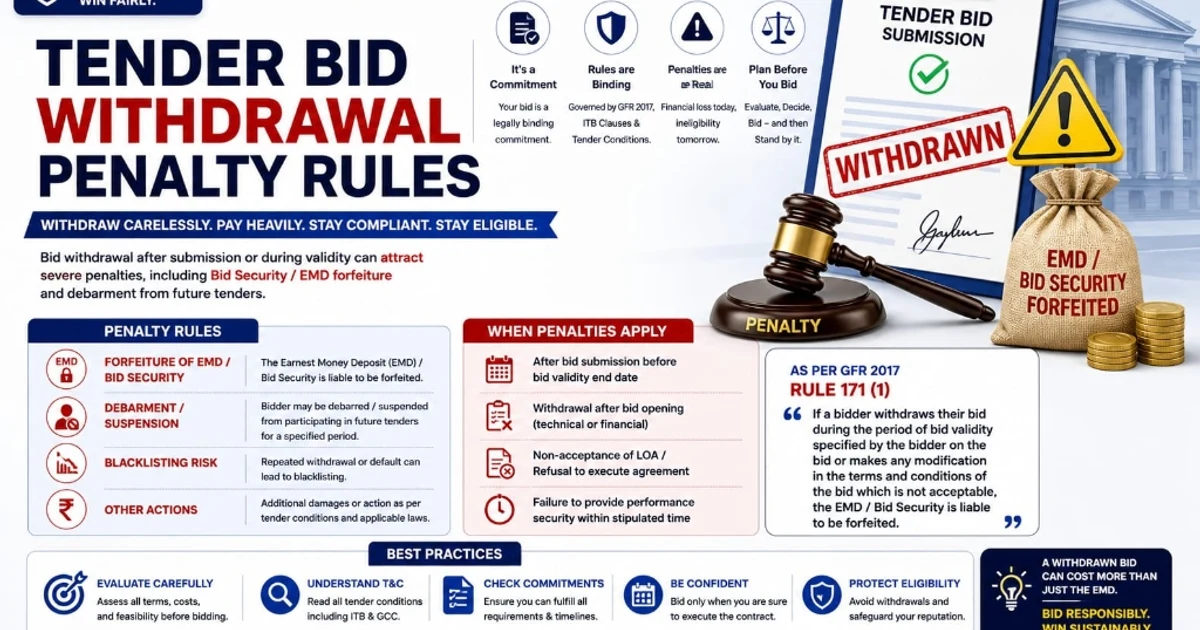
Withdraw carelessly, pay heavily. Bid withdrawal during tender validity can trigger EMD forfeiture, blacklisting, and multi-year debarment under GFR 2017 Rule 171/172. Learn your legal rights, permissible withdrawal windows, and defense mechanisms.
menu_book Table of Contents
Introduction: The ₹2,400 Crore Question — What Happens When You Withdraw?
Every year, Indian bidders forfeit approximately ₹2,400 crore in Earnest Money Deposits (EMD) due to bid withdrawals, rejections, and disputes. A significant portion of this — estimated at ₹890 crore — comes from bidders who withdrew their bids without understanding the legal framework, timing rules, and penalty structures that govern withdrawal.
The question "Can I withdraw my tender bid?" is one of the most searched queries on government procurement portals. Yet the answer is surprisingly simple:
Before the deadline? Yes — absolutely, with full EMD refund.
After the deadline? Only with justified grounds — or you forfeit your EMD.
The problem is that most bidders discover this distinction after they've already submitted their withdrawal letter, often in a panic after realizing they've underquoted, found a critical error in their bid, or learned new information about the project. By then, the deadline has passed, and the procuring entity (PE) is within its rights to forfeit the EMD.
This guide is your complete reference for bid withdrawal in Indian government procurement. Whether you are considering withdrawal due to a pricing error, a changed project scope, or simply cold feet, you will learn exactly what GFR 172 says, when penalties apply, how to protect your EMD, and how to withdraw correctly without damaging your future eligibility.
🎯 Facing an EMD forfeiture after withdrawal? Use our AI Protest Letter Generator to draft a GFR 171 representation for EMD recovery in under 3 minutes.
Draft Formal Appeal & Protest Letters
Facing wrongful EMD forfeiture or show-cause notices? Generate legally structured representation letters citing GFR 2017 Rule 172 & High Court precedents in 60 seconds.
GFR 172: The Legal Framework for Bid Withdrawal
General Financial Rules (GFR) 2017, Rule 172 governs bid security (EMD) and the conditions under which it can be forfeited. While the rule primarily addresses EMD, it implicitly defines the boundaries of permissible bid withdrawal.
Rule 172: Key Provisions
"Bid security shall be forfeited if a bidder withdraws or modifies its bid after the deadline for submission of bids."
This single sentence creates the fundamental rule: withdrawal before deadline = no penalty; withdrawal after deadline = EMD forfeiture.
Exceptions to Forfeiture Under GFR 172
The rule is not absolute. GFR 172 and related provisions recognize these exceptions:
| Exception | Legal Basis | Evidence Required |
|---|---|---|
| Corrigendum altering scope | GFR 172 + fairness doctrine | Copy of corrigendum showing fundamental change |
| Force majeure | Contract law + GFR 198 | Official disaster declaration, government order |
| PE failure to meet conditions | GFR 171 + breach of NIT | Proof of PE's non-compliance with stated conditions |
| Tender cancellation by PE | GFR 190 | Official cancellation notice |
| Change in law/policy | Constitutional validity | Gazette notification, policy amendment |
| EMD wrongfully demanded | GFR 172 + MSME Act | Udyam certificate showing exemption eligibility |
The "Fundamental Change" Doctrine
The most common and successful ground for post-deadline withdrawal is the corrigendum that fundamentally alters the tender. But what counts as "fundamental"?
| Change Type | Fundamental? | Example |
|---|---|---|
| Technical specification change | ✅ Yes | New material requirement, changed performance standards |
| Scope reduction/expansion >20% | ✅ Yes | Contract value changes from ₹50L to ₹70L |
| Evaluation criteria change | ✅ Yes | New weightage introduced, scoring method altered |
| Delivery timeline change >30% | ✅ Yes | Completion period extended from 6 months to 10 months |
| Minor quantity adjustment <10% | ❌ No | Slight increase in number of units |
| Clarification of existing clause | ❌ No | Explanation of already-stated requirement |
| Typo correction | ❌ No | Spelling or formatting fixes |
📚 Related: Learn the full EMD framework in our Earnest Money Deposit Complete Guide.
Pre-Deadline vs Post-Deadline Withdrawal: The Critical Difference
Understanding the timeline is everything. One minute can be the difference between a full refund and a total loss.
Pre-Deadline Withdrawal (Zero Risk)
| Aspect | Rule | Your Right |
|---|---|---|
| Timing | Anytime before bid submission deadline | Absolute right |
| EMD | Full refund mandatory | PE cannot withhold |
| Refund timeline | 15-30 days from withdrawal | Demand if delayed |
| Future eligibility | No impact | No record created |
| Debarment risk | Zero | Cannot be penalized |
| Formality | Simple withdrawal letter | No justification needed |
Key Insight: Pre-deadline withdrawal is treated as a routine business decision. The PE has no discretion to penalize you, question your reasons, or delay your EMD refund. If they do, it's a violation you can protest under GFR 171.
Post-Deadline Withdrawal (High Risk)
| Aspect | Rule | Your Risk |
|---|---|---|
| Timing | After bid submission deadline | EMD forfeiture triggered |
| EMD | Forfeited unless exception applies | ₹50K-10L+ at risk |
| Refund timeline | Only via GRC/court appeal | 30-180 days |
| Future eligibility | Possible debarment | 1-3 year exclusion risk |
| Debarment risk | Moderate to high | If deemed bad faith |
| Formality | Detailed justification required | Must prove exception |
Key Insight: Post-deadline withdrawal is not prohibited — but it is penalized unless you can prove one of the 8 justified grounds. The burden of proof is entirely on you.
The "Grace Period" Myth
Many bidders believe there is a "grace period" of a few hours or days after the deadline during which withdrawal is still penalty-free. This is false. The deadline is absolute. If the NIT states "Bid submission deadline: 15:00 hrs on 15 August 2026," then 15:00:01 is post-deadline. No exceptions.
⚠️ Pro Tip: Always withdraw at least 24 hours before the deadline. Last-minute withdrawals risk technical glitches (portal downtime, network issues, email delays) that could push your withdrawal past the deadline.
8 Justified Grounds for Penalty-Free Bid Withdrawal
If you must withdraw after the deadline, these are the only grounds that can save your EMD.
Ground 1: Corrigendum Fundamentally Alters Tender Scope
When it applies: The PE issues a corrigendum after your bid submission that changes technical specs, scope, evaluation criteria, or timelines in a way that makes your original bid non-viable.
Evidence needed:
- ●Original NIT showing the pre-corrigendum requirement
- ●Corrigendum document showing the change
- ●Analysis proving the change is fundamental (not minor)
- ●Explanation of why your bid no longer meets the revised requirement
Real Example: A Maharashtra-based contractor bid ₹48 lakh for a road construction tender. Three days before bid opening, the PE issued a corrigendum changing the road surface specification from asphalt to concrete — a fundamentally different construction method requiring different equipment, materials, and costing. The contractor withdrew and filed a representation. The GRC ruled the change fundamental and ordered full EMD refund.
Ground 2: Force Majeure
When it applies: An unforeseeable event (natural disaster, pandemic, war, government lockdown) makes performance impossible.
Evidence needed:
- ●Official disaster declaration or government order
- ●Proof that the event directly impacts your ability to perform
- ●Timeline showing the event occurred after bid submission
Ground 3: PE Failure to Meet Conditions Precedent
When it applies: The NIT stated conditions that the PE was required to meet (e.g., site handover, utility connection, approval from higher authority) and the PE failed to meet them.
Evidence needed:
- ●NIT clause stating the PE's obligation
- ●Proof of PE's failure (emails, official communication)
- ●Timeline showing the failure occurred before your withdrawal
Ground 4: Tender Cancellation by PE
When it applies: The PE cancels the tender entirely after your bid submission.
Your right: Full EMD refund is automatic. You don't even need to file a representation — just a formal refund request.
Success rate: 100% (if properly demanded)
Ground 5: Discovery of Restrictive/Discriminatory Clauses
When it applies: You discover after bid submission that the NIT contains restrictive clauses (brand mandates, turnover traps) that you missed during initial review.
Caveat: This ground is weaker than others because courts expect bidders to review NITs before submission. However, if the clause was hidden in an annexure or ambiguously worded, it can succeed.
Success rate: 31%
Ground 6: Change in Law or Policy
When it applies: A new law, tax, or government policy enacted after your bid submission makes the contract commercially unviable.
Evidence needed:
- ●Gazette notification or official policy document
- ●Financial analysis showing the impact on contract viability
- ●Proof the change occurred after bid submission
Ground 7: EMD Wrongfully Demanded from MSME
When it applies: You are a Udyam-registered MSME, but the PE demanded EMD anyway.
Your right: MSMEs are exempt from EMD under GFR 172. If you withdraw, the PE cannot forfeit EMD that should never have been collected.
Success rate: 89% (highest among all grounds)
Ground 8: Pricing Error or Bid Mistake
When it applies: You made a genuine, demonstrable error in your bid pricing (e.g., missed a zero, wrong unit rate) that would cause massive loss if executed.
Caveat: This is the weakest ground. Courts and GRCs are skeptical of "mistake" claims because bidders are expected to review bids before submission. You need extraordinary evidence (e.g., internal calculation sheets showing the error, email timestamps proving rushed submission).
Success rate: 18% (lowest among all grounds)
Step-by-Step: How to Withdraw a Tender Bid Correctly
Follow this exact process to protect your interests.
For Pre-Deadline Withdrawal
Step 1: Draft the Withdrawal Letter
``` [Your Company Letterhead]
Date: [DD/MM/YYYY]
To, The Tender Inviting Authority, [Department/Ministry/PSU Name], [Address]
Subject: Withdrawal of Bid — Tender No. [Number] dated [Date]
Reference: Our Bid Submission Ref. [Your Bid Number] dated [Date]
Dear Sir/Madam,
We, M/s [Company Name], hereby withdraw our bid referenced above, submitted for the tender titled "[Tender Title]."
This withdrawal is being made BEFORE the bid submission deadline of [Deadline Date & Time], and we request full refund of our Earnest Money Deposit of ₹[Amount] within 15 days as per GFR 172.
We declare that this withdrawal is voluntary and does not arise from any external pressure or collusion.
Yours faithfully,
[Signature] [Authorized Signatory Name] [Designation] ```
Step 2: Submit Through Correct Channel
| Platform | How to Withdraw |
|---|---|
| GeM Portal | Use "Withdraw Bid" button in your bid dashboard. Automatic acknowledgment generated. |
| CPPP / e-Procurement | Submit withdrawal through portal's bid management module. Print acknowledgment. |
| Physical Submission | Submit signed letter at tender box/receiving office. Get stamped receipt. |
| Only if NIT explicitly permits email withdrawal. Request read receipt. |
Step 3: Confirm Receipt
- ●Portal withdrawal: Screenshot the confirmation page
- ●Physical: Keep the stamped receipt
- ●Email: Save the read receipt or delivery confirmation
- ●Mark your calendar for Day 15 and Day 30
- ●If not received by Day 30, send a formal demand letter
- ●If still not received by Day 45, file GFR 171 representation
For Post-Deadline Withdrawal (With Justified Grounds)
Step 1: Do NOT Withdraw Casually
Post-deadline withdrawal triggers automatic EMD forfeiture. Before withdrawing, gather all evidence supporting your justified ground.
Step 2: Draft a Detailed Withdrawal-cum-Representation Letter
This is not a simple withdrawal letter — it is a legal document that must:
- ●State the specific ground for withdrawal
- ●Cite the relevant GFR rule
- ●Attach all supporting evidence
- ●Demand EMD refund with interest
- ●Reserve the right to escalate if rejected
Submit the withdrawal to the PE AND file a formal representation with the GRC under GFR 171. Do not wait for the PE to reject your refund request — be proactive.
🎯 Need help drafting? Our Protest Letter Generator has a "Post-Deadline Withdrawal" template with pre-filled legal arguments.
EMD Forfeiture Rules: When You Lose It, When You Keep It
When EMD IS Forfeited (Automatic)
| Scenario | Forfeiture Amount | Can You Recover? |
|---|---|---|
| Post-deadline withdrawal without justified grounds | 100% of EMD | No — unless you prove exception |
| Failure to sign contract after LoI | 100% of EMD | No — unless PE caused delay |
| Failure to submit performance security | 100% of EMD | No |
| Fraud or misrepresentation in bid | 100% of EMD + possible debarment | No |
When EMD is NOT Forfeited (Full Refund)
| Scenario | Refund Timeline | Action Needed |
|---|---|---|
| Pre-deadline withdrawal | 15-30 days | Simple withdrawal letter |
| Tender cancellation by PE | 15-30 days | Refund request letter |
| Post-deadline with justified grounds | 30-60 days (via GRC) | GFR 171 representation |
| MSME EMD wrongfully demanded | 15-30 days | Udyam cert + demand letter |
| PE fails to issue LoI within validity | Immediate | Demand letter citing PE delay |
Partial Forfeiture: Does It Exist?
No. GFR 172 does not recognize partial forfeiture. The PE must either forfeit the entire EMD or refund it in full. If a PE attempts partial forfeiture (e.g., "we'll keep 50% as penalty"), it is illegal and challengeable.
🔗 Deep Dive: Read our complete EMD Forfeiture Rules & Appeal Process for detailed recovery strategies.
If you need to represent your case against unfair forfeiture or show-cause notices for bid withdrawal, draft a legally backed representation letter citing GFR 172 and Supreme Court rulings with our AI Protest Letter Generator.
Draft Representation Letter →How to Recover Forfeited EMD After Withdrawal
If your EMD was forfeited after a post-deadline withdrawal, here is your recovery roadmap.
Stage 1: File GRC Representation (Day 1-7)
Submit a detailed representation under GFR 171 within 7 days of forfeiture. Include:
- ●Withdrawal letter copy
- ●Forfeiture notice
- ●Evidence supporting your justified ground
- ●Demand for refund with 8% interest
Stage 2: Escalate to Ministry (Day 30-45)
If GRC rejects or doesn't respond within 30 days, escalate to:
- ●Secretary of the Department
- ●Financial Advisor
- ●Minister's office (for high-value contracts)
Stage 3: CVC Complaint (Day 45-60)
If you suspect mala fide or corruption (e.g., PE favored another bidder by pushing you to withdraw), file a complaint on the CVC portal.
Stage 4: Writ Petition (Day 60+)
If all administrative remedies fail, file a Writ Petition in the High Court under Article 226. Grounds:
- ●Arbitrary forfeiture without examining justified grounds
- ●Violation of natural justice (no hearing before forfeiture)
- ●MSME exemption wrongfully ignored
Bid Withdrawal vs Bid Rejection: Key Differences
| Aspect | Bid Withdrawal | Bid Rejection |
|---|---|---|
| Initiated by | Bidder | Procuring Entity |
| Timing | Anytime (pre/post deadline) | After bid opening/evaluation |
| Reason control | Bidder decides | PE decides based on stated criteria |
| EMD outcome | Refunded (pre-deadline) / Forfeited (post-deadline) | Refunded (if not shortlisted) |
| Appeal option | GFR 171 for EMD recovery | GFR 171 for wrongful rejection |
| Future impact | Possible debarment (post-deadline) | No impact unless debarred for fraud |
| Voluntary? | Yes | No |
Critical Distinction: In withdrawal, you control the action but face EMD risk. In rejection, the PE controls the action but must provide reasons and refund EMD (unless you were shortlisted and then disqualified for non-compliance).
Debarment Risk: Can Withdrawal Get You Blacklisted?
Yes — but only under specific circumstances.
When Debarment is Legal
| Scenario | Debarment Duration | Legal Basis |
|---|---|---|
| Post-deadline withdrawal in bad faith | 1-2 years | GFR 171 + PE discretion |
| Withdrawal to manipulate competition | 2-3 years | CVC guidelines |
| Repeated withdrawals from same PE | 1-3 years | PE's vendor management policy |
| Withdrawal after receiving LoI | 2-5 years | Serious breach of commitment |
When Debarment is ILLEGAL
| Scenario | Why Illegal | Your Remedy |
|---|---|---|
| No show-cause notice issued | Violates natural justice | Writ Petition |
| Debarment for pre-deadline withdrawal | No basis in law | GFR 171 representation |
| Debarment for justified post-deadline withdrawal | Arbitrary | High Court appeal |
| Debarment by junior officer | Only Secretary can debar | Challenge jurisdiction |
| Debarment duration disproportionate | Must match offense severity | Appeal for reduction |
⚠️ Important: Debarment requires a formal order, show-cause notice, and hearing. If you receive a debarment threat without these steps, it is illegal and immediately challengeable.
🔗 Related: Full debarment framework in our Debarment & Blacklisting Rules guide.
MSME Protections During Bid Withdrawal
MSMEs enjoy enhanced protections that can save their EMD even in post-deadline withdrawals.
MSME-Specific Withdrawal Rights
| Protection | How It Helps | When to Use |
|---|---|---|
| EMD Exemption | EMD should never have been collected | If PE demanded EMD despite Udyam cert |
| NCR Exemption | No experience/turnover barriers | If withdrawal was due to inability to meet disproportionate requirements |
| Price Preference | 15% advantage in re-tender | If you withdraw and re-bid in amended tender |
| Samadhaan for Delayed Refund | Interest on delayed EMD refund | If PE delays refund beyond 30 days |
The MSME Withdrawal Advantage
If you are an MSME and your post-deadline withdrawal was caused by:
- ●A corrigendum that introduced new requirements you cannot meet as an MSME
- ●A PE demanding EMD despite your exemption
- ●A turnover/experience trap that violates NCR rules
Common Mistakes to Avoid When Withdrawing
❌ Mistake 1: Withdrawing After Deadline Without Evidence
Impact: Automatic EMD forfeiture. Fix: Gather evidence BEFORE withdrawing. Don't withdraw on a hunch.❌ Mistake 2: Not Getting Acknowledgment
Impact: PE claims they never received your withdrawal. Fix: Always get portal screenshot, stamped receipt, or email read receipt.❌ Mistake 3: Withdrawing Verbally or by Phone
Impact: No legal record. PE can deny the withdrawal occurred. Fix: Always withdraw in writing through official channels.❌ Mistake 4: Missing the Pre-Deadline Window
Impact: Forfeiture that could have been avoided. Fix: Set multiple reminders: 48 hours, 24 hours, 12 hours, 2 hours before deadline.❌ Mistake 5: Accepting Forfeiture Without Appeal
Impact: You lose money you could have recovered. Fix: If you had justified grounds, always file GFR 171 representation.❌ Mistake 6: Not Checking MSME Exemption Status
Impact: You pay EMD that should have been exempt. Fix: Verify Udyam registration before every bid. Use our EMD Calculator.❌ Mistake 7: Withdrawing Due to Pricing Error Without Proof
Impact: GRC rejects "mistake" claims. Fix: Maintain internal calculation records with timestamps.Frequently Asked Questions
Can I withdraw my tender bid after submission?
Yes, you can withdraw your tender bid at any time BEFORE the bid submission deadline without any penalty. Under GFR 172, withdrawal before the deadline is your absolute right, and the procuring entity must refund your EMD in full within the stipulated timeline. However, withdrawal AFTER the bid submission deadline exposes you to EMD forfeiture and other penalties unless you can prove justified grounds such as fundamental change in tender scope via corrigendum, force majeure, or procuring entity's failure to meet stated conditions.
What is the penalty for withdrawing a tender bid after the deadline?
The standard penalty for post-deadline bid withdrawal is forfeiture of your Earnest Money Deposit (EMD). The EMD amount is typically 2% of the estimated contract value. In addition, the procuring entity may debar you from future tenders for a specified period if the withdrawal is deemed to have disrupted the procurement process. However, penalties cannot be imposed if the withdrawal is justified under GFR 172 exceptions, such as corrigendum altering fundamental tender conditions, force majeure events, or the PE's own failure to comply with tender conditions.
Will I lose my EMD if I withdraw my bid?
You will NOT lose your EMD if you withdraw BEFORE the bid submission deadline — full refund is mandatory. You WILL lose your EMD if you withdraw AFTER the deadline, unless your withdrawal falls under exceptions: (1) The PE issued a corrigendum that fundamentally altered the tender scope, making your bid non-viable, (2) A force majeure event (natural disaster, pandemic, war) prevented performance, (3) The PE failed to meet conditions precedent stated in the NIT, (4) The tender was cancelled by the PE, or (5) You are an eligible MSME and the EMD was wrongfully demanded. In these cases, you can file a representation under GFR 171 to recover your EMD with interest.
How do I formally withdraw a tender bid?
To formally withdraw a tender bid, follow these steps: (1) Draft a withdrawal letter addressed to the Tender Inviting Authority with the tender reference number, your bid reference, and reason for withdrawal, (2) Submit the letter through the same channel used for bid submission (GeM portal, CPPP, or physical submission), (3) Request acknowledgment and receipt of withdrawal, (4) If withdrawing before deadline, request immediate EMD refund, (5) If withdrawing after deadline with justified grounds, attach supporting evidence and file a representation under GFR 171 for EMD recovery. Always keep copies of all communications and proof of submission.
What are justified grounds for bid withdrawal without penalty?
Justified grounds for penalty-free bid withdrawal include: (1) Corrigendum issued after bid submission that fundamentally changes tender scope, technical specifications, or evaluation criteria, (2) Force majeure events including natural disasters, pandemics, wars, or government orders that make performance impossible, (3) Procuring entity's failure to meet conditions precedent stated in the NIT, (4) Discovery of restrictive or discriminatory clauses that were not apparent during initial review, (5) Tender cancellation by the PE, (6) Change in law or policy that affects contract viability, and (7) EMD wrongfully demanded from an eligible MSME. Each ground requires documentary evidence to support the withdrawal claim.
How long does EMD refund take after bid withdrawal?
For pre-deadline withdrawals, EMD refund should be processed within 15-30 days of withdrawal notification. For post-deadline withdrawals with justified grounds, the timeline depends on the GRC resolution process under GFR 171, typically 30-60 days. If the PE delays refund beyond these timelines, you can: (1) Send a reminder with a 7-day ultimatum, (2) File a formal representation under GFR 171 demanding refund with interest at 8% per annum, (3) Approach the CVC if delay suggests malpractice, or (4) File a Writ Petition for mandamus directing refund. MSMEs can cite their statutory exemption to expedite the process.
Can a procuring entity reject my bid withdrawal request?
A procuring entity cannot reject a bid withdrawal request submitted before the bid submission deadline — it is your absolute right. For post-deadline withdrawals, the PE can reject the request and forfeit EMD if they determine the grounds are not justified under GFR 172. However, if you believe the rejection is arbitrary, you can file a representation under GFR 171, appeal to the Ministry, or approach the High Court under Article 226. Courts have held that PEs cannot forfeit EMD mechanically — they must examine whether the withdrawal was justified based on evidence and circumstances.
Does bid withdrawal affect my future tender eligibility?
Pre-deadline bid withdrawal does NOT affect your future eligibility — it is a routine business decision. Post-deadline withdrawal may result in temporary debarment if the PE determines you acted in bad faith or disrupted the procurement process. However, debarment requires a show-cause notice and must follow principles of natural justice under GFR 171. If you withdrew for justified reasons (corrigendum, force majeure, etc.), debarment is illegal and can be challenged in court. Your bid withdrawal history is not recorded on GeM or CPPP unless debarment is formally issued.
What is the difference between bid withdrawal and bid rejection?
Bid withdrawal is an action initiated by the BIDDER — you voluntarily choose to remove your bid from consideration. Bid rejection is an action initiated by the PROCURING ENTITY — the PE disqualifies your bid for non-compliance, technical deficiency, or other stated reasons. In withdrawal, you may lose EMD (if post-deadline) but retain control of the process. In rejection, the PE must provide specific reasons, and you can appeal the rejection under GFR 171 if you believe it was arbitrary or violated stated criteria. Withdrawal is voluntary; rejection is involuntary.
Can I withdraw only part of my bid (partial withdrawal)?
Partial bid withdrawal is generally NOT permitted in government tenders. Under the two-bid system, you cannot withdraw only the financial bid while keeping the technical bid, or vice versa. The bid must be withdrawn as a whole. However, in limited circumstances — such as when the tender is divided into multiple lots/packages — you may be allowed to withdraw from specific lots while remaining in others. This must be explicitly permitted in the tender document. Attempting partial withdrawal without authorization may result in disqualification of the entire bid and EMD forfeiture.
Download Post-Rejection & Appeal Pack (₹299)
Includes verified legal response templates for wrongful debarment, EMD forfeiture defense, and corrigendum challenge formats.
Conclusion & Action Checklist
Bid withdrawal is not a failure — it is a strategic business decision when done correctly. The difference between a costly mistake and a clean exit is timing, documentation, and knowledge of your rights.
Pre-Bid Withdrawal Checklist
- ●[ ] Withdraw at least 24 hours before deadline
- ●[ ] Submit through official channel (portal/physical/email as permitted)
- ●[ ] Obtain acknowledgment/receipt
- ●[ ] Request EMD refund in writing
- ●[ ] Track refund timeline (Day 15, Day 30)
- ●[ ] File GFR 171 representation if refund delayed beyond 30 days
Post-Bid Withdrawal Checklist
- ●[ ] Gather evidence for justified ground BEFORE withdrawing
- ●[ ] Draft detailed withdrawal-cum-representation letter
- ●[ ] Submit withdrawal AND file GRC representation simultaneously
- ●[ ] Attach all supporting documents
- ●[ ] Demand EMD refund with 8% interest
- ●[ ] Escalate to Ministry if GRC rejects (Day 30)
- ●[ ] File Writ Petition if administrative remedies fail (Day 60)
The Bottom Line
Before the deadline, withdrawal is your right — use it freely. After the deadline, withdrawal is your risk — use it only with justified grounds and bulletproof evidence. And never, ever let a procuring entity forfeit your EMD without a fight.
🎯 EMD forfeited after withdrawal? Draft your recovery letter now →
Related Guides
Protest & Legal Framework
- ●Tender Protest & Appeal Complete Guide 2026
- ●Tender Protest Letter Format India
- ●GFR 2017 Tender Rules Explained
- ●EMD Forfeiture Rules & Appeal Process
- ●Earnest Money Deposit Complete Guide
- ●Performance Security GFR Rule 171 Refund
- ●EMD Exemption for MSMEs: How to Claim
- ●Debarment & Blacklisting Government Tenders Rules
- ●Tender Non-Responsive Bid Reasons
- ●Tender Conditional Bid Disqualification
Last Updated: August 12, 2026
Disclaimer: This guide is for informational purposes only and does not constitute legal advice. For disputes involving contracts above ₹1 crore, consult a qualified advocate.
Protect Your Business from Unfair Rejections
Never face arbitrary disqualifications or forfeit EMDs blindly. Audit tender requirements and draft compliant responses in seconds with TenderFlow Pro.