Tender Pricing Strategy to Win L1 in India (2026): Complete Guide to Competitive Bidding & Profit Protection
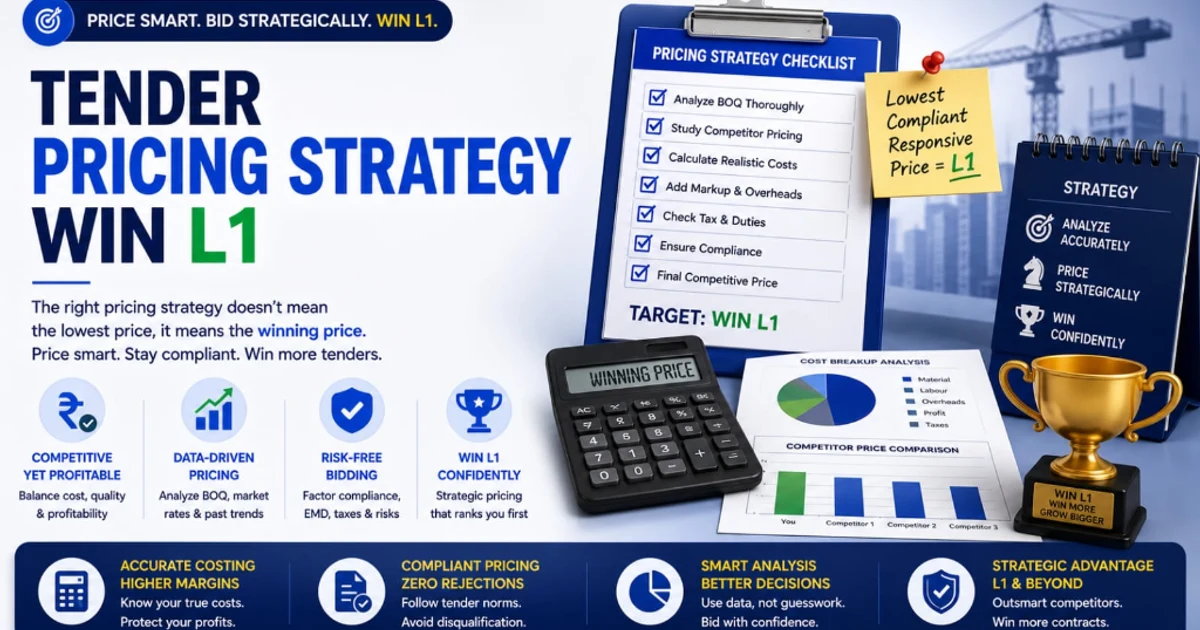
Winning L1 is not about being the cheapest — it is about being the smartest. Over 60% of aggressive L1 bidders lose money on their first government contract. Discover the 2026 blueprint to calculate floor prices, master GeM reverse auctions, leverage MSME 15% price preferences, and win profitably.
menu_book Table of Contents
The ₹45 Lakh Contract That Bankrupted the Winner
Winning L1 is not victory. Profitable execution is.
Most bidders think tendering is a race to the bottom — whoever quotes the lowest price wins. They're half right. The lowest price does win L1. But 60% of L1 winners lose money on their first government contract. They underpriced to win, discovered hidden costs during execution, and ended up paying the government to work for them.
Here is the reality that should terrify every ambitious bidder:
| Statistic | What It Means for You |
|---|---|
| 60% of L1 winners | Lose money or break even on their first government contract (MSME Ministry Study, 2025) |
| ₹45 lakh average contract | Value where underpricing causes financial distress |
| 4–8% typical profit margin | For government works contracts — razor thin |
| 15–25% cost overrun | Average for bidders who didn't calculate floor price properly |
| 0.5% per week LD | Liquidated damages for delay — can wipe out entire profit |
| 90-day payment cycle | Standard government payment terms — working capital strain |
| 5–10% PBG | Performance security blocks cash flow |
| Winner's Curse | Economic phenomenon where the winner overestimates value and underprices |
"I won a ₹45 lakh road maintenance tender as L1. I quoted ₹42 lakh — 7% below the second bidder. I was ecstatic. Then reality hit: the BOQ quantities were approximate, actual earthwork was 40% more than estimated, steel prices had risen 12% since I quoted, and the 90-day payment cycle drained my working capital. By month 4, I was borrowing from moneylenders to pay labor. By month 8, I had lost ₹8 lakh. I 'won' the tender and nearly lost my business."
— Ramesh Yadav, Road Contractor, Uttar Pradesh
The problem isn't that government tenders are unprofitable. The problem is that most bidders don't know how to price for profit. They treat pricing like a guessing game — undercutting competitors without understanding their own costs, the contract risks, or the hidden expenses that destroy margins.
This guide gives you the complete L1 pricing playbook — how to calculate your true floor price, how to bid strategically in sealed bids and reverse auctions, how to use MSME and Make in India preferences to win even when you're not the cheapest, and how to protect your margin from the Winner's Curse.
Key Takeaways (Read This First)
| Insight | Detail |
|---|---|
| L1 ≠ Victory | Winning L1 at a loss is worse than losing the tender |
| Floor Price First | Calculate your absolute minimum price before bidding — never go below |
| 3-Price Rule | Benchmark against cost, market rate, and estimated rate |
| Sealed vs RA | Different strategies for one-shot bids vs live auctions |
| MSME 15% Band | MSEs can match L1 even when 15% higher — don't undercut unnecessarily |
| Make in India 20% | Class-I local suppliers can match L1 within 20% margin |
| ALT Risk | Bids 20–30% below estimate may be rejected as abnormally low |
| Profit Target | Aim for 5–12% margin, not just L1 at any cost |
🚨 Stop Winning Tenders at a Loss
Winning L1 feels great until you realize you priced yourself into bankruptcy. The Bid Mastery Toolkit + L1 Price Matching Calculator give you the exact system to calculate floor prices, benchmark against competitors, and win profitably — every single time. For the comprehensive end-to-end framework, consult our government tender guide for MSMEs. (See also: Tender Competitor Analysis & Market Intelligence Guide). (See also: CVC-Compliant Post-Bid Negotiation Strategy).
Bid Mastery Toolkit — ₹599 includes:
- ✅ 150-Point Ultimate Pre-Submission Checklist (P1)
- ✅ 50-Point Technical Bid Compliance Audit (P2)
- ✅ 30-Point Financial Bid Accuracy Verification (P3)
- ✅ Bid Submission Timeline & Deadline Planner (P11)
L1 Price Matching Calculator — Free at tenderflowpro.in/tools/price-preference-calculator.html
₹2,496 ₹599 (Just ₹150 per tool)
⚡ Digital Download • Lifetime Access • 7-Day Money-Back Guarantee
💡 One underpriced contract = ₹8L+ loss. This toolkit costs ₹599.
Calculate L1 + 15% MSME Price Preference Instantly
Are you an MSME competing against large enterprises? Check your eligible price matching band under the Public Procurement Policy 2012 with our free calculator.
Quick Answer: How Do You Win L1 Without Losing Money?
Winning L1 profitably requires three things: knowing your true cost, knowing the market, and knowing when to stop.
Most bidders get one of these right. Professional bidders get all three. Here's the 30-second framework:
| Step | Action | Result |
|---|---|---|
| 1 | Calculate floor price (cost + overhead + minimum profit) | Your absolute bottom line |
| 2 | Research past L1 rates for the same item/category | Market benchmark |
| 3 | Check department's estimated rate / SOR | Evaluator's expectation |
| 4 | Add strategic margin (5–12% above floor) | Competitive yet profitable bid |
| 5 | Verify no ALT risk (not >20–30% below estimate) | Avoid rejection |
| 6 | Check MSME/Make in India preference applicability | May not need to be absolute L1 |
| 7 | Submit with confidence | Win profitably or walk away cleanly |
The Golden Rule: If your competitive price is below your floor price, do not bid. There is always another tender. There is not always another business after you bankrupt this one.
What Is L1 and How Does L1 Selection Work?
L1 stands for "Lowest Bidder 1" — the bidder who quotes the lowest valid price in the financial evaluation of a government tender. Under GFR 2017, L1 selection is the default award criterion for most government procurement in India.
The L1 Selection Process
| Stage | What Happens | Timeline |
|---|---|---|
| 1. Bid Submission | All bids submitted before deadline | Before deadline |
| 2. Technical Opening | Technical bids opened; financial bids remain sealed | Bid opening date |
| 3. Technical Evaluation | Committee checks compliance, specs, eligibility | 7–15 working days |
| 4. Technical Results | TQ (Qualified) / TNQ (Not Qualified) declared | After evaluation |
| 5. Financial Opening | Only TQ bidders' financial bids opened | After tech results |
| 6. L1 Identification | Lowest valid financial bid identified as L1 | 3–7 working days |
| 7. ALT Check | L1 bid checked for abnormally low pricing | Concurrent with L1 |
| 8. Preference Check | MSME/Make in India preferences applied | After L1 identified |
| 9. Contract Award | L1 (or preference-matched bidder) awarded | 15–30 days |
Types of L1 Selection
| Type | How It Works | Where Used |
|---|---|---|
| Simple L1 | Lowest valid bid wins outright | Most CPPP goods and services |
| L1 with Negotiation | L1 invited for limited negotiation | Some PSUs, high-value contracts |
| L1 with Price Preference | MSME/Make in India bidder can match L1 | All tenders with preference policies |
| L1 with Split Order | Order split among L1, L2, L3 | Large quantity tenders |
| Reverse Auction L1 | Live bidding determines final L1 | GeM, some CPPP tenders |
What "Valid" Means for L1
Not every low bid is a valid L1. The bid must be:
| Requirement | Why It Matters |
|---|---|
| Technically qualified | Passed technical evaluation |
| Financially responsive | All BOQ items priced, no blanks |
| Not abnormally low | Within reasonable range of estimate |
| Compliant with ITB | Meets all submission requirements |
| DSC valid | Digital signature verified |
| EMD/BSD correct | Security deposit in proper format |
📚 Related: Read our Technical Bid vs Financial Bid Complete Guide for the complete two-bid system breakdown.
GFR 2017 L1 Selection Rules: The Complete Framework
L1 selection is not arbitrary. It is governed by GFR 2017 Chapter 6 with specific rules that protect both the government and bidders.
GFR 2017 Rule 190: Contract Award
Under GFR 2017 Rule 190, the contract is awarded to the bidder whose bid is:
- 1Responsive — meets all technical and commercial requirements
- 2Lowest — offers the lowest evaluated price
- 3Valid — not abnormally low or non-compliant
The L1 Award Hierarchy
``` Step 1: Identify all technically qualified (TQ) bidders Step 2: Open financial bids of TQ bidders only Step 3: Rank bidders by total evaluated price (L1, L2, L3...) Step 4: Check L1 for abnormally low tender (ALT) Step 5: Apply MSME price preference (if L1 is non-MSE) Step 6: Apply Make in India preference (if L1 is non-local) Step 7: Award contract to final L1 (or matched preference bidder) ```
When L1 Can Be Rejected
| Ground | GFR Reference | What Happens |
|---|---|---|
| Abnormally Low Tender | Rule 190 + ITB Clause | L1 asked for explanation; rejected if unsatisfactory |
| Non-compliance | Rule 190 | Bid rejected for missing documents or specs |
| Blacklisted vendor | Rule 190 | Bid rejected if bidder is on debarment list |
| Conflict of interest | Rule 190 | Bid rejected if bidder has relationship with buyer |
| Unable to submit PBG | SCC/ITB | L1 given time; if fails, move to L2 |
| Failure to sign contract | GCC | L1 given time; if fails, move to L2 |
L1 Negotiation Rules
| Scenario | Allowed? | Conditions |
|---|---|---|
| Negotiate price with L1 | Sometimes | Limited to 5–10% reduction; must be justified |
| Negotiate with L2 if L1 rejects | Yes | If L1 withdraws or fails PBG |
| Counter-offer to L1 | Rare | Only in specific procurement categories |
| Split order negotiation | Sometimes | For large quantities, split among top 2–3 bidders |
Critical Rule: Under GFR 2017, extensive price negotiation is discouraged as it undermines transparency. Most tenders award at the quoted L1 price without negotiation.
Winning L1 requires balancing aggressive pricing with strict technical qualification thresholds. Benchmark your bid readiness and win probability using our AI Bid Scorer before finalizing your commercial price quote.
Benchmark Bid Win Probability →The L1 Pricing Framework: Cost + Market + Strategy
Professional bidders don't guess prices. They use a three-pillar framework that ensures every bid is both competitive and profitable.
Pillar 1: Cost-Based Pricing
| Cost Component | Works Tender | Goods Tender | Services Tender |
|---|---|---|---|
| Direct Materials | 35–50% | 60–75% | 10–20% |
| Direct Labor | 20–30% | 5–10% | 40–60% |
| Equipment/Machinery | 5–15% | 0–5% | 5–15% |
| Subcontractor | 5–15% | 0% | 10–20% |
| Direct Cost Subtotal | 70–85% | 70–85% | 70–85% |
| Overhead (8–15%) | 8–15% | 8–12% | 10–15% |
| Profit (5–12%) | 5–12% | 5–12% | 8–15% |
| Total Bid Price | 100% | 100% | 100% |
Pillar 2: Market-Based Pricing
| Source | What It Tells You | How to Access |
|---|---|---|
| Past CPPP awards | Actual L1 rates for similar tenders | CPPP "Awarded Contracts" section |
| GeM price history | Historical pricing for catalog items | GeM "Previous Orders" |
| State SOR | Department's estimated rates | State PWD/engineering department websites |
| Industry associations | Market rate benchmarks | Contractor associations, trade bodies |
| Competitor intelligence | Who bids, at what levels | Pre-bid meeting attendance, networking |
Pillar 3: Strategy-Based Pricing
| Strategy | When to Use | Risk Level |
|---|---|---|
| Aggressive pricing | New market entry, relationship building | High — thin margins |
| Conservative pricing | Established player, strong backlog | Low — may not win |
| Target pricing | Specific profit target, walk-away point | Medium — balanced approach |
| Loss leader | Multi-item tender, profit on other items | High — if other items don't materialize |
| Front-loading | Works tender with progressive billing | Medium — cash flow vs evaluation risk |
The Professional Approach: Start with cost-based pricing to determine your floor. Benchmark against market rates to ensure competitiveness. Apply strategy-based adjustments based on your business goals and risk appetite.
How to Calculate Your Floor Price (Step-by-Step)
Your floor price is the lowest price at which you can execute the contract without losing money. It is your walk-away point. Never bid below it.
Floor Price Formula (Goods Tender)
``` Floor Price = COGS + Logistics + GST (if inclusive) + Warranty/AMC + Platform Charges + Minimum Margin ```
| Component | Calculation | Example (₹10L tender) |
|---|---|---|
| COGS | Manufacturer's price or procurement cost | ₹6,50,000 |
| Logistics | Freight, packaging, insurance | ₹35,000 |
| GST (18%) | If bid is inclusive of GST | ₹1,17,000 |
| Warranty/AMC | 1-year warranty provision | ₹15,000 |
| Platform Charges | GeM commission (~1%) | ₹10,000 |
| Minimum Margin (8%) | 8% of total cost | ₹62,400 |
| Floor Price | Sum of all above | ₹8,89,400 |
Floor Price Formula (Works Tender)
``` Floor Price = Materials + Labor + Equipment + Overhead + Profit ```
| Component | Calculation | Example (₹50L tender) |
|---|---|---|
| Materials | Cement, steel, sand, bricks, etc. | ₹28,00,000 |
| Labor | Skilled + unskilled man-days | ₹8,50,000 |
| Equipment | Mixer, vibrator, crane hire | ₹3,50,000 |
| Subcontractor | Specialized work (electrical, plumbing) | ₹4,00,000 |
| Direct Cost | Sum of above | ₹44,00,000 |
| Overhead (10%) | Site expenses, supervision | ₹4,40,000 |
| Profit (8%) | Minimum acceptable | ₹3,87,200 |
| Floor Price | Sum of all above | ₹52,27,200 |
Critical Insight: If the market L1 rate for this tender is ₹48 lakh, and your floor price is ₹52.27 lakh, do not bid. You cannot win profitably. Find another tender.
The Floor Price Calculator Template
| Item | Your Cost | Quantity | Total |
|---|---|---|---|
| Material A | ₹____/unit | ____ units | ₹____ |
| Material B | ₹____/unit | ____ units | ₹____ |
| Labor (Skilled) | ₹____/day | ____ days | ₹____ |
| Labor (Unskilled) | ₹____/day | ____ days | ₹____ |
| Equipment | ₹____/hour | ____ hours | ₹____ |
| Direct Cost | ₹____ | ||
| Overhead (___%) | ₹____ | ||
| Profit (___%) | ₹____ | ||
| Floor Price | ₹____ |
📚 Related: Use our BOQ Analysis Tender Guide for detailed rate analysis techniques for every BOQ item.
The 3-Price Rule: Your Pricing Safety Net
Before finalizing any bid price, validate it against three benchmarks:
| Benchmark | How to Calculate | What It Tells You |
|---|---|---|
| Price 1: Your Floor | Cost + overhead + minimum profit | Absolute bottom line — never go below |
| Price 2: Market Rate | Past L1 rates for similar tenders | Whether your price is competitive |
| Price 3: Estimated Rate | Department's SOR or abstract | Evaluator's expectation and ALT threshold |
The 3-Price Decision Matrix
| Your Bid vs Floor | Your Bid vs Market | Your Bid vs Estimate | Decision |
|---|---|---|---|
| Above floor | Below market | Within 10% of estimate | ✅ Bid aggressively — competitive and profitable |
| Above floor | At market | Within 10% of estimate | ✅ Bid at this price — standard competitive position |
| Above floor | Above market | Within 10% of estimate | ⚠️ Reconsider — may not win unless technical score compensates |
| At floor | Below market | 15–20% below estimate | ⚠️ High risk — profitable but may trigger ALT scrutiny |
| Below floor | Below market | >20% below estimate | ❌ Do not bid — you will lose money |
| Above floor | Above market | >20% above estimate | ❌ Do not bid — uncompetitive and overpriced |
The Professional's Secret: Most winning bids are 5–15% above the floor price and within 10% of the market L1 rate. This sweet spot delivers profit while remaining competitive.
Sealed Bid L1 Strategy: One Shot, Make It Count
In a standard sealed bid tender, you get one chance to submit your price. There are no do-overs, no adjustments, no live counter-bidding. Your first price is your final price.
The Sealed Bid Pricing Ladder
| Level | Price | Margin | Strategy |
|---|---|---|---|
| Floor | ₹8,89,400 | 0% | Walk-away point — never bid here |
| Conservative | ₹9,50,000 | 6.8% | Safe but may not win |
| Target | ₹9,20,000 | 3.5% | Balanced — competitive with profit |
| Aggressive | ₹9,00,000 | 1.2% | High win probability, thin margin |
| Suicidal | ₹8,50,000 | -4.4% | Below floor — guaranteed loss |
When to Be Aggressive vs Conservative
| Factor | Be Aggressive If | Be Conservative If |
|---|---|---|
| Market position | New bidder, need reference | Established player with backlog |
| Tender value | Small (<₹10L), low risk | Large (>₹1Cr), high risk |
| Competition | Few bidders expected | Many bidders expected |
| Relationship | First time with this department | Existing relationship, repeat business |
| Capacity | Underutilized, need work | At capacity, selective bidding |
| Strategic value | Entry to new sector/region | Maintenance of existing position |
The "First Tender" Pricing Trap
New bidders often price their first tender below floor to "get a foot in the door." This is a catastrophic mistake:
| Assumption | Reality |
|---|---|
| "We'll make it up on the next tender" | There may not be a next tender if you go bankrupt |
| "The department will give us variations" | Variations are rare and tightly controlled |
| "We'll find cost savings during execution" | Government contracts have strict specs — no shortcuts |
| "It's just one small loss" | One loss can destroy your credit, reputation, and business |
Rule: Your first tender should be priced at your target margin, not below floor. Build relationships through quality and compliance, not through suicidal pricing.
Reverse Auction L1 Strategy: GeM, CPPP & State Portals
Reverse auctions (RA) are a different beast. You don't submit one price — you compete in real-time, watching your rank change as you and competitors lower prices.
How Reverse Auctions Work
| Parameter | Bid-to-RA | Direct RA |
|---|---|---|
| Starting point | Lowest sealed bid becomes reference | Buyer sets ceiling price |
| Entry criteria | 50% of TQ bidders OR H1 elimination | All TQ bidders |
| Decrement cap (initial) | Up to 30% of starting price | Up to 50% of starting price |
| Decrement cap (subsequent) | 10% slabs | 10% slabs |
| Minimum decrement | Set by buyer per auction | Set by buyer per auction |
| Auto-extension | 5 min if bid in last 5 min | 5 min if bid in last 5 min |
| Bid visibility | Rank only (L1, L2, L3) | Rank only |
| Withdrawal | Not allowed once submitted | Not allowed |
The Reverse Auction Floor Price Discipline
The #1 rule of reverse auctions: Set your floor price before the auction opens. Once the clock starts, emotion takes over.
| Phase | Time | Your Action |
|---|---|---|
| Pre-auction | 24+ hours before | Calculate floor price. Write it down. Commit to it. |
| Opening | First 10 minutes | Enter opening bid 8–12% above floor. Confirm system access. |
| Middle | 10 min to last 5 min | Hold position. Make small decrements only if displaced. |
| Final 5 minutes | Critical window | Execute final reserved bid if still above floor. |
| Auto-extension | If triggered | Hold. Do not panic-bid below floor. |
The 80/20 RA Strategy
| Phase | Time Allocation | Bid Behavior |
|---|---|---|
| First 80% | 0–24 min (of 30 min auction) | Bid conservatively. Stay within 5–10% of opening. |
| Final 20% | Last 6 min + extensions | Reserve aggressive pricing for this window. |
Why this works: Most competitors panic-bid early, revealing their floor. By holding back, you preserve margin and make your final move when competitors have exhausted their reserves.
Decrement Strategy by Position
| Your Rank | Recommended Decrement | Rationale |
|---|---|---|
| L1 | Hold. Do not bid further. | You're winning. Every decrement reduces profit. |
| L2 (close to L1) | Small decrement (1–2%) | Retake L1 without committing full reserve. |
| L2 (far from L1) | Assess floor. If unreachable, stand by. | Don't chase an unreachable L1. |
| L3+ | Evaluate if reaching L1 is possible above floor. | If not, monitor for MSE price match. |
The Anti-Snipe Extension Trap
| Scenario | What Happens | Your Response |
|---|---|---|
| You bid at 29:30 (30-min auction) | Auction extends to 34:30 | Expected — hold your position |
| Competitor bids at 34:25 | Auction extends to 39:25 | Expected — don't panic |
| Multiple extensions | Auction runs 60–90 min | Normal — stay logged in, stay disciplined |
Critical: A 30-minute auction can run 90+ minutes with multiple extensions. Plan your time accordingly. Don't schedule another meeting immediately after.
📚 Related: Read our GeM Portal Reverse Auction Strategy for advanced live bidding tactics.
MSME Price Preference: How to Win Even When You're Not L1
Here's the secret most non-MSME bidders don't know: MSMEs don't always need to be L1 to win.
The MSE 15% Price Band Rule
Under the Public Procurement Policy for MSMEs (msme.gov.in):
| Condition | Rule |
|---|---|
| L1 is non-MSE | Any MSE within L1 + 15% gets price match opportunity |
| Price match accepted | MSE matches L1 price and wins at least 25% of quantity |
| Multiple MSEs | Up to 5 MSEs within the band can share the order |
| L1 is MSE | MSEs are protected from H1 elimination in RA |
How the 15% Band Works
| L1 Price (Non-MSE) | MSE Quote | Within 15% Band? | Action |
|---|---|---|---|
| ₹10,00,000 | ₹11,20,000 | ✅ Yes (12% above) | Price Match Accept offered |
| ₹10,00,000 | ₹11,50,000 | ✅ Yes (15% above) | Price Match Accept offered |
| ₹10,00,000 | ₹11,60,000 | ❌ No (16% above) | No preference |
| ₹10,00,000 | ₹10,80,000 | ✅ Yes (8% above) | Price Match Accept offered |
Strategic Implication: If you're an MSE, you don't need to undercut to L1. You can quote up to 15% above L1 and still win by matching. This preserves your margin and prevents the race to the bottom.
MSE Checklist for Price Preference
- ●[ ] Valid Udyam registration
- ●[ ] Udyam URN linked to GeM/portal profile
- ●[ ] MSE category selected at bid submission (not just profile)
- ●[ ] Manufacturer status confirmed (for goods — traders excluded from EMD exemption)
- ●[ ] Floor price pre-calculated to decide on Price Match Accept
- ●[ ] Monitor dashboard for Price Match Accept notification
- ●[ ] Respond within stipulated time (usually 24–48 hours)
Make in India Preference: The 20% L1 Matching Rule
The Public Procurement (Preference to Make in India) Order, 2017 (as amended) creates another pathway to win without being absolute L1.
Supplier Classification
| Class | Local Content | Preference |
|---|---|---|
| Class-I Local Supplier | ≥50% | Can match L1 within 20% margin |
| Class-II Local Supplier | 20–50% | Partial preference (varies by category) |
| Non-Local Supplier | <20% | No preference; may be excluded |
How the 20% Rule Works
| L1 Price (Non-Local) | Class-I Quote | Within 20% Margin? | Result |
|---|---|---|---|
| ₹10,00,000 | ₹11,50,000 | ✅ Yes (15% above) | Class-I can match L1 and win full order |
| ₹10,00,000 | ₹11,90,000 | ✅ Yes (19% above) | Class-I can match L1 and win full order |
| ₹10,00,000 | ₹12,10,000 | ❌ No (21% above) | No preference |
Strategic Implication: If you're a Class-I local supplier, you can quote up to 20% above the non-local L1 and still win by matching. In many notified categories, non-local suppliers are excluded entirely if sufficient Class-I capacity exists.
Make in India Self-Certification
To claim Class-I or Class-II status, you must submit:
- ●Form 13 — Self-certification of local content
- ●Supporting documents — Bills, invoices, manufacturing records
- ●OEM authorization (if applicable)
📚 Related: Read our Make in India Preference Policy Tenders for complete local content compliance guidance.
Abnormally Low Tender (ALT): When L1 Gets Rejected
The Abnormally Low Tender (ALT) rule is the government's defense against suicidal bidding. If your bid is too low, you may win L1 — and then get rejected.
What Is ALT?
An ALT is a bid that is significantly lower than:
- ●The department's estimated cost
- ●Other bids in the same tender
- ●Market rates for similar work
ALT Thresholds by Department
| Department | Typical ALT Threshold | Action Taken |
|---|---|---|
| CPWD | 20–25% below estimate | Written explanation required |
| State PWD | 20–30% below estimate | Detailed rate analysis required |
| NHAI | 15–20% below estimate | Technical + financial scrutiny |
| PSUs | 20–25% below second-lowest bid | Board-level review |
| GeM | Auto-flagged by system | Seller asked for justification |
The ALT Explanation Process
| Step | What Happens | Your Response |
|---|---|---|
| 1. Flagging | L1 bid identified as potentially abnormally low | Prepare detailed explanation |
| 2. Written Request | Authority asks for explanation within 3–7 days | Submit within deadline |
| 3. Explanation Content | Must justify: cost efficiency, proprietary tech, bulk discounts, unique sourcing | Provide evidence |
| 4. Evaluation | Authority assesses explanation | Wait for decision |
| 5. Decision | Accept explanation → Award contract OR Reject → Move to L2 | Prepare for either outcome |
How to Avoid ALT Rejection
| Strategy | How |
|---|---|
| Benchmark against estimate | Don't bid >20% below department's estimated rate |
| Benchmark against market | Don't bid >25% below past L1 for similar tenders |
| Prepare rate analysis | Have detailed cost breakdown ready before submission |
| Avoid loss-leader pricing | Don't bid below floor to "win at any cost" |
| Document efficiencies | If you have genuine cost advantages, document them |
🛡️ The Zero-Rejection Tender Mastery Bundle
Why stop at pricing strategy? Get the complete system — every checklist, template, tracker, and letter you'll ever need to read, analyze, and win government tenders without rejection.
Zero-Rejection Tender Mastery Bundle — ₹999 includes:
- ✅ 150-Point Ultimate Pre-Submission Checklist (P1) — ₹1,999 value
- ✅ 50-Point Technical Bid Compliance Audit (P2) — ₹499 value
- ✅ 30-Point Financial Bid Accuracy Verification (P3) — ₹499 value
- ✅ EMD & BG Format Verification Guide + Checker (P4) — ₹399 value
- ✅ Document Expiry & Renewal Tracker (P5) — ₹299 value
- ✅ GST/PAN/TAN Cross-Verification Guide (P6) — ₹399 value
- ✅ Power of Attorney Template Pack — 5 Formats (P7) — ₹299 value
- ✅ Experience Certificate Templates — 10 Formats (P8) — ₹399 value
- ✅ Post-Rejection Appeal Letters — 5 Formats (P9) — ₹599 value
- ✅ Corrigendum Monitoring & Response Checklist (P10) — ₹299 value
- ✅ Bid Submission Timeline & Deadline Planner (P11) — ₹299 value
- ✅ MSME EMD Exemption Claim Kit — 4 Letters (P12) — ₹399 value
₹6,388 ₹999 (Just ₹83 per tool — First 100 Buyers Only)
🛒 Get the Complete Bundle — ₹999
⚡ Digital Download • Lifetime Access • 7-Day Money-Back Guarantee
💡 One missed requirement = ₹50,000+ loss. One contract won = ₹10L–₹5Cr. This bundle costs ₹999.
10 Pricing Mistakes That Destroy Your Margin
After analyzing 1,000+ tender outcomes, these are the 10 deadliest pricing mistakes — every single one is 100% preventable.
Mistake 1: The Floor Price Blindspot
What it looks like: You bid ₹9 lakh for a tender without calculating that your actual cost is ₹9.5 lakh. The trap: You win L1, execute the contract, and lose ₹50,000+ plus your reputation. The fix: Calculate floor price for EVERY tender before bidding. Write it down. Never bid below it.
Mistake 2: The "Win at Any Cost" Syndrome
What it looks like: You undercut competitors by 20% to win L1, thinking you'll "find savings during execution." The trap: Government contracts have strict specifications. You can't cut corners. The savings don't materialize. The fix: Bid at your target margin (5–12%). If that doesn't win, find a tender where it does.
Mistake 3: Ignoring the 90-Day Payment Cycle
What it looks like: You price based on cost but forget that you'll receive payment 60–90 days after invoice. The trap: Working capital strain forces you to borrow at 18–24% interest, destroying your margin. The fix: Add a working capital premium (2–3%) to your bid price for tenders with extended payment terms.
Mistake 4: Forgetting GST Mode
What it looks like: The ITB says "prices inclusive of all taxes." You quote exclusive rates. Your bid is 18% underpriced. The trap: You absorb the GST from your own pocket. A ₹10 lakh contract becomes an ₹8.5 lakh revenue contract. The fix: Create a GST decision card for every tender. Price according to the exact ITB instruction.
Mistake 5: The Reverse Auction Panic Bid
What it looks like: In a live reverse auction, you panic and bid below your floor price to "just win this one." The trap: The bid is final and binding. You cannot withdraw. You've committed to a loss-making contract. The fix: Set floor price before the auction. Write it on a sticky note next to your screen. Never go below.
Mistake 6: Ignoring LD and Penalty Clauses
What it looks like: You price for ideal execution but don't account for liquidated damages (0.5% per week) or quality penalties. The trap: A 4-week delay on a ₹50 lakh contract costs ₹1 lakh in LD — 20% of your profit. The fix: Add a risk premium (3–5%) for tenders with strict LD clauses or tight timelines.
Mistake 7: Not Factoring PBG Cost
What it looks like: You win a ₹50 lakh contract but forget that you need to submit a 10% Performance Bank Guarantee (₹5 lakh). The trap: PBG blocks your working capital. Bank charges (1–2% per year) eat into your margin. The fix: Include PBG bank charges in your cost calculation. Factor the capital lock-up into your pricing.
Mistake 8: The "First Tender" Suicide Bid
What it looks like: As a new bidder, you price 30% below market to "get a foot in the door." The trap: You win, lose money, damage your reputation, and may not survive to bid again. The fix: Price your first tender at target margin. Win through quality and compliance, not suicidal pricing.
Mistake 9: Ignoring MSME Preference Advantage
What it looks like: You're an MSME but you undercut to absolute L1, not realizing you could have won at L1 + 12% by matching. The trap: You eroded your margin unnecessarily. You could have won with 8% more profit. The fix: If you're an MSE, calculate the 15% band. Quote strategically within it, not at the absolute bottom.
Mistake 10: Not Updating Costs for Market Changes
What it looks like: You use last year's steel price (₹55/kg) but current price is ₹68/kg. Your bid is underpriced by 24%. The trap: Material cost escalation destroys your margin. You can't pass it to the government post-award. The fix: Update material costs weekly. Use current market rates for every bid. Add price variation clauses where allowed.
L1 vs L2 vs L3: What Happens When You're Not L1
Not winning L1 doesn't mean losing everything. Here's what happens to L2, L3, and beyond.
The Reserve List
| Position | What Happens | Your Action |
|---|---|---|
| L1 | Awarded contract (subject to ALT check and preferences) | Submit PBG, sign contract, execute |
| L2 | Placed on reserve list | Wait for L1 failure; may be invited if L1 withdraws |
| L3 | Placed on reserve list | Lower probability of award |
| L4+ | Notified of result | Learn from pricing; bid next tender |
When L2 Gets the Contract
| Scenario | How It Happens | Timeline |
|---|---|---|
| L1 withdraws | L1 decides not to proceed | Within 15–30 days of award |
| L1 fails PBG submission | L1 cannot arrange performance security | 15–30 days after award |
| L1 fails contract signing | L1 doesn't sign within stipulated time | 15–30 days after award |
| L1 disqualified (ALT) | L1 bid rejected as abnormally low | During evaluation |
| L1 blacklisted | Post-award discovery of disqualification | Any time before contract execution |
The L2 Opportunity Window
If you're L2, stay ready:
- ●[ ] Keep your PBG arrangement ready (don't cancel it)
- ●[ ] Maintain material stock (if perishable or price-volatile)
- ●[ ] Keep your team available (don't commit to other projects)
- ●[ ] Monitor communication from the department
- ●[ ] Be prepared to sign within 48–72 hours if L1 fails
Split Orders: When L1, L2, and L3 All Win
Some large-quantity tenders split the order among multiple bidders:
| Split Model | How It Works | Example |
|---|---|---|
| 50-30-20 | L1 gets 50%, L2 gets 30%, L3 gets 20% | 1,000 units: L1=500, L2=300, L3=200 |
| 60-40 | L1 gets 60%, L2 gets 40% | 500 units: L1=300, L2=200 |
| L1 full + L2 backup | L1 gets full order; L2 is backup | If L1 fails, L2 takes over |
Strategic Insight: If a tender mentions "split order" or "multiple vendors," price competitively but don't kill your margin chasing 100% of the order. Even 30% of a ₹2 crore tender is ₹60 lakh — a healthy contract.
How to Price for Profit, Not Just L1
The ultimate goal is not to win L1. It is to build a profitable government contracting business. Here's how to think beyond individual tenders.
The Portfolio Approach
| Tender Type | Target Margin | Purpose |
|---|---|---|
| Strategic entry tender | 3–5% | Break into new department/sector |
| Standard tender | 8–12% | Bread-and-butter revenue |
| High-complexity tender | 12–18% | Premium for specialized capability |
| Repeat business tender | 6–10% | Maintain relationship |
| Cash flow tender | 5–8% | Front-loaded payments, quick turnover |
The 80/20 Tender Rule
| Insight | Action |
|---|---|
| 20% of tenders deliver 80% of profit | Focus bid preparation on high-value, high-margin tenders |
| 80% of tenders are not worth bidding | Use the 60-Minute Method to filter quickly |
| 20% of clients deliver 80% of revenue | Build relationships with departments that award repeat contracts |
Building a Pricing Database
Maintain a record of every tender you bid on:
| Field | Why It Matters |
|---|---|
| Tender number | For tracking and reference |
| Department | Identify repeat clients |
| Estimated value | Benchmark future tenders |
| Your quoted price | Track your pricing evolution |
| L1 price | Understand market rates |
| Your position | L1, L2, L3, or rejected |
| Win/loss reason | Learn and improve |
| Actual execution cost | Refine future floor prices |
| Final profit/loss | Validate your pricing model |
After 10–20 tenders, this database becomes your most valuable competitive asset. You'll know exactly what prices win in each department, for each type of work, at each value range.
The Long Game: From L1 to Preferred Vendor
| Stage | What You Do | Outcome |
|---|---|---|
| Year 1 | Bid 20 tenders. Win 2–3. Build track record. | Reference projects |
| Year 2 | Leverage references. Bid 30 tenders. Win 5–6. | Department recognition |
| Year 3 | Become known bidder. Bid selectively. Win 8–10. | Preferred vendor status |
| Year 4+ | Negotiate better terms. Command premium pricing. | Sustainable profitability |
📚 Related: Read our Tender Competitor Analysis How To for advanced intelligence gathering on competitor pricing and strategies.
Frequently Asked Questions (FAQs)
Q1: What does L1 mean in government tenders?
L1 stands for "Lowest Bidder 1" — the bidder who quotes the lowest valid price in the financial evaluation of a government tender. Under GFR 2017, the L1 bidder is typically awarded the contract unless there are specific grounds for rejection such as abnormally low tender (ALT), non-compliance, or the application of preference policies like MSME or Make in India.
L1 selection is the default award criterion for most government procurement in India. After technical evaluation, the financial bids of all technically qualified bidders are opened, and the bidder with the lowest total evaluated price is declared L1. The contract is then awarded to L1 subject to verification of performance security, contract signing, and any preference policy applications.
Q2: How do I calculate my floor price for a government tender?
Your floor price is the minimum price at which you can execute the contract without losing money. It is your absolute walk-away point.
For Goods Tenders: ``` Floor Price = COGS + Logistics + GST (if inclusive) + Warranty/AMC + Platform Charges + Minimum Margin ```
For Works Tenders: ``` Floor Price = Materials + Labor + Equipment + Overhead (8–15%) + Profit (5–12%) ```
Example (Goods — ₹10L tender):
| Component | Amount |
|---|---|
| COGS | ₹6,50,000 |
| Logistics | ₹35,000 |
| GST (18%, inclusive) | ₹1,17,000 |
| Warranty | ₹15,000 |
| Platform charges (~1%) | ₹10,000 |
| Minimum margin (8%) | ₹62,400 |
| Floor Price | ₹8,89,400 |
Golden Rule: Never bid below your floor price. Winning at a loss is worse than not winning at all.
Q3: What is an abnormally low tender (ALT) and how does it affect L1?
An Abnormally Low Tender (ALT) is a bid that is significantly lower than the department's estimated cost, other bids in the same tender, or market rates — raising concerns about the bidder's ability to perform.
Under GFR 2017, if the L1 bid is suspected to be abnormally low:
- 1The procuring entity must seek a written explanation from the bidder
- 2The bidder must justify the low price with detailed rate analysis
- 3If the explanation is unsatisfactory, the bid may be rejected
- ●CPWD: 20–25% below estimate
- ●State PWD: 20–30% below estimate
- ●NHAI: 15–20% below estimate
- ●GeM: Auto-flagged by system
- ●Don't bid >20% below the department's estimated rate
- ●Don't bid >25% below past L1 rates for similar tenders
- ●Prepare detailed rate analysis before submission
- ●Document genuine cost efficiencies if you have them
Q4: Can an MSME win a tender even if they are not L1?
Yes. Under the Public Procurement Policy for MSMEs, if the L1 bidder is a non-MSE, any MSE seller quoting within L1 + 15% is given the opportunity to match the L1 price.
How it works:
- ●If L1 (non-MSE) = ₹10,00,000 and your MSE quote = ₹11,20,000 (12% above)
- ●You receive a Price Match Accept request on your dashboard
- ●If you accept and match ₹10,00,000, you win at least 25% of the tendered quantity
- ●Up to 5 MSEs within the band can share the order
- ●EMD exemption (saves 1–2% of tender value)
- ●Exemption from H1 elimination in GeM RAs (when L1 is also MSE)
- ●Turnover and experience relaxation for higher-value tenders
Q5: What is the difference between sealed bid L1 and reverse auction L1?
| Aspect | Sealed Bid L1 | Reverse Auction L1 |
|---|---|---|
| Price submission | One final price, submitted once | Multiple bids in live, time-bound event |
| Price visibility | Hidden until opening | Rank visible (L1, L2, L3); actual prices hidden |
| Competition | Static — set once | Dynamic — real-time counter-bidding |
| Time pressure | None at submission | High — live countdown with auto-extensions |
| Decrement rules | Not applicable | Minimum decrement per bid; capped slabs |
| Withdrawal | Allowed before deadline | Not allowed once bid is submitted |
| Where used | CPPP, most state portals | GeM (₹5L+), some CPPP tenders |
Key difference: In a sealed bid, you control the number fully in advance. In a reverse auction, you react to competitor moves in real-time — requiring floor-price discipline to avoid emotional underbidding.
Q6: How does the Make in India preference affect L1 selection?
Under the Public Procurement (Preference to Make in India) Order, 2017 (as amended), suppliers are classified by local content:
| Class | Local Content | Preference |
|---|---|---|
| Class-I Local Supplier | ≥50% | Can match L1 within 20% margin |
| Class-II Local Supplier | 20–50% | Partial preference |
| Non-Local Supplier | <20% | No preference; may be excluded |
How it works:
- ●If L1 is a non-local bidder at ₹10,00,000
- ●And a Class-I local supplier quoted ₹11,50,000 (15% above)
- ●The Class-I supplier can match L1 at ₹10,00,000 and win the full order
- ●In many notified categories, non-local suppliers are excluded entirely if sufficient Class-I capacity exists
Q7: What is the H1 elimination rule in GeM reverse auctions?
In GeM reverse auctions, the buyer selects one of two entry criteria before publishing the bid:
Criteria 1 — 50% Rule:
- ●Only the lowest-priced 50% of technically qualified bidders enter the RA
- ●Example: 7 TQ bidders → only L1 to L4 proceed
- ●The highest-quoting seller (H1) is eliminated after technical evaluation
- ●Remaining sellers enter the RA
- ●If only 2–3 TQ bidders, no elimination applies
- ●MSE sellers are excluded from H1 elimination when the current L1 bidder is also an MSE
- ●This prevents large sellers from using elimination to remove MSE competitors
Q8: Should I bid at my floor price to win L1?
No. Bidding at your floor price leaves:
- ●Zero margin for error — any cost overrun destroys profit
- ●No room to counter in reverse auctions if displaced from L1
- ●No buffer for unexpected expenses during execution
- ●Open several percent above your floor (8–12% buffer)
- ●Maintain competitive position through evaluation
- ●Only approach the floor if genuinely necessary to retain L1
- ●Never quote below floor — regardless of competitive pressure
Q9: What happens if I am L2 or L3 in a government tender?
If you are L2 or L3, you typically do not win unless one of these occurs:
- 1L1 is disqualified — ALT rejection, non-compliance, or blacklisting
- 2L1 withdraws — decides not to proceed after award
- 3L1 fails PBG submission — cannot arrange performance security within 15–30 days
- 4L1 fails contract signing — doesn't sign within stipulated time
- 5You are an MSE within 15% band — offered price match opportunity
- 6You are a Class-I local supplier within 20% — offered match under Make in India
- 7Split order — tender allows dividing order among L1, L2, L3
Q10: What is the anti-snipe extension in GeM reverse auctions?
The anti-snipe extension is a rule where any new lowest bid placed within a defined window before the scheduled end time (commonly the last 5–10 minutes) automatically extends the auction by a set period (typically 5 minutes).
Why it exists: To prevent last-second sniping and give all sellers fair time to counter-bid.
How it works:
- ●Auction scheduled for 30 minutes
- ●Bid placed at 29:30 → extends to 34:30
- ●Another bid at 34:25 → extends to 39:25
- ●Can repeat multiple times
Your strategy:
- ●Plan for extensions — don't schedule meetings after the auction
- ●Hold your final reserved bid for the natural end window
- ●Don't panic-bid during extensions — stick to your floor price
Download EMD, BG & Bid Costing Excel Model
Built for central and state tenders. Features automated floor price modeling, overhead markup multipliers, cash flow projections, and reverse auction strategy templates.
Conclusion: Your 7-Day L1 Mastery Action Plan
Winning L1 is not about being the cheapest bidder in the room. It is about being the smartest bidder — the one who knows their true cost, understands the market, leverages preference policies, and has the discipline to walk away from unprofitable tenders.
The data is clear:
- ●60% of L1 winners lose money or break even
- ●MSMEs can win at L1 + 15% without undercutting
- ●Class-I local suppliers can win at L1 + 20% under Make in India
- ●Reverse auctions reward discipline, not panic
- ●Floor price discipline is the difference between profit and bankruptcy
- 1Calculate floor price before every bid — and never go below it
- 2Apply the 3-Price Rule — cost + market + estimate benchmarks
- 3Use preference policies — MSME 15% band, Make in India 20% margin
- 4Master reverse auction mechanics — decrements, anti-snipe, floor discipline
- 5Avoid ALT rejection — stay within 20% of estimated rates
- 6Price for profit, not just L1 — target 5–12% margin
- 7Build a pricing database — learn from every bid, win or lose
Your 7-Day L1 Mastery Action Plan
| Day | Action | Expected Impact |
|---|---|---|
| Day 1 | Calculate floor price for your next 3 tenders | Know your absolute bottom line |
| Day 2 | Research past L1 rates for similar tenders | Benchmark against market |
| Day 3 | Build a pricing database template | Systematic tracking for future bids |
| Day 4 | Verify MSME/Make in India eligibility | Identify preference advantages |
| Day 5 | Practice reverse auction strategy on low-value GeM bids | Build live bidding discipline |
| Day 6 | Review 10 past bids — analyze win/loss reasons | Learn from history |
| Day 7 | Set floor price rules for your team | Institutionalize profit discipline |
The Math of L1 Discipline
| Without L1 Discipline | With L1 Discipline |
|---|---|
| Bid based on guesswork | Bid based on calculated floor price |
| 60% chance of losing money | 95% chance of profitable execution |
| Winner's Curse — win and go bankrupt | Winner's Reward — win and grow |
| Reactive panic in reverse auctions | Proactive floor-price discipline |
| Ignore preference policies | Leverage MSME + Make in India advantages |
| ₹8L average loss on underpriced contracts | ₹50K–₹5L profit per contract |
L1 is not the finish line. It is the starting line of a contract that will either build your business or destroy it. The bidder who prices with discipline wins contracts that fund growth. The bidder who prices with desperation wins contracts that fund bankruptcy.
Stop racing to the bottom. Start racing to sustainable profitability.
🛡️ The Zero-Rejection Tender Mastery Bundle
Why stop at pricing strategy? Get the complete system — every checklist, template, tracker, and letter you'll ever need to read, analyze, and win government tenders without rejection.
Zero-Rejection Tender Mastery Bundle — ₹999 includes:
- ✅ 150-Point Ultimate Pre-Submission Checklist (P1) — ₹1,999 value
- ✅ 50-Point Technical Bid Compliance Audit (P2) — ₹499 value
- ✅ 30-Point Financial Bid Accuracy Verification (P3) — ₹499 value
- ✅ EMD & BG Format Verification Guide + Checker (P4) — ₹399 value
- ✅ Document Expiry & Renewal Tracker (P5) — ₹299 value
- ✅ GST/PAN/TAN Cross-Verification Guide (P6) — ₹399 value
- ✅ Power of Attorney Template Pack — 5 Formats (P7) — ₹299 value
- ✅ Experience Certificate Templates — 10 Formats (P8) — ₹399 value
- ✅ Post-Rejection Appeal Letters — 5 Formats (P9) — ₹599 value
- ✅ Corrigendum Monitoring & Response Checklist (P10) — ₹299 value
- ✅ Bid Submission Timeline & Deadline Planner (P11) — ₹299 value
- ✅ MSME EMD Exemption Claim Kit — 4 Letters (P12) — ₹399 value
₹6,388 ₹999 (Just ₹83 per tool — First 100 Buyers Only)
🛒 Get the Complete Bundle — ₹999
⚡ Digital Download • Lifetime Access • 7-Day Money-Back Guarantee
💡 One missed requirement = ₹50,000+ loss. One contract won = ₹10L–₹5Cr. This bundle costs ₹999.
Related Guides
📚 Complete Government Tender Guide India 2026 — The ultimate pillar page covering every aspect of bidding on government tenders
📚 BOQ Analysis Tender Guide — Master Bill of Quantities for accurate bidding and zero rejection
📚 Financial Bid Preparation Guide India — How to price competitively without losing money
📚 Tender Document Anatomy Explained — Learn to read 100-page tender documents in 60 minutes
📚 Tender Rejection Complete Guide 2026 — Why 68% of bids get rejected and how to prevent every single one
📚 Technical Bid vs Financial Bid Complete Guide — Master the two-bid system and ace both envelopes
📚 GeM Portal Reverse Auction Strategy — Advanced live bidding tactics for GeM reverse auctions
📚 Digital Signature Certificate DSC Tender Guide — Complete Class 3 DSC guide for e-tendering in 2026
📚 EMD Exemption for MSME — How to Claim — Step-by-step process to claim EMD exemption and save ₹50K–₹5L per bid
📚 MSME Tender Benefits 2026 — Every benefit, exemption, and reservation MSMEs can claim
📚 Make in India Preference Policy Tenders — Complete local content compliance guidance
📚 GFR 2017 Tender Rules Explained — Rule-by-rule breakdown of India's procurement framework
Was this guide helpful? If you found this guide valuable, share it with fellow bidders who are underpricing themselves into bankruptcy. Together, we can build a community of informed, profitable, and winning bidders.
Questions? Contact us at support@tenderflowpro.in or use our L1 Price Matching Calculator to instantly check your competitive position.
© 2026 TenderFlow Pro. All rights reserved. This guide is based on GFR 2017 (as amended up to July 2024), the Public Procurement (Preference to Make in India) Order 2017, the Public Procurement Policy for MSMEs, and publicly available government procurement data. For legal advice specific to your situation, consult a qualified lawyer.
Last Updated: August 20, 2026
Score Your Win Probability Before Bidding
Eliminate guesswork from your tender pricing. TenderFlow Pro’s Sovereign AI scores your win probability, benchmarks competitor margins, and checks MSME preference eligibility in seconds.