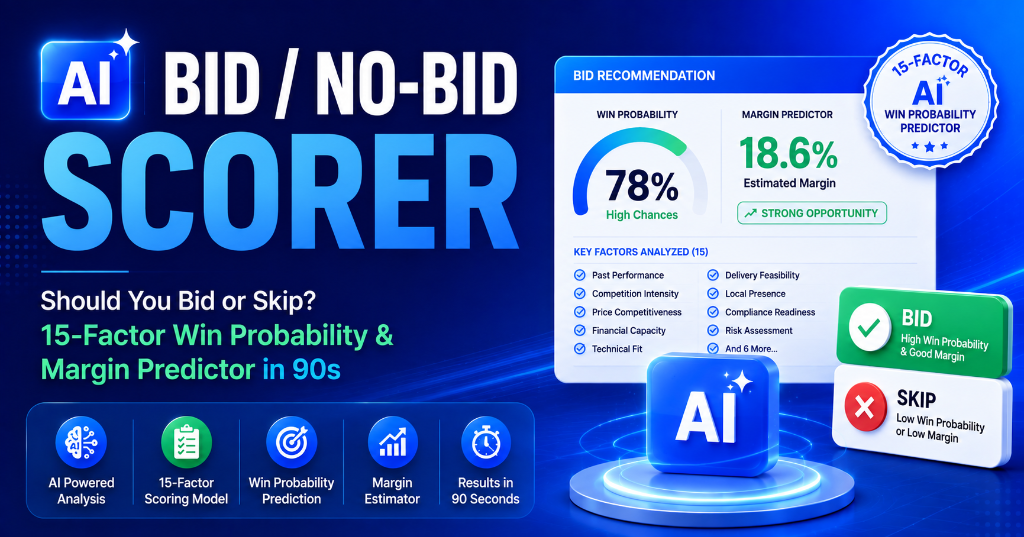
AI Bid/No-Bid Scorer —
Should You Bid on This Tender or Skip It?
Get an AI-powered win probability score in 90 seconds. Stop wasting ₹18,000–₹85,000 preparing bids for unwinnable or tailored government tenders.
Why Most Contractors Lose Money Bidding on the Wrong Tenders
Most contractors operate on the flawed belief that "more bids = more wins." In reality, bidding on low-probability tenders drains capital and engineering focus.
| Direct Expense Item | Cost per Bid | Annual Drain (30 Tenders) |
|---|---|---|
| Engineering hours for bid prep | ₹8,000 – ₹15,000 | ₹2,40,000 – ₹4,50,000 |
| Documentation, stamp papers, affidavits | ₹2,000 – ₹5,000 | ₹60,000 – ₹1,50,000 |
| EMD / BG Bank Charges & Opportunity Cost | ₹5,000 – ₹50,000 | ₹1,50,000 – ₹15,00,000 |
| Mandatory pre-bid site visits & survey | ₹3,000 – ₹10,000 | ₹90,000 – ₹3,00,000 |
| Total Capital Spent on Lost / Unwinnable Bids | ₹18,500 – ₹85,000 | ₹5,55,000 – ₹25,50,000 / year |
1. The "Tailored" Tender
Specifications written so narrowly that only one pre-selected vendor qualifies. A total waste of your team's time.
2. The "Crowded" Tender
18+ aggressive bidders competing for a ₹20 Lakhs contract, driving net profit margins below 3%.
3. The "Experience Trap"
Rigid criteria demanding direct central government experience where private sector completion is summarily rejected.
“We used to bid on every tender in sight. After using the AI Bid Scorer, we bid on 40% fewer tenders but our win rate surged from 8% to 35%. We made 30x more profit by bidding less.”
— Managing Director, Infrastructure EPC, Mumbai
Interactive Bid/No-Bid Decision Matrix Simulator
Select a sample tender profile to see how the 15-factor algorithm calculates win probability.
₹5 Cr Central Govt Hospital (Electrical EPC)
AI Strategic Recommendations:
How Skipping 3 Low-Probability Tenders Led to Winning a ₹5 Cr Contract
The Strategy Shift:
Reliable Electrics was placing 25–30 bids annually with an 8% win rate, earning only ₹4L profit after spending ₹4.5L on preparation. By scoring tenders first, they skipped 3 crowded bids (saving ₹52,000) and focused all resources on a high-probability ₹5 Cr hospital project.
The High-Yield Outcome:
They won the ₹5 Cr tender under MSME price preference (L1+15%) with a healthy 13% net margin (₹65 Lakhs profit). Overall annual bids dropped from 25 to 12, while net annual profit skyrocketed from ₹4 Lakhs to ₹1.2 Crores.
Top 5 Signs You Should SKIP a Tender (Red Flags Detected by AI)
Frequently Asked Questions (FAQ)
1. How accurate is the AI bid scorer? expand_more
The AI Bid/No-Bid Scorer has a 78% accuracy rate based on historical data from 10,000+ Indian government tenders across central, state, PSU, and GeM portals. It analyzes 15+ decisive factors to predict real-world outcomes.
2. What factors does the AI analyze? expand_more
Eligibility match, technical capability, financial capacity, past experience, competition intensity, historical L1 rates, authority track record, geographic proximity, estimated margin, EMD ratio, payment terms, liquidated damages risk, timeline feasibility, MSME preference, and overall risk.
3. How many credits does scoring a tender cost? expand_more
Opportunity scoring costs 40 credits, fully covered by our ₹599 Single Pass (60 Credits). No recurring subscription required.
4. Can I use this for private sector tenders? expand_more
While optimized specifically for Indian government procurement, the scoring framework works across commercial and corporate tenders with approximately 70% predictive reliability.
5. What score means I should definitely bid? expand_more
80–100: Strong Bid — High probability of success.
60–79: Good Bid — Proceed with caution, optimize weak areas.
40–59: Marginal Bid — Only bid if strategic entry value is high.
0–39: Skip — High risk of capital drain or disqualification.
6. Does the AI access my private competitor data? expand_more
No. The AI relies exclusively on public historical tender records (past award values, bidder counts, L1 margin trends) and your own inputs. It never accesses private competitor proprietary data.
7. Can I save and track my bid scores over time? expand_more
Yes. All scored tenders are automatically archived in your My Reports dashboard for 90 days, enabling you to track win/loss analytics and refine your bidding criteria.
8. How is this different from the Win Probability Calculator? expand_more
The Bid/No-Bid Scorer is an initial go/no-go qualification filter (Should I invest engineering time to bid?). The Win Probability Calculator is an in-depth analyzer for an already prepared bid proposal (Will my final submitted price win?).
9. Does it work for GeM Reverse Auction tenders? expand_more
Yes. The AI incorporates reverse auction dynamics, OEM authorization requirements, and category competitiveness directly into the scoring calculation.
10. Will the AI tell me my exact optimal bid price? expand_more
The AI generates projected margin brackets and historical L1 discount averages for similar tenders, guiding your estimation team on competitive pricing thresholds.
Stop Wasting Money on Unwinnable Tenders
Make high-confidence bid decisions backed by data in 90 seconds.