Price Preference Policy for MSMEs in Government Tenders (2026): 25% Quota, L1+15% Matching & 358 Reserved Items
menu_book Table of Contents
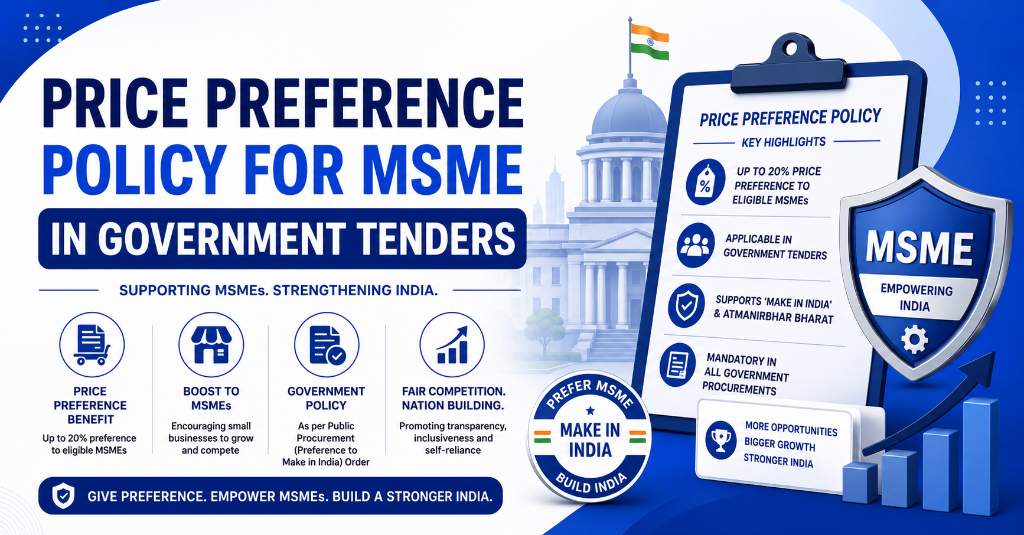
The ₹36,000 Crore Opportunity: Why MSME Price Preference Matters
In FY 2024-25, central government ministries, departments, and CPSEs reported total procurement of ₹94,266.60 crore through the MSME Sambandh portal. Of this, ₹36,348.87 crore (38.56%) went to Micro and Small Enterprises—benefiting 1,11,401 MSEs across India. For the comprehensive end-to-end framework, consult our ultimate guide to Indian government tenders. (See also: MSME Turnover Calculation & Thresholds Guide).
This is not charity. It is mandated law under the Public Procurement Policy for Micro and Small Enterprises (MSEs) Order, 2012, amended in 2018, and enforced through the MSMED Act 2006.
The MSME price preference policy is the single most powerful competitive advantage available to small businesses in Indian government procurement. It transforms a 50-person manufacturing unit from an underdog into a preferred vendor. It allows a woman entrepreneur to beat a ₹500 crore conglomerate on price matching. It creates a protected market of 358 products where only MSEs can compete.
But this advantage is not automatic. It requires Udyam Registration, correct portal configuration, understanding of L1+15% mechanics, and awareness of reserved item categories. The MSEs that master these rules capture disproportionate government business. The MSEs that don't—even if they manufacture superior products—remain invisible to 50,000+ government buyers.

Get the MSME Advantage Toolkit
Claim every statutory exemption, track document renewals, and enforce price preferences.
- ✓ 150-Point Pre-Submission Checklist (PDF)
- ✓ Document Expiry & Renewal Tracker (Excel)
- ✓ GST / PAN / TAN Cross-Verification Guide
- ✓ MSME EMD Exemption Claim Kit (4 Letters)
🔒 256-Bit Secure Razorpay Checkout · Lifetime Access · Instant Digital Delivery
Public Procurement Policy for MSEs: The Complete Legislative Timeline
| Date | Event | Impact |
|---|---|---|
| 23 March 2012 | Public Procurement Policy for MSEs Order, 2012 notified under MSMED Act 2006 | 20% target introduced; voluntary for 3 years |
| 1 April 2015 | Policy made mandatory | All central ministries/departments/CPSEs must comply |
| 9 November 2018 | Amendment Order: 20% → 25% target | Increased procurement obligation |
| 9 November 2018 | 3% women-owned MSE sub-target added | New category for gender-inclusive procurement |
| 1 July 2020 | Udyam Registration launched (replacing EM-I/EM-II/UAM) | Unified, PAN-linked, lifetime registration |
| 2022 | Revised list of 469 items (draft) proposed | Expansion from 358 to include services |
| FY 2023-24 | 34.59% achievement (₹35,671 Cr from MSEs) | Exceeded 25% target; 1,23,853 MSEs benefited |
| FY 2024-25 | 38.56% achievement (₹36,349 Cr from MSEs) | Continued over-achievement; 1,11,401 MSEs benefited |
The 25% Mandatory Procurement Quota: How It Works
The Legal Mandate
"Every Central Ministry or Department or Public Sector Undertaking shall set an annual goal of procurement from Micro and Small Enterprises... with the objective of achieving an overall procurement of minimum of 25 per cent, of total annual purchases of products produced and services rendered by Micro and Small Enterprises."
— Public Procurement Policy for MSEs Order, 2012 (as amended in 2018)
Who Is Covered?
| Entity Type | Covered? | Exemptions |
|---|---|---|
| Central Government Ministries | ✅ Yes | Defence armament imports |
| Central Government Departments | ✅ Yes | None |
| Central Public Sector Enterprises (CPSEs) | ✅ Yes | None |
| State Governments | ❌ No (separate policies) | N/A |
| State PSUs | ❌ No (separate policies) | N/A |
| Autonomous Bodies under Central Govt | ✅ Yes | None |
How the 25% Is Calculated
| Component | Included? | Example |
|---|---|---|
| Goods procured from MSEs | ✅ Yes | ₹50 Cr from MSE manufacturers |
| Services rendered by MSEs | ✅ Yes | ₹20 Cr from MSE IT service providers |
| Works subcontracted to MSEs | ✅ Yes | ₹15 Cr civil works subcontract |
| Total MSE Procurement | ₹85 Cr | |
| Total Annual Procurement | ₹300 Cr | All goods + services + works |
| MSE % Achievement | 28.33% | Exceeds 25% target |
What Happens If Target Is Not Met?
| Scenario | Consequence |
|---|---|
| Shortfall in annual target | Must substantiate reasons to Review Committee headed by Secretary, MSME |
| Repeated shortfall | Review Committee examines; may recommend corrective measures |
| No exemption without approval | Case-by-case exemption only with recorded reasons |
Reality Check: The government has consistently exceeded the 25% target since 2018-19. Individual CPSEs may underperform, but aggregate achievement removes political pressure for strict enforcement against specific entities.
Instant Tender Eligibility & Risk Audit
Upload any 500-page NIT / BOQ PDF. Extract hidden disqualification traps, EMD waiver clauses, and complete eligibility criteria in under 45 seconds.
L1+15% Price Matching: The MSME's Secret Weapon
The Rule (From the Original 2012 Order)
"In tender, participating Micro and Small Enterprises quoting price within price band of L1+15 per cent shall also be allowed to supply a portion of requirement by bringing down their price to L1 price in a situation where L1 price is from someone other than a Micro and Small Enterprise and such Micro and Small Enterprise shall be allowed to supply up to 25 per cent of total tendered value."
How L1+15% Works: A Complete Example
| Bidder | Type | Quoted Price | Status |
|---|---|---|---|
| Large Corp Ltd. | Non-MSE | ₹100/unit | L1 |
| SmallTech Mfg. | MSE | ₹110/unit (10% above L1) | Within L1+15% ✅ |
| MicroBuild Pvt. Ltd. | MSE | ₹114/unit (14% above L1) | Within L1+15% ✅ |
| MegaInfra Corp. | Non-MSE | ₹105/unit | L2 (non-MSE, no preference) |
| NanoWorks | MSE | ₹118/unit (18% above L1) | Outside L1+15% ❌ |
Outcome:
- SmallTech Mfg. and MicroBuild Pvt. Ltd. are invited to match L1 price of ₹100/unit
- If both accept, the 25% quantity is shared proportionately between them
- If SmallTech accepts and MicroBuild declines, SmallTech gets the full 25%
- If both decline, the 25% goes to L1 (Large Corp Ltd.) or is re-tendered
The Math: Why This Matters
| Scenario | Without L1+15% | With L1+15% |
|---|---|---|
| MSE quoted price | ₹110 | ₹110 |
| L1 price | ₹100 | ₹100 |
| MSE gets order? | No | Yes, at ₹100 |
| MSE margin at ₹110 | 15% | — |
| MSE margin at ₹100 | — | 5% (still profitable) |
| Order value (25% of ₹10 Cr tender) | ₹0 | ₹2.5 Cr |
Strategic Insight: L1+15% allows MSEs to price at their true cost + reasonable margin without fear of being undercut by large competitors with economies of scale. Even if you quote 14% above L1, you still get the order at L1 price.
How GeM Automates MSME Purchase Preference
On the Government e-Marketplace (GeM), MSME purchase preference is fully automated—no manual intervention, no discretionary approvals, no delays.
The Automated Workflow
| Step | System Action | Seller Action |
|---|---|---|
| 1. Bid Creation | Buyer opts for "MSE Purchase Preference" during bid creation | — |
| 2. Bid Participation | System identifies MSE sellers via linked Udyam number | MSE seller submits bid |
| 3. L1 Determination | System calculates L1 from all technically qualified bids | — |
| 4. MSE Identification | System auto-identifies MSEs within L1+15% band | — |
| 5. Price Match Request | System sends price-match notification to qualifying MSEs | MSE receives alert |
| 6. Match Acceptance | — | MSE clicks "Accept" to match L1 price |
| 7. Award | System awards 25% quantity to matched MSE(s) | MSE receives contract |
For Services (New in 2024-25)
| Feature | Goods | Services |
|---|---|---|
| Matching basis | Per-item price | Total contract value |
| MSE preference | Mandatory for central buyers | Mandatory for central buyers |
| Price match | Item-level | Total value level |
| Quantity split | 25% of items | 25% of total value |
Central vs State Government Buyers on GeM
| Buyer Type | MSE Preference | Override |
|---|---|---|
| Central Government | Mandatory | Can only bypass with competent authority approval + recorded reasons |
| State Government | Optional | Buyer decides whether to enable MSE preference |
| PSUs | Mandatory | Same as central government |
The 358 Reserved Items: Your Exclusive Market
The government has reserved 358 items for exclusive procurement from MSEs. If your product is on this list, only MSEs can bid—large corporations are completely excluded.
Reserved Items by Category (Selected)
| Category | Examples | Tender Value Range |
|---|---|---|
| Electrical & Electronics | Call bells, soldering irons, transmission hardware, invertors (up to 5 kVA), emergency lights | ₹5 lakh – ₹5 Cr |
| Agricultural Tools | Hand-operated tools, animal-driven implements | ₹2 lakh – ₹2 Cr |
| Textiles & Garments | All garments (excluding ordnance factories), gauze cloth, surgical gauze | ₹10 lakh – ₹10 Cr |
| Hardware & Tools | Hand tools of all types, pad locks, measuring tapes, hinges | ₹3 lakh – ₹3 Cr |
| Glass & Ceramics | Glass ampules, enamel wares, pressed wares | ₹5 lakh – ₹5 Cr |
| Safety Equipment | Fire extinguishers (wall type), helmets (non-metallic), hand gloves | ₹2 lakh – ₹2 Cr |
| Food & Agriculture | Honey, hand-pounded rice, palm gur | ₹1 lakh – ₹1 Cr |
| Leather Goods | Harness leather, hide and country leather, kit boxes | ₹3 lakh – ₹3 Cr |
| Chemicals & Paints | Oil-bound distemper, paint remover, naphthalene balls | ₹2 lakh – ₹2 Cr |
| Miscellaneous | Dust bins, foot powder, French polish, gum tape, lathies | ₹1 lakh – ₹1 Cr |
Proposed Expansion to 469 Items (Under Review)
In October 2022, the MSME Ministry proposed expanding the reserved list to 469 items including 16 services:
| New Service Categories | Rationale |
|---|---|
| Architectural & engineering consultancy | MSEs capable but excluded from service tenders |
| Canteen operation | Large market; MSEs underrepresented |
| Housekeeping services | Labor-intensive; fits MSE capacity |
| Tailoring services | Traditional MSE strength |
| Tour operator services | Post-pandemic growth sector |
| Waste collection services | Municipal requirement; MSE-friendly |
| Interior decorator services | Creative sector; MSE-dominated |
| Vehicle renting/leasing | Transport departments need |
Action Item: Check if your product or service is on the 358 reserved items list or the proposed 469-item draft. If yes, your addressable market is protected from large competitors.
4% SC/ST & 3% Women MSE Sub-Targets: Who Qualifies
Within the 25% mandatory procurement, the policy specifies sub-targets for socially disadvantaged groups:
| Sub-Target | Percentage | Eligibility |
|---|---|---|
| SC/ST-Owned MSEs | 4% of total procurement | Proprietor(s) SC/ST; or 51%+ shares held by SC/ST partners/directors |
| Women-Owned MSEs | 3% of total procurement | Proprietor(s) women; or 51%+ shares held by women partners/directors |
SC/ST MSE Definition (From Official FAQs)
| Business Structure | Qualification Criteria |
|---|---|
| Proprietorship | Proprietor(s) must be SC/ST |
| Partnership | SC/ST partners must hold at least 51% shares |
| Private Limited Company | At least 51% shares held by SC/ST promoters |
| HUF | Karta must be SC/ST |
What Happens If Sub-Target Is Not Met?
| Scenario | Resolution |
|---|---|
| SC/ST MSEs fail to participate | 4% sub-target met from other MSEs (not non-MSEs) |
| Women MSEs fail to participate | 3% sub-target met from other MSEs |
| Both fail | Combined shortfall absorbed into general 25% MSE pool |
Strategic Note: If you are an SC/ST or women entrepreneur, highlight this status prominently in your bid. Some CPSEs actively seek SC/ST and women MSE vendors to meet sub-targets, creating additional competitive advantage beyond L1+15%.
5 Core Benefits Every MSME Must Claim
| # | Benefit | Value | How to Claim |
|---|---|---|---|
| 1 | L1+15% Price Matching | Win orders despite quoting 14% above L1 | Declare Udyam number in bid; ensure price within L1+15% |
| 2 | EMD Exemption | Save 2-3% of tender value in blocked deposits | Upload Udyam certificate in EMD section |
| 3 | Free Tender Sets | Save ₹1,000–₹5,000 per tender | Request free tender document download |
| 4 | 358 Reserved Items | Exclusive market with zero large-company competition | Verify your product is on reserved list; bid exclusively |
| 5 | GeM MSE Preference | Automatic price matching, highlighted search results | Link Udyam to GeM profile; maintain 4.5+ rating |
Udyam Registration: The Gateway to All MSME Benefits
Udyam Registration (launched 1 July 2020) is the single prerequisite for accessing all MSME price preference benefits. Without it, you are invisible to the policy.
Udyam Classification (Based on Investment & Turnover)
| Category | Investment in Plant & Machinery | Annual Turnover |
|---|---|---|
| Micro | Up to ₹1 crore | Up to ₹5 crore |
| Small | Up to ₹10 crore | Up to ₹50 crore |
| Medium | Up to ₹50 crore | Up to ₹250 crore |
Note: The 2020 Udyam criteria (revised from earlier EM-I/EM-II system) use both investment AND turnover. An enterprise must satisfy both criteria for its category.
How to Register
| Step | Action | Timeline |
|---|---|---|
| 1 | Visit udyamregistration.gov.in | Immediate |
| 2 | Enter Aadhaar number (proprietor/authorized signatory) | Immediate |
| 3 | Validate via OTP | 1 minute |
| 4 | Enter PAN, GSTIN, and business details | 5 minutes |
| 5 | Self-declare investment and turnover | 2 minutes |
| 6 | Submit and receive Udyam Registration Number | Instant |
| 7 | Download Udyam Certificate | Immediate |
Critical Requirements
| Requirement | Common Mistake | Consequence |
|---|---|---|
| Aadhaar linked to mobile | Old mobile number | OTP failure; registration blocked |
| PAN matches business name | Personal PAN for proprietorship | Mismatch with GST; benefit denial |
| GSTIN active and filed | Expired GST or non-filer | Udyam flagged; benefits suspended |
| Investment figure accurate | Overstated to get "Small" status | Audit risk; potential de-registration |
MSME Sambandh Portal: Tracking Government Procurement Data
The MSME Sambandh Portal is the official transparency platform monitoring government procurement from MSEs.
What the Portal Shows
| Data Point | Utility for MSEs |
|---|---|
| CPSE-wise procurement from MSEs | Identify which PSUs buy most from MSEs in your sector |
| Monthly procurement trends | Time your bids when procurement peaks |
| SC/ST and Women MSE procurement | Track sub-target achievement; identify underperforming buyers |
| Financial year comparison | Benchmark your performance against sector averages |
| Item-wise procurement | Discover which product categories have highest MSE demand |
Key Statistics (FY 2024-25, as of November 2024)
| Metric | Value |
|---|---|
| Total Reported Procurement | ₹94,266.60 crore |
| Procurement from MSEs | ₹36,348.87 crore |
| MSE Achievement % | 38.56% |
| MSEs Benefited | 1,11,401 |
| Procurement from SC/ST MSEs | 3.96% |
| Procurement from Women MSEs | Data tracked separately |
Strategic Use: Search the portal for your target CPSEs. If their MSE procurement is below 25%, they are desperate for MSE vendors—making your bid more likely to succeed.
How to Claim Price Preference on CPPP & GeM: Step-by-Step
On CPPP (eprocure.gov.in)
| Step | Action | Document |
|---|---|---|
| 1 | Register as bidder with Class 3 DSC | DSC, PAN, GST, Bank details |
| 2 | Complete "MSE Information" section in profile | Udyam Registration Number |
| 3 | Upload Udyam Certificate (portal-downloaded PDF) | Udyam Certificate |
| 4 | In bid form, check "MSE" category | Auto-populated from profile |
| 5 | Attach Udyam Certificate in technical bid | Same as step 3 |
| 6 | Submit bid within deadline | — |
| 7 | During financial evaluation, system flags MSE status | Automatic |
| 8 | If within L1+15%, receive price-match invitation | Email + portal notification |
On GeM (gem.gov.in)
| Step | Action | Document |
|---|---|---|
| 1 | Complete seller registration | GST, PAN, Bank, Aadhaar |
| 2 | Link Udyam number in "My Profile" | Udyam Registration Number |
| 3 | Upload Udyam Certificate | Udyam Certificate |
| 4 | System auto-verifies MSE status via API | Instant |
| 5 | Create product listings | Product specs, images, pricing |
| 6 | Participate in bids with MSE preference enabled | System auto-identifies you |
| 7 | Receive price-match request if within L1+15% | Dashboard notification + email |
| 8 | Accept match online | One-click acceptance |
7 Common Mistakes That Cost MSMEs Their Price Preference
Mistake 1: Not Registering on Udyam
Impact: Zero access to any MSME benefit Fix: Register immediately at udyamregistration.gov.in
Mistake 2: Name Mismatch Between Udyam and Portal
Impact: System cannot auto-verify MSE status; manual verification delays bid evaluation Fix: Ensure exact name match across Udyam, GeM, CPPP, and GST
Mistake 3: Expired or Invalid Udyam Certificate
Impact: MSE status revoked; benefits denied Fix: Udyam is lifetime registration, but update for any business changes
Mistake 4: Not Declaring MSE Status in Bid
Impact: Treated as non-MSE; no price preference Fix: Always check "MSE" box and upload Udyam certificate
Mistake 5: Quoting Beyond L1+15%
Impact: No price-match invitation Fix: Research L1 prices in your category; price strategically within 15% buffer
Mistake 6: Ignoring Reserved Item Opportunities
Impact: Competing in open market when exclusive market exists Fix: Check 358 reserved list; pivot product strategy if applicable
Mistake 7: Not Tracking Sub-Target Opportunities
Impact: Missing SC/ST or women entrepreneur advantages Fix: If eligible, highlight status prominently in bid and vendor profile
Case Study: How a Jaipur Textile MSE Won ₹47 Lakh Through L1+15% Matching
Company: Rajasthan Weaves Pvt. Ltd., Jaipur Business: Handloom textiles and garments Udyam Status: Small Enterprise; Women-owned (51% women directors) Annual Turnover: ₹3.2 crore
The Tender
| Parameter | Details |
|---|---|
| Buyer | Central Railway, Jaipur Division |
| Item | Uniform fabric (cotton khaki) |
| Quantity | 50,000 meters |
| Estimated Value | ₹45 lakh |
| Tender Type | Open tender on GeM |
The Bidding
| Bidder | Type | Quoted Price | Position |
|---|---|---|---|
| Vardhman Textiles Ltd. | Large Non-MSE | ₹85/meter | L1 |
| Rajasthan Weaves Pvt. Ltd. | MSE (Women-owned) | ₹96/meter (12.9% above L1) | Within L1+15% ✅ |
| Bombay Dyeing Ltd. | Large Non-MSE | ₹88/meter | L2 |
| Bhilwara Fabrics | MSE | ₹98/meter (15.3% above L1) | Outside L1+15% ❌ |
The Outcome
- GeM system auto-identified Rajasthan Weaves as MSE within L1+15%
- Price-match request sent; Rajasthan Weaves accepted ₹85/meter
- 25% quantity (12,500 meters) awarded to Rajasthan Weaves
- Order value: ₹10,62,500
- Margin at matched price: 8% (still profitable)
Follow-Up Orders
- Quality and timely delivery impressed Central Railway
- Rajasthan Weaves added to Railway's approved vendor list
- Subsequent direct orders: ₹36.5 lakh over 18 months
- Total revenue from single L1+15% win: ₹47.1 lakh
Key Insight: The initial ₹10.6 lakh order was not the prize. The vendor list entry and subsequent direct orders were. L1+15% is a door-opener, not just a transaction.
Case Study: How a Non-Udyam Seller Lost a ₹12 Lakh Reserved Item Tender
Company: Precision Tools Workshop, Indore Business: Hand tools manufacturing Registration Status: Registered under old UAM system (pre-2020) Annual Turnover: ₹1.8 crore
The Tender
| Parameter | Details |
|---|---|
| Buyer | Ministry of Defence (Ordnance Factory) |
| Item | Hand tools set (reserved item #142) |
| Value | ₹12 lakh |
| Tender Type | Reserved for MSEs only |
The Disaster
| Event | Details |
|---|---|
| Bid submitted | Precision Tools uploaded UAM certificate (expired 2021) |
| Technical evaluation | UAM not recognized post-2020; MSE status unverified |
| System flag | "MSE certificate invalid—treated as non-MSE" |
| Reserved item rule | Non-MSEs cannot bid on reserved items |
| Result | Bid rejected despite being technically qualified |
The Aftermath
- Precision Tools had manufactured the exact tools for 15 years
- Their quality was superior to competitors who won
- They lost ₹12 lakh order + future reserved item pipeline
- 6-month delay to complete Udyam registration and re-bid
The Lesson
Udyam is not optional. UAM and EM-I/EM-II are dead. The 30 minutes spent on Udyam registration would have saved a ₹12 lakh order and years of vendor relationship building.
TenderFlow Pro: MSME Benefit Maximizer & Udyam Compliance
Navigating MSME price preference across CPPP, GeM, and 500+ state portals is operationally complex. TenderFlow Pro automates the entire benefit stack:
🔍 Reserved Item Opportunity Finder Upload your product catalogue and our AI matches it against the 358 reserved items list + proposed 469-item draft. Identifies exclusive tender opportunities you didn't know existed.
📊 L1+15% Price Optimizer Analyzes historical L1 prices in your category and recommends the optimal bid price that maximizes margin while staying within the L1+15% matching band.
⚠️ Udyam Compliance Monitor Tracks your Udyam registration status, expiry alerts, name-match verification across portals, and certificate validity. Prevents the "UAM rejection" disaster.
🎯 SC/ST & Women MSE Sub-Target Tracker Identifies tenders where buyers are below their 4% SC/ST or 3% women MSE sub-targets. These buyers are motivated to award to qualifying vendors.
📈 MSME Sambandh Intelligence Real-time dashboard showing CPSE procurement patterns, MSE achievement rates, and buyer-specific MSE demand—so you target the right buyers at the right time.
🤖 GeM MSE Auto-Configuration One-click linking of Udyam number to GeM profile, automatic MSE status verification, and price-match acceptance automation for qualifying bids.
👉 Maximize Your MSME Benefits with TenderFlow Pro
FAQs: MSME Price Preference Mastery
Q1. What is the price preference policy for MSMEs in government tenders? The Public Procurement Policy for MSEs Order, 2012 mandates 25% annual procurement from MSEs by central ministries/departments/CPSEs. Benefits include L1+15% price matching, EMD exemption, free tender sets, and 358 reserved items for exclusive MSE procurement.
Q2. What is L1+15% price matching for MSMEs? MSEs quoting within 15% above the L1 (lowest) non-MSE price can match L1 price and win at least 25% of the tendered quantity. On GeM, this process is fully automated.
Q3. How much procurement does the government do from MSMEs annually? FY 2023-24: ₹35,671 Cr (34.59%) from 1,23,853 MSEs. FY 2024-25 (as of Nov 2024): ₹36,349 Cr (38.56%) from 1,11,401 MSEs. The government consistently exceeds the 25% target.
Q4. What are the 358 items reserved for MSME procurement? Reserved items include electrical goods, agricultural tools, garments, hand tools, safety equipment, glassware, leather goods, chemicals, and 340+ more products. Only MSEs can bid on these. The list is under review for expansion to 469 items including services.
Q5. Is Udyam registration mandatory to claim MSME price preference? Yes. Udyam Registration (since 2020, replacing UAM/EM-I/EM-II) is mandatory for all MSME benefits. Without it, you cannot access L1+15% matching, EMD exemption, reserved items, or GeM MSE features.
Q6. How does GeM automate MSME purchase preference? GeM automatically identifies MSE sellers within L1+15%, sends price-match requests, and awards 25% quantity to matched MSEs. Central government buyers must enable MSE preference; state buyers can optionally select it.
Q7. What is the SC/ST and women MSE sub-target? Within the 25% MSE procurement, 4% must come from SC/ST-owned MSEs and 3% from women-owned MSEs. If sub-targets are unmet, the shortfall is reallocated to other MSEs.
Q8. Can a non-MSME compete for reserved items? No. The 358 reserved items are exclusively for MSE procurement. Non-MSMEs cannot bid on tenders for these items.
Q9. What happens if a ministry fails to meet the 25% MSME target? They must explain shortfalls to the Review Committee headed by the Secretary, MSME. However, aggregate government achievement consistently exceeds 25%, so strict penalties are rare.
Q10. How do I claim MSME benefits on CPPP and GeM? On CPPP: Declare Udyam number in bid form, upload Udyam certificate, check "MSE" category. On GeM: Link Udyam number to seller profile during registration. Ensure exact name match across all portals.
Your 30-Day MSME Price Preference Activation Plan
Week 1: Udyam Foundation
- Register on Udyam portal (if not already done)
- Download Udyam certificate
- Verify Aadhaar-mobile linkage
- Ensure PAN and GSTIN match business name
- Update Udyam for any business changes (address, turnover, investment)
Week 2: Portal Configuration
- Link Udyam number to GeM seller profile
- Update CPPP bidder profile with Udyam details
- Verify name match across Udyam, GeM, CPPP, and GST
- Upload Udyam certificate to all portal document repositories
- Check "MSE" status in all active portal profiles
Week 3: Reserved Item & Market Analysis
- Check if your products are on the 358 reserved items list
- Research historical L1 prices in your category (last 12 months)
- Identify CPSEs with low MSE procurement (high opportunity)
- Map SC/ST or women entrepreneur status for sub-target advantage
- Build pricing strategy with L1+15% buffer
Week 4: Bid Execution & Tracking
- Submit first bid with MSE preference claimed
- Monitor GeM for price-match notifications
- Track MSE procurement data on Sambandh portal
- Document lessons learned from first bid experience
- Set up automated tender alerts for reserved item categories
Conclusion
The MSME price preference policy is not a subsidy. It is a structural competitive advantage written into law. The 25% quota, L1+15% matching, 358 reserved items, and EMD exemption create a procurement ecosystem where small businesses can not only survive but dominate against larger competitors.
But this advantage is not automatic. It requires Udyam Registration, correct portal configuration, strategic pricing within the L1+15% band, and awareness of reserved item opportunities. The MSEs that master these mechanics capture disproportionate government business. The MSEs that don't—even with superior products—remain invisible.
The data is clear: 1,11,401 MSEs captured ₹36,349 crore in FY 2024-25. The question is not whether the opportunity exists. The question is whether your MSE is configured to capture it.
Ready to maximize your MSME price preference benefits? Get TenderFlow Pro and automate Udyam compliance, reserved item discovery, L1+15% price optimization, and sub-target opportunity tracking across your entire bidding pipeline.
Related Articles:
- How to Write a Technical Bid for Government Tenders
- Financial Bid Preparation Guide for India
- GeM vs CPPP: Which Portal Should You Use?
- GeM Product Listing Approval Guide
- GeM Portal Caution Money Rules & Refund
- Tender Technical Disqualification Reasons India
- GeM Vendor Assessment Complete Guide
- Performance Security Under GFR Rule 171
- Liquidated Damages in Government Tenders